
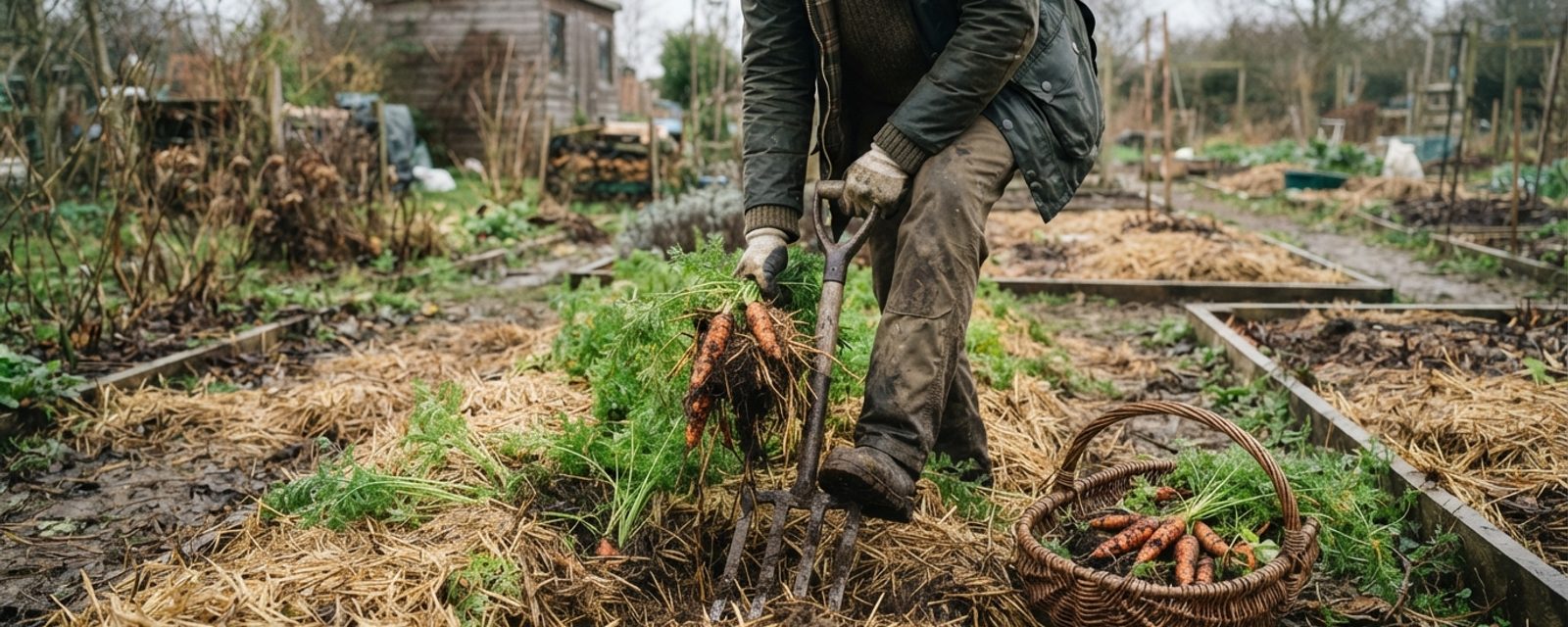
Carrots don't need to come out of the ground the moment they're ready, but once frost is a real risk, what happens next depends more on your soil than on your enthusiasm. Left in well-drained ground under a mulchA layer of material spread over the soil around plants to suppress weeds, retain moisture, and improve soil structure as it breaks down. Full definition →, they'll hold until March. Lifted into a box of damp sand in a frost-free shed, they'll do the same job on heavy or waterlogged ground where leaving them in place would rot them instead.
On free-drainingSoil that lets water pass through quickly rather than pooling, so roots aren't sitting in wet ground after rain. Full definition → soil, leave carrots where they grew: cut the leaves, cover the row with straw or cardboard, and lift as needed through winter. On heavy or waterlogged ground, lift in autumn and store in boxes layeredPropagating a new plant by pinning a low, flexible stem into the soil while still attached to the parent, so it roots before being cut free. Full definition → with damp sand, kept frost-free and dark. Either method can realistically carry carrots through to March.
When to lift for storage
Main-season carrots are ready 12-16 weeks after sowing, full detail on sowing timing and thinning is in the carrots growing guide. Whichever storage method you're using, lift or cover the row before hard frost reaches the roots, frost damages even sound-looking carrots, not just the ones already showing problems. If frost is forecast and nothing's done yet, it's still worth acting while the ground is workable rather than waiting for a better moment. The frost dates page has local timing, inland and upland areas typically see their first frost well before coastal ones.
Lift with a fork rather than pulling by the leaves, torn or bruised skin is where rot gets started either way you store them. Twist the leaves off rather than washing the roots. Early or baby carrots are for eating fresh; it's the maincropThe main, usually latest-sown and longest-growing type of a crop, grown for bulk and storage rather than an early harvest. Full definition → varieties, covered in the Best Carrot Varieties for Scotland article, that are the real storage candidates.
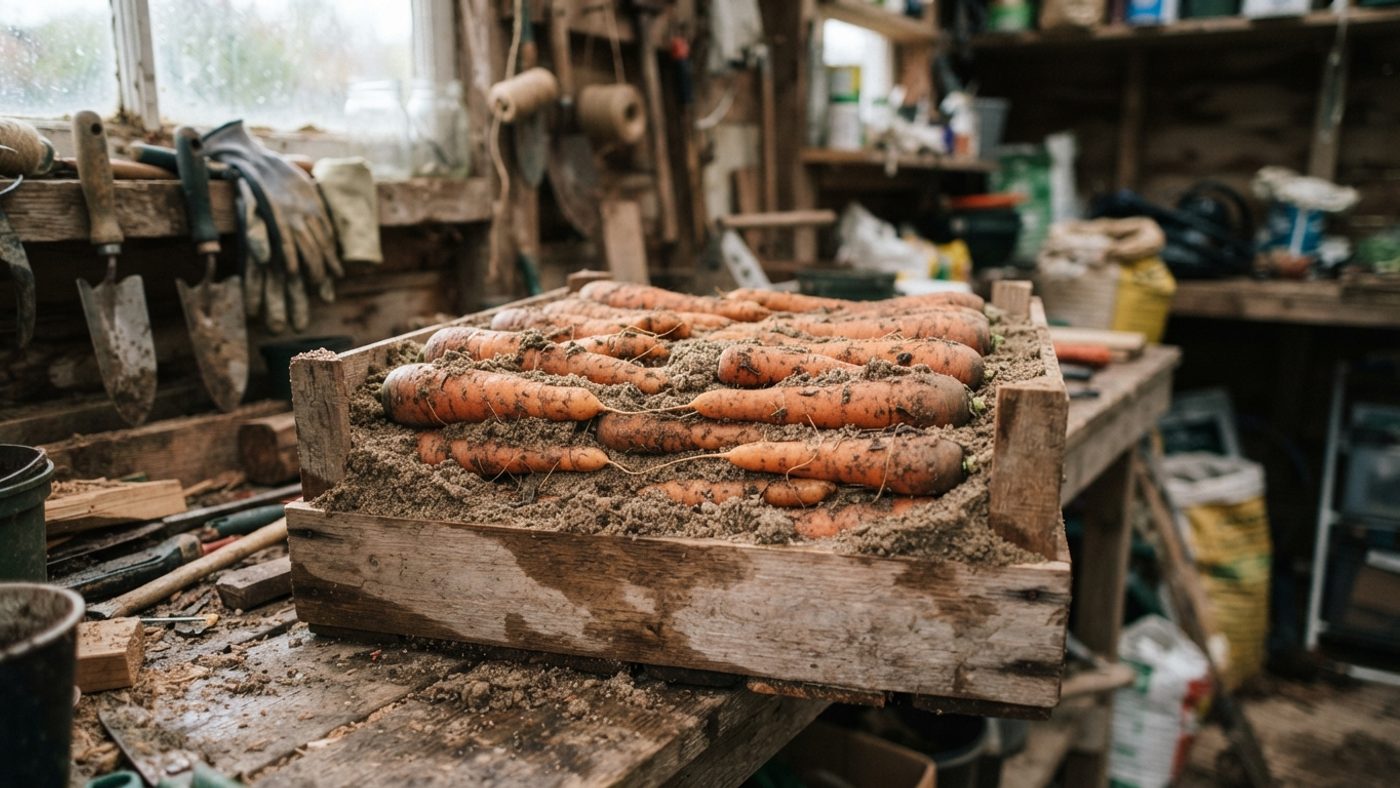
The sand and box method
Layer damp sand, or sieved soil, leaf mould, coir, or untreated sawdust, with carrots in a shallow crate, keeping roots from touching each other where possible. Store the box somewhere frost-free and dark, a shed, garage, or cellar, aiming for around 0-4°C. There's no published humidity figure for home carrot storage; damp-not-wet packing material does the practical work regardless of the exact number. Check the box periodically for mice, and raise it off the floor if that's a risk in your shed.
In-ground overwintering: a real option, if your soil drains
Cut the leaves and cover the row with a 15cm layer of straw, cardboard, or bracken, held down with netting or horticultural fleeceA lightweight, breathable fabric laid or draped over plants to trap a little warmth and keep off frost, wind and some flying pests. Full definition → against rabbits and birds as well as wind. Fleece adds roughly 2°C of frost protection, worth the extra layer inland or upland where frost bites harder. Handled this way, carrots keep in the ground until March.
The real condition that decides whether this works isn't how cold your area gets, it's whether the ground drains. Standing water causes rot, which is why RHS advises lifting to box storage instead once waterlogging becomes a real risk, a soil condition rather than a Scotland-specific hazard, though central-belt clay and west-coast ground tend to run heavier and wetter than most parts of the UK. A raised bed is a genuine fix where the ground itself won't drain. SRUC's technical guidance on organic vegetable growing records straw-covered overwinteringKeeping a plant alive and intact through the cold months, whether left outdoors, moved under cover, or stored dormant. Full definition → as standard practice among Scottish carrot growers, so this isn't a method fighting the climate, it's one that's already established here. One added risk with a late-season crop left in the ground: slug pressure runs higher on it than on carrots lifted earlier, so choose a low-slug bed for anything you're planning to overwinter.
The clamp method, for a large harvest
A clamp, straw and soil layered over a pyramid stack outdoors, is the traditional answer for storing a bulk quantity of root vegetables rather than a typical home plot's harvest. Site it somewhere sheltered and well-drained, standing water under a clamp is worse than under a mulched row, since there's no way to check or dry it out mid-winter, west-coast or low-lying ground gives that water nowhere to go. A clamp also carries a real risk of rodents or slugs finding their way in. For most home harvests, box-and-sand storage does the same job with far less effort and risk.
Comparing the three methods
| Method | Effort | Realistic duration | Requirements |
|---|---|---|---|
| In-ground overwintering | Low | Until March | Free-draining soil; 15cm straw/cardboard/bracken mulch, held down with netting or fleece |
| Box and sand | Moderate | Until March | Frost-free, dark location; damp sand or equivalent |
| Clamp (large harvests) | High | Not stated separately | Sheltered, well-drained site; straw and soil layers; rodent/slug risk |
What differs between them is what actually threatens the roots: drying out and skin damage for boxed carrots, drainage-dependent rot for carrots left in the ground. Whichever method you choose, check on the roots roughly every couple of weeks through winter. A third option that sidesteps both the drainage question and any shed-pest risk is freezing a batch, blanchedExcluding light from part of a growing plant, usually by earthing up, wrapping or covering, so it grows pale, tender and less bitter. Full definition →, cooled, and frozen, worth considering for part of a harvest even if boxing or mulching handles the rest.
Checking stored roots through winter
Soft or discoloured roots signal rot, usually from conditions that ran too wet or too warm. Remove them promptly and don't let them sit against sound roots. Carrot fly damage is a separate issue, and one that's often only visible once you lift the root, the tunnelling runs through the root's centre rather than showing on the surface while it's still growing. Look for rusty scarring where collapsed tunnels reach near the surface, and maggots up to 9mm long if you cut one open. The fly runs two or three generations between late spring and autumn, with a second egg-laying period in August-September that overlaps main-season lifting, so damage found at lifting isn't a sign of an earlier mistake, it can simply be from the most recent generation. A scarred root is more vulnerable to further rot, so use it straight away rather than storing it alongside sound ones. Green shoulders, cosmetic sun discolouration from the top of the root sitting proud of the soil, are harmless and don't affect storage life at all.
Common questions
Can I leave carrots in the ground all winter in Scotland?
Yes, provided the soil drains well, waterlogging is the deciding factor, not the region. Central-belt clay and west-coast ground tend to run heavier and wetter than most, so they’re the sites most likely to need lifting instead. Cover the row with mulch and lift as needed through winter.
Can I mix carrots with other root vegetables in the same storage box?
Yes, beetroot and carrots share the same packing method and roughly the same temperature target, so there’s no reason to keep them in separate boxes if space is tight. Keep an eye on the mix a little more closely though, one crop going soft in a shared box still spreads rot to whatever else is packed against it.
How often should I check on stored carrots?
Roughly every couple of weeks is enough for a box that’s stored somewhere stable. Check sooner after any spell of unusually mild or damp weather, since that’s when rot is most likely to take hold, rather than waiting out the full interval on a fixed schedule.
I found tunnelling in a carrot when I lifted it, is it still safe to store?
That’s carrot fly damage rather than a storage problem. Use that root straight away rather than storing it, the scarring gives rot an easy way in, and it can spread to roots stored alongside it.
Does a green shoulder mean a carrot won’t store well?
No, that’s cosmetic sun discolouration from the shoulder poking above soil level while growing. It has no bearing on how well the root stores.
Sources
5 sources, recorded with what each was used for
- RHS: Storing root vegetables: Sand/box method and materials, clamp method, in-ground overwintering with straw/cardboard/bracken to March, fleece frost-protection detail, "in cold regions" hedge
- RHS: Carrots — grow your own: Main-season harvest timing, in-ground overwintering method, advice to lift and box-store once ground waterlogs
- Garden Organic: Harvesting and storing vegetables: Box and layering method, packing-material options, 0–4°C storage temperature, harvest handling
- RHS: Carrot fly: Symptoms, generation and egg-laying timing, secondary rot risk from damaged roots
- SRUC: TN488 — Organic Vegetables in Scotland: An Introduction: Straw-covered in-ground overwintering recorded as established practice among Scottish carrot growers