
It's late October and you're standing at the top of the plot with a mug going cold in your hand, watching the same thing happen it did last year: the kale on the windward row is scorched brown on one side, the bean canes are leaning at fifteen degrees, and a sheet of black polythene that was weighing down the compost has wrapped itself around next door's raspberry canes. Something has to go up before spring. The question is what.
Most people reach for whatever's at the builders' merchant, a run of solid featherboard panels, because that's what a "fence" means in most gardeners' heads. It's not always the wrong answer. But it's worth five minutes' thought before you commit, because the physics of what stops wind and what doesn't isn't intuitive, and the materials that look flimsiest on the shelf are often the ones doing the real work.
The underlying wind physics, why a barrier you can see through often shelters a plot better than one you can't, and how far downwind that shelter actually reaches, is covered in full in Shelter Belt Planting for Exposed Coastal and Island Gardens. The short version, stated there and confirmed directly by RHS: a solid barrier causes turbulent eddies on its leeward (sheltered, downwind) side, while a semi-permeable structure that filters 50-60% of the wind slows it over a much longer distance, roughly ten times the barrier's height, without the turbulence problem. On the west coast, the Hebrides, and the Northern Isles, that's not a theoretical distinction: it's the difference between a barrier that actually earns its keep against a near-constant Atlantic wind and one that just moves the damage a few metres further back. So which built material, timber panel, post-and-rail, woven hurdle, chestnut paling, or mesh netting, actually delivers that filtering effect, and which just looks like it does?
Solid timber panel fencing: closeboard, larch lap, hit-and-miss
This is what most people picture, and what most people install, because it's sold everywhere, goes up in a weekend, and does something useful immediately: privacy, a defined boundary, and a windbreak for the first metre or two behind it.
The honest problem is the one already established on the shelter belt page. A flat, unbroken panel is a solid barrier, not a permeable one. Jacksons Fencing, a UK fencing manufacturer writing for installers rather than gardeners, puts it plainly: "In wind, a solid fence panel with no gaps will act like a sail," creating maximum load on posts and panels while generating the turbulent eddies on the leeward side that damage planting close to the fence. The same source recommends semi-solid designs, Venetian or hit-and-miss panels, which use overlapping slats with air gaps, specifically because the gaps let wind filter through and reduce both the structural load and the leeward turbulence, closer in spirit to the RHS's permeable-barrier principle than a true closeboard panel is.
So the trade-off is real, not marketing spin: closeboard and lap panels give you privacy and an immediate, no-establishment-time barrier, but they concentrate wind stress and turbulence rather than dispersing it, and in a genuinely exposed spot that turbulence can flatten the row of plants nearest the fence even as it seems to be doing its job.
Costs and lifespans, from UK fencing suppliers and cost guides:
- Closeboard (feather-edge) panels: a standard 1.8m-high, 1.83m-wide panel from a UK fencing manufacturer runs to roughly £60-£75 including VAT, supply-only; well-installed closeboard on concrete posts with a gravel board carries a manufacturer guarantee of up to 25 years against rot and insect attack.
- Larch lap panels: cheaper to buy, £20-£50 per panel, but shorter-lived, untreated lap panels can start deteriorating within 5-8 years, though regular preservative treatment (every 2-3 years) extends that to 10-20 years.
- Hit-and-miss / Venetian panels: priced similarly to closeboard but built with a permeability gap, which is the closest a solid-timber product gets to the RHS's 50-60% filtering target, though manufacturers don't publish an exact porosity figure for it the way mesh suppliers do.
Whichever panel type you choose, posts are usually the first thing to fail, not the boards, concreting posts in and keeping the base off wet soil (a gravel board rather than timber touching ground) does more for lifespan than the timber grade does.
Post-and-rail: a support, not a windbreak
Post-and-rail is worth including because people sometimes buy it expecting a wind barrier and get an open rural boundary instead. It's an open structure by design, two or three horizontal rails on posts, with wide gaps between, built to mark a boundary and keep sightlines open, not to slow wind. On its own it does very little wind-blocking.
Its real job in a windbreak strategy is as a frame: something to stretch windbreak mesh across, or to plant and support a hedge against while it establishes. It's reliably cheaper per metre than panel fencing, since there's far less timber in it, though exact pricing varies too much by rail count and timber grade to quote a single reliable figure here. A pressure-treated post-and-rail run is commonly rated at 15-20 years, with the softwood rails usually needing replacement before the posts do. Treat it as infrastructure for one of the other materials on this list, not a finished answer.
Woven willow and hazel hurdles
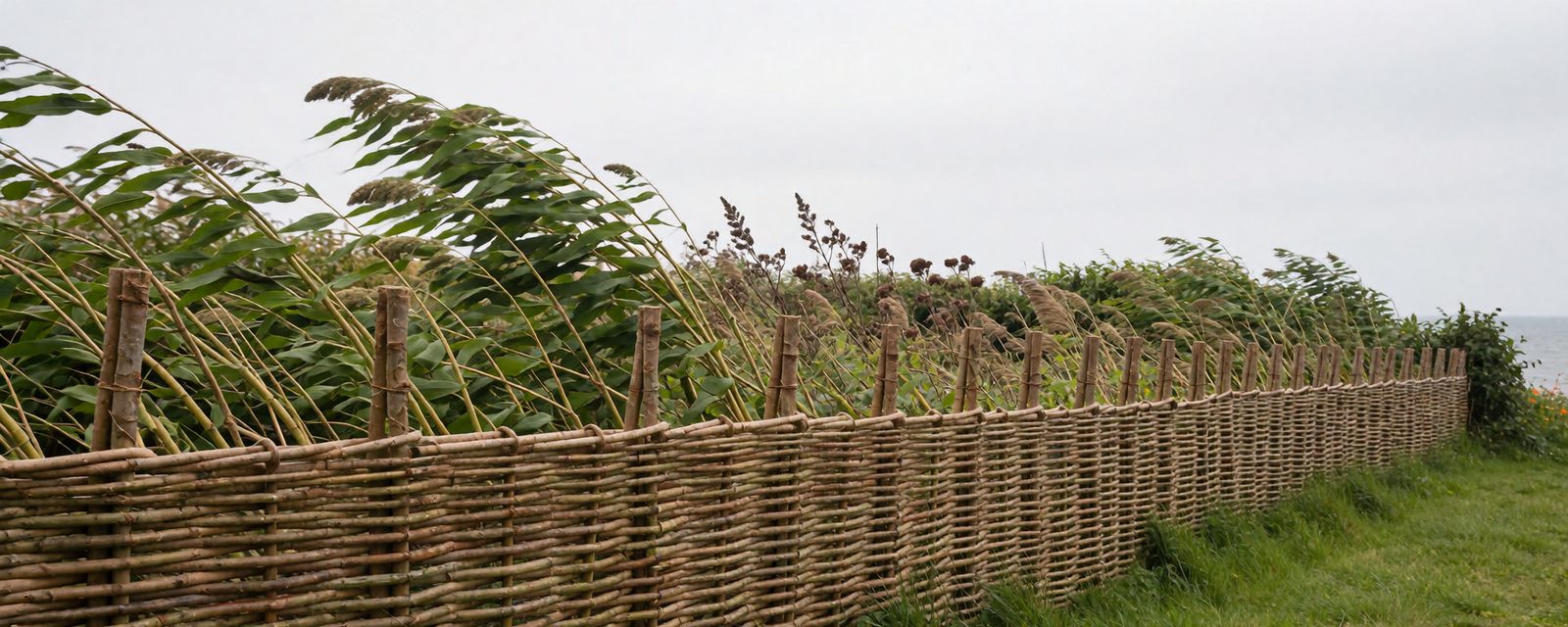
Hurdles are the material that most directly embodies the "permeable barrier" principle without needing an engineered spec sheet to prove it, a hand-woven lattice of rods is inherently full of small gaps. They're also genuinely traditional: hurdle-making is an old British craft, historically tied to coppice woodland and hedge-laying districts, and both willow and hazel hurdles are still hand-woven by specialist makers rather than mass-produced.
Willow and hazel differ meaningfully in durability. Woven Wood, a UK hurdle maker, rates willow hurdles at around 5-8 years with proper maintenance, and hazel, made from thicker, sturdier rods, at 10-15 years with minimal upkeep; hazel is consistently described as the stronger, more robust of the two. Cost for continuous woven fencing runs roughly £4-£14 per square foot, with willow generally cheaper up front and hazel commanding a premium for its longer life. Both benefit from an occasional linseed-oil or wood-preserver treatment, which extends the lifespan range meaningfully, the makers' own guidance notes hurdles in a wet, exposed spot may need replacing within five years, while the same hurdle in a drier, more sheltered position can last close to ten.
On regional availability: hurdle-making is historically associated with English coppice districts, particularly hazel coppicing in the south and Midlands. Most UK hurdle makers, including Scottish stockists, ship nationally from specialist workshops rather than sourcing from local coppice woodland, so unless a buyer already knows of a local maker, it's worth budgeting for delivery cost and lead time rather than assuming a nearby supplier.
Chestnut paling
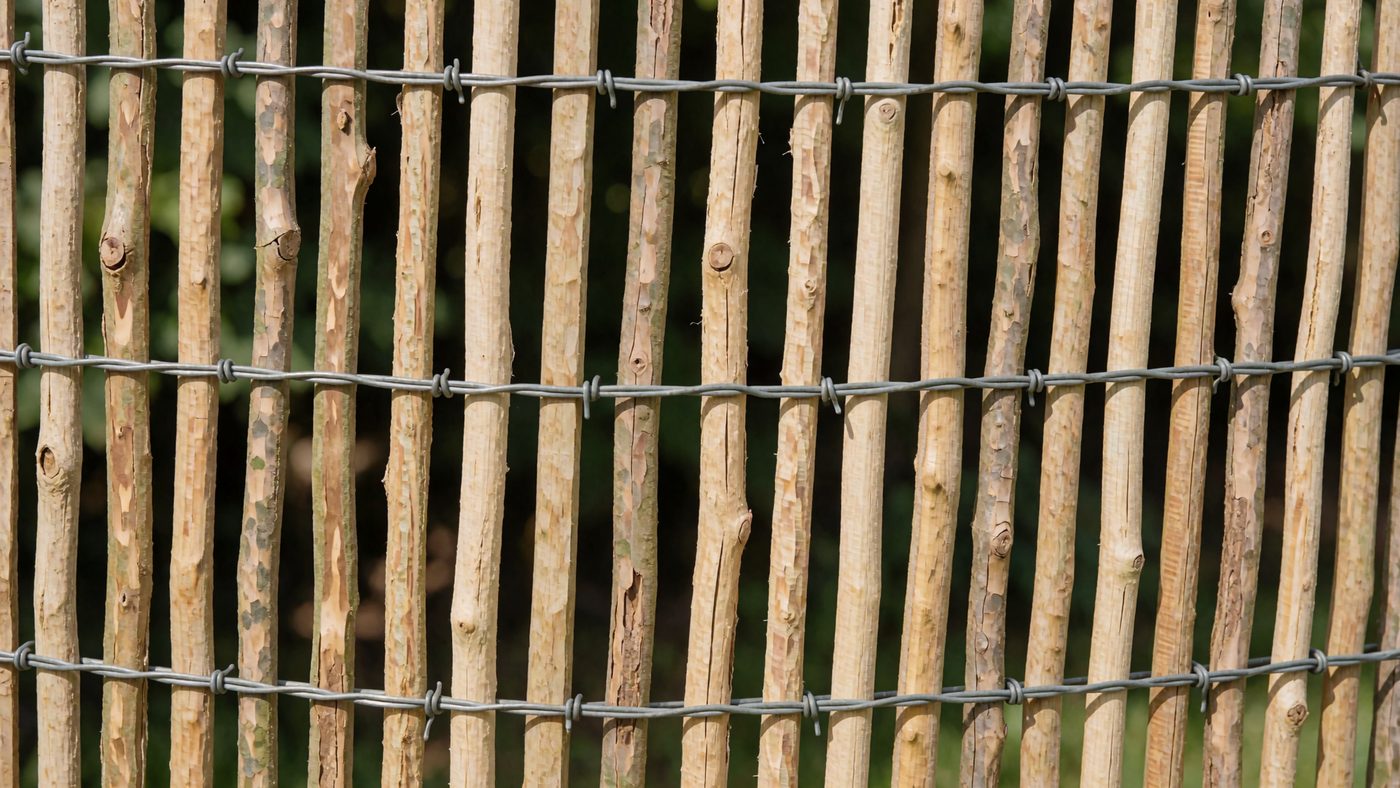
Cleft chestnut paling, individual split chestnut stakes wired together in rolls, is the other traditional permeable option, and it's the one built explicitly for boundary and stock control rather than ornament, which shows in its spacing: a supplier gap of roughly 50-75mm between pales that lets wind through by design while still turning back "smaller wildlife" and keeping people and larger animals out, per Chart Fencing's own product specification.
Sweet chestnut's selling point is that it doesn't need chemical treatment: the timber's natural tannin content makes it rot-resistant untreated, unlike most fencing softwood. Green-tech, a UK landscaping supplier, rates chestnut paling at 10-15 years depending on site conditions; well-drained ground and a well-installed run can outlast that baseline. Cost runs roughly £86-£164 ex. VAT per roll (rolls commonly 5-10m long) depending on height and wire count, with two-wire versions cheaper than three-wire. Installation is straightforward: stakes at roughly 2m intervals, main posts at 10m intervals or at any change of direction.
Windbreak mesh netting
This is the material that matches the shelter-belt physics most literally, because manufacturers build and sell it to a stated porosity figure rather than leaving permeability to the weave.
Porosity target. Commercial windbreak netting is sold across a wide range, and the percentage on the label matters, too low and it barely filters anything, too high and it starts acting like a solid panel again.
| Porosity (wind reduction) | Effect | Typical use |
|---|---|---|
| ~35-40% | Light filtering, minimal turbulence | Low-wind sites, light screening |
| ~50-60% | The sweet spot, matches the RHS figure for hedges and hurdles | General garden and allotment windbreak use |
| ~70-75%+ | Behaves closer to a solid barrier, more leeward turbulence | Extreme, direct coastal exposure only |
Knowle Nets, a Bristol-based UK netting supplier, sells their standard green knitted windbreak netting on the claim that it will "reduce windspeed by about 50% without eddies," the "without eddies" phrasing is the same turbulence-avoidance logic RHS applies to hedges and hurdles, just stated by a mesh manufacturer instead.
Lifespan. UV-stabilised HDPE windbreak netting is commonly rated for up to around 10 years outdoors before the tape or knit starts to degrade; unstabilised or budget nets fail sooner, and on the west-coast, Hebridean and Northern Isles sites named above, where the wind carrying the salt spray is also the reason the netting is up in the first place, that shorter end of the range is the more realistic planning figure, not the 10-year ceiling.
Cost. UK suppliers sell it by the metre run rather than by panel: Knowle Nets prices plain windbreak netting at roughly £1.35/metre for 1m-wide material, rising to around £5.30/metre for 3m-wide, with cheaper rates on 50m and 100m bulk rolls.
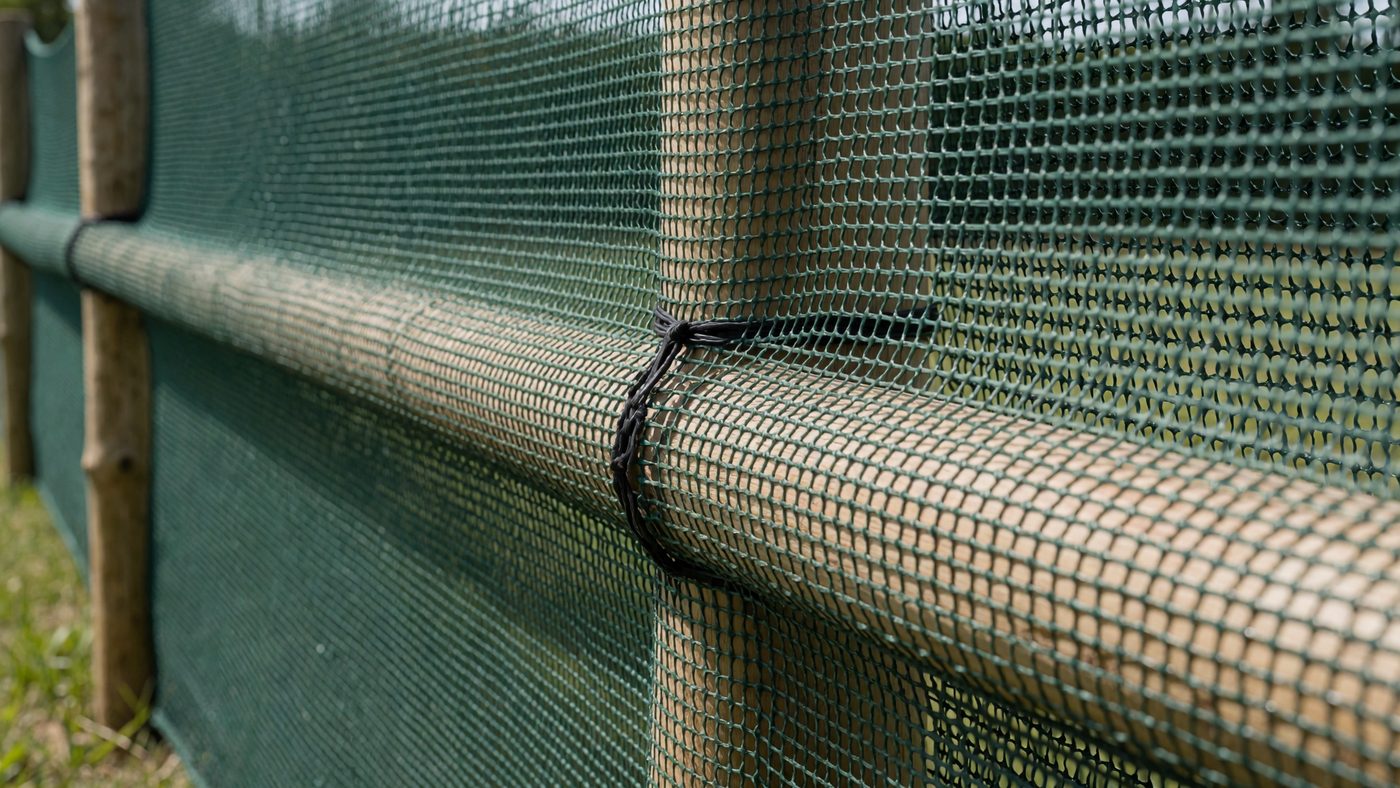
Installation basics. Mesh needs a support structure, it isn't freestanding, which is why it pairs naturally with post-and-rail. UK supplier guidance (Garden Netting, a UK windbreak-kit retailer) recommends wooden posts spaced at roughly 1.2m intervals, with the net run along the posts, kept taut and evenly aligned along the top edge, and fixed to each post through the reinforced eyelets along the netting's edge using galvanised staples or netting clips, under-tensioned mesh sags, flaps, and wears through at the fixing points faster than a properly tensioned run. On a west-coast, Hebridean or Northern Isles site, the same salt-laden air that's the reason the netting is up in the first place also corrodes standard galvanised staples and clips faster than it would inland, stainless steel fixings cost more but are worth it on a genuinely salt-exposed run, since a failed fixing brings the whole tensioned edge down with it, not just one point.
Cost, lifespan and installation compared
| Material | Approx. cost | Typical lifespan | Wind approach | Installation effort |
|---|---|---|---|---|
| Closeboard panel | ~£60-£75/panel (1.8m) | Up to 25 years (manufacturer guarantee) | Solid, blocks, causes leeward turbulence | Low (factory panels, concrete posts) |
| Larch lap panel | £20-£50/panel | 5-8 yrs untreated, 10-20 yrs treated | Solid, same turbulence issue, thinner boards | Low |
| Hit-and-miss/Venetian panel | Similar to closeboard | 15-25 years | Semi-permeable (gapped slats) | Low-moderate |
| Post-and-rail | Cheaper per metre than panels | 15-20 years (rails 10-15) | Minimal alone, open structure, needs infill | Low (not a standalone windbreak) |
| Willow hurdle | £4-£14/sq ft | 5-8 years | Permeable, woven, no eddies | Moderate (needs posts/frame) |
| Hazel hurdle | £4-£14/sq ft (premium end) | 10-15 years | Permeable, woven, no eddies | Moderate |
| Chestnut paling | ~£86-£164/roll (5-10m) | 10-15+ years | Permeable, ~50-75mm gaps by design | Moderate (stakes every ~2m) |
| Windbreak mesh netting | £1.35-£5.30/metre run | Up to ~10 years (UV-stabilised) | Permeable, sold to 50-60% porosity target | Moderate (needs post frame, tensioning) |
Site exposure, ground conditions and maintenance all shift real-world lifespan up or down from these ranges.
Before you buy: height limits, deer, and snow
A few practical factors apply across every material above and are easy to miss until the fence or hurdle is already up.
Planning permission and height. In Scotland, a garden fence or wall up to 2 metres doesn't need planning permission, this automatic allowance is called "permitted development." That drops to 1 metre where the fence faces onto a road or extends past the front or side of the house nearest the road, and conservation areas or listed-building grounds don't get this automatic allowance at all. Check with the local council before ordering materials for anything taller or in one of those situations, rather than assuming the standard rule applies. It's also worth confirming with a neighbour which side of a shared boundary is whose before building anything on it, a dispute over boundary ownership is a more common snag than any of the material choices below.
Deer, rabbits, and livestock. On a rural or farm-adjacent plot, wind isn't the only thing a barrier needs to stop. Roe deer are the species most Scottish gardens near woodland or farmland actually need to keep out (red deer, larger still, are more a farm and forestry-boundary problem than a garden one); RHS guidance on deer fencing recommends 1.8m for roe deer and other larger species, dropping to 1.5m only for the much smaller muntjac, a species with little presence in Scotland, using a heavy-duty wire mesh pegged tight to the ground so deer can't lift it and squeeze underneath. Rabbits are a common problem on Scottish allotments and gardens too, and need a different spec entirely: RHS recommends 2.5cm wire mesh at 120-140cm height, with the bottom 30cm buried and the lowest 15cm bent outwards to stop tunnelling underneath. None of the low windbreak-height figures used elsewhere in this article are tall enough or fine-gauge enough to double as deer or rabbit protection on their own, if either is a real risk on the plot, that height and mesh-gauge requirement, not the wind-porosity target, becomes the limiting factor on fence design, and a separate rabbit-proof mesh skirt is often added at the base of whichever windbreak material gets chosen.
Treated timber near edible beds. Any timber option here, closeboard, lap, hit-and-miss, post-and-rail, is normally pressure-treated to survive outdoors, and it's a fair question on a growing plot whether that's safe next to vegetable beds. The older arsenic- and chromium-based (CCA) preservative that raised that concern was banned from sale across the UK from September 2006; current UK timber treatments (water-based copper, boron or azole-based preservatives) replaced it. Wood treated before construction, not brushed on afterwards, is the standard advice for anything going near a growing bed.
Snow. Snow loading is uneven across Scotland but real in most gardens for at least part of the winter, per Met Office regional records:
| Region | Snow falling | Snow lying |
|---|---|---|
| West coast | Fewer than 30 days/year | — |
| Westernmost isles | — | Fewer than 6 days/year |
| The Grampians | Over 100 days/year | — |
| Higher ground generally | — | More than 50 days/year |
Anywhere in the inland or upland range on that table, the two materials best at filtering wind, tensioned mesh netting and woven hurdles, are also the ones most likely to sag or tear under snow load if it isn't cleared promptly, since neither is a rigid structure. A solid or rigid timber panel doesn't have this failure mode, one of the few points in its favour against the alternatives above.
Which material for which situation
A cheap, permeable, quick fix for an allotment plot. Windbreak mesh on a simple post-and-rail frame is hard to beat here: lowest material cost per metre, sold to a known porosity figure, and quick to put up and take down if the plot layout changes. It won't give privacy or a finished look, but that's rarely the allotment brief.
A garden boundary that needs privacy plus some wind reduction. Hit-and-miss or Venetian timber panelling is the compromise: it reads as a normal garden fence, gives genuine privacy, and its slatted gaps filter wind rather than blocking it outright the way a flat closeboard panel does. If budget allows and the look suits the garden, chestnut paling is the permeable alternative that also functions as a stock- or pet-proof boundary.
A coastal or otherwise seriously exposed site where wind reduction matters more than appearance. Windbreak mesh at 50-60% porosity, tensioned properly on a post-and-rail frame, is the material actually engineered and sold to the same principle RHS validates for hedges: maximum leeward shelter distance for a given barrier height, with the least turbulence. A hazel hurdle run does the same job with a more traditional look, at a shorter lifespan and higher labour cost to replace it. On the very worst sites, an open Orkney or Shetland croft, or an unsheltered headland where even the best mesh or hurdle struggles against a near-constant Atlantic wind, a solid dry-stone or turf dyke is the traditional local answer, a genuinely Scottish craft rather than the imported English coppice-hurdle or chestnut-paling tradition. A dyke works by mass and ground-level solidity rather than by filtering, the opposite principle to everything else compared here, and it's the option the shelter belt guide's own FAQ points to when living shelter isn't achievable in the short term either. It's also the most expensive and slowest to build: the Dry Stone Walling Association prices a new dry-stone wall at roughly £120-£220 per square metre where stone has to be bought in (£60-£100 if existing stone is reused), well above any material compared above, built by a skilled waller rather than a DIY weekend job, but built without mortar or a concrete foundation, most dry-stone walls in Britain have lasted for hundreds of years, a lifespan no timber, hurdle, paling or mesh option here comes close to.
A longer-term answer, once a barrier is up. None of these built materials is permanent, and every one of them needs eventual replacement. A living hedge, covered in the Hedge Planting Species Guide, is the option that gets more effective over time rather than less, it's usually worth treating a built barrier as the thing that buys a hedge time to establish, not as the final answer. Once shelter is in place, Top 5 Crops for Exposed, Windy Gardens covers what's worth growing in front of it while it does its job.
Common questions
Is a solid fence ever the right choice for a windy garden?
For privacy and an immediate boundary, yes, that's a real advantage none of the permeable options match. Go in aware of the turbulence trade-off (covered in full on the shelter belt planting guide); a gapped design costs about the same or less and avoids it.
What percentage of wind should a windbreak actually block?
Around 50-60% is the target both RHS guidance and UK windbreak netting suppliers converge on, it's why mesh sold at that porosity, and hit-and-miss panels or a woven hurdle's natural gaps, all outperform a flat solid panel in practice. Netting rated much higher (70%+) starts to behave like a solid barrier and is generally kept for the most extreme direct coastal exposure rather than a typical garden.
Do I need a fence this tall to actually shelter my whole plot?
Not necessarily the whole plot from one barrier: shelter reaches roughly ten times the barrier's height on the leeward side (full mechanism and worked example on the shelter belt planting guide), so a 1.8m fence, hurdle run or hedge shelters meaningfully to around 18m behind it, then tails off. A long, narrow plot may need shelter at more than one point rather than relying on a single boundary barrier to cover its full depth.
Do woven hurdles need much maintenance?
An occasional coat of linseed oil or a proprietary wood preserver extends hurdle life meaningfully, the difference between a hurdle lasting toward the bottom or the top of its rated range often comes down to whether it's treated and how exposed and wet the base of the posts stays.
Is chestnut paling animal-proof?
It's designed to be, the wire-bound pale spacing (roughly 50-75mm) is close enough to deter larger animals and people while still letting smaller wildlife and, by design, a proportion of the wind through. It was originally a stock-fencing product, which is part of why it holds up outdoors without chemical treatment.
Sources
16 sources, recorded with what each was used for
- Met Office: Northern Scotland Climate: Snowfall and snow-lying day counts by region (west coast vs Grampians/higher ground)
- RHS: Windbreaks and Shelterbelts: Porosity target (50-60%), solid-vs-permeable turbulence explanation, ten-times-height shelter distance
- Dry Stone Walling Association (national trade/craft body): Dry-stone wall cost (£60-£220/m² depending on stone sourcing) and multi-century lifespan
- RHS: Rabbits in Gardens: Rabbit-proof fence mesh size (2.5cm), height (120-140cm) and ground-burial/outward-bend detail
- NetRegs: Wood Preservatives: UK ban on arsenic/chromium (CCA) wood preservatives from September 2006, current preservative types
- RHS: Deer: Deer fencing height (1.5m muntjac, 1.8m other deer including roe), mesh gauge and ground-fixing guidance
- mygov.scot: Build a Gate, Fence or Wall Around Your House: Scottish permitted-development height rules (2m general, 1m facing a road), conservation-area exception
- Jacksons Fencing: A Fence Exposed to Strong Winds (commercial/trade, UK fencing manufacturer): Solid panel "sail" effect, hit-and-miss/Venetian panel gaps reducing wind load, post-and-rail's open design
- Jacksons Fencing: 1.80m Featherboard Panel product page (commercial/trade, UK fencing manufacturer): Closeboard panel price and 25-year rot/insect guarantee
- Walford Timber: Closeboard Fence Panels vs Lap Panels (commercial/trade, UK timber merchant): Closeboard vs lap panel lifespan and construction detail
- Woven Wood: Willow vs Hazel Hurdles (commercial/trade, UK hurdle maker): Willow (5-8 yr) vs hazel (10-15 yr) hurdle lifespan, cost and durability comparison
- Chart Fencing: Chestnut Fencing (commercial/trade, UK fencing supplier): Chestnut paling cost, pale spacing, post/stake interval specification
- Green-tech: Chestnut Paling Fencing (commercial/trade, UK landscaping supplier): Chestnut paling lifespan, natural tannin rot-resistance, roll pricing
- Knowle Nets: Windbreak / Shade Netting (commercial/trade, UK netting supplier): Windbreak netting wind-reduction claim, per-metre pricing
- Windbreak Netting: Knitted Windbreak Netting product page (commercial/trade, netting manufacturer): Porosity range across product line, UV-stabilised lifespan
- Garden Netting: 1m Windbreak Screening Fence Kit (commercial/trade, UK windbreak-kit retailer): Installation guidance, post spacing, fixing method