
A potato you've lifted from the ground doesn't stop being alive. It's still respiring: slowly burning its own stored starch and losing moisture as vapour, exactly as it did while sitting in the soil, just without a plant above it to replace what's lost. Everything that goes wrong in a store of potatoes, and everything every storage method is trying to prevent, comes down to managing three linked variables around that ongoing respiration: moisture, temperature and light.
Moisture is the double-edged one. Too much, and damp skins and trapped humidity around the tubersA swollen underground stem or root a plant uses to store energy, which can also grow into a new plant, the classic example being a potato. Full definition → invite the fungi and bacteria that cause rot; potatoes packed wet or stored in sealed plastic sweat and spoil quickly. Too little, and the tubers themselves keep losing water to the air faster than they can afford, and they shrivel and go rubbery. A good store keeps the air around the potatoes humid enough that the tubers aren't drying out, but moving enough that condensation doesn't sit on the skins.
Temperature governs how fast that respiration runs, and it cuts both ways. Warmth speeds everything up: potatoes respire faster, use up their reserves faster, and break dormancy sooner, which is why a warm store sprouts within weeks. But go too cold, close to freezing, and the tubers respond by converting starch into sugars as a kind of antifreeze strategy, which is what gives chilled potatoes an odd sweet taste and a tendency to discolour when fried or roasted. There's a middle band, commonly put at roughly 4 to 10°C, cool cellar temperature, where respiration ticks along slowly enough that the tubers stay dormant and firm for months without tipping into either failure mode.
Light, meanwhile, doesn't affect respiration directly but triggers greening: exposure turns the skin green and builds up solanine, a natural toxin that tastes bitter and makes a potato unsafe to eat in any quantity, which is why every serious storage method insists on darkness.
For drying tubers after lifting, brushing off soil, and the skin-set test before they go into store, see our guide to harvesting and curing potatoes, which also covers paper and hessian sack storage for typical allotment quantities.
When sacks and trays aren't enough
Sacks and trays are small-scale versions of the cool-dark- frost-free target and work well for it, but their limit is capacity and space. A big maincropThe main, usually latest-sown and longest-growing type of a crop, grown for bulk and storage rather than an early harvest. Full definition → harvest, several stone of potatoes off a full allotment bed, quickly outgrows what a household has indoors, and not every grower has a garage, shed, or unheated porch to spare in the first place. That's the gap clamp storage was developed to fill.
This is a maincrop question specifically. First and second earlies get dug and eaten fresh within days rather than stored long-term, so a large clamp is only ever a maincrop decision, once that crop is lifted, cured and ready to go somewhere for the winter.
Clamp storage: the traditional alternative
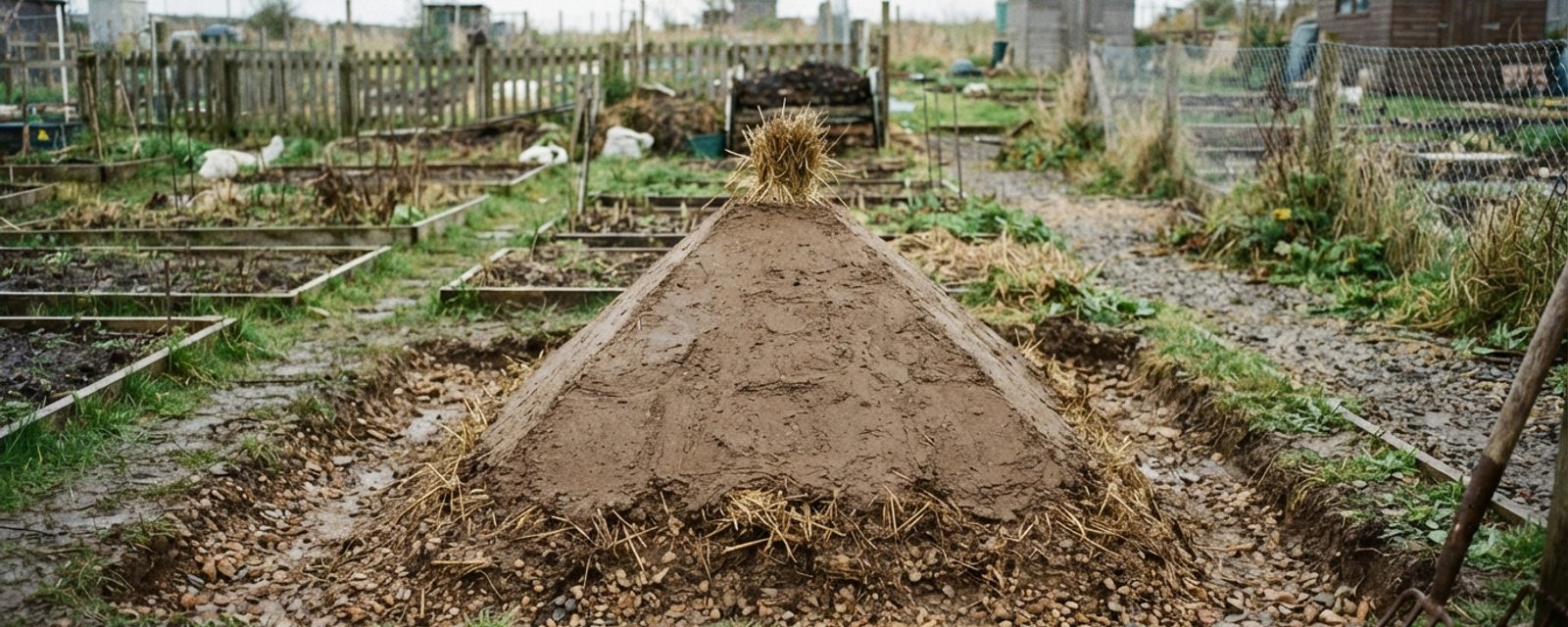
A clamp, sometimes called a potato pit or, in Scots usage, a "potato grave" or "pit", is an outdoor mound built to store a large quantity of potatoes through winter without any building at all. It works on the same three variables as a sack, just at field scale: straw and soil layers hold in enough warmth to stay above freezing, the pile shape and a deliberate air gap let excess moisture and heat escape rather than condense, and the soil cap keeps light out entirely.
Build a clamp straight after curing, using the same dry, sound, brushed-off tubers you'd otherwise sack up, there's no separate curing process for clamp storage. According to RHS guidance on storing root vegetables in bulk, the layers from the ground up are:
| Layer | Material | Depth |
|---|---|---|
| Base | Sandy soil or sand | 20cm |
| Tuber bed | Straw | Enough to cushion the tubers off the base |
| Tubers | Cured, dry potatoes | Piled into a pyramid, largest at the bottom, maximum height around a metre |
| Insulation | Straw | About 20cm |
| Cap | Soil | About 15cm, patted smooth with the back of a spade |
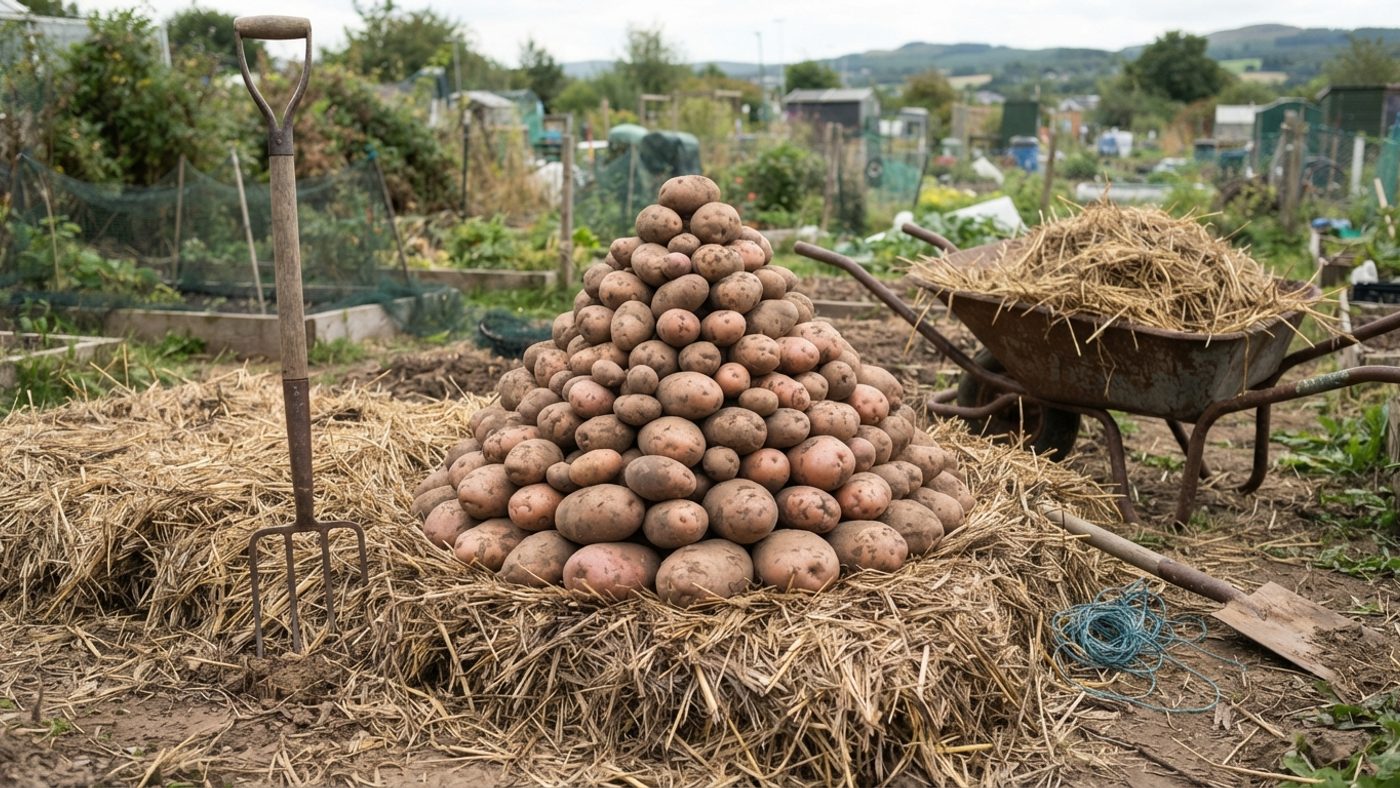
A sandy base drains fastest, but the same effect on a heavier Scottish clay allotment is a few centimetres of coarse grit or sharp sand worked into the base before the straw goes down, the point is stopping water sitting directly under the tubers, not the sand itself. "Slightly raised" simply means picking the highest, driest corner of the plot rather than a hollow where rain collects, and digging a shallow drainage trench right around the base to carry water away further reduces the risk. Piling the tubers higher than a metre makes the middle of the heap harder to ventilate and more prone to overheating, so widen the base for a bigger harvest rather than build taller. There's no fixed capacity figure since it depends on the footprint you dig, but a single one-metre pyramid on a decent-sized base holds a genuinely large quantity, well beyond what a few sacks would.
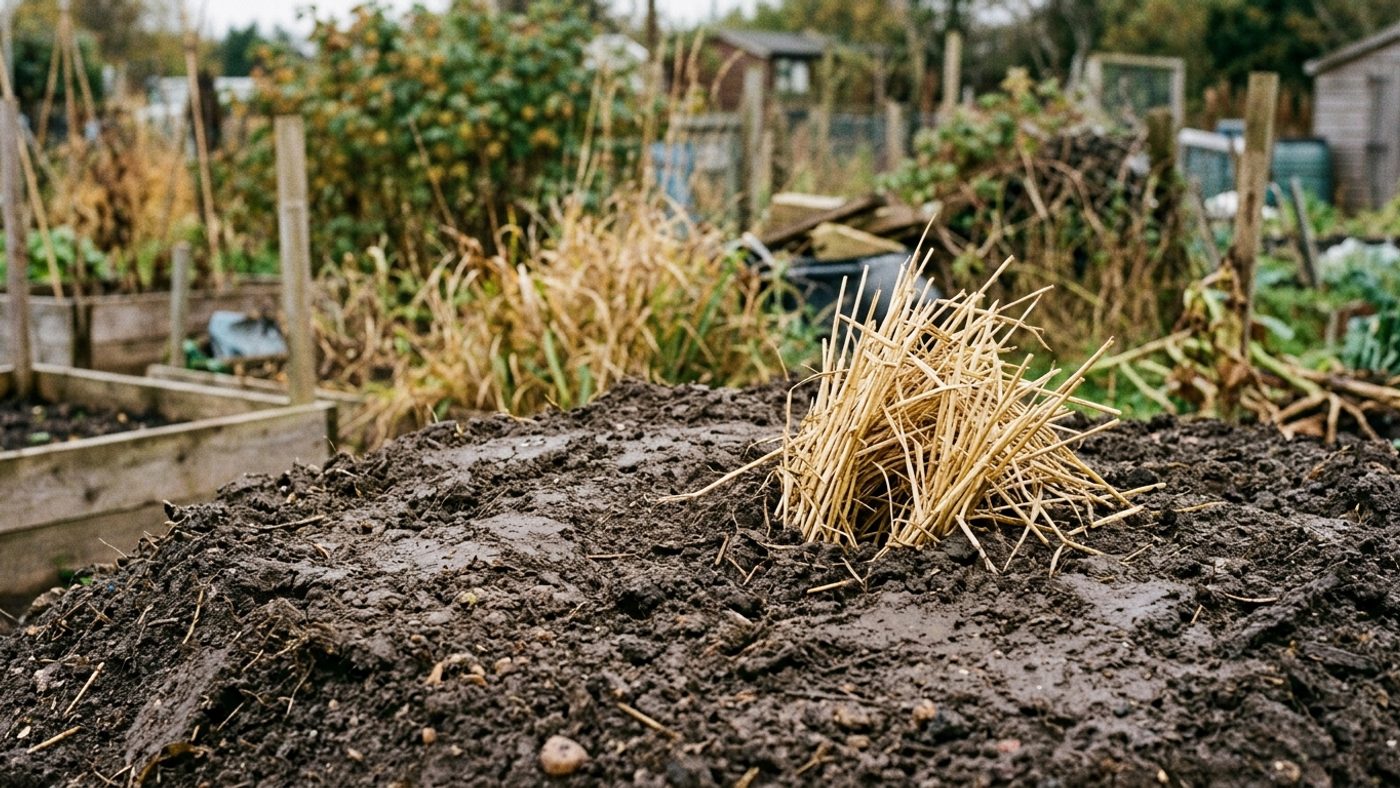
Leave a tuft of straw poking through the soil cap at the top as a ventilation "chimney," the detail that separates a working clamp from a rotten one: without that escape route, the heat and moisture the potatoes are constantly giving off as they respire has nowhere to go, and the pile turns to slush from the middle out.
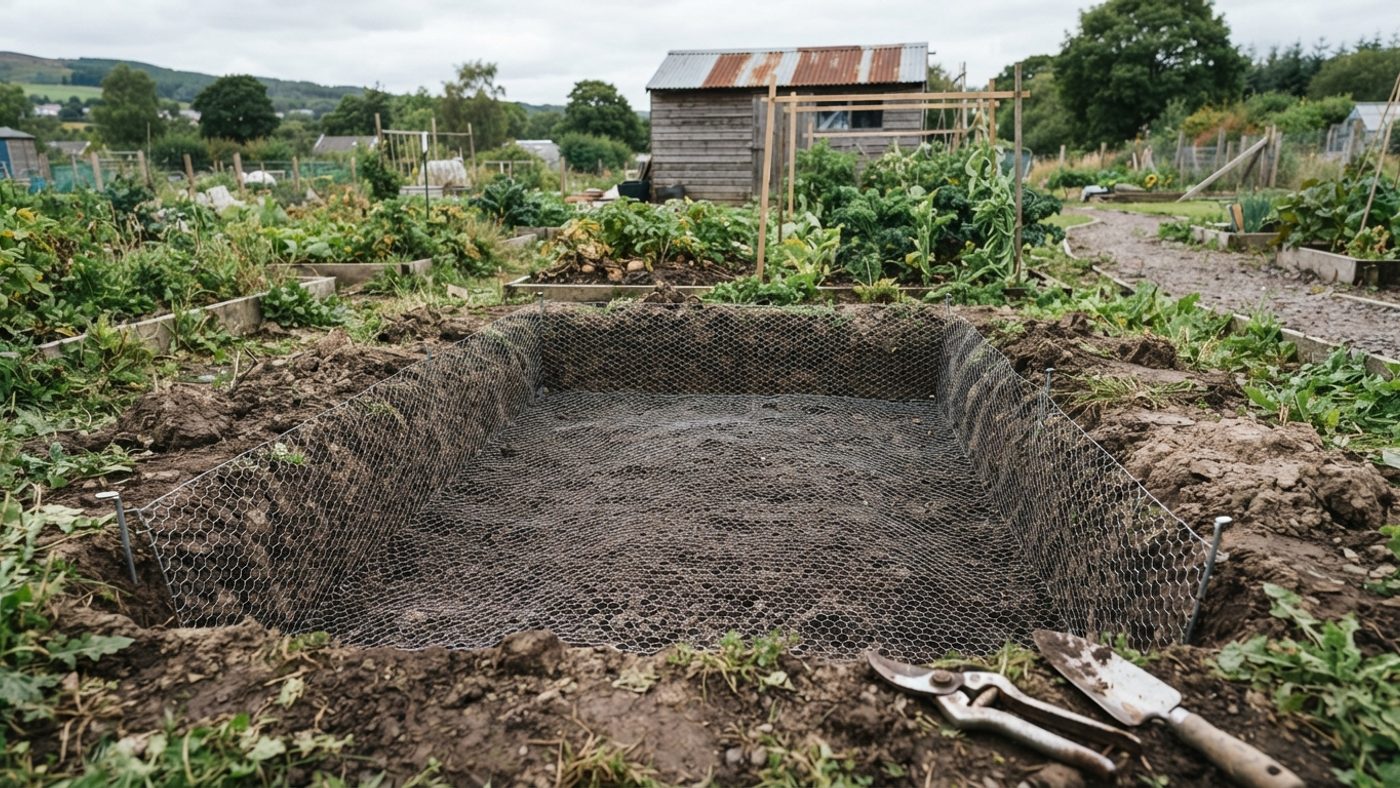
Rodent damage is the other main risk: lining the base and sides with fine wire mesh before the straw goes in keeps mice and rats from tunnelling up into the pile, and it's worth checking for signs of them periodically through winter.
Building several smaller clamps rather than one large one is also worth doing if you have the tubers to fill them: if rot or a rodent gets into one, it costs you that clamp, not the whole crop. Only store sound, disease-free tubers in a clamp: any showing blight damage, splits, or slug and wireworm tunnelling should go into the use-now pile instead, since a single infected or damaged tuber inside a sealed clamp can take out everything packed around it before you ever see it happen.
Is a clamp still worth building?
For most home gardeners, no, not as a first choice. A shed, garage or unheated porch with sacks or trays is simpler to build, easier to check on a wet Tuesday in November, and lower-risk from rodents and slugs, which are drawn to the straw and soil of an outdoor clamp. Clamps also demand a bit of nerve: once it's built and capped, you can't easily see how the potatoes inside are doing.
Where a clamp still earns its place is capacity: if you've grown a genuinely large maincrop harvest and have no indoor frost-free space at all, a clamp lets you store hundreds of potatoes outdoors for the cost of some straw and digging, using ground you already have. For an allotment holder without a shed, that's a real, practical option, not a museum piece.
Sack, tray or clamp: comparing the options
| Method | Typical capacity | Space needed | Ease of checking | Main failure risk |
|---|---|---|---|---|
| Paper/hessian sack | A few kilos per sack, stackable | Garage, shed, porch shelf | Very easy, open and look | Poor ventilation or handling error |
| Slatted wooden tray | Moderate, limited by shelf space | Garage, shed, cellar | Very easy, tubers visible | Draughts or frost in an unheated space |
| Clamp | Very large, effectively unlimited by site size | Outdoor ground, no building required | Difficult, requires opening the cap | Rot from poor ventilation, rodent damage |
Sacks and trays remain the better default for anyone with shed or garage space, simply because they're easier to monitor and lower-risk. A clamp is a genuine, useful fallback for scale, not an upgrade.
A genuine Scottish angle
Clamp storage has a real, if modest, extra relevance in Scotland. It's commonly described as a technique crofts and smallholdings leaned on when potatoes were grown as a staple crop in quantities that outstripped whatever indoor storage a small building could offer, long before sheds and fridges were standard. That background doesn't translate into a strong modern recommendation: the standard clamp dimensions above are the same wherever you build one, and what changes in Scotland is how strictly they need to be followed. A damp climate makes the ventilation chimney and drainage trench less optional than they might seem further south, since excess moisture is exactly what a wetter site produces in greater volume, and a longer, harder frost season leaves less margin for a skimped soil cap. Anyone building a clamp on a wet, exposed Scottish plot should treat both as non-negotiable, not as details to cut corners on.
Common questions
Do I need a clamp if I have a shed?
No. Sacks and trays remain the simpler, easier-to-check default whenever you have cool, dark, frost-free indoor space. A clamp earns its place specifically when the harvest is too large, or the indoor space too small, for that option.
Why does the clamp need a straw "chimney"?
Because the potatoes inside are still respiring and giving off heat and moisture even while dormant. Without a route for that moisture to escape, it condenses inside the pile and causes rot from the centre outward.
How long do clamped potatoes keep, and do I need to check on them?
Through winter into early spring, similar to sack storage, but not by opening the cap on a whim. Take what you need from one end, then close the gap straight back up with fresh straw and re-pat the soil over it, rather than leaving the pile part-open.
What happens if potatoes are stored too cold, and does that matter more for an outdoor clamp?
Very cold storage, close to freezing, causes tubers to convert starch into sugars as a stress response, giving them an unusually sweet taste and a tendency to discolour when cooked. An outdoor clamp sits much closer to that edge than an indoor sack in a Scottish winter, which is exactly why the straw and soil layers need to be built to the full depth.
Sources
2 sources, recorded with what each was used for
- RHS: Root vegetables — storing: Clamp construction details (base layer, straw and soil cap dimensions, ventilation chimney, drainage trench) and general in-ground/box storage context for root vegetables
- RHS: Potatoes — grow your own: Baseline potato storage conditions and the storage window through to early spring before sprouting