
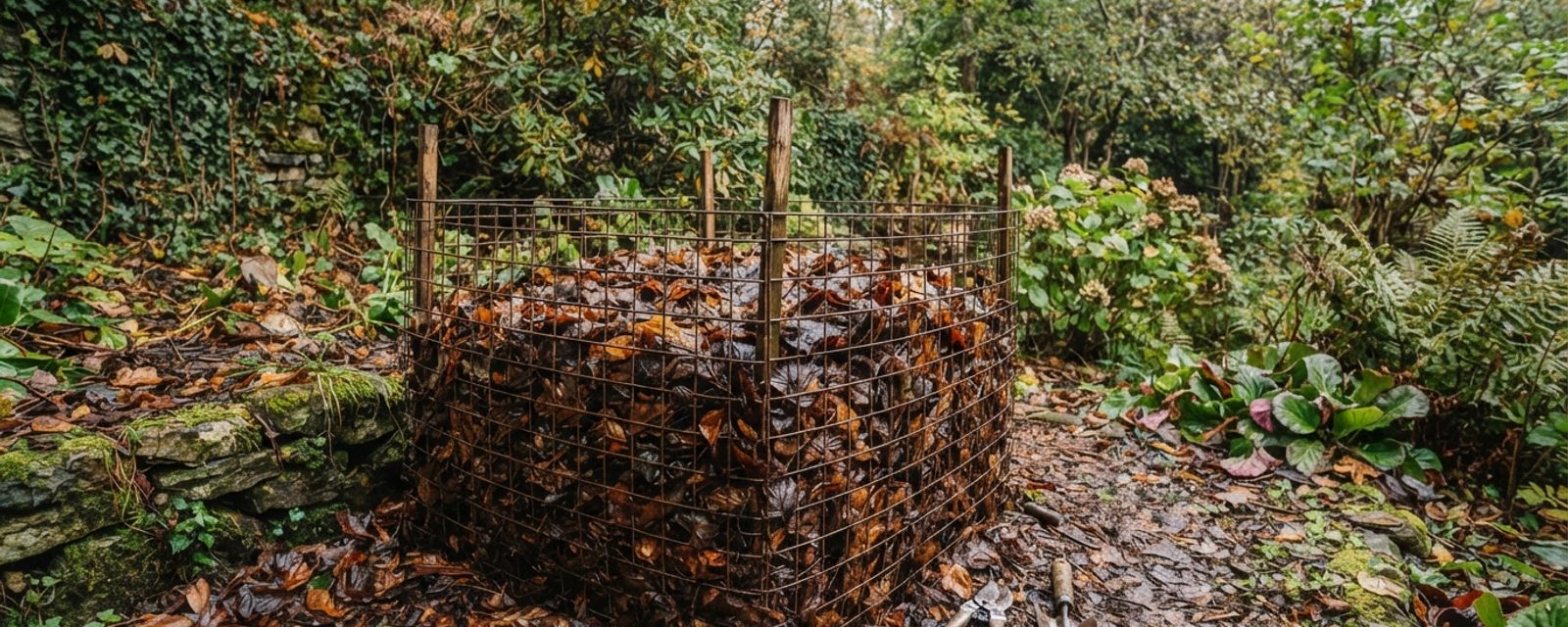
By late October the leaves are coming down faster than anyone can rake them, and there's always more of them than there's room for in the compost bin. That's usually the exact moment somebody standing over a full wheelbarrow wonders whether it's worth the bother of a separate pile at all, why not just tip the leaves in with the kitchen peelings and grass clippings and let the compost heap deal with everything at once?
It's a fair question, and the honest answer is: leaves will rot down in an ordinary compost heap eventually, but they do it badly there, and slow the rest of the heap down while they're at it. They break down by a genuinely different process, on a genuinely different timescale, to everything else going into that bin, which is exactly why keeping them separate produces a better result for less effort, not more.
Why leaves get a heap of their own
Ordinary composting is bacterial. Soft green material, kitchen scraps, grass clippings, annual weeds, supplies nitrogen, drier brown material like cardboard and woody prunings supplies carbon, and bacteria feeding on that mix generate the heat and speed behind a working compost heap. Get the ratio roughly right and a heap can produce usable compost in four months to a year.
Kitchen scraps specifically have another home too, if a garden heap isn't practical or a household wants somewhere for peelings year-round. Starting a Wormery → covers the smaller-scale, worm-powered alternative, including how much winter protection the worms actually need in a Scottish garden.
Leaves don't fit that recipe. They're almost all carbon, low in nitrogen, and their cell structure is built around lignin, a tough fibre that's slow to break down under any conditions. Dumped into a heap built for a bacterial process, a thick layer of leaves does the opposite of speeding things up: it swamps the green-to-brown balance, mats down and excludes air, and slows the whole pile rather than composting quickly itself.
Left on their own instead, leaves rot by a different route entirely: a slow, cool, fungal process, not a bacterial one. It's a quiet, natural process, a gentle decay that can be harnessed by gardeners, and it needs a cooler, damper environment than a bacterial compost heap does, which is a large part of why a dedicated pile in a shaded corner works so much better than mixing leaves into the bin already doing something else.
Three ways to make it
All three come down to the same thing, corral damp leaves somewhere they'll stay damp and undisturbed for a year or more, with different trade-offs for space and tidiness.
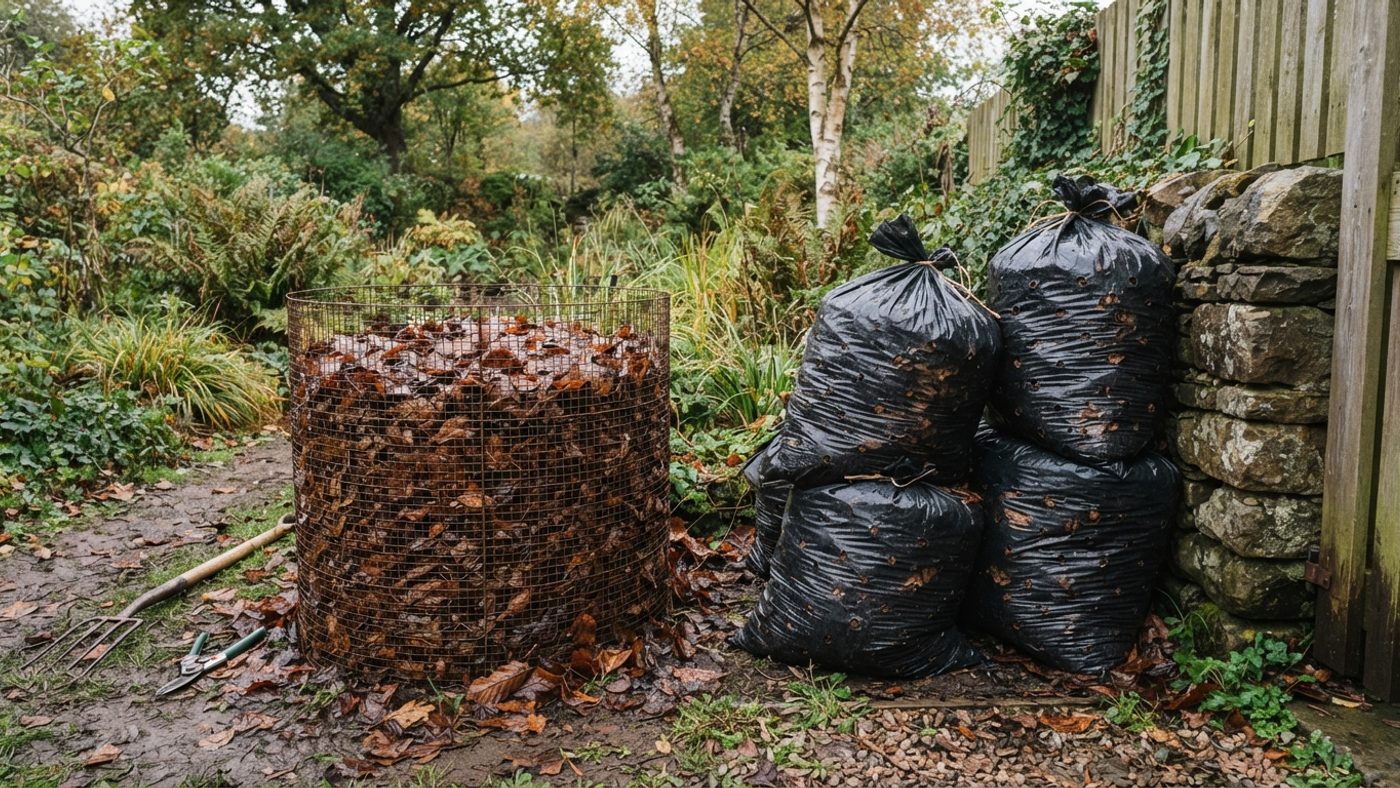
A wire or chicken-wire cage
Build a square or round frame from chicken wire, held up by stakes or bamboo canes at the corners, and site it somewhere sheltered so the leaves don't blow straight back out again. This is the best option for genuine volume, a big pile holds its own dampness better than a small one and rots faster as a result, but it's also the least tidy option if space and appearance matter.
Bin bags with holes
Pack damp leaves into an ordinary bin liner, pierce it with a fork or knife to let air in, tie the top loosely, and stack the bags somewhere out of sight for up to two years. This is the low-effort, low-space option: no building required, and a full bag can sit behind a shed or in a corner of the garden without needing to look tidy while it works.
Shred first with a mower
Running a rotary mower over a lawn covered in fallen leaves collects and shreds them in one pass, and, a genuine bonus rather than a contamination risk, mixes in a share of grass clippings, which adds nutrients the leaves alone don't supply. Shredded material breaks down faster and more evenly than whole leaves in either a cage or a bag, which is worth doing for any leaf type that's on the slow side to begin with.
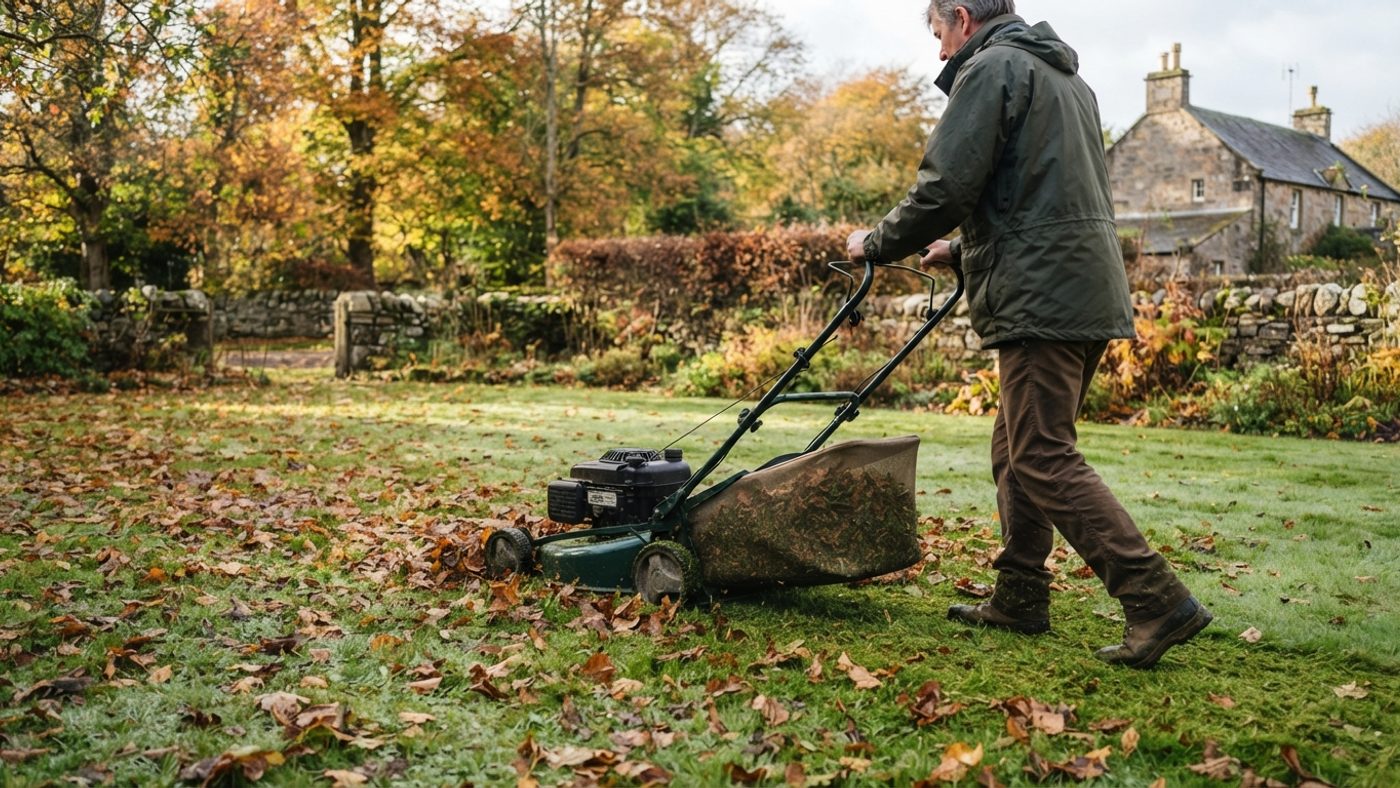
Whichever method, the same basic care applies throughout: keep the pile or bag damp, water it if a dry spell sets in, and don't expect much from it before autumn comes round again. Where the leaves came from matters too: those gathered from beside a busy main road can carry a share of atmospheric pollution, so leaves from quieter streets and back gardens are the better choice.
Which leaves work, and which don't
Not every leaf behaves the same way, and it's worth sorting them before they go in, since one or two categories genuinely don't belong in a leaf mould pile at all.
| Leaf type | Behaviour | What to do |
|---|---|---|
| Oak, beech, hornbeam | Break down well without shredding, the classic leaf mould trio | Straight into the pile as they fall |
| Ash, cherry, elm, lime, maple, poplar, willow | Lower in lignin, higher in nitrogen, the fastest-rotting leaves going | Straight into the pile |
| Sycamore, walnut, horse chestnut, sweet chestnut | Thick and slow to break down unshredded | Shred with a mower first |
| Holly, Aucuba, cherry laurel and other evergreens | Can take up to three years in a leaf mould pile | Shred and put in the ordinary compost heap instead, they rot faster there |
| Conifer/pine needles | Very slow (two to three years), but produce a useful acidic result | Keep in their own separate pile, don't mix with deciduous leaves |
The oak/beech/hornbeam trio is worth a second look, because "good leafmould leaves" and "fast leafmould leaves" turn out to be two different claims, not one. Oak, beech and hornbeam produce reliable leafmould breaking down with little assistance, meaning they don't need shredding first, unlike sycamore or chestnut. But by lignin content, the fibre that governs how slowly a leaf breaks down, beech, birch, hornbeam and oak sit in the higher-lignin, slower-rotting group, against ash, cherry, elm, lime, maple, poplar and willow as the genuinely quick ones. Both things are true at once: oak, beech and hornbeam don't need any special treatment and produce a fine, reliable result without shredding, but going by lignin content, they're still relatively slow leaves, so a pile made mostly of them sits toward the two-year end of the timeline rather than the one-year end, where a pile of ash or willow leaves would be quicker.
Pine and conifer needles are worth keeping separate for a second reason beyond their slow rotting: the finished result is distinctly acidic, which is a genuine asset rather than a defect if it's earmarked for mulchingA layer of material spread over the soil around plants to suppress weeds, retain moisture, and improve soil structure as it breaks down. Full definition → rhododendrons, azaleas, camellias or blueberries, and a problem if it ends up mixed into an ordinary bed by accident. That's worth remembering specifically here, given how many Scottish gardens already lean acidic and grow exactly those plants, see our guide to soil pH testing and adjustment for why.
How long it takes, and what each stage is for
Leaf mould isn't a single finished product, it's useful at more than one point along the same slow decay, and knowing which stage you're looking at changes what it's good for.
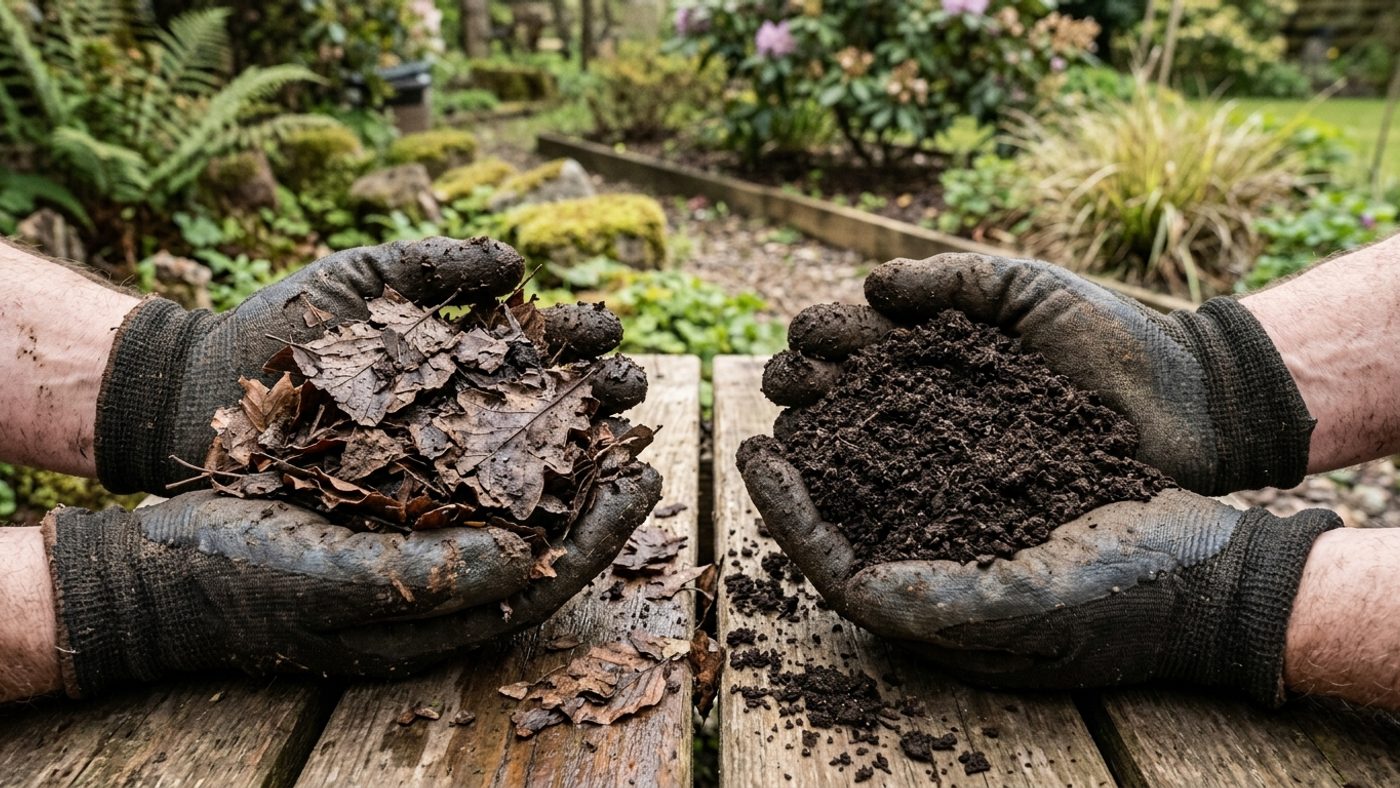
After a year or so, leaves have started to break up and crumble easily in the hand, but individual leaf shapes are still visible. This young leaf mould is genuinely useful as it is: dig it in as a soil improver, use it as a summer mulch to hold moisture and suppress weeds, spread it as a winter covering to protect bare soil, or work it into a lawn as an autumn top-dressingAdding fresh compost, feed or grit to the soil surface around an established plant, rather than digging it in. Full definition →.
After two years or more, it's a different material entirely, dark brown, crumbly, with no trace of the original leaf shape left. This stage is worth waiting for specifically because it's low in nutrients and fine in texture, which is exactly what seed germinationA seed sprouting: breaking dormancy and putting out its first root and shoot, given the right warmth and moisture. Full definition → needs: too rich a mix pushes leggyDescribes a plant that's grown tall, thin and sparse rather than bushy, usually from too little light or not being pinched out. Full definition →, overfed seedlings rather than steady growth, and leaf mould's low fertility avoids that. Use it alone, or mixed with sharp sand, for seed sowing, or combine roughly equal parts sharp sand, garden compost and soil for homemade potting compost. Shredding leaves before piling them, or building the biggest pile the space allows, is the most reliable way to land nearer the one-year end of that range rather than the two.
Does anything change north of the border?
Not much, honestly, this is one of the few techniques that doesn't need reworking for Scotland, because the whole process runs on shade and dampness rather than anything climate-sensitive in a way that cuts one way here.
It's worth noting what this technique doesn't fight, in contrast to hot composting: a fungal process that specifically wants things cool and damp isn't up against Scotland's cooler, wetter summers the way a heat-dependent hot compost heap is, it's simply doing what it was always going to do regardless of where it's sited. That doesn't mean it runs any faster here, though. By the same logic that makes cold composting slower in cool, damp conditions, the fungi and other organisms doing the work are less active the colder and wetter it gets, not just less obstructed, a Scottish leaf pile plausibly sits toward the two-year end of the range more often than the one-year end, even without a study measuring that directly.
The other honest check is whether Scotland's own tree mix tilts the leaf-type table above one way or the other. It doesn't. Birch is Scotland's most widespread native woodland species by a wide margin, but on lignin content it sits in the slower-rotting group alongside beech, oak and hornbeam, not the fast one, there's no species-mix advantage here worth reporting.
Common questions
Do I need to add anything to a leaf mould pile, an activator, or nitrogen feed?
No. Unlike a bacterial compost heap, leaf mould doesn't rely on a green-to-brown ratio, and adding nitrogen-rich material defeats the point of keeping it separate in the first place. Damp leaves and time are the only two ingredients it needs.
My leaves are bone dry, does that matter?
Yes, more than most people expect. Fungal decomposition needs consistent moisture, so dry leaves piled up as they are will barely rot at all. Water them as you add them, and check the pile through any prolonged dry spell.
Can I use grass clippings mixed in with mown-up leaves?
Yes, running a mower over fallen leaves collects and shreds them in one pass and mixes in a share of clippings automatically, which is a genuine benefit rather than something to sort back out, since the clippings add nutrients the leaves alone don’t supply.
Is it worth doing if I've only got a small garden?
Yes, on a smaller scale. A stack of perforated bin bags takes up far less room than a wire cage and needs no building, at the cost of being slightly slower and less tidy-looking than a proper pile, a reasonable trade for a garden with no spare corner.
Can diseased leaves go in?
It's safer not to. Leaf mould runs cool by design rather than hot, so unlike a properly built hot compost heap, it isn't reaching temperatures that would reliably destroy fungal disease spores, blackspot-affected rose leaves are a common example. Bin or burn visibly diseased leaves rather than piling them.
Sources
5 sources, recorded with what each was used for
- RHS: Leafmould: Methods (bin bags, wire frame, mower collection), which leaves need shredding or should be avoided, conifer/pine needle timelines and acidic-mulch use, how to use leaf mould at different ages, and the advice to avoid leaves gathered from busy roads
- RHS: Making the most of fallen leaves: The fungal-versus-bacterial mechanism and why leaf mould needs a cooler, damper environment than compost
- Garden Organic: Leafmould: Lignin content and the fast/slow leaf classification, timelines by stage (1-2 years vs 2+ years), and uses of young vs well-rotted leaf mould
- Soil Association: How to make your own compost: Green/brown ratio and the four-months-to-a-year timeline for ordinary bacterial composting, used as the contrast point for why leaves don’t fit that process
- NatureScot: Birchwood: Birch as Scotland's most widespread native woodland type, used to check (and rule out) a species-mix Scottish angle