
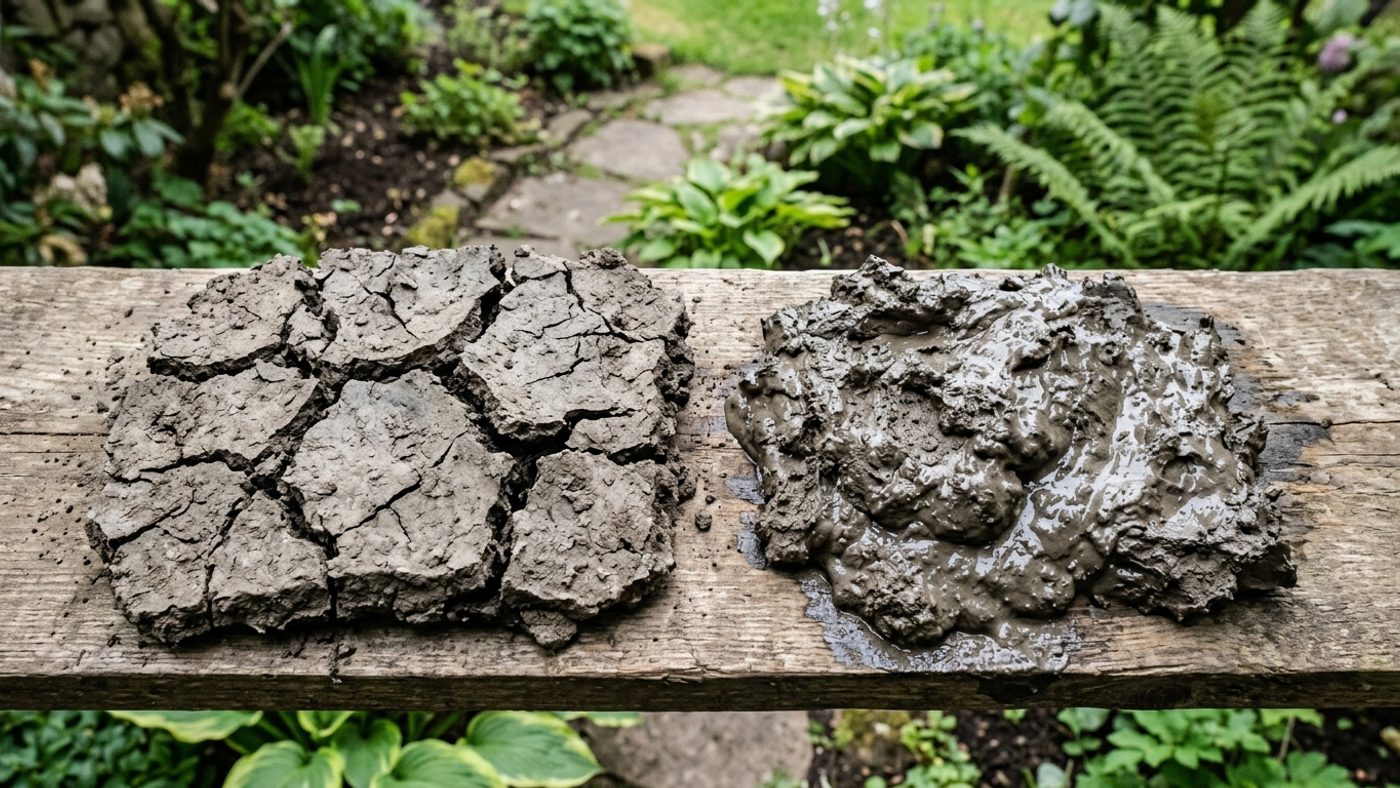
Stand over a clay bed in a dry spell and it looks like a dropped dinner plate: grey, cracked into hard plates with gaps you could lose a trowel down, and digging it feels like breaking up a paving slab. Come back after a week of rain and it's the opposite problem entirely, the same ground is grey-slick, sucks the boot off your foot, and a spade pushed in comes back out with a wet clonk, leaving a smeared, airless slot rather than a clean cut. Most gardeners meet clay in one of these two states and assume they're looking at two different soils. They're not. It's the same clay, and the double bind, rock-hard dry, sticky-wet, with only a short window where it's actually workable, is exactly what heavy clay does, everywhere it's found.
Scotland has more of this ground than most of the UK. Podzols cover 23.7% of the country's land area, peat 22.5%, and gleys, periodically or permanently waterlogged ground, the class that behaves most like the "always sticky, rarely diggable" clay above, 20.6%, with peat and gley concentrated in the Highlands and Southern Uplands. That's not a niche problem for a handful of unlucky plots. It means drainage, not organic matter alone, has to be the first decision on a lot of Scottish clay ground, get the water moving off the bed and everything else, digging, planting, root growth, gets easier; skip it and no amount of compost fixes a bed that sits wet from October to April.
Why clay behaves like this
Clay particles are tiny and flat, and they pack together far more tightly than the coarser particles in sand or loam. That tight packing is exactly why clay holds water and nutrients so well, there's more surface area per gram than in any other soil type, which is why an improved clay bed often out-yields a sandy one once it's workable. But the same tight packing means there's very little space between particles for air or drainage. Rain doesn't pass through clay so much as pool on top of it and creep down slowly, which is why a clay bed can still be saturated weeks after a dry sandy bed nearby has dried out.
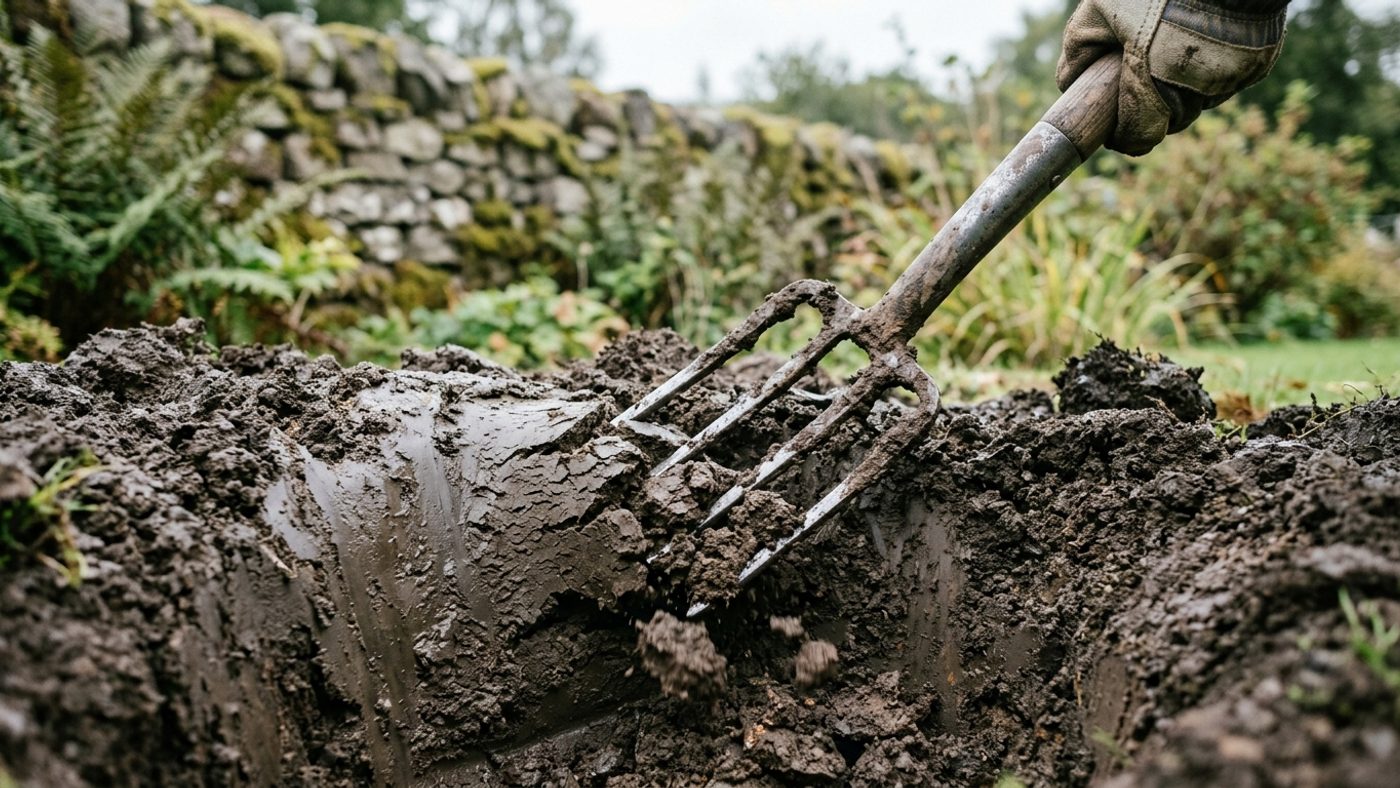
The cracking in a dry spell isn't damage, it's the same particles pulling tightly together as they lose water, opening gaps between the plates. Left alone, this seasonal wetting and cracking is one of the main things that improves clay structure naturally over years, breaking a solid mass down into smaller crumbs. Digging or walking on it while it's wet does the opposite: it collapses that crumb structure into a dense, airless smear, usually called puddling or compaction, and that damage doesn't undo itself in a season. It's slow and laborious to fix, so the working rule is to stay off clay entirely when it's wet enough to stick to a boot, no matter how tempting it is to get a bed dug while the weather's dry enough to be outside.
That's ordinary compaction from foot traffic or wet-weather digging. A new-build garden can have a different, harder problem sitting under a thin skim of turf: New-Build Garden Won't Grow: Diagnosing and Fixing Rubble Subsoil → covers how to tell construction rubble and overconsolidated subsoil apart from ordinary clay, and what to do about each.
Lead with drainage
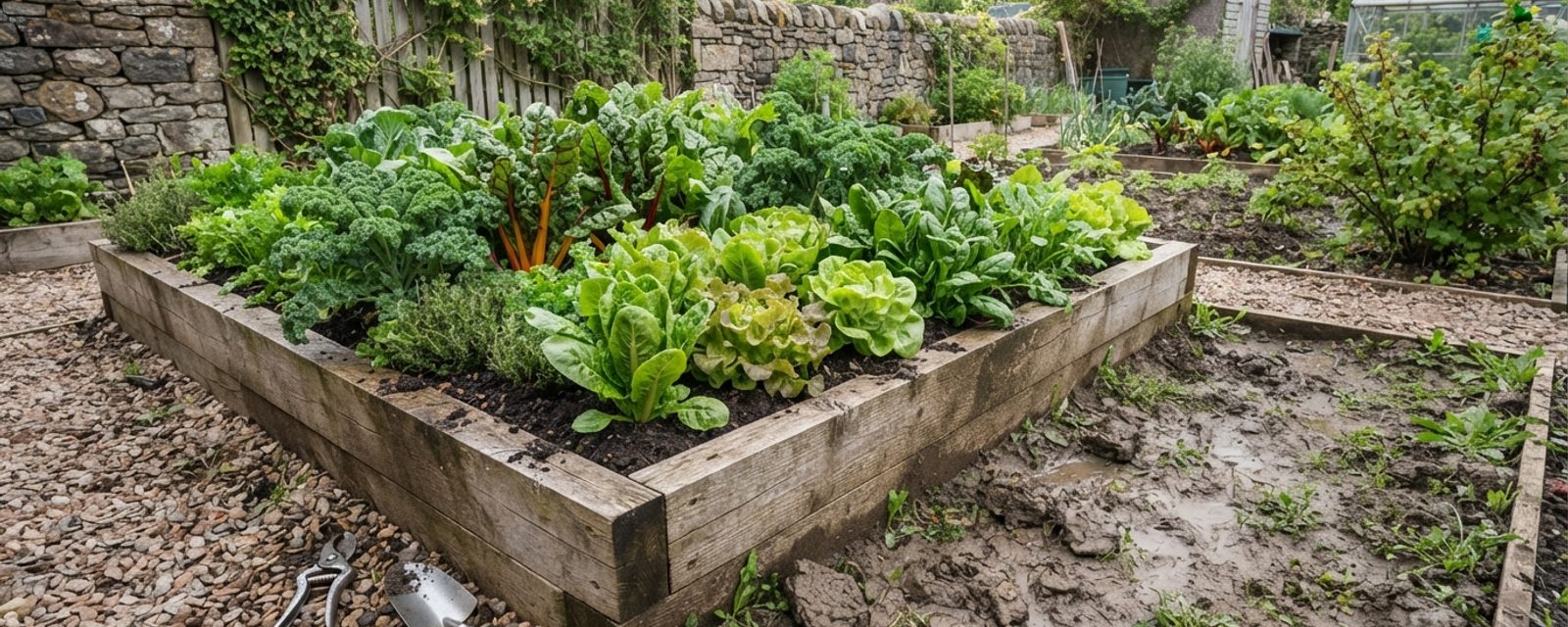
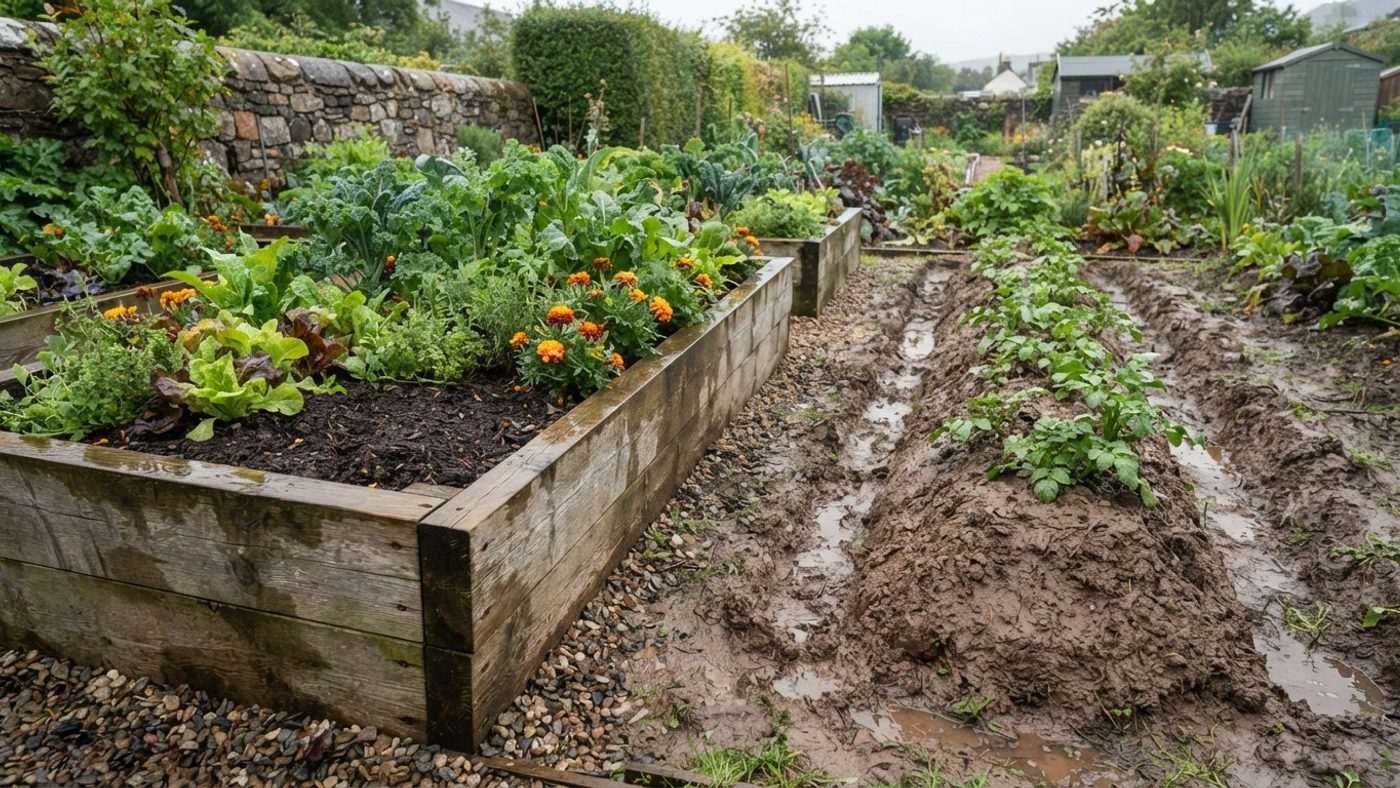
On genuinely heavy clay or gley ground, especially in the wetter west and at altitude, drainage decides whether anything else you do actually works. Raised beds are the single most effective fix available to an ordinary garden: building the growing surface 20–30cm above the surrounding ground, even without any underlying drain, gets roots up out of the saturated zone and gives rain somewhere to run off rather than pool. It also keeps feet and barrow wheels off the growing soil itself, which matters more on clay than on any other soil type, since compaction from trampling is exactly the damage described above.
Where a full raised bed isn't practical, mounding rows or beds by even 10–15cm has much of the same effect, and it's the traditional approach on wet clay in exposed regions: digging the ground into narrow ridges rather than a flat bed, so each ridge sheds water to the furrows on either side and gets more exposure to frost and wind for natural breakdown over winter. Both approaches solve the same problem from the same direction, get water off the root zone before it has time to pool, rather than trying to make flat, undrained clay behave like it isn't clay.
A true land drain, perforated pipe run to a soakaway or ditch, is worth considering only where a bed is genuinely waterlogged for months at a time, not just slow to dry after rain; it's a bigger job than most home gardens need, and raised beds or mounding solve the everyday version of the problem without digging in drainage pipework.
Drainage matters at planting time too, not just at bed level. A planting hole dug into clay with a spade often ends up with smooth, smeared sides, an auger or a slick spade blade can glaze clay almost like the inside of a plant pot, and that glazed surface stops both water and new roots from moving through it. The hole becomes a sump that fills with water and drowns whatever's just been planted in it. Before planting, fork or prick the sides and base of the hole to break that smeared surface up; it takes a minute and it's the difference between a plant establishing and one that looks permanently wilted despite sitting in wet soil, since waterlogged roots show the same drought-like stress symptoms as a plant that's too dry.
Organic matter is still the core fix
Drainage buys you a workable bed; organic matter is what actually rebuilds clay's structure over time. Dig in plenty of bulky material, well-rotted manure or, ideally, composted bark, with garden compost, leafmould and mushroom compost all useful too, and it physically wedges particles apart, creating the air gaps and crumb structure that clay doesn't form on its own. Digging in a 5–10cm layer, worked into the top 30–40cm where most roots grow, is a reasonable one-off application on a new bed; on established beds, an annual mulchA layer of material spread over the soil around plants to suppress weeds, retain moisture, and improve soil structure as it breaks down. Full definition → of the same material does most of the same job without repeated digging.
The same organic matter that helps clay drain in a wet spell also helps any soil hold onto moisture for longer in a dry one, worth knowing if a bed swings between waterlogged and parched depending on the season; see watering your garden in a heatwave for the other side of that.
Homemade garden compost is a genuinely useful source for this, not just a way to use up kitchen waste: a well-managed heap, built from roughly equal parts green and brown material and turned every few months, takes anywhere from four months to over a year to mature into the crumbly, dark material worth digging into clay. That timeline matters for planning, start a heap now for a bed you want to improve for next autumn or the one after, rather than expecting a spring-built heap to be ready in the same season.
One caution on a clay bed specifically: a thick surface mulch sitting on ground that's already slow to dry gives slugs somewhere damp and sheltered to sit through the day, and Scotland's wetter, cooler summers keep slug pressure high for longer than further south. It's not a reason to skip mulching, the structural benefit is worth it, but keep mulch pulled back a few centimetres from seedling stems rather than banked right up against them.
When to work it
Clay has a genuinely short workable season, and getting the timing wrong undoes the effort. Autumn and early winter, while the soil is still relatively dry from summer, is the best window for digging in organic matter: winter frost and rain then break down the dug clods naturally over the following months, doing structural work no amount of raking can replicate. Leave it until after the winter rains set in and clay can stay too wet to touch until well into spring; leave it too late in spring and it can bake hard again before you've got anything planted. On lighter, free-drainingSoil that lets water pass through quickly rather than pooling, so roots aren't sitting in wet ground after rain. Full definition → ground this window is forgiving. On genuinely heavy clay or peaty gley further west or at altitude, it can close to a matter of weeks either side of the last hard frost, see Scottish frost dates by region for how that window shifts across the country, since a plot can be past its last frost date and still too wet or heavy to dig without damaging the structure.
Rainfall is the other half of that timing question, and it varies sharply across Scotland:
| Area | Typical annual rainfall |
|---|---|
| Coastal East Lothian, Fife, Moray Firth | Under 700mm |
| Upper Clyde valley, Ayrshire and Dumfries and Galloway coasts | Under 1,000mm |
| Southern Grampians | Over 1,500mm |
| Higher ground of the west Highlands | Over 3,500mm |
A clay or gley bed in the drier east has a genuinely longer workable window most years than the same soil in the west or at altitude, where the ground can still be close to saturated well into what should be spring digging season. If you're gardening on clay in the higher-rainfall west, raised beds and mounding earn their keep even more than the general advice above suggests, they're the difference between a bed you can plant on schedule and one still too wet to touch in April.
What not to do
Don't add sand to clay expecting it to lighten the soil
This is one of the most persistent pieces of garden folklore, and it's wrong for a specific, measurable reason: to meaningfully dilute the clay fraction of a heavy soil, one that's roughly 40% clay particles, needs around 250kg of grit or sand per square metre, a volume that's rarely practical to source, barrow, and dig in in a domestic garden. Add less than that and you haven't diluted the clay at all; you've mixed clay, water and sand into something closer to concrete, since a small amount of coarse material added to a fine clay matrix fills the gaps between fine particles rather than opening new ones. If drainage is the goal, raised beds and organic matter get there without the risk; if you do want to add grit, it belongs in a container mix or a small, isolated planting hole for a specific plant, not worked into a whole clay bed.
Don't dig, fork, or walk on clay while it's wet
Covered above, but worth repeating as the single most common way gardeners make their own clay worse: every pass with boots or a spade on saturated clay collapses the crumb structure that summer cracking and winter frost spent months building. If a bed's still sticking to your boot, leave it, lay a plank to spread your weight if you must cross it, and come back when it's dried out enough to crumble rather than smear.
Don't expect gypsum to be a universal fix
Gypsum, calcium sulphate, is the active ingredient in most commercial "clay improvers," and it works by encouraging fine clay particles to flocculate, clump into larger crumbs, which can genuinely improve structure on some clay soils. But not all clay responds to it in the same way, and it isn't a substitute for organic matter or drainage; treat it as a possible extra step on a bed that's already had proper drainage and organic matter, tested on a small area first, rather than a first move.
Gypsum and Clay Soil: What It Actually Fixes → goes into that flocculation mechanism in more depth, including why most ordinary Scottish garden clay isn't the sodium-heavy soil type it actually reverses.
Common questions
Is my soil clay, or just compacted?
Take a handful of moist (not wet) soil and roll it between your palms. Clay forms a smooth, bendable sausage or ribbon that holds its shape; compacted soil of another type crumbles or breaks apart instead. Genuine clay also stays sticky when wet and cracks into hard plates when it dries out, which compacted sandy or loamy soil doesn’t do to the same degree.
How long does it take to improve a clay bed?
Expect a genuine improvement over two to three years of regular organic matter additions, not one season. A single autumn dig-in of manure or compost makes an immediate difference to workability, but rebuilding the crumb structure that lets clay drain and root through properly is a cumulative effect of repeated organic matter, correct-season cultivation and, ideally, not compacting it back down in between.
Can I improve clay soil without digging?
Yes, a no-digA growing method that avoids turning the soil over, building fertility instead by adding organic matter on the surface. Full definition → approach, where organic matter is spread on the surface as a mulch and left for worms and soil life to work down, suits clay particularly well, since it avoids the compaction risk of digging altogether. It's slower to see results than digging material in, and works best on a bed that already has reasonable drainage (raised or mounded), since a flat, waterlogged clay bed left undug can still sit wet regardless of what's mulched on top.
Should I add sand to break up clay soil?
No, not on its own and not in small amounts. Improving a clay soil's drainage by diluting the clay fraction takes roughly 250kg of grit or sand per square metre, far more than most gardeners dig in, and a smaller amount usually makes the soil denser and more concrete-like rather than lighter. Organic matter and raised beds achieve the same drainage goal without that risk.
Is clay soil actually bad for growing vegetables?
No, once it’s workable, clay holds nutrients and moisture better than sandy or light soil, which often means less feeding and watering once beds are established. The real cost is upfront: getting drainage and structure right before planting, and respecting the short workable window each year rather than fighting the soil when it’s too wet or too hard.
Sources
6 sources, recorded with what each was used for
- RHS: Clay soils: Organic matter types, autumn digging timing, raised beds/no-dig, gypsum and lime, wet-clay damage warning, the 250kg/sq m grit-dilution figure behind the sand myth
- RHS: Waterlogging and flooding solutions: Glazed/smeared planting-hole "sump" effect, breaking up hole sides before planting, waterlogged roots showing drought-like stress symptoms
- Soil Association: How to make your own compost: Green/brown ratio, four-months-to-over-a-year maturation timeline, turning frequency
- gov.scot: The Scottish Soil Framework: Podzol/peat/gley shares of Scotland's land area and their concentration in the Highlands and Southern Uplands
- Met Office: Eastern Scotland climate: Eastern Scotland rainfall figures
- Met Office: Western Scotland climate: Western Scotland rainfall figures