
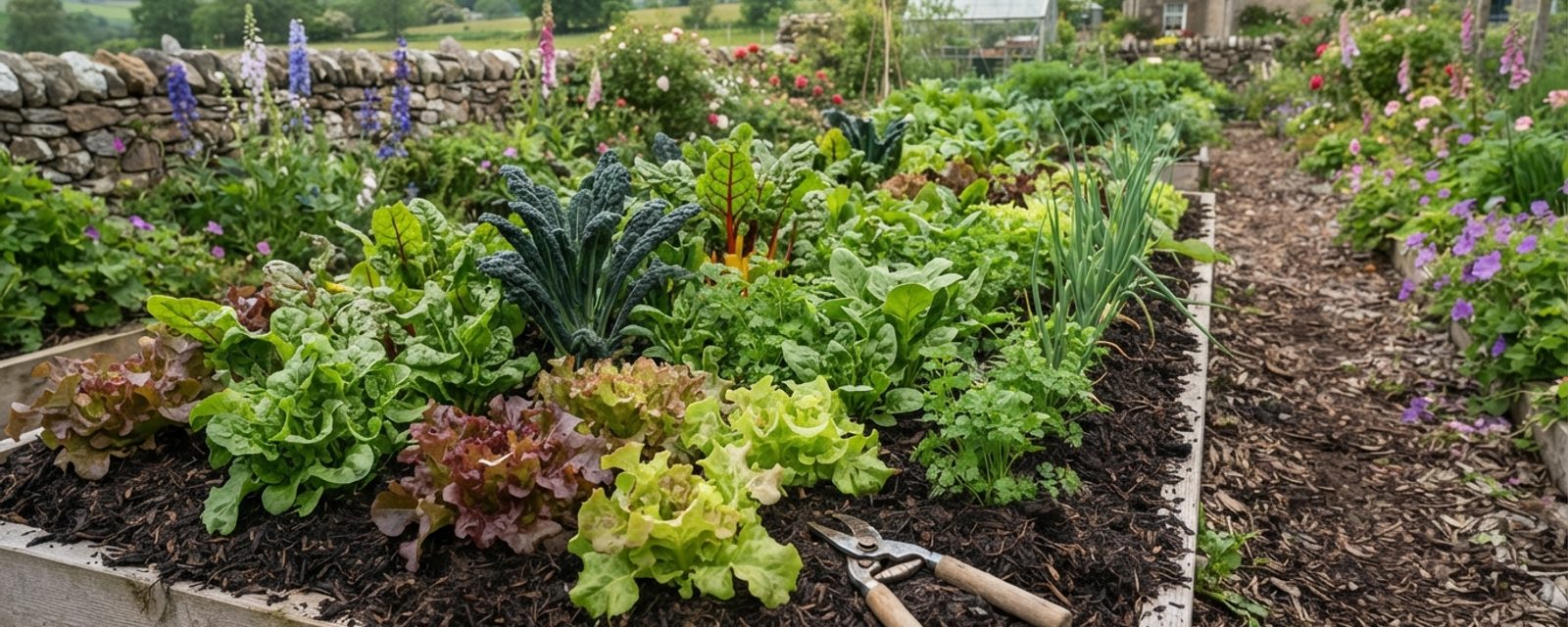
Below the surface of an undisturbed clay bed, something is working that a spade interrupts every time it goes in. Worms tunnel down and back up, leaving permanent vertical channels that water and air travel through. Fine fungal threads spread out from plant roots underground, a network called mycorrhizae, trading water and nutrients they gather from the soil for sugars the plant makes above ground. Dig that bed over and every one of those channels and threads gets severed and has to start again from nothing. On clay specifically, there's a second cost on top: turning or even walking on clay while it's wet collapses "crumb structure," the small, stable clumps that let water and roots move through the soil instead of it behaving as one solid slab, and that collapse doesn't heal itself over a season the way a bruise does; it has to be rebuilt from scratch. No-digA growing method that avoids turning the soil over, building fertility instead by adding organic matter on the surface. Full definition → gardening is built around a simple decision to stop causing that damage in the first place: instead of digging organic matter into the ground, it goes on top, as a mulchA layer of material spread over the soil around plants to suppress weeds, retain moisture, and improve soil structure as it breaks down. Full definition →, and is left for worms and soil organisms to carry down at their own pace. Clay punishes disturbance more than any soil type most gardeners commonly work with, so that decision matters more on clay than it does anywhere else.
Improving clay by digging organic matter in, the traditional route, works, and it's covered in full in our guide to improving clay soil, including Scotland's regional rainfall differences and why drainage has to come first on genuinely waterlogged ground. This piece goes deep on the alternative: what no-dig actually changes at the soil level, why it suits clay's specific weakness, how to start a bed on ground that's never had this treatment before, what mulch to use given Scotland's climate, and how long it genuinely takes before the difference is real rather than promised.
What no-dig actually is
No-dig gardening means exactly what it says: the soil itself is never turned, forked over or broken up. Organic matter, garden compost, well-rotted manure, leafmould, goes on the surface as a mulch instead of being worked in, and soil-dwelling organisms, principally worms, do the incorporation. Worms pull material down into their burrows, break it down as they feed, and redistribute the nutrients through their casts; what starts as a layer sitting on top of the bed ends up mixed through the topsoil within a season or two, without a fork ever touching the ground.
The soil that results is different from dug soil in a way you can feel with a trowel. Undisturbed ground develops a firm structure riddled with fine, stable pores, the old root channels, worm burrows and gaps left by decayed roots, that let water and air move through while still holding the soil particles together. Digging destroys that structure and replaces it with a looser mix of large, unstable clods and air gaps that collapse again as soon as the soil resettles, which is one reason a freshly dug bed can crust over and compact again within weeks of the work being done.
That undisturbed structure is also behind the clearest practical result for no-dig so far: gardener Charles Dowding ran side-by-side comparison beds at his own market garden from 2013 to 2020, growing the same crops in each and adding the same amount of organic matter, but digging one bed and leaving the other alone. The no-dig beds produced more over that period, 855kg against 755kg from the dug beds, and needed less weeding, since digging soil over is what brings buried weed seed to the surface to germinateA seed sprouting: breaking dormancy and putting out its first root and shoot, given the right warmth and moisture. Full definition →; leaving the soil undisturbed doesn't. It's worth being clear about what that figure is and isn't: it's one gardener's own long-run comparison at his own site in England, not an independent multi-site scientific trial, and Scotland's shorter, cooler growing season means a like-for-like Scottish yield comparison hasn't been published. Treat it as good evidence the method genuinely works, not as a number that would transfer exactly to a Scottish plot.
Why clay specifically rewards this approach
Clay particles are small, flat and packed together far more tightly than the coarser particles in sand or loam, so there's very little air space between them even when the soil is in good condition. Clay and other heavy soils, worked or walked on when wet, lose their structure and become puddled and compacted, and remedying that damage is slow and laborious, so it's worth avoiding altogether rather than fixing after the fact. No-dig avoids it by design, there's never a point in the process where a fork or a boot needs to press down on wet clay to work material in.
Raised beds reinforce the same logic without changing the method: keeping the growing surface slightly proud of the surrounding ground, and confining foot traffic to permanent paths either side, means the bed's own soil is never trodden on, wet or dry, by anyone tending it.
Digging clay isn't purely a mistake, though, and it's worth naming the one thing it does that no-dig gives up: clods dug up in autumn are left exposed to winter frost, and repeated freezing and thawing physically shatters heavy clay into smaller pieces, a genuine structural benefit that Scotland's colder inland winters and harder, more frequent frosts than most of England deliver more of than a milder climate would. No-dig gives that particular mechanism up in exchange for never causing the compaction damage that digging risks in the first place. Which trade-off suits a given bed better is partly a question of how bad the compaction risk already is, and partly how much digging you actually want to do.
None of this replaces the drainage argument in the companion clay-soil guide: a genuinely waterlogged bed still needs water moved off it before anything else helps, no-dig included, and the method works best once a bed already drains reasonably well rather than as a fix for standing water on its own.
Starting a no-dig bed on existing heavy clay
The steps below are the same whether the ground underneath is clay or anything else; getting them right just matters more on clay, because a mistake made while setting up the bed, forking it over first, for instance, is harder to undo on this soil than any other.
Clear, don't cultivate
Remove existing perennial weeds by hand or by cutting them back hard, rather than digging them out; the point of the whole method is to avoid disturbing the ground at this stage as much as any other. Mow or strim tall growth down to ground level if there's grass or rough weed cover, but leave the roots and soil beneath untouched. Couch grass, ground elder and bindweed, all common on established Scottish plots, are the ones most likely to need real persistence rather than a single clearing pass; see the common questions below for how they behave once cardboard goes down.
Lay cardboard as a light barrier
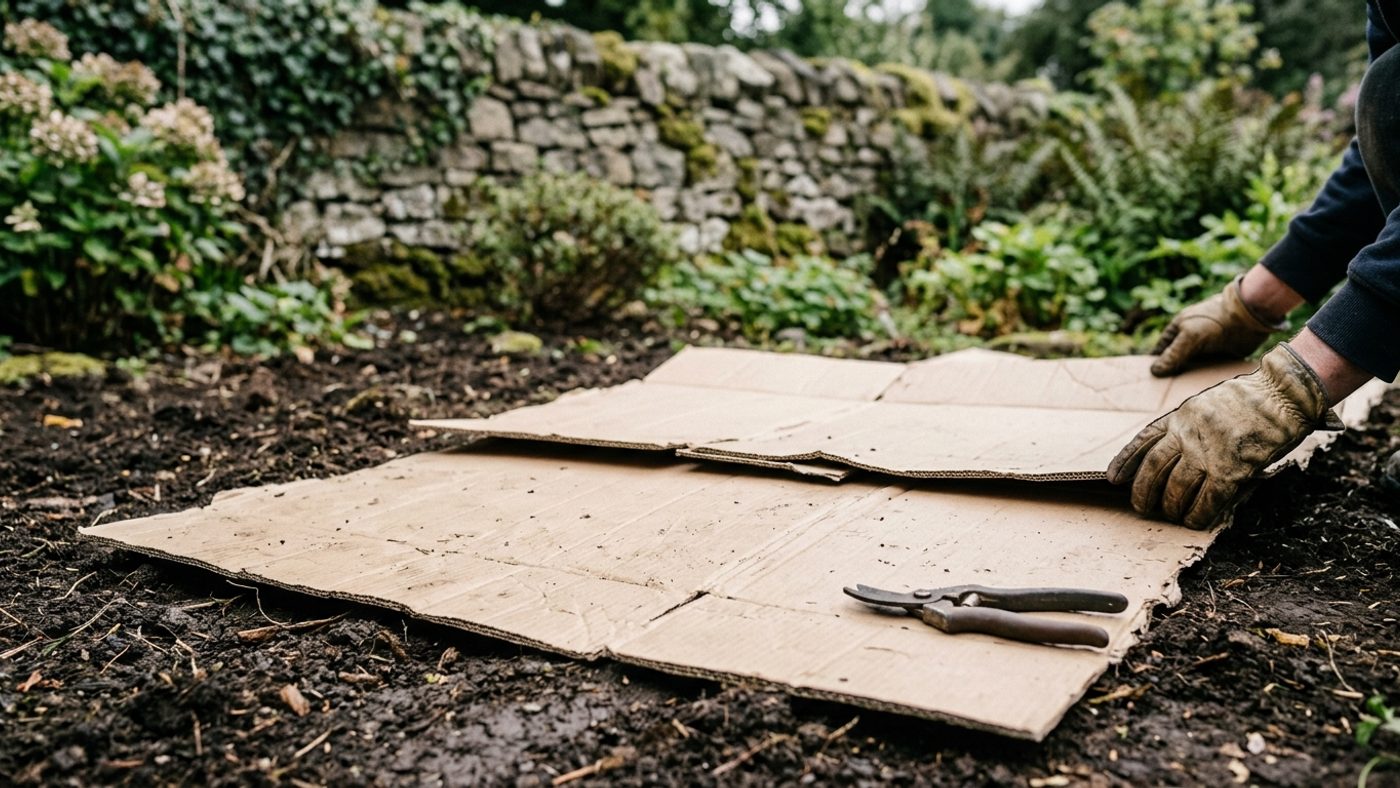
Cover the cleared area with a layer of plain cardboard, overlapping the edges generously and removing tape, staples and printed plastic labels first. This blocks light to whatever's left underneath, weakening and eventually killing it without a spade ever going near the clay. A single layer is usually enough on a well-mown area; a doubled layer gives more reliable weed suppression on rougher ground.
Mulch heavily on top
Cover the cardboard with a generous layer of organic matter: well-rotted manure, garden compost, leafmould, or a mix. Guidance varies on the exact figure for a first layer, 10–15cm to 15–20cm, worth treating as a range rather than chasing an exact number: thicker rather than thinner where you have the material to spare, since a deeper layer both suppresses weeds more reliably and gives worms more to work with before it needs topping up. Firm it down once it's spread rather than leaving it loose.
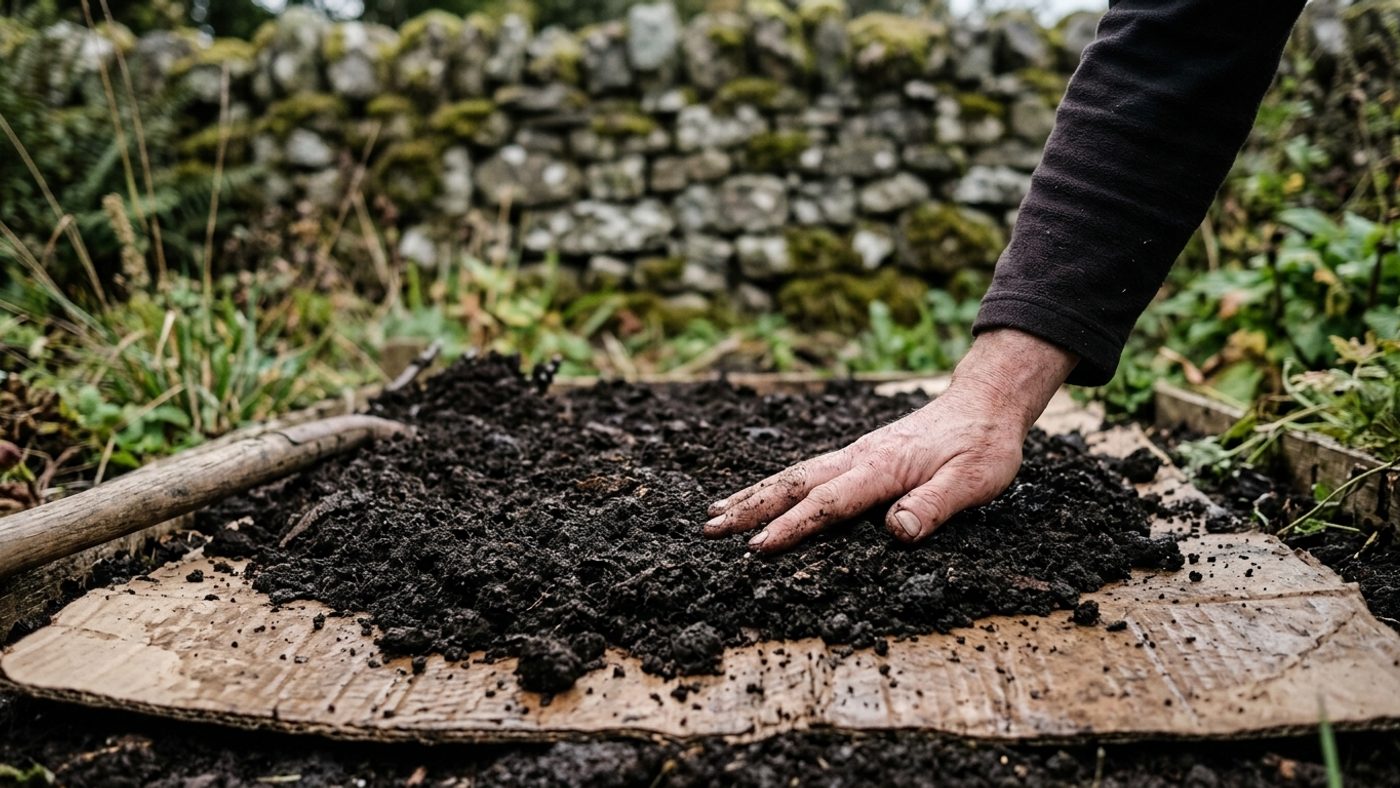
For quantity, a bed 1.2m wide by 3m long at 15cm deep needs a little over half a cubic metre of material, roughly what a builder's bag or a small trailer load holds. Council green-waste compost, delivered or collected in bulk, and well-rotted manure from a local stables are usually the cheapest ways to find that volume; home-made garden compost rarely covers a whole new bed's opening layer on its own, though it's ideal for the smaller annual top-ups once the bed's established.
Time it for late winter
Late February or early March suits making a new no-dig bed, provided the ground underneath isn't frozen or waterlogged, so the bed has a full growing season ahead of it before the first proper harvest. On genuinely heavy Scottish clay or peaty gley, especially further west or at altitude, that window can sit closer to the back end of it, or slip later, since the ground can still be wet from winter into what should be spring elsewhere; see Scottish frost dates by region for how the workable season shifts across the country. This timing matters doubly on clay specifically, since late winter is also when clay is typically at its driest and least prone to compacting if any part of the process, moving material about, does involve standing on the bed itself.
Plant and sow directly into the mulch
There's no need to wait for the mulch to fully break down before using the bed. Seeds and young plants go straight into the compost layer on top; roots reach down through it and into the clay below as both the plant grows and the mulch itself is drawn down by worm activity. Leafy and shallow-rooted crops, salads, brassicasThe cabbage family: cabbage, kale, broccoli, cauliflower, Brussels sprouts, kohlrabi, swede, turnip and more, sharing the same pests, diseases and rotation rules. Full definition →, courgettes, do best in a bed's first year, since their roots mostly stay within the new mulch layer itself. Deep-rooting crops like carrots and parsnips are the ones to hold back until the clay underneath has genuinely started to improve, usually not the first season, since a taprootA single, thick, dominant root growing straight down from a plant, storing energy and anchoring it, as opposed to a spreading mass of fine roots. Full definition → pushing down into undug, still-heavy clay below the mulch will still hit the same resistance it always did; a raised or slightly mounded bed, built with this mulch layer from the outset, helps here too, giving roots more depth of loosened material before they reach unimproved ground.
Maintain with an annual top-up
Once established, an annual mulch of around 5cm, added in late winter, replaces the initial thick layer as the ongoing routine. A light dusting of garden lime can go on the surface at the same time if a soil test calls for it; there's no need to dig it in specially, it works down with the same worm activity that incorporates everything else. This is the point where no-dig stops being a one-off conversion project and becomes the standing way the bed is managed every year afterwards.
| Stage | Mulch depth | What to expect |
|---|---|---|
| New bed, first application | 10–20cm | Weed suppression and a plantable surface within days |
| Established bed, annual top-up | ~5cm | Maintains structure gained in prior years |
| First few weeks | — | Worms begin carrying material into the top few cm of clay |
| 2–3 years of annual mulching | — | Genuine crumb-structure change through the working depth |
Mulch choice in Scotland's wetter climate: what actually changes
Scotland's west and uplands sit among the wettest ground in the UK; the companion clay-soil guide has the full regional breakdown, but the western Highlands alone can see over 3,500mm of rain a year against under 700mm on the drier east coast. The tempting assumption is that this higher rainfall must change which mulch material is the right choice, and that a damp mulch must mean a worse slug problem than the same bed would have further south. Checked against what's actually published, one of those turns out to hold up and the other doesn't, and it's worth keeping the two separate rather than treating them as the same finding.
What genuinely differs: how the material behaves once it's down
Different mulch materials handle moisture differently, and that difference is real and sourced, even though nothing published frames it as Scotland-specific. Woody mulches, bark and wood chip, decompose slowly, which is exactly why they're sold as long-lasting, and they work as a moisture buffer: absorbing rain and releasing it back gradually rather than shedding it or drying out quickly. On free-drainingSoil that lets water pass through quickly rather than pooling, so roots aren't sitting in wet ground after rain. Full definition → soil that's a genuine advantage in a dry spell. On clay, ground that already drains slowly and already sits wet for longer than other soil types, the same buffering effect works against the bed rather than for it, keeping the surface damp for longer after rain than a faster-drying material would. Garden compost and well-rotted manure, already broken down and crumbly, don't hold that same distinct wet layer at the surface the way a chunkier woody mulch does.
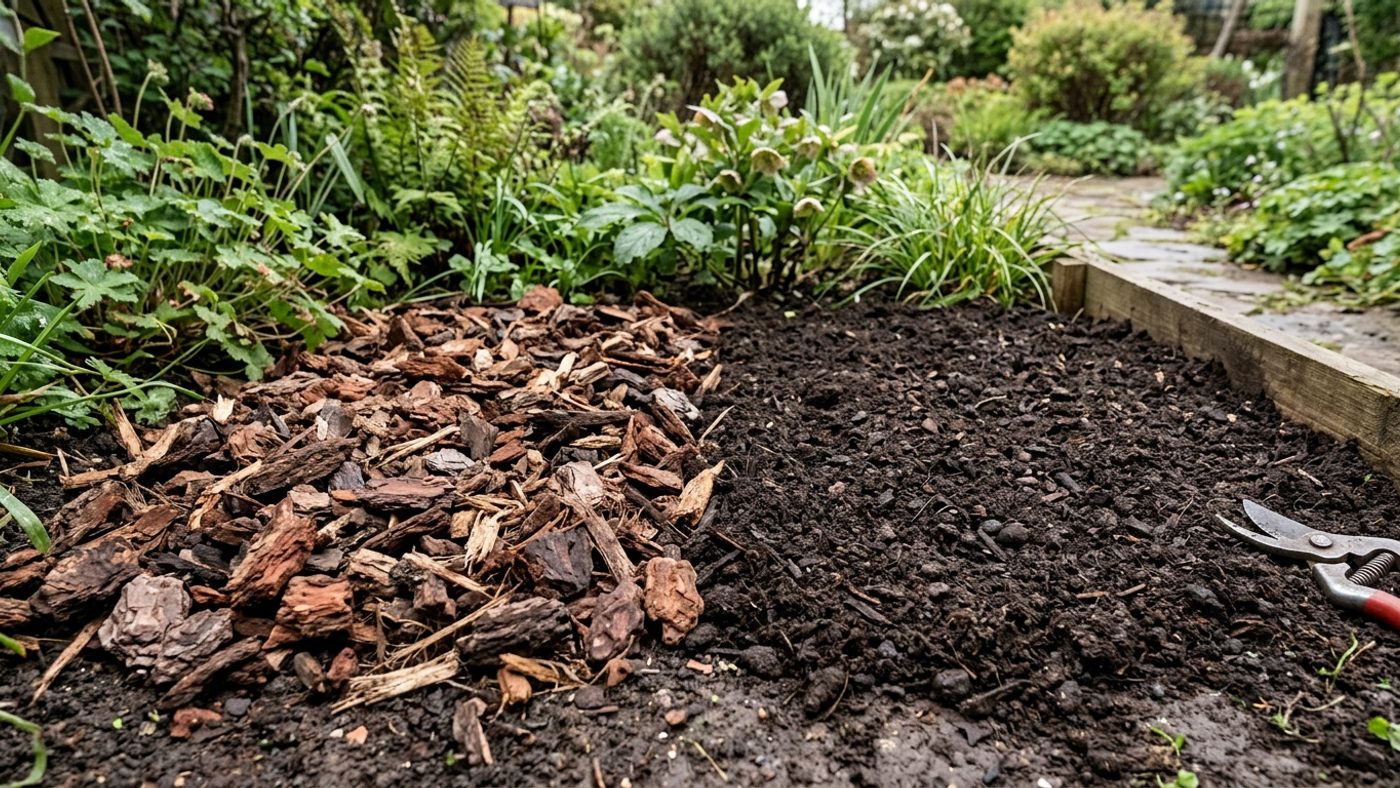
That gives a genuine, mechanistic reason to favour garden compost or well-rotted manure over bark or wood chip on clay ground specifically in a wetter climate. No source studied this in Scotland directly; the reasoning comes from combining how the materials behave, sourced from general UK mulching guidance, with how clay drains and how much rain a Scottish bed actually gets.
What's genuinely unproven: mulch causing more slug damage here specifically
The stronger claim, that a mulched Scottish bed suffers worse slug damage than the same bed further south, doesn't hold up as a direct, sourced finding. No study compares slug damage on mulched beds in Scotland against the same setup in a drier part of the UK. That specific comparison simply hasn't been done, which is different from having been done and shown to favour Scotland one way or the other.
What is sourced is narrower and, in one respect, surprising. Slugs are well suited to damp, mild conditions generally, wherever in the UK that occurs, and a thick, damp mulch does offer the kind of shelter that favours them. But the barrier claim gardeners repeat most often, that a layer of bark mulch, copper tape, eggshells, sharp grit or wool pellets deters slugs, was tested directly in a realistic garden setting, not a lab, and none of those materials reduced slug damage at all. That cuts against the mulch-and-slugs story from an unexpected angle: bark mulch doesn't obviously repel slugs as a barrier, but the same trial doesn't show that mulch of any kind actively draws in more of them either. Putting the two sourced facts together, damp conditions favour slugs everywhere and Scotland's climate hands a bed more days of those conditions across the year than a drier region gets, a chunkier, slower-draining mulch on clay staying damp for longer is a real, if modest, reason to lean toward well-rotted compost over bark on a Scottish clay bed specifically. That reasoning is not the same thing as a proven Scotland-specific slug-damage penalty from mulching in general, and the two are worth keeping apart rather than treating one as evidence for the other.
The practical takeaway
On heavy clay in Scotland, well-rotted garden compost or manure is the better default mulch over bark or wood chip, for the drainage and slug-shelter reasoning above, not because of a Scotland-specific trial. Straw sits in between: genuinely useful for strawberries and for paths between beds, but as fresh, loose material it holds damp air within itself in a way a broken-down compost mulch doesn't, which makes it a better choice for a path than for the growing surface of a clay bed itself. Seaweed is worth a specific mention for anyone gardening near the Scottish coast: it's a genuinely useful mulch in its own right, containing nitrogen, potassium, phosphate and magnesium, and unlike straw or fresh woody material it doesn't sit as a loose, air-filled layer, so it doesn't add the same shelter concern. None of this is a reason to skip mulching, the structural benefit is worth having regardless of material. Keep any mulch pulled back a few centimetres from seedling stems whatever material you use, since a damp mulch banked directly against a stem is a shelter risk in any climate.
A realistic timeline
No-dig doesn't transform a bed overnight, and clay is the soil type where the gap between "looks better" and "the structure has actually changed" is widest.
In the first season, the visible changes are about the surface and the crop, not the clay underneath: weed pressure drops noticeably, since digging is what would otherwise have brought a fresh batch of buried seed up to germinate, and the mulch layer itself keeps light off anything trying to grow through it. Leafy and shallow-rooted plants root into the compost layer on top and can crop reasonably well in that first year, even though the clay underneath hasn't changed yet at all.
Structural change to the clay itself is slower and works from the top down. Worms carry organic matter into the top few centimetres of soil within weeks of a mulch going on, and that thin zone visibly improves, easier to push a finger into, less prone to crusting, within the first year. But the deeper change that actually matters for root growth and drainage, the crumb structure clay needs to stop behaving like a solid slab, builds cumulatively over repeated annual mulching rather than from one application. Two to three years of consistent annual mulching is a realistic point at which a no-dig clay bed's structure is genuinely different from where it started, the same rough timescale improving clay by digging organic matter in takes, covered in the companion guide. The two methods reach that point by different routes: digging in makes an immediate difference to workability the same season, at the cost of the disturbance no-dig avoids, while no-dig's structural gain builds more slowly but without that setback. Neither is faster overall; each trades an early, disturbed improvement for a slower, undisturbed one.
Common questions
Can I start a no-dig bed on clay that's currently waterlogged?
Not as the first step. No-dig improves structure over time, but it doesn’t move standing water off a bed today. If a bed sits wet for weeks at a time rather than just being slow to dry after rain, deal with drainage first, raised sides or mounding, then start the no-dig mulch layer once the bed drains at a normal rate.
Do I need to dig out couch grass, ground elder or bindweed roots before laying cardboard?
Not by digging, which reintroduces the disturbance the method is built to avoid, but these three are the perennial weeds most likely to test your patience under cardboard rather than dying back cleanly. Annual weeds are usually gone within two to three months under a mulch; couch grass and ground elder generally take a full growing season to exhaust their underground roots, and bindweed can take up to a year. Expect regrowth to break through here and there in the first season regardless and pull it by hand rather than assuming the cardboard alone finishes the job in one pass.
Will a thick mulch attract slugs onto my clay bed?
Damp, sheltered conditions favour slugs generally, and a thick mulch on ground that's already slow to dry does create more of that shelter than bare soil would. But no study has actually shown mulched beds in Scotland suffer worse slug damage than the same setup elsewhere in the UK, and bark mulch specifically doesn't repel slugs as a barrier either, tested directly and found to make no difference. Favour well-rotted compost over bark or straw on clay for the drainage reasons above, and keep mulch pulled back from seedling stems, rather than avoiding mulch altogether.
How is this different from just piling compost on top without the cardboard?
Cardboard's job is weed suppression on ground that's never been a cultivated bed before, blocking light to existing grass or weed growth so it dies back rather than pushing straight up through the new mulch. On a bed that's already free of perennial weeds, an annual mulch on its own, without a fresh cardboard layer, is the normal ongoing routine; cardboard is mainly a one-off step for converting new ground.
Can I use this method for vegetables, or is it mainly for ornamental beds?
It works for both, and vegetable growers were among the first to popularise the method in Britain, so if anything it’s more strongly associated with productive beds than ornamental ones. Leafy crops and brassicas suit a first-year clay bed well; hold deep-rooting crops like carrots and parsnips back until the clay underneath has had a season or two to loosen.
Sources
11 sources, recorded with what each was used for
- RHS: No-dig gardening: Mechanism, starting steps (cardboard, mulch depth), late Feb/early March timing, bed width
- RHS: The benefits of no-dig gardening: Dowding's 2013-2020 trial figures and what they do/don't establish, weed-seed mechanism, fungal-network preservation
- RHS: Clay soils: Direct RHS recommendation of no-dig/raised beds for clay, wet-clay compaction mechanism
- RHS: How to mulch with organic matter: Mulch materials, depth, clay drainage improvement
- RHS: Woody Waste, Using as Mulch: Wood chip/bark decomposition rate and moisture-buffering behaviour
- RHS: Slugs and snails: Slug-favouring conditions, RHS barrier study
- RHS: Mulches and mulching: Seaweed as a mulch material and its nutrient content
- Garden Organic: No-dig Gardening: Mechanism, starting steps, weed die-back timeline
- Soil Association: How to make your own compost: Compost maturation timeline
- Met Office: Western Scotland climate: Rainfall figure
- Met Office: Eastern Scotland climate: Rainfall figure