
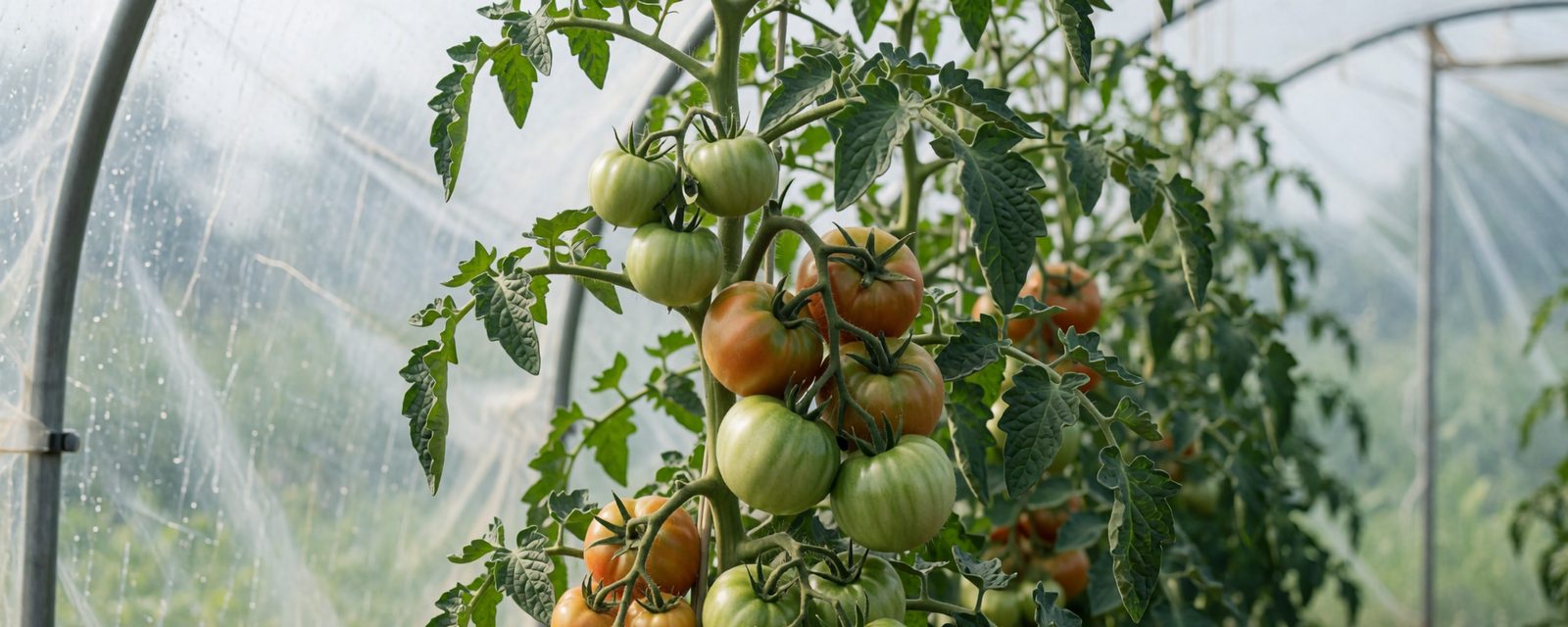
You're standing over the plant with a leaf between your fingers, and it doesn't look right. Maybe it's gone yellow in patches, or curled at the edges, or grown a dusting of something pale and powdery. Before you reach for a fungicide or a feed, the leaf itself usually tells you which one you actually need, tomato leaves show a genuinely distinct signature for each of the common problems, and mixing them up means treating the wrong thing while the real cause carries on underneath.
Match what you're looking at against the chart below, then read the linked section for the mechanism and what to do about it. For blossom end rot and the late blight disease, see the dedicated tomato blight page; both are mentioned here only where they help tell a leaf symptom apart from something else. For the full growing calendar, see the tomato growing guide.
Quick diagnostic chart
| What you see | What it usually means | Do this first |
|---|---|---|
| Yellowing between the leaf veins, veins staying green, on older/lower leaves first | Magnesium deficiency | Spray diluted Epsom salts on the leaves for a fast fix; work magnesium sulphate into the soil for the long term |
| Leaves curling with brown, crispy edges | Underwatering, or a hot day/cool night temperature swing | Check compost moisture and water evenly; expect this more under cover than outdoors in Scotland |
| Dark spots with concentric, target-like rings, usually on older leaves | Possibly early blight, but genuinely uncommon in UK gardens and easily confused with magnesium deficiency | Check for interveinal yellowing first; only suspect early blight if the spots are genuinely ring-patterned lesions |
| Whole leaf pale, washed-out yellow-green, veins included, not just older leaves | Nitrogen deficiency | Liquid feed for a quick fix; mulchA layer of material spread over the soil around plants to suppress weeds, retain moisture, and improve soil structure as it breaks down. Full definition → with garden compost or manure for the long term |
| White, dusty, powder-like coating on leaves and stems | Powdery mildew | See the full powdery mildew page — the short version: water more, not less |
| Leaves cupping or rolling upward along their length, not just curling at the edge | Heat stress (hot day, cold night) or overwatering | Even out watering and, under cover, ventilate on warm days rather than letting heat build up |
Yellowing between the veins: magnesium deficiency
The tell here is precise: the leaf veins themselves stay green while the tissue between them turns yellow, sometimes with a reddish-brown tint, and it shows up on the older, lower leaves first. Left long enough, those older leaves go on to develop brown dead patches and drop off early. Tomatoes are among the crops most commonly affected, alongside apples, grapes and raspberries.
The cause is a genuine shortage of magnesium reaching the leaf, which happens two ways: the soil itself is short of it, particularly on light, sandy soils that don't hold nutrients well, or there's plenty of magnesium present but a heavy dose of potassium-rich feed has out-competed it, since plants take up potassium in preference to magnesium when both are available. That second route matters for tomato growers specifically, because a potassium-heavy tomato feed is exactly what most people are applying through summer to push flowering and fruiting, the fix that's supposed to help the crop can trigger this deficiency as a side effect.
For a fast correction, spray a foliar dose of 20g Epsom salts (magnesium sulphate) per litre of water, applied to the leaves two to three times a fortnight, on a dull or overcast day rather than in bright sun, which avoids scorching the leaf. Finding a dull day to spray on is rarely the hard part of this in Scotland. For the longer-term fix, work magnesium sulphate into the soil at 30g per square metre, and go easier on high-potassium feeds once the deficiency clears rather than stopping tomato feed altogether.
Scotland's rainfall runs well above the driest parts of England: western Scotland gets over 2,000mm a year against eastern England's under 700mm. Light, sandy soil is where magnesium deficiency shows up hardest, because those soils don't hold nutrients against rain the way clay does. A light, free-drainingSoil that lets water pass through quickly rather than pooling, so roots aren't sitting in wet ground after rain. Full definition → Scottish plot in a wet spell carries a genuine, if unremarkable, extra risk of this specific deficiency for that reason, heavier clay soils don't carry the same exposure. The potassium-competition route matters here too, and arguably more, because of how most Scottish tomatoes are grown: in pots or growing bags of free-draining multi-purpose compost under cover, fed heavily with a potassium-rich tomato feed through summer to push fruiting, the exact combination that out-competes magnesium. For the feeding side of this once you've corrected it, see fertiliser types explained.
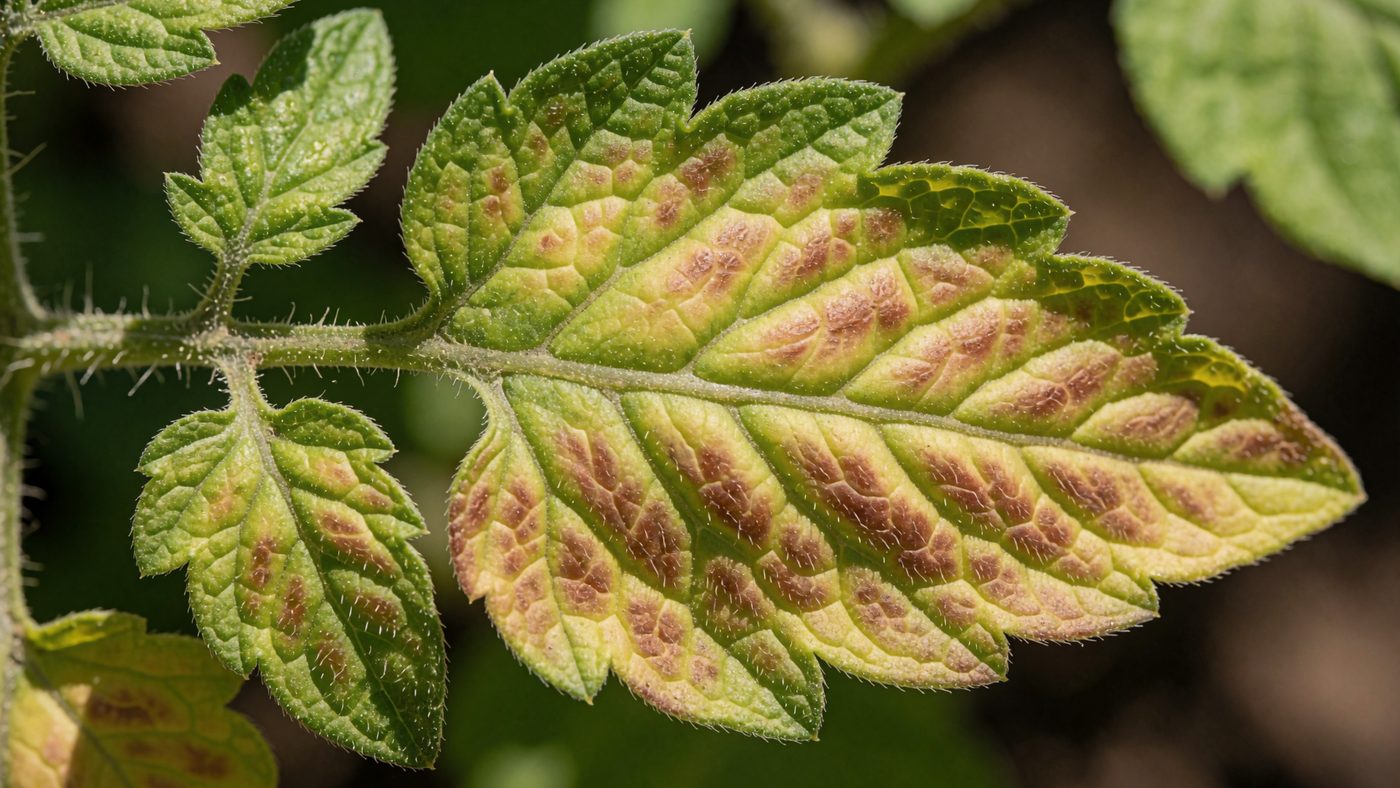
Curling leaves with crispy, brown edges: underwatering or heat stress
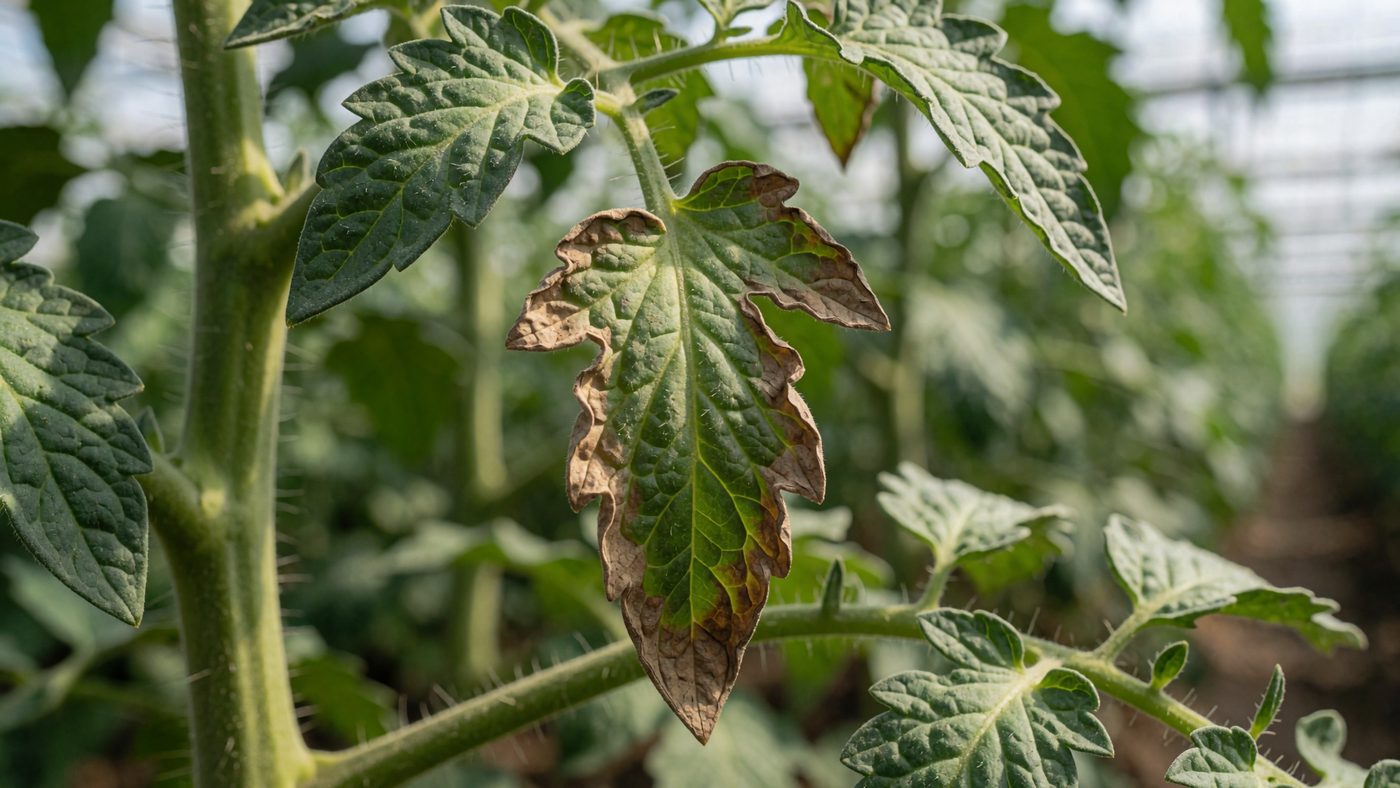
Leaf curl has two common causes that can look nearly identical: a plant genuinely short of water, and a plant reacting to a big day-to-night temperature swing (a warm day followed by a distinctly colder night), which is common early in the season before summer settles. Curling from an aphid attack is a third possibility, so check the underside of a curling leaf for aphids before assuming it's watering or temperature.
Where the two genuine causes differ in practice: underwatering curl tends to come with dry, brittle, browning leaf margins and a compost that's visibly dry to a finger pushed in an inch, while temperature-swing curl can look alarmingly severe without the plant actually being short of water at all, and it usually settles down once the nights warm up. Either way, the fix is the same: don't let the plant swing between bone-dry and flooded. If the compost has gone properly dry, bring the moisture level back up gradually rather than flooding it in one go, since a sudden flood after a dry spell is what causes fruit to split and crack, not the leaf curl itself.
There's a fourth possibility worth ruling out if watering and temperature both check out: potassium deficiency also browns and scorches leaf margins on older leaves first, and it's common on the same light, free-draining soils and heavily-fed pots covered elsewhere on this page. The fix is the same shape as for the other deficiencies here, a potassium-rich feed for a quick correction, mulching with garden compost for the longer term.
Most Scottish tomatoes are grown under cover rather than outdoors, since outdoor cropping is marginal north of the Central Belt and unreliable at altitude. That changes which half of this symptom a Scottish grower is more likely to meet: a polytunnel on a sunny day traps heat well above the outside air temperature, and the compost in a growing bag or container dries out fast in that heat, often needing water daily. So underwatering curl, specifically, is a real everyday risk for a typical under-cover Scottish tomato, arguably more of one than for a tomato grown outdoors in a milder English summer, precisely because of where the climate here pushes people to grow the crop rather than because Scotland is short of rain.
Dark, concentric ring spots: early blight, a genuinely rare diagnosis in a UK garden
The honest answer to a leaf showing this pattern is "probably not early blight."
Early blight is a real, distinct fungal disease, caused by Alternaria solani and a related species, A. alternata. It is not the same organism as the late blight already covered on this site's tomato blight page, that page is specifically about Phytophthora infestans, the same organism as potato blight, which spreads fast in warm wet weather and rots leaves, stems and fruit outright. Early blight is a different fungus with a slower-developing symptom: spots that start small and dark, then enlarge and typically develop concentric rings, giving each lesion a target-like appearance, usually starting on the older, lower leaves.
A third tomato leaf disease worth naming here, since it's genuinely common under cover in Scotland and doesn't match any of the six symptoms on the chart above: tomato leaf mould. It shows as yellow blotches on the upper leaf surface with a pale, greyish-brown mould growth on the underside directly below, a different pattern from blight's white growth or early blight's dark rings. A humid, poorly-ventilated greenhouse or polytunnel is exactly the setting it favours, so ample ventilation is the main defence, the same lever that helps against blight and powdery mildew. 'Shirley', already a reliable greenhouse cordonA fruit tree or bush trained as a single main stem with short fruiting side-spurs, usually grown at an angle against a wall, fence or wire. Full definition → variety, also carries resistance to it.
Early blight "is not a common problem in British gardens," and its appearance "can be confused with the symptoms caused by the much more common magnesium deficiency" — meaning a leaf showing yellow-brown patchiness is statistically far more likely to be magnesium deficiency than early blight, before Scotland's climate is even factored in.
Early blight is already uncommon across British gardens generally, and nothing points to Scotland's cooler, wetter climate making it more likely here than anywhere else in the UK, if anything, a disease already rare in milder English gardens has no obvious reason to turn up more often in a cooler Scottish one. The practical upshot: if you're seeing yellow-brown discolouration with a ring-like pattern, check the magnesium deficiency entry above first, and only treat for a fungal disease if you can genuinely see raised, spreading lesions rather than flat, interveinal yellowing.
Overall pale, washed-out yellow leaves: nitrogen deficiency
The distinguishing feature against magnesium deficiency above is coverage: nitrogen deficiency turns the whole leaf a spindly, pale yellow-green, sometimes with pink tints, rather than leaving the veins green while the tissue between them yellows. The whole-plant picture is "spindly, stunted plants with pale yellow leaves," with the older leaves affected first before the yellowing spreads to younger growth too, so on a badly-affected plant it eventually stops being a lower-leaves-only symptom, unlike magnesium deficiency, which stays concentrated on the older foliage.
Worth ruling out before settling on nitrogen: a genuine virus (tomato mosaic virus and several others are recorded on tomatoes) produces a mottled or mosaic pattern of light and dark green rather than an even, whole-leaf pale wash, alongside distorted leaves and stunted growth. If the yellowing is patchy and mottled rather than uniformly pale, that's the one to rule out first; there's no cure for a virus, only removing and destroying affected plants.
The cause of a genuine nitrogen deficiency is straightforward: nitrogen is highly water-soluble and washes out of soil with rain, and out of a pot or growing bag's potting compost even faster, it can deplete a container within a few months of use. For containers, a general-purpose liquid feed corrects it quickly. In the ground, a fortnightly liquid feed fixes the immediate problem, and mulching with garden compost (the rotted-down organic matter from a compost heap, not potting compost) or well-rotted manure gives a steadier, longer-term supply rather than a repeated quick fix.
Scotland's rainfall is genuinely higher than most of England's, the same west-versus-east gap as above (western Scotland over 2,000mm a year, eastern England under 700mm). Nitrogen is the nutrient washed out fastest by rain, so a wetter climate is a real, if unremarkable, reason nitrogen deficiency shows up sooner and needs topping up more often in a Scottish garden than a drier one. It doesn't apply evenly across all Scottish soils, though: heavy clay holds nutrients against rain far better than light, free-draining ground does, so the real risk factor is free-draining soil in a wet climate specifically, not rainfall on its own. See fertiliser types explained for choosing between a fast synthetic feed and a slower organic one.
White, powdery coating on leaves: powdery mildew
This one is the most visually unambiguous entry on the chart, a white, dusty coating across leaves, stems and sometimes flowers, sometimes with leaf distortion or stunted growth on a badly affected plant. Powdery mildews are a group of related fungi that attack a wide range of plants.
It's a genuinely counterintuitive disease: powdery mildew favours dry conditions rather than wet, so watering more rather than less is often the right response once it appears, and that has a real, sharp twist for a plant grown under cover in a Scottish polytunnel. The full mechanism and the under-cover angle are covered in depth on the powdery mildew page, read that page in full for what to actually do about it.
Leaves curling or cupping upward: heat stress or overwatering
This is a different shape of curl to the crispy-edged version above, the whole leaflet cups or rolls upward and inward along its length, rather than just the edges browning and curling in. It tends to start on the lower leaves, and the leaf itself often stays a normal green colour and size rather than looking damaged, which is part of what makes it alarming to see: a plant can look severely affected while this particular condition actually has little real effect on the crop.
The same trigger sits behind this as behind the crispy-edge curl above: a sharp swing between a warm day and a distinctly cooler night. Overwatering, or watering unevenly, is the other named cause. The two can look the same from the outside, so check the compost before assuming which one you've got, waterlogged, heavy, slow-draining compost points to overwatering, while everything else pointing to a warm-day/cold-night pattern (and a plant that's otherwise been watered sensibly) points to the temperature swing instead.
As with the crispy-edge version above, growing location matters more here than climate alone. Most Scottish tomatoes are grown under cover rather than outdoors, and a polytunnel or greenhouse can swing from a genuinely hot midday to a cold night once the sun goes down and heat escapes fast through thin plastic or glass, exactly the combination this condition needs. Good ventilation on warm days, so the tunnel doesn't build up more daytime heat than it needs to, is the practical lever available here.
Common questions
Can more than one of these be happening at once?
Yes, and it's genuinely common, a plant short of water is also under more stress generally, and stressed plants are more susceptible to a real fungal disease landing on top. Treat the chart as a starting point for the dominant symptom, then recheck the plant after a week of correcting it to see whether anything else is still showing.
My tomato leaves are yellow at the very bottom of the plant only, is that always a problem?
Not always. Some yellowing and dropping of the very lowest, oldest leaves as a plant matures and puts its energy into fruit is normal, especially once several trussesThe flowering, then fruiting, stem cluster on a tomato plant; each truss ripens its fruit together. Full definition → have set. Treat it as a real symptom needing a diagnosis only when it spreads upward to newer leaves, or matches one of the specific patterns above rather than just a leaf or two at the very base.
Is it worth spraying with a fungicide "just in case" if I'm not sure which of these it is?
No. Three of the six causes here (magnesium deficiency, nitrogen deficiency, heat stress/overwatering) aren't diseases at all, so a fungicide does nothing for them, and for the two fungal ones covered here, there's no fungicide available to amateur gardeners for tomato blight, and fungicides are actively unhelpful against powdery mildew specifically. Diagnose from the leaf first.
Should I remove affected leaves once I've worked out what's wrong?
For the two deficiencies, no, correct the feeding or watering and the plant recovers in place; removing leaves just costs it photosynthesis area. For powdery mildew, the dedicated page covers hygiene measures including removing infected leaves. If you've genuinely confirmed a fungal leaf-spot disease rather than a deficiency, removing the worst-affected leaves and destroying rather than composting them is standard practice.
Sources
9 sources, recorded with what each was used for
- RHS: Nutrient deficiencies: Magnesium deficiency symptoms, cause and remedy (Epsom salts rates); nitrogen deficiency symptoms, cause and remedy; potassium deficiency symptoms and remedy
- RHS: Chlorosis in plants: Confirming interveinal chlorosis as the general term for yellowing between leaf veins and its usual nutrient causes
- RHS: Tomato leaf problems: Causes of curling leaves (temperature swings, aphid attack, underwatering)
- RHS: Potato blight: Early blight as a distinct disease, its rarity in British gardens, and its noted confusion with magnesium deficiency
- RHS: Tomato blight: Confirming late blight is a different, already-covered disease from early blight
- RHS: Tomato leaf mould: Leaf mould's symptom description, ventilation as the main control, and 'Shirley' as a resistant variety
- RHS: Powdery mildews: General identification, pointing to the dedicated powdery mildew page
- RHS: Tomato viruses: Viral mosaic/mottling as a lookalike to rule out before diagnosing nitrogen deficiency
- Met Office: How much does it rain in the UK?: The west-to-east UK rainfall gradient underpinning the magnesium and nitrogen leaching Scotland angles