
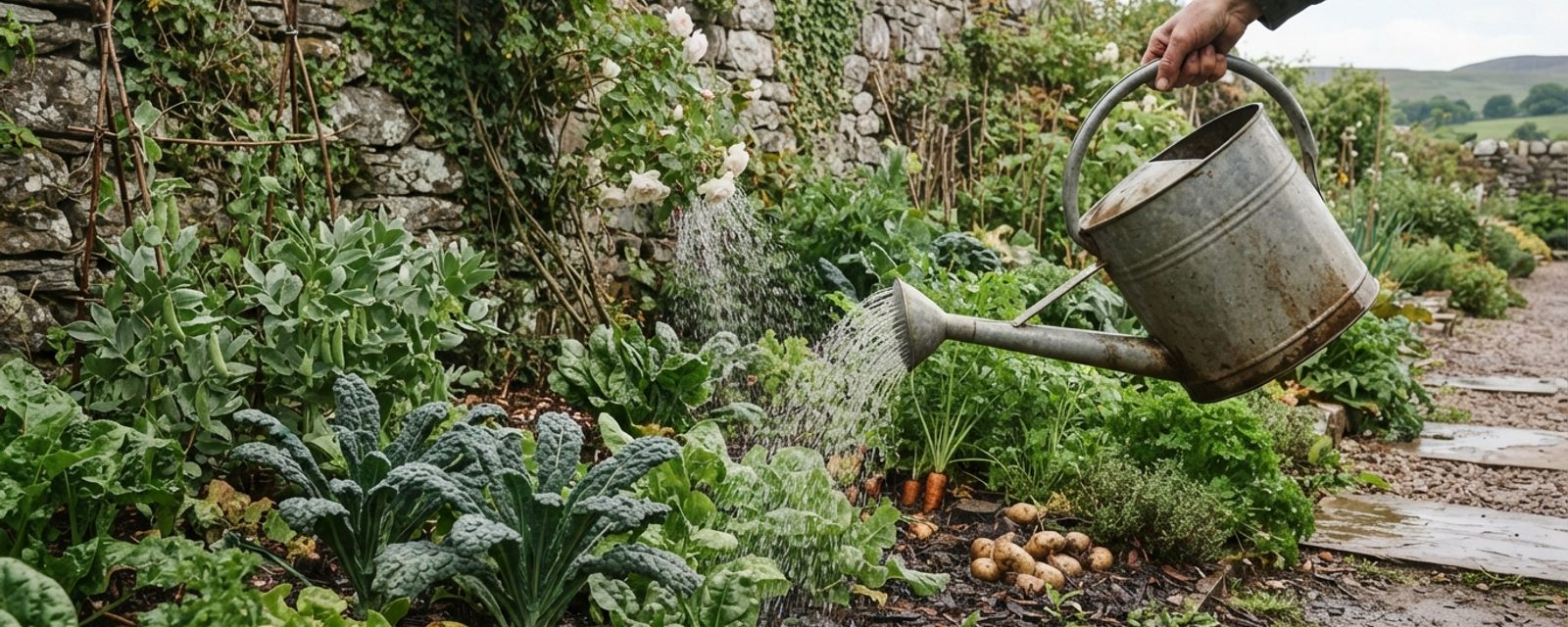
A tray of seedlings on a windowsill in April needs checking daily, sometimes twice. The same gardener's herbaceous border in July might go three weeks without a drop from a can and be none the worse for it. By October, that border has stopped needing anything at all. But the greenhouse tomatoes ten feet away still want water twice a week, because the roof over their heads means the Scottish weather doing all the work outside simply isn't reaching them. Watering isn't one skill applied uniformly; it's a set of judgements that change with the plant, the container, the season, and with where in Scotland you're gardening.
This is a guide to the everyday practice of watering: seedlings, transplants, pots, borders, and the greenhouse or polytunnel, plus the equipment that makes it easier. Hot spells get their own dedicated heatwave watering article; this one is about the other 350-odd days of the year.
Does Scotland really need less watering? Checking the assumption
It's tempting to assume that a country known for rain barely needs a watering routine at all. That's only partly true.
Met Office regional climate data shows Scotland's rainfall is extremely uneven, and it changes what "check less often" actually means depending on where a garden is.
| Region | Annual rainfall | Summer wet days (out of ~90) |
|---|---|---|
| Western Highlands (high ground) | Over 3,500mm | n/a |
| Ayrshire / Dumfries & Galloway coast | Under 1,000mm | ~35 |
| East Lothian / Fife / Moray Firth coast | Under 700mm | ~27 |
| Driest parts of eastern England (for comparison) | ~500mm | n/a |
Out of roughly 90 days in a season, even the wetter western coasts have well over half with no useful rain at all, and the eastern coasts (home to a large share of the country's gardens) sit closer to some of the driest counties in England than to the rest of Scotland. In the west, Met Office data also notes that spring and early summer, exactly when seedlings and new transplants are going in, is normally the driest part of the year, not the wettest.
Wind adds a further complication that rainfall totals alone don't capture. The Met Office's own regional summaries describe both halves of the country as genuinely windy by UK standards: Eastern Scotland "one of the more windy parts of the UK", Western Scotland "one of the more exposed areas of the UK", with exposed coasts, islands and high ground seeing markedly more gales than sheltered inland areas. RHS guidance is separately explicit that windy conditions dry out soil and foliage faster than sun or heat alone, calling out newly turfed or seeded lawns and evergreens such as bamboo as especially quick to desiccate in a dry wind. Put the two together and a garden on an exposed hillside, an open coastal site, or one of the islands is losing moisture to wind on days when a sheltered inland garden barely notices it, worth factoring in alongside the rainfall picture, not instead of it.
Less watering is the right approach only in some of these cases, not as a blanket rule. It holds up reasonably well for established borders and beds, especially away from the drier east coast: soil-grown, settled plants in a country with this much annual rainfall genuinely don't need the frequent supplemental watering that drought-prone-climate advice assumes. But it does not hold up for containers, hanging baskets, or anything under a greenhouse or polytunnel roof, because none of them receive rain regardless of how wet the regional climate is: their water supply is entirely down to you, in Aberdeen as much as in Arizona. And it doesn't hold up uniformly across the country: a garden in Fife is working with a rainfall total closer to Cambridge than to Fort William.
Scotland isn't immune to dry spells even outside heatwave conditions, either. In 2025, SEPA (the Scottish Environment Protection Agency) reported that every part of Scotland reached some level of water scarcity for the first time on record, following an extended run of below-average rainfall; groundwater levels in Fife and Angus hit record April lows, and the River Dee ran at its second-lowest level in 97 years for that time of year. SEPA's water scarcity reporting is aimed primarily at large-scale water abstractors rather than domestic gardeners, and Scotland has never needed a hosepipe ban: the legal process, involving Scottish Ministers and SEPA review, can take over a month, by which point a dry spell has often already moved on, and Scottish Water has said it would only use the power as a last resort anyway. But the scarcity event is a reminder that "it always rains here" is a generalisation, not a guarantee. Oddly, Scottish households also use more water day-to-day than the UK average: research cited by the Scottish Parliament's SPICe briefings puts average Scottish household use at around 180 litres a day per person, against 139 litres in England, partly because so few homes are metered. None of that is a reason to panic about garden watering, but it's a reason not to lean too hard on "Scotland is wet" as an excuse to ignore your plants.
Around 3% of people in Scotland get their household water from a private supply rather than the mains (a borehole, a spring, a loch or a stream), mostly in rural and remote areas. A private supply doesn't come with the same buffering capacity as the mains network behind it, so it's worth being more careful with garden water use from one, particularly during a dry spell, than the "check SEPA's scarcity status" advice above assumes for a mains-fed garden.
In practice, that means the categories below need genuinely different amounts of attention rather than one routine applied everywhere: seedlings and containers on a near-daily check regardless of the forecast, established borders on a light touch that gets lighter the further west and lower the garden sits, and the greenhouse on its own separate schedule entirely.
Reading the soil before you reach for the can
Whatever the plant, check before you water rather than watering on a fixed schedule. The simplest test is a finger pushed into the compost or soil up to the first knuckle: if it's dry at that depth, water; if it's still moist, wait. For containers, the RHS recommends checking whether compost is dry 2–3cm below the surface. For borders, dig a little deeper: moisture at 15cm down is the more meaningful test, since surface soil dries out even when the root zone below is still damp. A trowel or widger (a narrow, flat-bladed hand tool normally used for lifting seedlings, but handy here too) makes this quicker than a finger for anything beyond a pot.
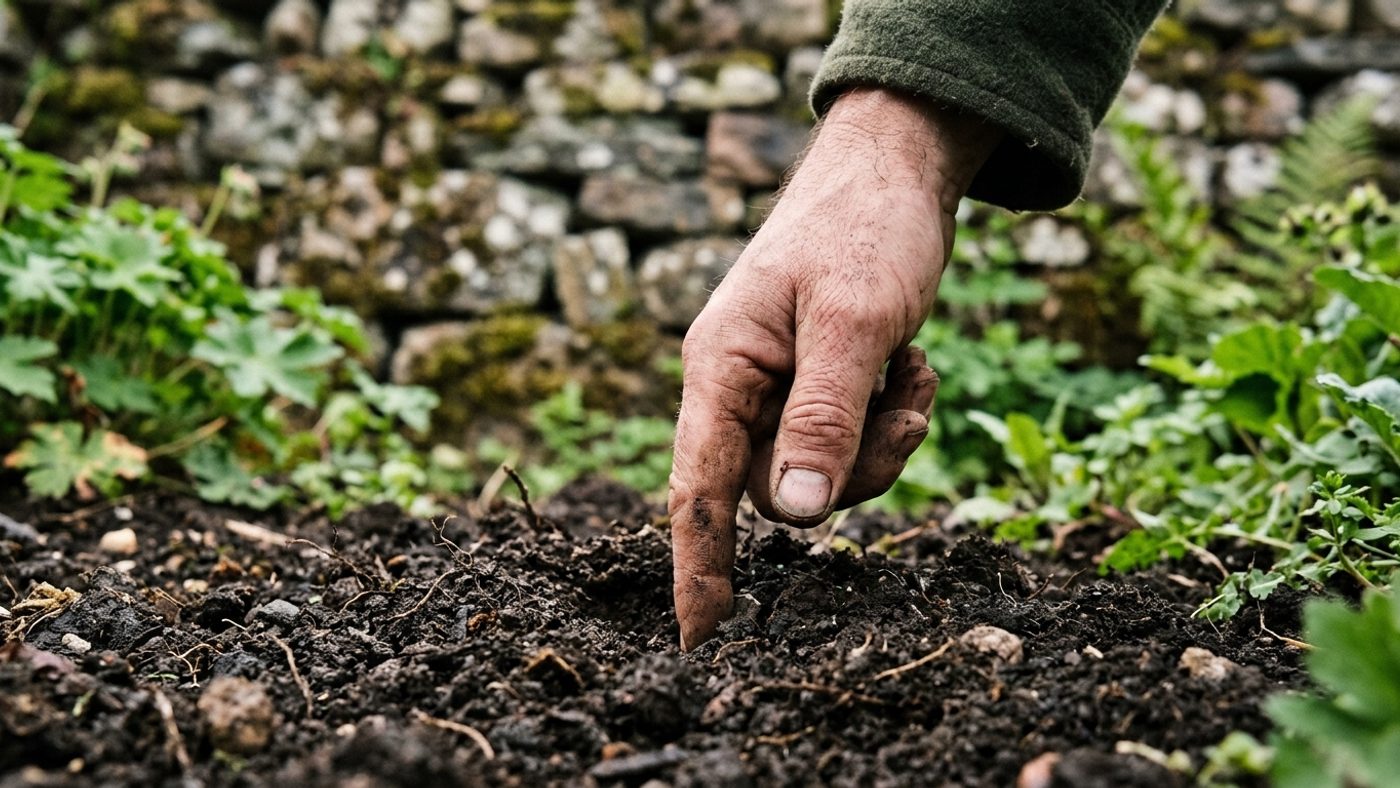
This matters more in Scotland than the "just water on Tuesdays" habit some gardeners bring from drier-climate advice, precisely because rainfall is so locally variable: a soil check tells you what your garden actually has, rather than what a generic schedule assumes it needs.
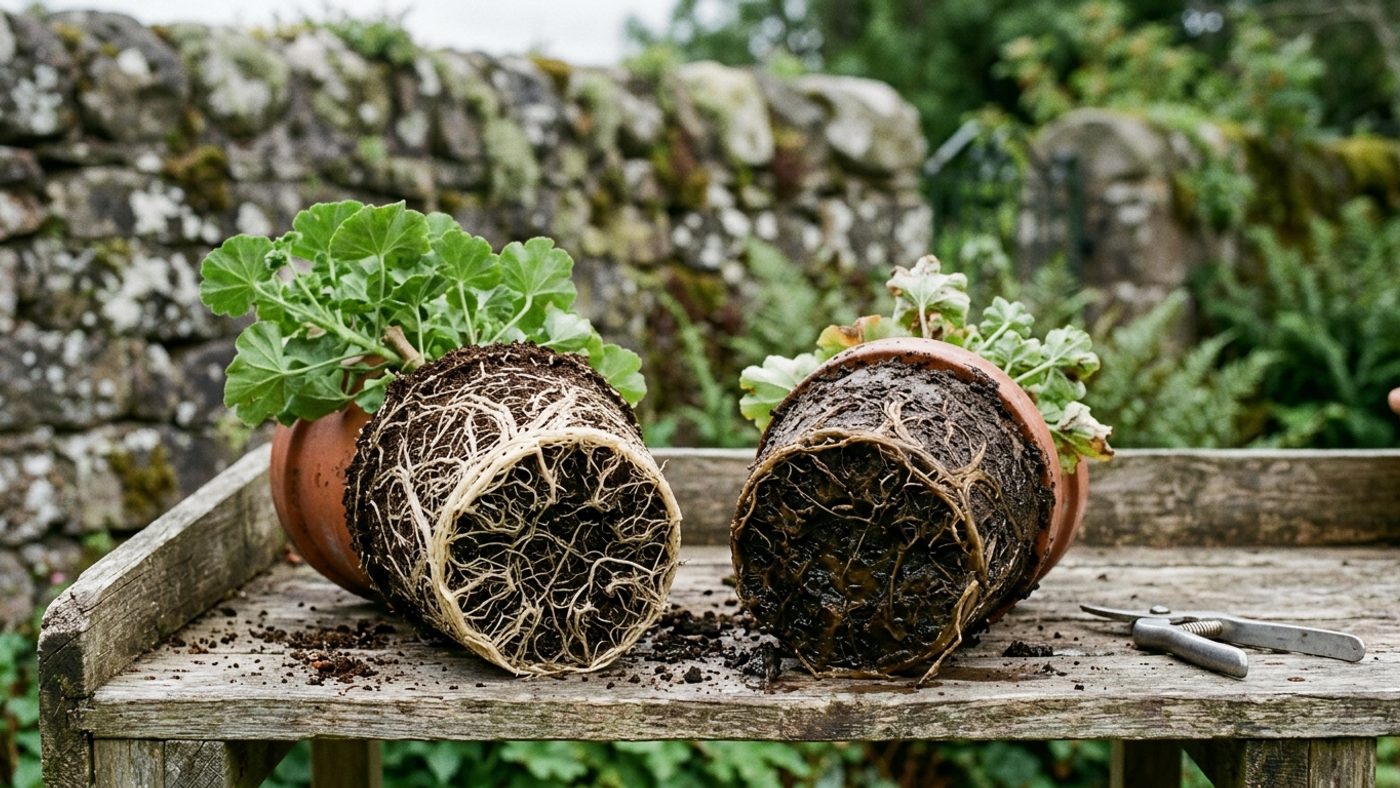
Worth knowing before reaching for the can: a wilting, drooping plant can mean either too little water or too much, and the leaf alone doesn't tell you which. Waterlogged soil pushes air out from around the roots, so they can't take up the water sitting right next to them and the plant wilts as if it were dry. The soil check above is what actually distinguishes the two. Dry at depth means water; already damp or wet means the problem is something else, and more water will only make it worse. If it's still ambiguous, tip a container plant out and look at the roots directly: white or pale and firm is healthy, while brown or black, soft, and sour-smelling points to rot from too much water rather than too little.
Watering seedlings and young sowings
Seedlings have no root reserve to draw on, so they're the most watering-sensitive stage of the year and the one where mistakes show fastest, both underwatering (wilting, collapse) and overwatering (damping offA fungal disease that kills seedlings at soil level, usually caused by overwatering, poor airflow, or reused unsterilised compost or trays. Full definition →, a fungal rot that kills seedlings at the base). Before sowing, water the seed drillA shallow, straight groove made in prepared soil for sowing seed into, at a set depth so germination and rows are even. Full definition → or tray with a watering can fitted with a fine rose, so the compost is evenly moist without being waterlogged. After sowing, keep the surface consistently moist rather than letting it dry and re-wet in cycles: that inconsistency is what triggers poor germinationA seed sprouting: breaking dormancy and putting out its first root and shoot, given the right warmth and moisture. Full definition →. Always water from a can with a fine rose or from below (standing trays in a shallow tray of water and letting compost wick it up), never with a hard jet that displaces seed or compacts the surface. Check trays daily; in a warm room or a propagator they can dry out within a day even though the room air feels humid. Tap water is fine for the vast majority of seedlings; it's only a real issue for a small number of lime-hating plants, where rainwater collected in a water butt is worth using instead if you have it to hand.
Watering transplants and new plantings
Trees, shrubs and perennials in their first year or two after planting haven't yet grown roots into the surrounding soil, so they're dependent on watering even in a wet country until they're established. For trees and shrubs, that means regular watering through dry spells from spring to autumn for the first year, and for larger specimens for up to three summers: RHS guidance suggests a newly planted tree needs roughly four to six full 10-litre cans a week in dry weather, more on an exposed hillside or coastal site where wind is adding to the drying the way the earlier section describes. Water slowly and let it soak in, rather than a quick surface splash: the aim is moisture reaching 20–30cm down for trees and shrubs, and around 15cm for herbaceous perennials, so roots are drawn downward rather than staying shallow near the surface. A slow trickle at the base, paused and repeated once the water has soaked away, does this better than a fast pour that runs off before it penetrates.
Watering containers and hanging baskets
Containers and baskets are the one category where the Scottish climate is largely irrelevant, because a pot doesn't intercept rain the way open ground does: a hanging basket under an eave gets none at all even during a downpour. Check compost daily from spring through autumn, and water whenever it's dry 2–3cm below the surface; in small pots, hanging baskets, or during any warm, windy spell, that can mean daily watering regardless of what the forecast says. In winter, rainfall is usually enough for most containers left outdoors, though evergreens in a sheltered but windy spot can still dry out and are worth an occasional check. Water until it runs from the drainage holes, which confirms the whole root ballThe mass of roots and the soil or compost clinging to them, as it comes out of a pot or out of the ground when a plant is lifted. Full definition → has been reached rather than just the surface. Self-watering containers, which hold a reservoir beneath the compost that the roots draw from as needed, are worth considering for anything you can't check daily. They don't remove the need to top up the reservoir itself, but they buy real slack on the day-to-day watering that ordinary pots and baskets don't give you. Water-retaining granules mixed into compost at planting genuinely cut watering frequency early on, though RHS's own testing found the effect fades by late summer once roots have filled the pot and are using all the water available regardless. Simply grouping pots together rather than spacing them out is the more reliably lasting fix, since it leaves less bare compost surface exposed to sun and wind at once, for much the same reason a mulchA layer of material spread over the soil around plants to suppress weeds, retain moisture, and improve soil structure as it breaks down. Full definition → helps a border.
Watering borders and established beds
This is the category where the Scottish rainfall picture genuinely changes the advice most UK-wide guidance gives. Once trees, shrubs and perennials are established (generally after their first year or two), they typically need watering only during extended dry spells, and across much of Scotland's rainfall pattern, those spells are less frequent and less severe than in much of England. If you do need to water an established border, do it thoroughly and infrequently rather than little and often: a slow, deep soak that reaches 15cm down encourages deep rooting, while frequent shallow watering trains roots to stay near the surface and makes plants more dependent on you. Vegetables are the exception worth tracking separately: leafy crops want evenly moist soil throughout, while root vegetables need less frequent water except when the harvested part itself would be affected by drought. If your border is in Fife, East Lothian, or elsewhere on the drier east coast, don't assume "Scotland is wet" excuses skipping this check during a dry spring. That's exactly the region and season where the assumption is weakest, and it's also where choosing genuinely drought-tolerant planting for new beds pays off more than it would further west.
Soil type changes how often that check turns up dry, too, whatever the regional rainfall figures say: heavy clay, common across much of the Central Belt, holds water for far longer than the free-drainingSoil that lets water pass through quickly rather than pooling, so roots aren't sitting in wet ground after rain. Full definition → sandy and machair soils (machair being the low-lying, shell-sand grassland found along parts of the Hebrides and north-west coast), so a border on light coastal ground can need checking well before one on clay, in the same weather and the same region. See our guides to identifying your soil type and improving clay soil for how to tell which you've got.
Raised beds are worth treating separately from ground-level borders for exactly this reason: the improved drainage that makes them useful on heavy Scottish clay also means they dry out quicker than soil at ground level, so a bed raised specifically to solve a clay-drainage problem can end up needing checked more like a large container than like the border it replaced. A water butt installed alongside one earns its keep faster than most places in the garden.
A mulch changes the equation further. A layer of organic matter or bark at least 5–7.5cm thick, laid over moist soil in spring per RHS guidelines, cuts evaporation from the surface and genuinely reduces how often a border needs watering afterwards, on top of whatever the rainfall and soil type are already doing. Since a mulch works by physically covering the soil surface rather than by countering any one specific cause of drying, it cuts moisture loss to wind as well as to sun and heat, which makes it worth prioritising on the exposed hillside and coastal gardens flagged earlier, not just as a general good habit everywhere. It's one of the few watering-adjacent jobs that pays for itself directly in fewer trips with the can.
Greenhouse and polytunnel routine
Like containers, anything under glass or polythene is cut off from rainfall entirely. A greenhouse or polytunnel also runs warmer and often more humid than the open garden, which changes watering timing: morning watering is usually better than evening, because it gives the day's heat a chance to dry foliage and reduces the risk of fungal disease building up overnight in a still, enclosed space. Capillary matting is worth setting up for anything you can't check daily: pots sit on a permanently damp matting sheet fed from a reservoir or occasional top-up, and take up water as needed, which is particularly useful for seed trays and for stretches when you're away. Ventilate whenever you water on a mild day; a freshly watered, sealed-up structure is exactly the moist, still environment that fungal problems favour. Check greenhouse and polytunnel plants year-round, not just in growing season. Even in winter, an unheated structure can dry out surprisingly fast if it's had a run of bright days, since no rain reaches the compost regardless of what's happening outside.
Choosing your watering equipment
Different jobs suit different tools, and the right choice is usually about precision and control rather than sheer volume.
| Method | Best suited to | Water efficiency | Notes |
|---|---|---|---|
| Watering can (fine rose) | Seedlings, seed trays, containers, targeted watering | Highest, since you see exactly how much you're applying | Slowest for large areas; pairs well with a water butt |
| Watering can (no rose) / hose with spot nozzle | Established borders, trees and shrubs needing a deep soak | High | Direct to root zone, avoids wetting foliage |
| Garden hose (general) | Larger areas, when carrying cans isn't practical | Moderate, easy to over- or under-apply without a measured attachment | No built-in sense of volume applied |
| Drip line / drip irrigation | Containers, greenhouse borders, edibles needing consistent moisture | High, very targeted | Higher setup cost; calibrated emitters (e.g. 2 litres/hour) deliver precise, repeatable amounts |
| Seep/leaky hose | Dense border or vegetable plantings, heavier soils | High for the area covered | Space runs 30–45cm apart in dense planting; look for food-grade PU/PE/HDPE/LDPE hose, not porous rubber, which can shed contaminants over time |
| Sprinkler | Establishing a new lawn from seed or turf only | Low, can use as much water in an hour as a household uses in two days | Encourages shallow rooting if overused; avoid for general border or bed watering |
For most everyday jobs in an ordinary Scottish garden, a can remains the most useful single tool precisely because it forces you to watch how much you're giving each plant, which matters more than the method itself.
Drip and seep systems earn their setup cost in a greenhouse, polytunnel, or a border with a lot of thirsty edibles, where consistency matters more than the flexibility a can gives you. Sprinklers have a narrow, genuine use case (establishing a new lawn) and a poor one everywhere else: they lose the most water to evaporation and drift, and they wet foliage indiscriminately, which is exactly what borders and vegetable beds don't need. Whatever you install permanently, there's a real legal requirement behind it: Scotland's own Water Byelaws, like the equivalent regulations south of the border, require a "double check valve" on any outside tap feeding a hose or irrigation system, to stop water running back and contaminating the supply, and a proper air-gapped break tank on any permanent automated system. That protection matters more, not less, on a private water supply of the kind mentioned earlier: there's no wider mains network of byelaw-enforced safeguards behind a borehole or loch intake, so a garden's own fittings are doing more of the real work.
A drip line and timer bought for everyday convenience doubles as the same kit a holiday-watering setup needs, see holiday watering systems for how to test and run one unattended, along with capillary matting and other options for houseplants and containers while you're away.
A water butt is worth more than a passing mention: even a small shed roof can collect 2,500-3,500 litres of rainwater a year, enough to fill 10-15 standard 240-litre butts, connected via a downpipe with a leaf-and-debris filter fitted ahead of it to keep the stored water clean. In a country with Scotland's rainfall, that supply tends to refill faster than it's used. Rainwater is also genuinely better than tap water for lime-hating plants such as rhododendrons and camellias, since it's naturally soft and low in minerals, where hard tap water can push soil pH the wrong way for them over time, the same reason it's worth using for seedlings of those species mentioned earlier.
Before the first hard frost, drain and disconnect hoses, seep lines and drip systems rather than leaving them full outdoors: water left standing in a hose or an outdoor tap freezes, expands, and can split the fitting or the pipe behind it, turning a routine autumn job into a repair the following spring. An outdoor tap fitted with its own insulating cover is worth the small cost for exactly this reason.
Does time of day matter as much here as the general advice suggests?
Most watering advice, RHS included, recommends early morning as the best time, with evening as an acceptable second choice, and warns against midday because evaporation losses are highest in full sun and heat, and because wind (see above) adds to that loss on an exposed site. Morning is worth defaulting to as a habit for routine watering of open ground, since it suits plant biology generally and costs nothing extra to do. The exception that matters more here than the sun-and-heat reasoning behind the general advice is under cover: in a greenhouse or polytunnel, morning watering genuinely earns its place for a different reason, because it lets the day's warmth dry any wet foliage and cuts the risk of fungal disease taking hold overnight in that enclosed, humid air. If you're gardening through an actual hot spell, timing becomes more important again — that's covered in full in our heatwave watering article.
Common questions
Does a windy garden need watering more than a sheltered one, even with the same rainfall?
Yes. Wind pulls moisture out of soil and foliage on top of whatever sun and heat are doing, and the Met Office's own regional data names exposed coasts, islands and high ground as genuinely windier than sheltered inland sites across both halves of Scotland. A garden on an open hillside or coastal plot is worth checking more often than the rainfall figures for its region alone would suggest.
Does mulching actually cut down how much I need to water?
Yes, measurably. A 5–7.5cm layer of organic mulch over moist soil in spring reduces evaporation from the surface and cuts how often an established border needs supplemental water afterwards, on top of whatever the local rainfall and soil type are already doing, and one of the few jobs in this list that pays for itself directly in fewer trips with the can.
Is it true Scotland doesn't need to worry about water restrictions?
Not entirely. Scotland has never imposed a hosepipe ban, partly because the legal process for one is too slow to be useful, but in 2025 SEPA reported that every part of the country reached some level of water scarcity following a prolonged dry spell, showing that "it's a wet country" isn't an absolute guarantee in every year.
Should I water my greenhouse or polytunnel through the winter?
Check, don't skip. An unheated structure gets no rain reaching the compost at all, and a run of bright winter days can dry pots out faster than you'd expect from the temperature alone. Watering needs drop right off compared with summer, but "none required" is rarely correct.
Is a watering can genuinely better than a hose, or is that just traditional advice?
For most everyday jobs, yes, and the reason is control rather than tradition: a can lets you see and limit exactly how much water each plant gets, which reduces both under- and overwatering. A hose earns its place for larger areas or when carrying water any distance isn't practical, but it's easier to apply too much or too little without a can's built-in sense of volume.
Sources
14 sources, recorded with what each was used for
- RHS: Watering: Per-plant-type watering technique (seedlings, transplants, containers, established borders, vegetables, lawns), soil-depth checks (2-3cm for containers, 15cm for borders/perennials, 20-30cm for trees/shrubs), the four-to-six-10-litre-cans-a-week figure for new trees, wind drying newly turfed lawns and evergreens faster, and morning/evening timing guidance
- RHS: Garden Watering Methods: The equipment comparison (cans vs hose vs drip lines vs seep hoses vs sprinklers), seep-hose material and spacing guidance, the sprinkler water-use comparison, and the double check valve/break tank legal requirement
- RHS: Collecting, storing and using water: Water butt collection figures (2,500-3,500 litres a year from a small shed roof, filling 10-15 standard 240-litre butts), the need for a leaf/debris filter, and rainwater being naturally soft and low in minerals, better than hard tap water for lime-hating plants such as rhododendrons and camellias
- RHS: Mulches and mulching: Mulch depth (5-7.5cm) and the finding that mulching reduces evaporation from the soil surface and how often watering is needed
- RHS: Waterlogging and flooding: The overwatering mechanism (saturated soil displaces air from around the roots, so a plant can wilt from too much water and look the same as one that's too dry), and blue-black, sour-smelling roots as the physical symptom of waterlogging on a plant tipped out of its container
- RHS: Growing veg in raised beds: Raised beds drying out quicker than soil at ground level, and RHS advice to install a water butt alongside one to manage that
- RHS: Water-retaining granules: Water-retaining granules mixed into compost reducing watering frequency initially, but RHS's own finding that the effect fades by late summer once container roots are using all available water regardless
- Met Office: Eastern Scotland climate: East Lothian/Fife/Moray Firth coasts receiving under 700mm of rain a year against the southern Grampians' over 1500mm, around 27 summer wet days on those coasts, spring being the normally driest season, and the region being described as 'one of the more windy parts of the UK'
- Met Office: Western Scotland climate: The upper Clyde valley/Ayrshire/Dumfries and Galloway coasts receiving under 1000mm of rain a year against over 3500mm in the higher west Highlands, eastern England's driest parts averaging around 500mm for comparison, around 35 spring/summer wet days on the coasts, April-to-June being the normally driest period, and the region being described as 'one of the more exposed areas of the UK'
- SEPA: All of Scotland now at some level of water scarcity: The 2025 Scotland-wide water scarcity event, record-low April groundwater levels in Fife and Angus, and the River Dee flow figure
- SEPA: Water scarcity information: Confirming SEPA's water scarcity reporting is aimed primarily at large-scale abstractors rather than domestic gardeners, and that it runs seasonally (May-September) each year
- SPICe Spotlight (the Scottish Parliament’s own research briefing service): Why are there no hosepipe bans in Scotland?: The east/west rainfall contrast, the explanation of why Scotland hasn’t used hosepipe bans, and the household water-use comparison (approximately 180 litres/day in Scotland vs 139 litres/day in England)
- mygov.scot: Owning or using a private water supply: Around 3% of Scotland's population getting household water from a private supply (borehole, spring, loch or stream) rather than the mains, mostly in rural and remote areas
- DWQR (Drinking Water Quality Regulator for Scotland): Scottish Water Byelaws: Scotland having its own Water Supply (Water Fittings) (Scotland) Byelaws 2014, requiring backflow protection on plumbing fittings connected to the public water supply