
Quick answer
No — there's no hosepipe ban in force anywhere in Scotland right now, and nothing is close to one. Even if Scottish Water proposed a restriction today, SPICe's own estimate puts the earliest it could actually take effect at over a month away. The reason isn't luck or a quieter climate; it's a genuinely different legal mechanism from England's. Here's how it actually works.
Picture the same parched July across the UK: lawns crisping in Surrey, lawns crisping in Fife, reservoirs dropping in both. In England, a water company can decide on a Tuesday that a Temporary Use Ban starts on Friday, and by the weekend a hosepipe on a private garden is a criminal offence. In Scotland, that same dry spell has never once produced an equivalent restriction, not because Scottish gardens use less water, and not simply because "it hasn't happened since 1995", but because the legal lever that would have to be pulled is a different lever, held by a different hand, moving through a different process. Understanding hosepipe ban rules properly means understanding that mechanism, not just knowing the trivia that Scotland is exempt.
England and Wales: the company decides, and decides fast
The power behind an English or Welsh hosepipe ban sits in Section 76 of the Water Industry Act 1991. It gives a water undertaker (the private, regionally licensed company that supplies your taps, such as Thames Water, Southern Water or Yorkshire Water) the authority to declare what the Act calls a Temporary Use Ban whenever it believes it "is experiencing, or may experience, a serious shortage of water for distribution."
Crucially, the company itself makes that call. There's no independent regulator sign-off required before it takes effect, no minister involved, no statutory waiting period. The undertaker publishes notice, typically via local media and its own website, specifying the date the ban starts and the geographic area it covers. Customers can object, but objecting doesn't delay commencement. In practice, a ban can go from decision to enforceable restriction within days.
Breach of a Temporary Use Ban is a criminal offence, capped at a fine of level 3 on the standard scale, up to £1,000. Above Temporary Use Bans sits a more severe tier: Drought Orders, issued not by the company but by the Secretary of State or the Environment Agency under the Water Resources Act 1991 as amended. These can restrict abstraction itself (taking water directly from a river, reservoir or underground source, rather than a household using the mains), not just customer behaviour, and are reserved for more serious shortages. England and Wales therefore run a two-tier system: a fast company-level ban first, a slower government-level abstraction order held in reserve above it. Scotland's Water Shortage Order, covered next, folds both jobs into one instrument rather than splitting them across two.
Section 76's own extent clause is explicit: it applies to England and Wales only. Scotland is carved out because Scottish water services operate under a different legal framework entirely.
Scotland: the company proposes, ministers decide
That different framework is Part 7 of the Water Resources (Scotland) Act 2013, which creates something called a Water Shortage Order. The name sounds like a Scottish translation of a Temporary Use Ban. Structurally, it isn't. The 1995 ban itself predates this framework, and predates Scottish Water too: Scottish Water wasn't established until 2002, when the Water Industry (Scotland) Act 2002 dissolved the regional water and sewerage authorities that ran Scotland's water supply before then and merged them into the single public body that exists today. The "hasn't happened since 1995" fact and the structural argument that follows aren't two separate stories; the last actual ban happened under an older, more fragmented system, before today's single public body existed at all.
Under section 38 of the 2013 Act, Scottish Water cannot declare a restriction on its own customers. It can only propose one, formally recommending to Scottish Ministers that an order be made, when it believes there's a serious deficiency of water supplies in an area, or a real threat of one. The decision itself belongs to Scottish Ministers, not to the water body.
That one design choice changes everything downstream. The realistic process involves public notice, a 14-day period during which representations and objections can be lodged, consultation with and advice from the Scottish Environment Protection Agency (SEPA), and only then a ministerial decision. Government officials' own estimate is that the full process could take more than a month from start to finish, a timescale with no equivalent in the fast, company-issued English model.
What a Water Shortage Order can actually impose, once made, is set out in Schedule 2 of the Act, and the domestic activities it covers are strikingly close to Section 76's, category for category:
| Domestic activity | England & Wales (s.76) | Scotland (Schedule 2) |
|---|---|---|
| Hosepipe/sprinkler on garden or plants | Banned | Banned |
| Hosepipe on a private vehicle | Banned | Banned |
| Hosepipe on boats, walls, windows, paths, patios | Banned | Banned |
| Hosepipe to fill/clean ponds or home exteriors | Banned | Banned |
| Filling/maintaining pools, paddling pools, fountains | Banned | Banned |
| Non-domestic uses (golf courses, commercial cleaning, dust suppression) | Minister may add by order | Included directly, plus a catch-all for further measures |
That single-instrument design shows up in section 44's enforcement wording too: the same offence covers failing to comply with a water saving measure (the hosepipe-level restriction) or an abstraction restriction imposed by the same order, one order and one offence, covering both the customer-facing and the abstraction-facing sides that England and Wales split across two separate legal tools. Breach is punishable on summary conviction by a fine up to the "statutory maximum," currently £10,000, the general ceiling for a summary conviction in a Scottish sheriff court, or, on conviction on indictment (the more serious court route, reserved for more serious cases), by an unlimited fine. England's Temporary Use Ban tops out at £1,000 by statute; Scotland's equivalent power, on paper, has no such ceiling and a higher floor even at the lower tier. It's a genuinely different penalty structure, even though, and this matters, it has never once been used in practice. Scottish Water, not the police or SEPA, is the body responsible for enforcing a hosepipe restriction once one is in force.
The comparison, side by side
| England & Wales | Scotland | Northern Ireland | |
|---|---|---|---|
| Legal basis | Water Industry Act 1991, s.76 | Water Resources (Scotland) Act 2013, Part 7 | Water & Sewerage Services (NI) Order 2006, Art. 116 |
| Who decides | The water company itself | Scottish Ministers, on Scottish Water's proposal | NI Water, under a narrower, older-style power |
| Process | Company notice; can take effect within days | Public notice, 14-day representation period, SEPA consultation, ministerial decision: over a month | Notice by NI Water |
| Maximum penalty | £1,000 (level 3 standard scale) | Unlimited fine on indictment | Set under older NI-specific provisions |
| Ever used for a domestic ban? | Yes, repeatedly (2018, 2022, 2025) | No: last ban was 1995, under earlier legislation | Yes (2018) |
Northern Ireland adds a third, different picture again. Its power, Article 116 of the 2006 Order, mirrors older, pre-2010 Great Britain law and is narrower than the current England and Wales regime: it covers garden hosepipe use and private car washing, not the wider list Section 76 now reaches. When NI Water tried to extend its 2018 ban to patios and pools, it later acknowledged it had gone beyond what Article 116 actually permitted. Four UK nations, four genuinely different legal architectures, not one law with three regional footnotes.
Why the mechanism differs
England and Wales are served by numerous separately regulated, privately owned water companies, each managing its own supply area and answerable to its own commercial and operational pressures. A fast, company-level power to restrict customer use fits that landscape: each company needs to act on its own local shortage without waiting on anyone else.
Scotland runs the opposite way round. There's one public, not-for-profit body, Scottish Water, answering to Scottish Ministers rather than shareholders, and restricting what an entire national utility's customers can do with their taps sits with elected government rather than one company's own management, with statutory consultation and a public objection window attached, because a single body's decision reaches every customer in the country at once, not just one company's own patch. No government source spells that reasoning out in so many words; it's a reading of why the two systems are built the way they are, not a quoted policy line, but it fits the design far better than the 1995-and-no-ban-since track record does on its own.
SEPA's escalation levels: a different system, aimed at a different audience
A separate but easily confused system sits alongside all this: SEPA's water scarcity report, which grades conditions across Scotland on a five-point scale.
| Level | What it means |
|---|---|
| Normal | Standard water availability |
| Early Warning | Conditions are drying; no action required yet, but abstractors are expected to start preparing |
| Alert | Water levels are falling; SEPA advises voluntary reductions in non-essential use, for abstractors |
| Moderate Scarcity | Environmental impact on rivers is clear; action expected from abstractors to protect rivers and the species depending on them |
| Significant Scarcity | The most severe level; SEPA can restrict abstraction licences to protect rivers, triggered when river flow at a monitoring station stays below the "Q95" low-flow threshold for 30 days |
As an illustrative snapshot rather than a fixed figure (weekly reports run through the May–September monitoring season and the picture shifts constantly), the national status on 7 August 2026 was 23 areas Normal, 8 Early Warning, 7 Alert, 9 Moderate Scarcity and 2 Significant Scarcity.
This is genuinely important to get right: SEPA's escalation levels target licensed abstractors (farms, industry, and businesses drawing water directly from rivers, burns or groundwater), not domestic gardeners on the mains. A hosepipe filled from your kitchen tap isn't "abstraction" in this system, and SEPA reaching Significant Scarcity in your catchment doesn't itself touch your garden hose. The route that could restrict domestic hosepipe use is the separate Water Shortage Order process above.
That distinction shows up in real data. Eastern Scotland's reservoirs sat at 51% in 2025 against an 81% seasonal norm, and SEPA restricted agricultural and industrial abstraction across eleven catchments that reached significant scarcity: real, exercised power.
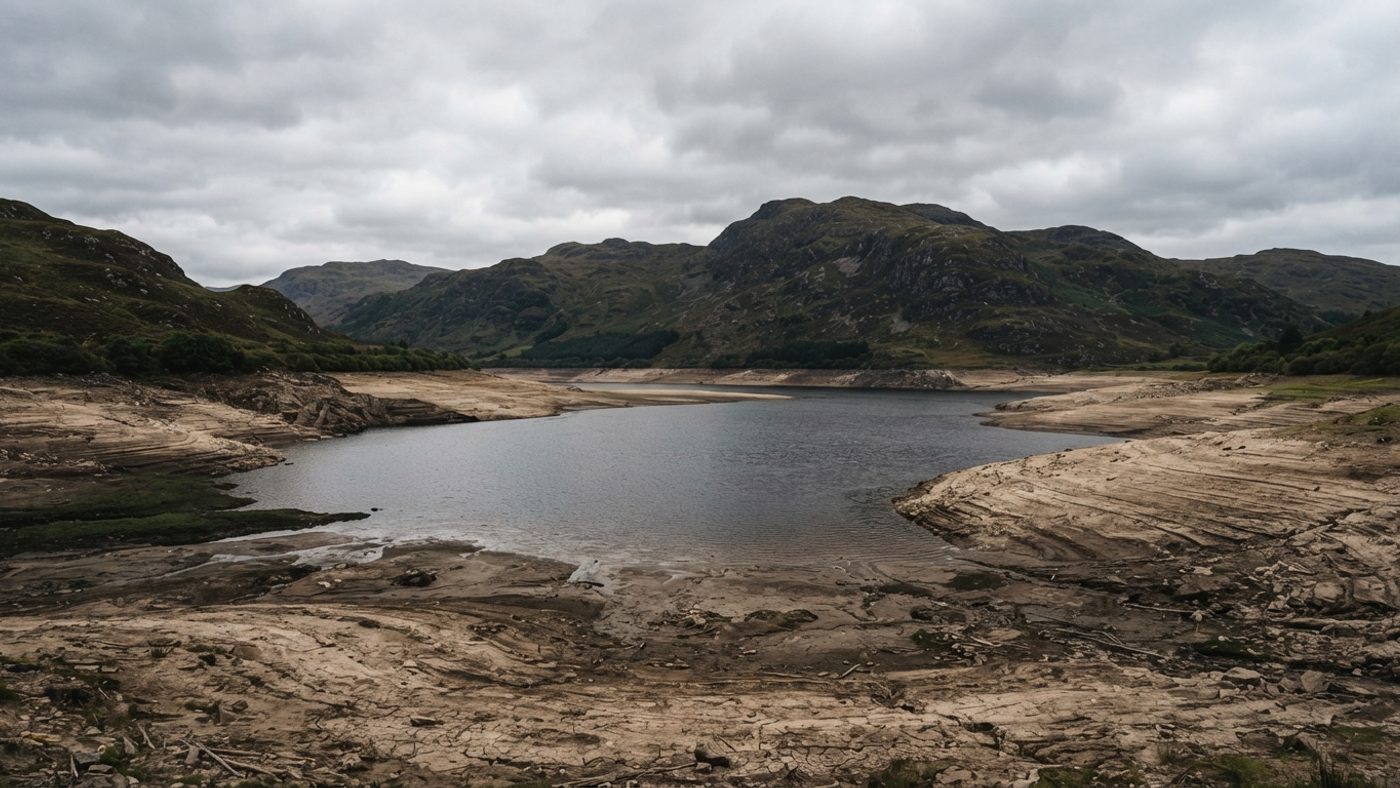
The domestic Water Shortage Order lever, sitting right alongside it in the same Act, was not triggered, even that year, with conditions that severe. Nothing in the public record points to Scottish Water ever coming close to proposing one since the current framework began, 2025 included; on the evidence available, one lever gets used routinely when rivers run low, and the other has simply never been reached for.
What to actually do if a restriction ever came
If Scottish Ministers ever did make a Water Shortage Order, expect advance public notice rather than a same-week surprise, given the 14-day representation window built into the process. Check the order's specific terms: Schedule 2 lists a range of possible measures, and not every order need impose all of them. Keep an eye on Scottish Water's own public communications for the order's actual start date and area, since that's where operational detail would appear. And treat a formal order differently from Scottish Water's routine efficiency messaging: the company has said it treats any restriction as a last resort and prefers asking customers to conserve voluntarily, which is a request, not a legal requirement, and carries no penalty for ignoring it.
Neither Act sets out specific customer exemptions (medical need, a newly laid lawn, and similar cases sometimes reported when English water companies announce a ban) directly in the legislation itself: those are set by each individual company's own drought plan in England and Wales, or would be a matter for the specific terms of a Water Shortage Order in Scotland, not a fixed statutory list set out in advance. If a restriction ever came, checking the order or company notice's own stated terms is the only reliable way to know what, if anything, is excused.
Commercial growers, nurseries and garden centres sit in the non-domestic tier of both regimes, not the domestic list covered above. Schedule 2 names commercial plant watering specifically, alongside golf courses and industrial cleaning, as a separate category Scottish Water or Ministers can restrict on its own terms, and Section 76 gives the England & Wales minister the same power to add non-domestic purposes by order. A commercial grower facing a real restriction is working from a different, generally broader set of rules than the domestic list above, not an exemption from it.
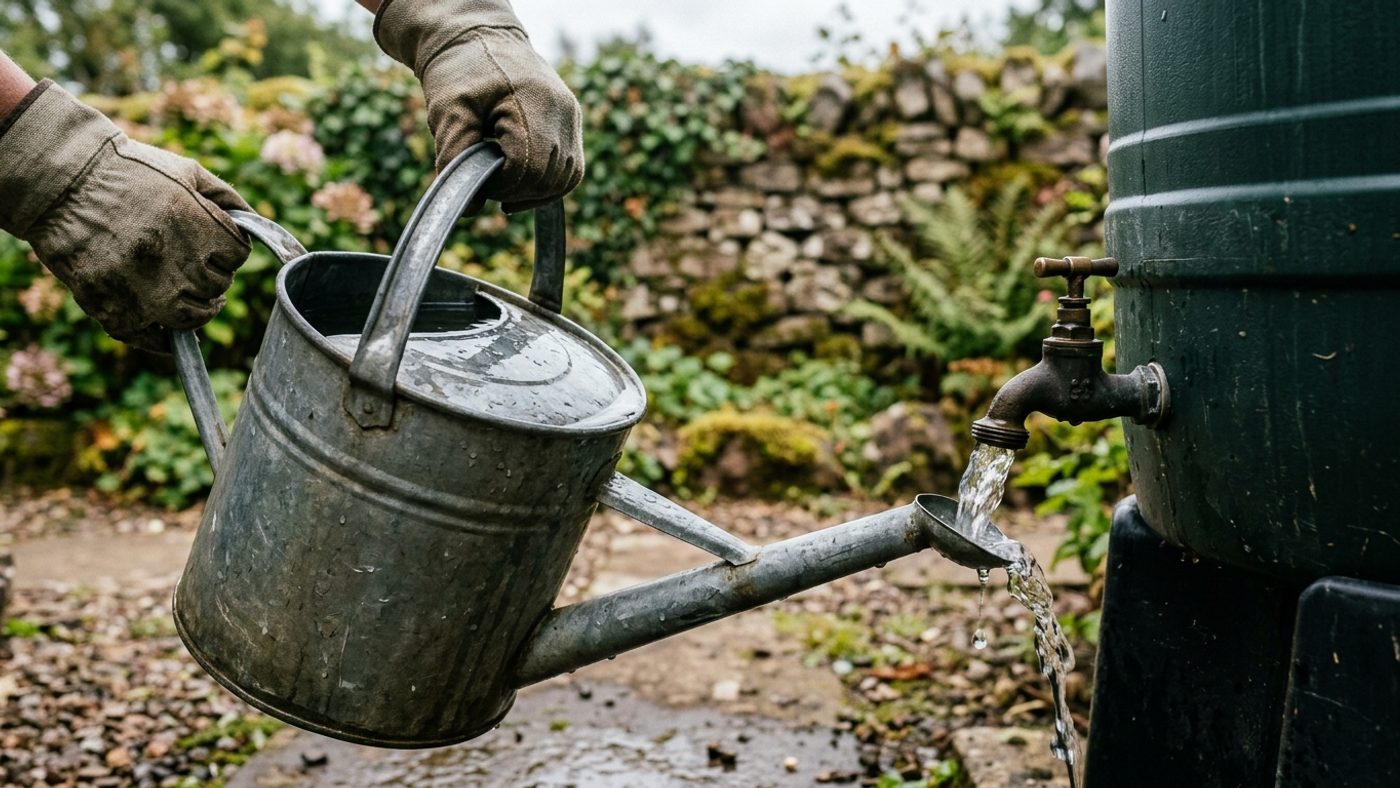
Both Section 76 and Schedule 2 restrict a hosepipe or sprinkler specifically, not watering itself. A watering can, a water butt, and any method that doesn't run water through a hose stay unrestricted under either regime, ban or no ban, worth knowing before assuming a restriction means the garden goes unwatered entirely; GrowScotland's watering guides linked below cover water butts and rainwater harvesting in full.
Neither regime reaches a private water supply either. Around 3% of people in Scotland get their household water from a borehole, spring, loch or stream rather than the mains, mostly in rural areas: both Section 76 and Water Shortage Orders regulate customers of a water undertaker, so a garden on a private supply sits outside either restriction, even during an order in force elsewhere in the same region.
For how to water efficiently day to day, and what changes in a heatwave, GrowScotland's everyday watering technique guide and hot weather and heatwave watering guide cover the practical side in full.
Common questions
Could Scotland get a hosepipe ban if this summer stays dry?
Legally, yes — the power exists and has never been repealed. Practically, it would need Scottish Water to propose it and Scottish Ministers to approve it through a public consultation process that SPICe's own estimate puts at over a month. Nothing currently in force restricts domestic hosepipe use anywhere in Scotland.
Does SEPA's 'Significant Scarcity' rating mean my area is close to a ban?
Not directly. That rating concerns licensed abstraction, mainly farms and industry drawing water from rivers, not mains-water gardeners. A catchment reaching Significant Scarcity doesn't automatically move Scotland closer to a Water Shortage Order, though sustained shortage across many catchments is exactly the kind of evidence that could inform Scottish Water's decision on whether to propose one.
Does a hosepipe ban stop me using a watering can or a water butt?
No. Both the England & Wales power and Scotland's Water Shortage Order restrict a hosepipe or sprinkler specifically, not watering itself. A watering can, stored rainwater from a butt, or hand-carried water all stay unrestricted whichever regime is in force — a ban limits the method, not the activity.
If a hosepipe ban applied elsewhere in the UK, would it apply to me in Scotland?
No. Temporary Use Bans under Section 76 of the Water Industry Act 1991 are declared by individual water companies for their own supply areas in England and Wales only. They have no legal reach into Scotland, whatever UK-wide news coverage might suggest.
What would the actual penalty be if a Water Shortage Order were breached in Scotland?
Under section 44 of the Water Resources (Scotland) Act 2013, it's a criminal offence: a fine up to the 'statutory maximum', currently £10,000, on summary conviction in a sheriff court, or an unlimited fine on conviction on indictment (the more serious court route). Both are a higher potential ceiling than England and Wales's £1,000 cap, though the power has never actually been used.
Does any of this apply to an allotment, not just a private garden?
Section 76 in England and Wales explicitly covers hosepipe use on 'non-commercial premises' as its own category, separate from 'a garden' — wording broad enough to include a non-commercial allotment plot, not just a private back garden. Scotland's Schedule 2 restricts a hosepipe or sprinkler used to water 'a garden or plants' in similarly general terms. Neither law names allotments specifically, and neither says anything about a shared standpipe or communal water point on an allotment site: check with your allotment site's own committee or water supplier if it ever becomes a live question, since the legislation itself doesn't settle it.
Sources
9 sources, recorded with what each was used for
- Water Industry Act 1991, Section 76: England & Wales's Temporary Use Ban power: a water undertaker may itself prohibit specified uses (garden hosepipes, private vehicle washing, watering plants on non-commercial premises, wording broad enough to cover an allotment plot, not just a private garden, and filling pools/ponds/fountains) when it believes it is or may be experiencing a serious shortage of water, the notice-based process with no mandatory waiting period, the maximum fine of level 3 on the standard scale (up to £1,000), and the section's territorial extent (England and Wales only, not Scotland)
- Water Resources (Scotland) Act 2013, Section 38: Scotland's Water Shortage Order mechanism: Scottish Water may only propose that Scottish Ministers make an order, when it believes there is a serious deficiency of water supplies or a threat of one; the decision itself sits with Ministers, not the water body
- Water Resources (Scotland) Act 2013, Section 44: The non-compliance offence for breaching a Water Shortage Order: a fine up to the statutory maximum on summary conviction, or an unlimited fine on conviction on indictment
- Criminal Procedure (Scotland) Act 1995, Section 225: The current figure behind the 'statutory maximum' term used in section 44 of the 2013 Act: the 'prescribed sum' for a summary conviction in a sheriff court is currently £10,000
- Water Resources (Scotland) Act 2013, Schedule 2: The list of water saving measures a Water Shortage Order can impose, including refraining from using a hosepipe or sprinkler to water a garden, refraining from using a hosepipe on vehicles/boats/paths/patios, and refraining from filling or maintaining pools, ponds and ornamental fountains
- SPICe Spotlight (the Scottish Parliament’s own research briefing service): Why are there no hosepipe bans in Scotland?: The realistic process for a Water Shortage Order (public notice, 14-day representation period, SEPA consultation, ministerial decision), government officials' own estimate that the whole process could take more than a month, the fact these powers have never been used, Scotland's last hosepipe ban in 1995, and 2025's eastern Scotland reservoir levels (51% against an 81% seasonal norm) with SEPA restricting abstraction across eleven catchments
- SEPA (Scottish Environment Protection Agency): Water scarcity: The five-level water scarcity escalation scale (Normal, Early Warning, Alert, Moderate Scarcity, Significant Scarcity), what each level means and who it's aimed at (licensed abstractors, not domestic mains-water gardeners), the Q95 low-flow threshold behind Significant Scarcity, and a live status snapshot (23 Normal / 8 Early Warning / 7 Alert / 9 Moderate Scarcity / 2 Significant Scarcity) fetched 2026-08-07 as an illustrative example, not a fixed figure
- Water Industry (Scotland) Act 2002, Introduction: Scottish Water being established in 2002, dissolving the regional water and sewerage authorities (created under the Local Government etc. (Scotland) Act 1994) that ran Scottish water supply before then and merging them into the single public body that exists today: the basis for noting the 1995 ban predates the current single-body structure
- mygov.scot: Owning or using a private water supply: Around 3% of Scotland's population getting household water from a private supply (borehole, spring, loch or stream) rather than the mains, mostly in rural areas, and therefore outside either country's hosepipe-restriction regime, which regulates customers of a water undertaker