
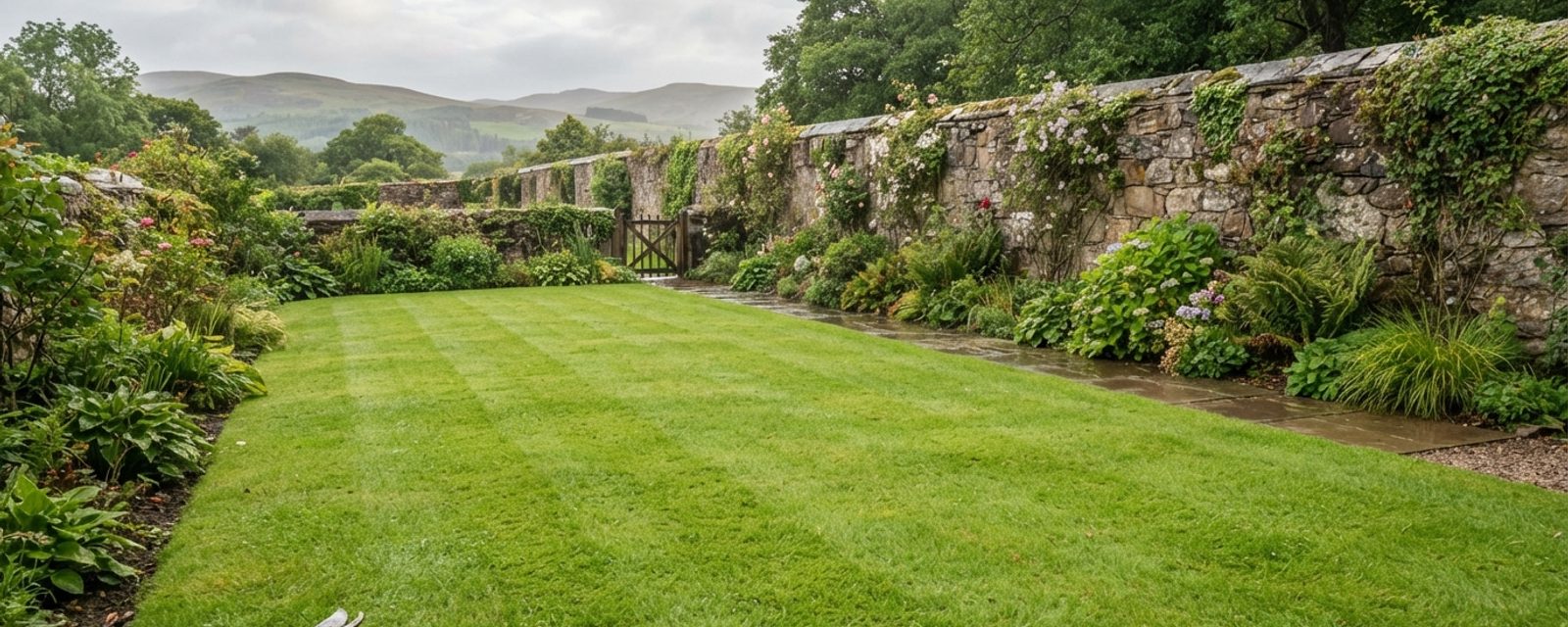
If you've come outside after rain and your lawn squelches underfoot, or there's a puddle sitting on the grass hours, sometimes days, after the rain stopped, you're looking at a waterlogged lawn. Maybe there are dark, boggy patches near the fence line. Maybe the whole thing has gone soft and spongy, and mowing leaves tyre tracks that don't spring back. This is common, it's fixable, and in most cases the cause is sitting right under your feet rather than anywhere more exotic.
This guide walks through how to tell what's actually wrong, then the real fixes: aeration, sand top-dressingAdding fresh compost, feed or grit to the soil surface around an established plant, rather than digging it in. Full definition →, drainage channels, and when it's actually worth digging in a French drain, plus what not to waste your weekend on.
First, diagnose it: three different problems look the same
Standing water on a lawn has three broad causes, and they need different fixes. Treating a high water table like a compaction problem, or vice versa, wastes effort.
1. Soil compaction (the most common cause)
Repeated foot traffic, kids' trampolines, parked cars, or a heavy roller during construction presses the soil particles together and squeezes out the air gaps water would otherwise drain through. Compacted soil, from heavy machinery, especially after construction work, or regular foot traffic and play, is one of the three primary causes of lawn waterlogging. Compaction shows up as water sitting in specific high-traffic zones (gateways, under swings, along desire-line paths) rather than the whole lawn; soil that feels rock-hard when dry and greasy when wet; and grass thinning out exactly where people walk. A thick thatch layer (dead grass and organic debris built up at the soil surface) can produce a similar surface-sealing effect and is worth checking for at the same time as compaction, by raking back the top of the turf to see how much spongy brown material sits above the soil itself.
2. Heavy clay soil structure
Clay particles are smaller than 0.002mm, far finer than sand or silt, and they pack together tightly, leaving very little pore space for water to pass through, which is why clay drains poorly: the particles stick together and attract water to form large, sticky lumps. If your whole lawn is slow to drain, not just the well-trodden bits, and the soil beneath it is grey-brown, sticky when wet and rock-hard when dry, clay structure, not just compaction, is doing most of the damage. You can't dig organic matter into an existing lawn the way you would a planting bed, so the fix here is different: aeration and drainage rather than digging in compost or gypsum. If you're also improving a border or vegetable bed on the same clay, our guide to improving clay soil covers that separately.
3. A genuinely high water table (less common, but worth ruling out)
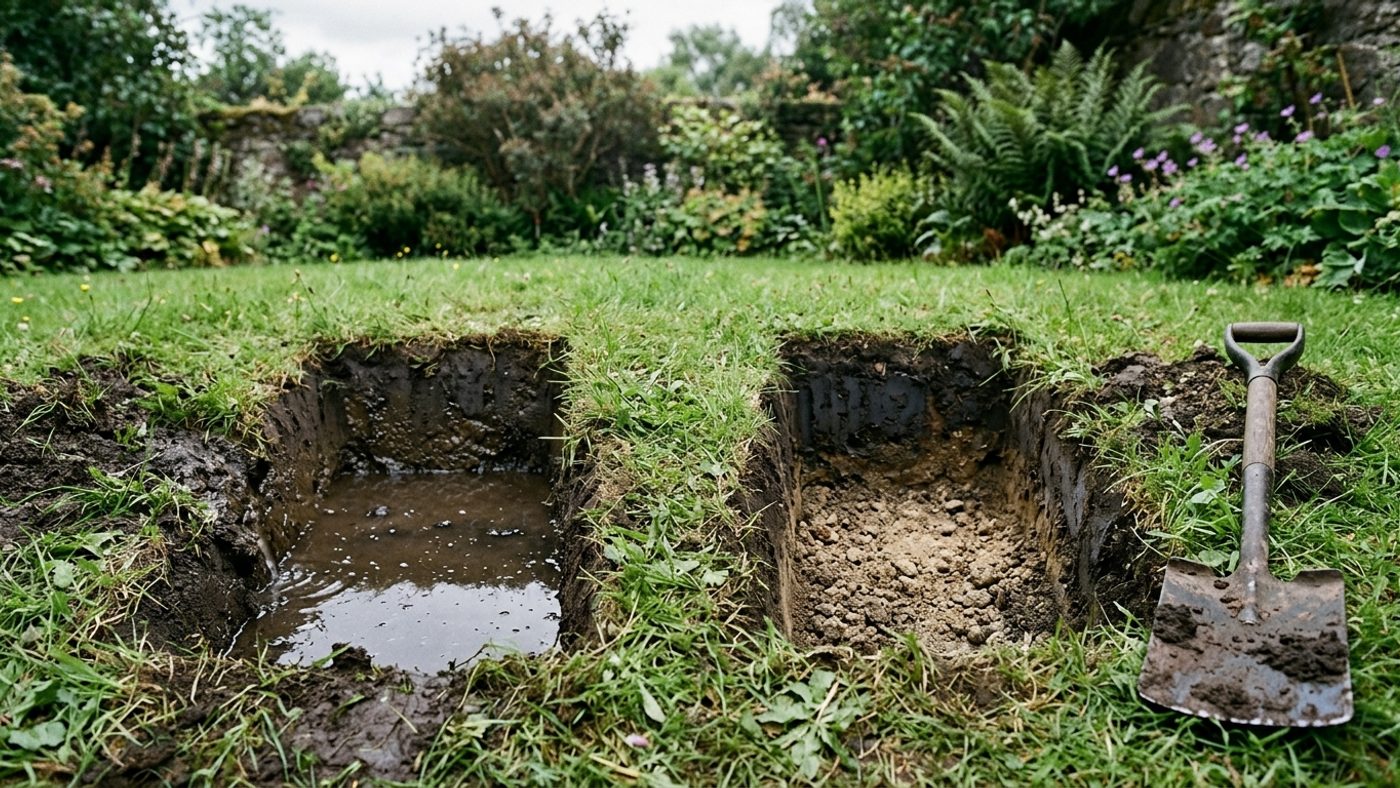
If water rises from below rather than just sitting on top, for instance a small test hole 30cm deep fills with water from the bottom rather than the top, or the wet patch persists through a dry spell with no recent rain, the ground itself may be saturated below the surface, not just poorly draining at the surface. This is a smaller share of waterlogging cases but a genuinely different problem: aeration and sand top-dressing won't fix a high water table, because you're not breaking up a barrier, you're trying to lower water that's already at or near the surface. This needs a proper drainage run (see below) or, in persistent cases, professional land-drainage advice. A drainage contractor can run a proper site survey if the spade-hole test below leaves you genuinely unsure which of the three causes you're dealing with, worth the cost before digging in a French drain that turns out to be solving the wrong problem.
A quick test: dig a hole roughly spade-depth (25-30cm) in the boggy patch after a dry day or two. If it fills with water from the sides and bottom and stays full, suspect a high water table or a genuinely impermeable clay layer at depth. If it's dry at the bottom but the surface stays wet after rain, you're dealing with surface compaction or a shallow clay pan, and the fixes below will do far more good.
Is this actually more of a problem in Scotland? What the evidence shows
It's a reasonable question for anyone who's gardened both sides of the border: is a waterlogged lawn a bigger issue here because of the climate and the soil, or does it just feel that way?
On soil, partially yes, and it's regional. Scotland's national soil survey, the Scottish Government's Scottish Soil Framework, records that Scotland has notably higher proportions of podzols (acidic, often iron-leached soils typical of upland heath and forestry, 23.7% of land area), peat soils (22.5%) and gley soils (20.6%) than Europe as a whole. Gleys are the class most directly relevant here: they're the "wet soils" category, formed where drainage is periodically or permanently restricted. But the framework is also clear that this isn't spread evenly: the Highlands and Southern Uplands are dominated by peaty soils, especially in the west, while the Central Belt, home to the great majority of Scotland's population and therefore most of its gardens, is dominated by mineral soils, which includes clay-heavy ground but isn't the same as the peat/gley- dominated uplands. So the "Scotland has more waterlogging-prone soil" claim holds nationally in the raw statistics, but a Central Belt gardener on clay is dealing with a different mechanism (compacted mineral clay) than a Highland gardener on gley or peat.
On rainfall, strongly yes, but hugely dependent on where in Scotland you are. Met Office regional climate data shows just how wide that range is:
| Region | Average annual rainfall |
|---|---|
| East Lothian, Fife, Moray Firth coasts | Under 700mm |
| Ayrshire, Dumfries & Galloway coast | Under 1,000mm |
| Southern Grampians | Over 1,500mm |
| West Highlands (higher ground) | Over 3,500mm |
For comparison, the driest parts of eastern England average around 500mm a year. Even Scotland's driest coastal strips get noticeably more rain than that, and the wetter west can see seven times that figure. Both regional summaries also note that spring (April-June) is normally the driest stretch and autumn through early winter (October-January) the wettest, useful to know when timing the fixes below, since "wet" here isn't spread evenly across the year either.
Put together, the rainfall case for "Scotland has it worse" is well-supported and dramatic in the wetter west, but much weaker on the drier east coast, where rainfall is closer to, if still somewhat above, southern English totals. The soil case is real but geographically patchy: it's strongest in the Highlands and Southern Uplands, and in the Central Belt the more relevant driver is ordinary clay-heavy mineral soil plus compaction, the same as it would be in a clay-soil garden anywhere in the UK; it just gets more rain to sit on top of it.
Fixing it: the real remedies
Aeration (spiking): the first thing to do, and the thing to repeat
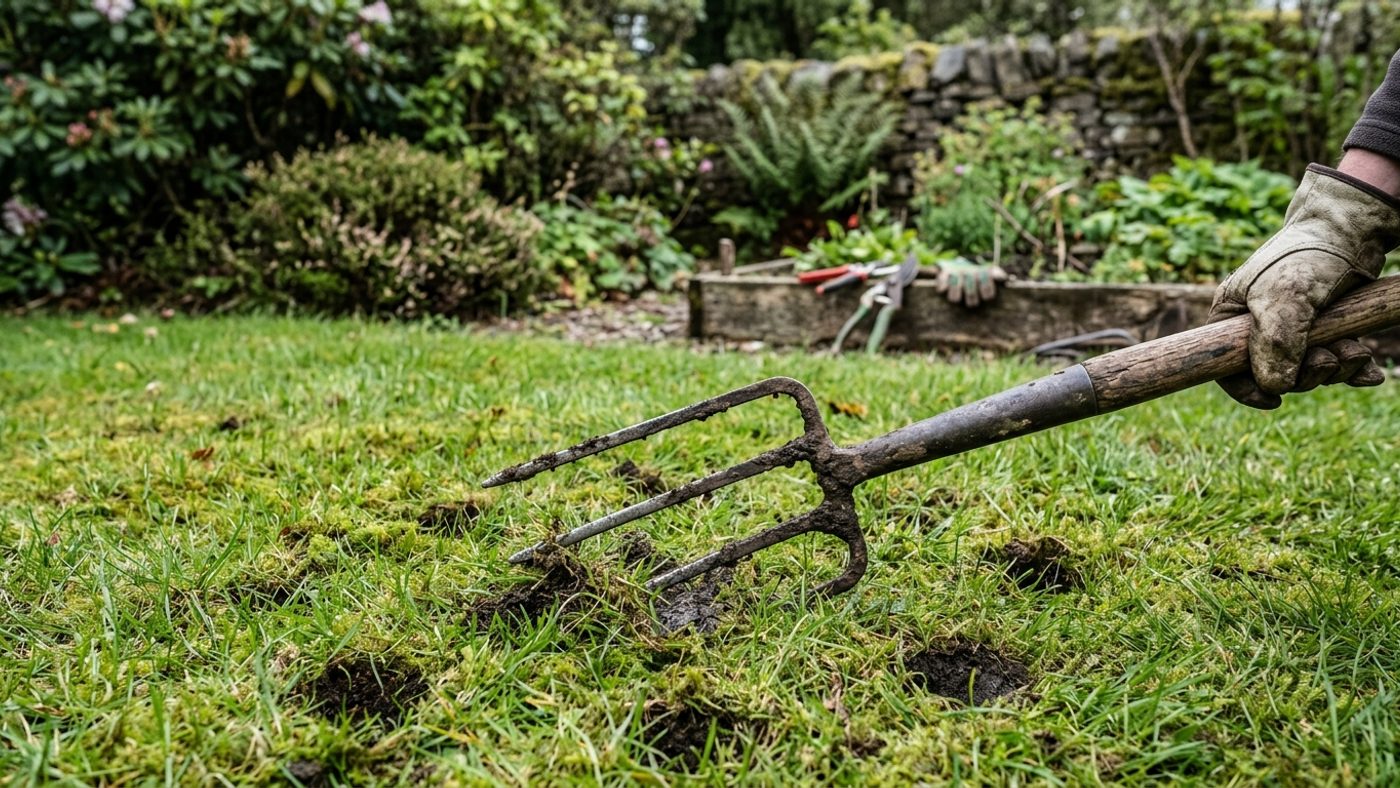
Aeration physically punches holes through compacted or clay-heavy soil so water and air can get back down to the root zone. Aim for holes 10-15cm deep, done every few years in autumn: autumn matters because the soil's damp enough to spike cleanly but the grass still has some growing season left to recover. In much of Scotland that window is worth planning around rather than leaving to the calendar: with spring the driest stretch and autumn through early winter the wettest (see above), aim for early-to-mid autumn while the ground is still workable rather than waiting until the wetter months make spiking clay heavy going, especially in the wetter west. For a garden lawn, a simple garden fork pushed in and rocked slightly does the job on a small area; hollow-tine aerators (which pull out a plug of soil rather than just pushing a spike in) do a more thorough job on more compacted ground because they actually remove material rather than just compressing it sideways.
Sand top-dressing: brush it into the holes, not on top of the grass
After spiking, brush a free-drainingSoil that lets water pass through quickly rather than pooling, so roots aren't sitting in wet ground after rain. Full definition → top-dressing, sharp horticultural sand, into the aeration holes so they don't just seal back over. Where you're renovating a badly waterlogged patch of turf entirely, lay a 5cm layer of sharp sand beneath the new turf as a drainage layer. This is a targeted use, sand worked into holes or laid as a sub-base directly under turf, and it's a different technique from mixing sand into clay soil generally to try to lighten it: unless applied in bulk (roughly 250kg per square metre, far more than a garden top-dressing), a small amount of sand stirred into clay usually packs the gaps between clay particles and makes the soil denser, not lighter, which is why the two techniques shouldn't be confused.
Scarifying: the fix if thatch is the culprit
If the thatch check above turned up a spongy brown layer rather than (or as well as) compaction, aeration alone won't clear it: scarifying, raking or machine-combing the thatch out of the lawn surface, is the direct fix, done alongside rather than instead of aeration since a heavily thatched lawn is often compacted underneath as well. Late summer to early autumn suits both jobs together, for the same reason autumn suits aeration: enough growing season left for the lawn to recover from what's inevitably a rough-looking few weeks afterwards.
Levelling and filling low spots
If water is pooling in one specific dip rather than across the whole lawn, the simplest fix might just be levelling: lift the turf, add topsoil to bring the low spot level with the surrounding ground, then relay. This won't fix a drainage problem underneath, but if the "waterlogging" is really just rainwater collecting in a shallow depression that would otherwise drain fine, it solves the visible symptom without needing anything more involved.
Drainage channels and French drains: when they're actually worth it
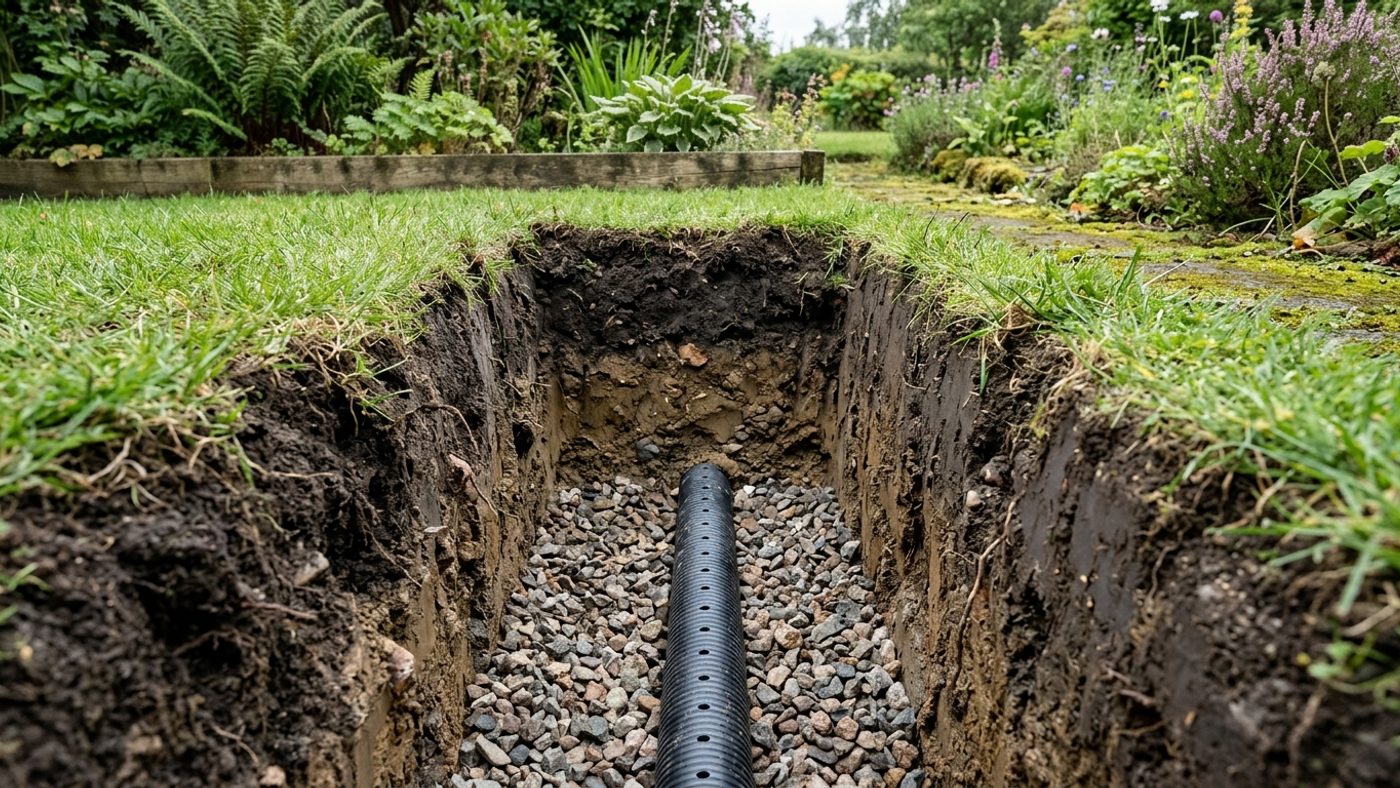
A French drain, a trench filled with gravel over a perforated pipe that carries water away to a soakaway or a lower point in the garden, is a proper engineering fix, not a quick weekend job, and it's worth being honest about when it earns its cost and effort versus the simpler options above.
| Fix | Effort | Cost | Best for | Permanence |
|---|---|---|---|---|
| Aeration/spiking | Low (afternoon) | Very low | Compaction, first response | Temporary, repeat every few years |
| Sand top-dressing | Low-medium | Low | Following aeration; new turf sub-base | Medium, needs topping up |
| Levelling low spots | Medium | Low | Isolated dips, not general drainage | Long-lasting for that spot |
| Drainage channel to a soakaway | Medium-high | Medium | Whole-lawn surface water with somewhere to send it | Long-lasting |
| French drain (piped) | High | Medium-high | Persistent wet strip, high water table, no natural fall | Long-lasting, low maintenance once in |
A French drain is worth the effort when aeration and top-dressing haven't solved it after a season or two, the wet area is a persistent strip or zone rather than the whole lawn, and you have somewhere for the water to actually go: a soakaway, a lower part of the garden, or, with the right permissions, a watercourse. It's usually not worth it for a lawn that's merely slow to drain after heavy rain but recovers within a day; that's normally a compaction and aeration problem, and a French drain is a lot of digging to solve something a fork would fix. A short domestic run is realistic as a DIY weekend job with hired tools; a longer run, awkward access, or ground that needs machine excavation is where most people bring in a contractor, and cost varies enough by drain length, depth and access that it's worth getting a couple of local quotes rather than guessing at a figure in advance.
Where your French drain's water actually goes decides whether you need anyone's permission before you dig.
| Where the drain discharges to | Permission needed? |
|---|---|
| Your own soakaway or existing surface water drainage | Normally covered automatically under SEPA's General Binding Rules (a set of standard conditions for low-risk activities, no separate application needed if you comply with them) |
| A watercourse (burn, ditch, loch) | Check with SEPA or your local authority first, a different, higher-risk category |
| Any soakaway, regardless of destination | Should sit at least 10 metres from a watercourse, permeable drain, loch, or the sea |
Don't take the first row as a blanket green light without checking your specific situation: this guidance is written primarily around septic systems rather than garden French drains specifically, so if you're draining anything more than ordinary surface rainwater, confirm with SEPA directly before you start digging.
After the fix: helping the lawn recover
Aeration and scarifying both leave a lawn looking rough for a few weeks, holes or bare patches and all, before it thickens back up. Overseed thin or bare patches straight after either job while the ground is still open, rather than waiting, and hold off on heavy feeding until the grass is actively growing again; feeding stressed turf too early pushes soft leaf growth the roots can't yet support. Autumn timing works in your favour here too, on the same wetter-autumn, drier-spring pattern already covered: new grass gets the moisture it needs to establish without the daily watering a spring or summer reseed would need.
Sowing Grass Seed → covers seedbed prep, germinationA seed sprouting: breaking dormancy and putting out its first root and shoot, given the right warmth and moisture. Full definition → temperature and watering in full, whether you're overseeding a recovering patch or starting a new lawn from scratch.
When to stop fighting it: rain gardens and bog features
Not every wet patch is worth draining. If the same low corner floods after every heavy rain, especially where it's collecting run-off from a roof, drive, or path rather than just sitting on slow- draining ground, it's worth considering working with that instead of against it: a rain garden or shallow bog bed, planted with moisture-tolerant species instead of turf, intercepts the run-off before it reaches drier parts of the garden and turns a recurring problem into a feature rather than an annual repair job. Moisture-loving plants that cope well with permanently damp ground, rather than fighting it, include hostas, astilbes, primulas, and ferns for a shadier spot, a very different planting list from the rest of the garden, and part of the appeal: it's the one corner where a persistently wet Scottish garden is an advantage rather than a problem to solve. This is worth considering seriously in the wetter west and in any garden shedding a lot of hard-surface run-off onto one corner of lawn, where drainage alone may be fighting a losing battle.
What not to do
Don't add loose sand directly to clay soil to "lighten" it. This is a genuinely persistent myth: mixed in the wrong ratio, sand and clay can combine into something closer to concrete, for the reason explained above. Sand belongs in aeration holes or as a proper drainage sub-base, not stirred into the topsoil generally.
Don't work or walk on waterlogged clay any more than you have to. Working wet clay, digging, heavy foot traffic, driving a mower over it, compacts it further and makes the underlying problem worse, even while you're trying to fix the symptom.
Don't assume a single fix will solve a whole-lawn problem overnight. Aeration typically needs repeating over a couple of seasons before compacted clay properly opens up; a French drain solves flow but not the surrounding soil structure.
Don't direct drainage water onto a neighbour's property. Deliberately channelling water so it floods next door, rather than to a soakaway or watercourse you're entitled to use, can leave you liable under the same general legal principle that stops any property owner from causing a nuisance or damage to a neighbour by redirecting water; a boundary or watercourse discharge is worth checking (see the table above), not assumed safe because it's off your own lawn.
Common questions
How long does it take for a waterlogged lawn to dry out naturally?
As a rough guide: a day or two once the rain stops is normal. Still holding water three or four days later with no further rain forecast is the point to stop waiting and start diagnosing, rather than assuming it'll clear on its own.
Will spiking my lawn with a garden fork actually make a difference, or do I need a proper aerator?
A garden fork, pushed in to about 10-15cm and rocked slightly to widen the holes, is a genuine fix for a small compacted lawn and a real baseline technique. Hollow-tine aerators (which remove a plug of soil rather than just compressing it) do a better job on more seriously compacted ground or larger areas, but a fork is a perfectly real starting point, not a placebo.
Can I just re-turf over a waterlogged patch?
Not without addressing what's underneath: new turf laid straight over compacted or waterlogged clay will develop the same problem within a season or two, sand layer or not. Fix the drainage first (aeration, sand sub-base, or a drainage channel if the patch is persistently wet), then re-turf or reseed; a standard hard-wearing lawn mix will keep thinning out in exactly the spot that stays wettest if the underlying problem hasn't actually been solved. Turf and seed suppliers do sell mixes marketed specifically for damp or shaded ground, usually leaning more heavily on fine fescues than a standard hard-wearing mix, worth asking for by name if the patch is a persistent problem, and worth prioritising over a standard mix in the wetter west, where the underlying ground stays damp for longer regardless of how well the drainage fix works.
Is moss on my lawn a sign of waterlogging, or just shade?
Often both at once, and worth checking rather than assuming either. Moss colonises damp, poorly-drained lawns as well as shady and acidic ones, and Scotland's own soil survey records notably acidic ground in large parts of the country, so it's a useful early warning sign but not proof of waterlogging on its own — check whether the mossy patches are also the ones holding water after rain, or whether they're simply the shadiest, most acidic corner of the garden regardless of drainage.
Do I need permission to install a French drain that discharges into a ditch or burn at the bottom of my garden?
Likely yes, in the sense of needing to check first rather than assuming it's fine: discharging into a watercourse is a higher-risk category than draining to your own soakaway, and it's worth confirming directly with SEPA or your local authority before you dig.
Sources
7 sources, recorded with what each was used for
- RHS: Waterlogged Lawns - Solutions: Causes of lawn waterlogging (compaction, clay, poor preparation), symptoms (bare patches, algae/lichens, moss, rush tussocks), aeration depth (10-15cm), sand top-dressing depth for new turf (5cm), and the rain garden/bog-bed alternative for a persistently flooded corner
- RHS: Clay Soils: Clay particle size (under 0.002mm) and the mechanism behind why clay drains poorly, and the roughly 250kg/sq m grit-dilution figure behind why a small amount of sand mixed into clay increases density rather than lightening it
- Scottish Government: The Scottish Soil Framework: Scotland-wide soil type percentages (podzols 23.7%, peat 22.5%, gleys 20.6%) and the geographic concentration of peaty/gley soils in the Highlands and Southern Uplands versus ordinary mineral soils in the Central Belt
- Met Office: Eastern Scotland climate: Annual rainfall figures for East Lothian/Fife/Moray Firth coasts (under 700mm) and the southern Grampians (over 1,500mm)
- Met Office: Western Scotland climate: Annual rainfall figures for the Ayrshire/Dumfries and Galloway coast (under 1,000mm) and the west Highlands (over 3,500mm), plus the region's year-round Atlantic weather influence and its seasonal wet/dry pattern
- SEPA: Discharging to land via a soakaway: The minimum 10-metre soakaway distance from a permeable drain, watercourse, loch, or the sea — written primarily for septic/sewage discharge rather than garden French drains specifically, so treated as a general benchmark rather than a definitive rule for this use
- SEPA: General Binding Rules for surface water discharge: Confirming low-risk discharges into a surface water drainage system are authorised under General Binding Rules without a separate SEPA application, provided the rules are complied with