

Check a Scottish weather forecast across almost any week outside a settled midsummer spell and the same problem shows up: a run of mowing-length dry hours rarely lines up with a free evening or a weekend. Grass does not pause its growth to wait for that gap. Through a damp spring or a wet autumn it keeps putting on height while the ground stays greasy underfoot, and the gap between "the lawn needs cutting" and "the lawn is actually dry enough to cut" can stretch on for days. Whether you can just mow anyway, with the grass or the ground still wet, is a genuinely practical question here, not a theoretical one.
The short answer
No, not if you can avoid it. Never mow wet or frosty grass: it can damage turf and compact the soil, and the fix is simply to wait until later in the day once the lawn has dried out, or to postpone the cut to another day. The same warning covers frost as well as wet, worth keeping in mind on a cold Scottish morning where the grass looks merely damp but is actually still frozen: frozen grass blades snap and bruise underfoot and under a mower blade in much the same way wet ones tear.
Knocking dew off the grass before mowing an early lawn is a simple, old habit worth reviving: dragging a cane, besom, or the back of a rake across the lawn, or just running a hose over it lightly and letting it drip off, clears surface dampness without needing to wait hours for the sun to do it, and it's often enough on its own to turn an unmowable early morning into a workable one.
Why mowing wet grass is worth avoiding
Soil compaction and rutting
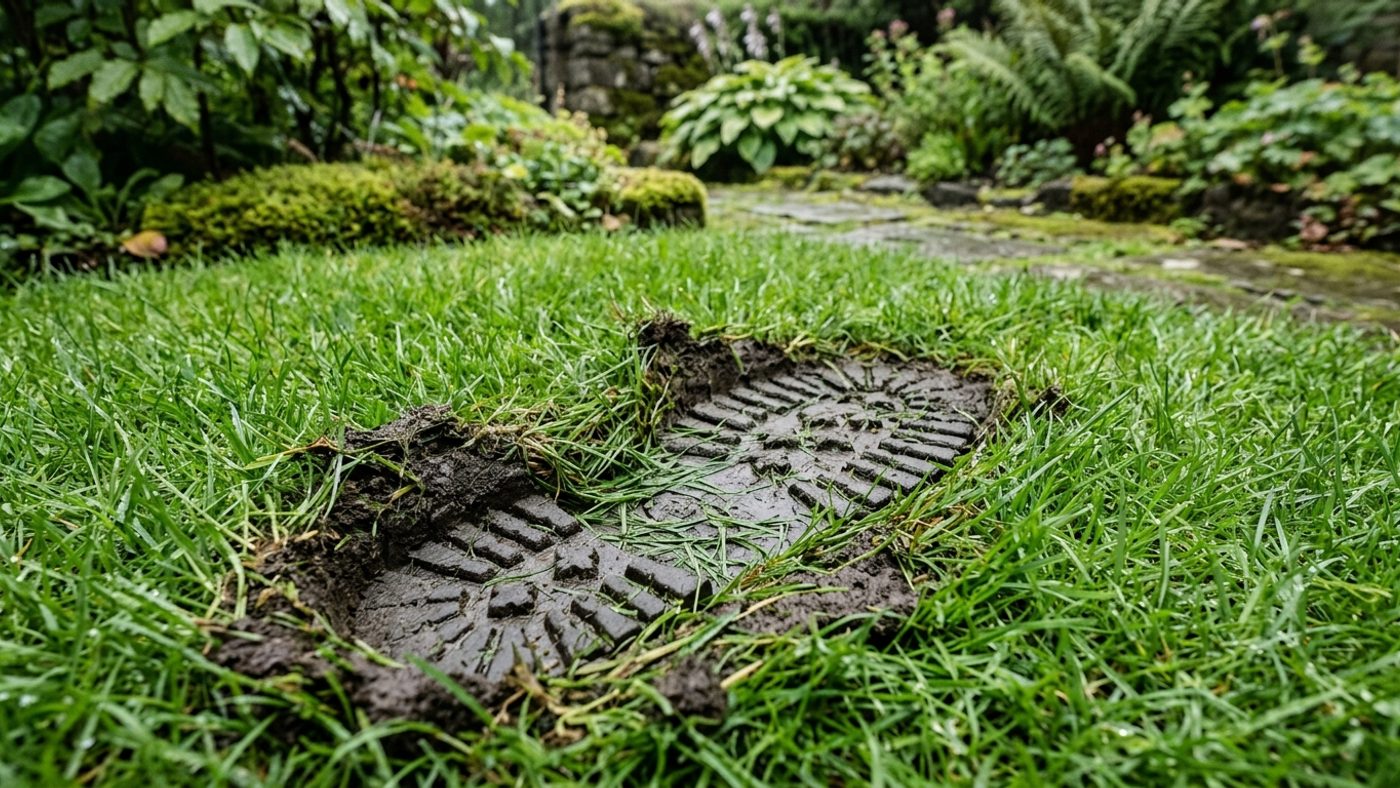
A mower, even a light push mower, presses down on ground that has far less structural resistance when it's saturated. Wet soil particles slide past each other more easily than dry ones, so wheels sink slightly, leave ruts, and squeeze air out of the pore spaces between soil particles. That compaction restricts root growth and drainage long after the grass itself has dried out, and it's why mowing wet grass causes real soil damage, not just a poor cut. Recovering from a few damp mows isn't complicated: aerating the lawn (spiking it with a fork or a hollow-tine aerator to open the compacted ground back up) once things properly dry out undoes most of the harm, and is worth doing as routine maintenance if a lawn's had a run of unavoidable wet-weather cuts. If your lawn already struggles with standing water or slow drainage as a matter of course rather than after one wet day, that's a separate underlying problem worth tackling directly: see fixing a waterlogged lawn on clay soil rather than trying to solve it through mowing technique. That guide covers heavy clay specifically; further north and west, thin, peaty topsoil over rock behaves differently again. It can shed surface water fast once saturated, but the compaction risk from mowing it wet is just as real, since peat compresses easily under weight even where it isn't holding a puddle.
An uneven, torn cut
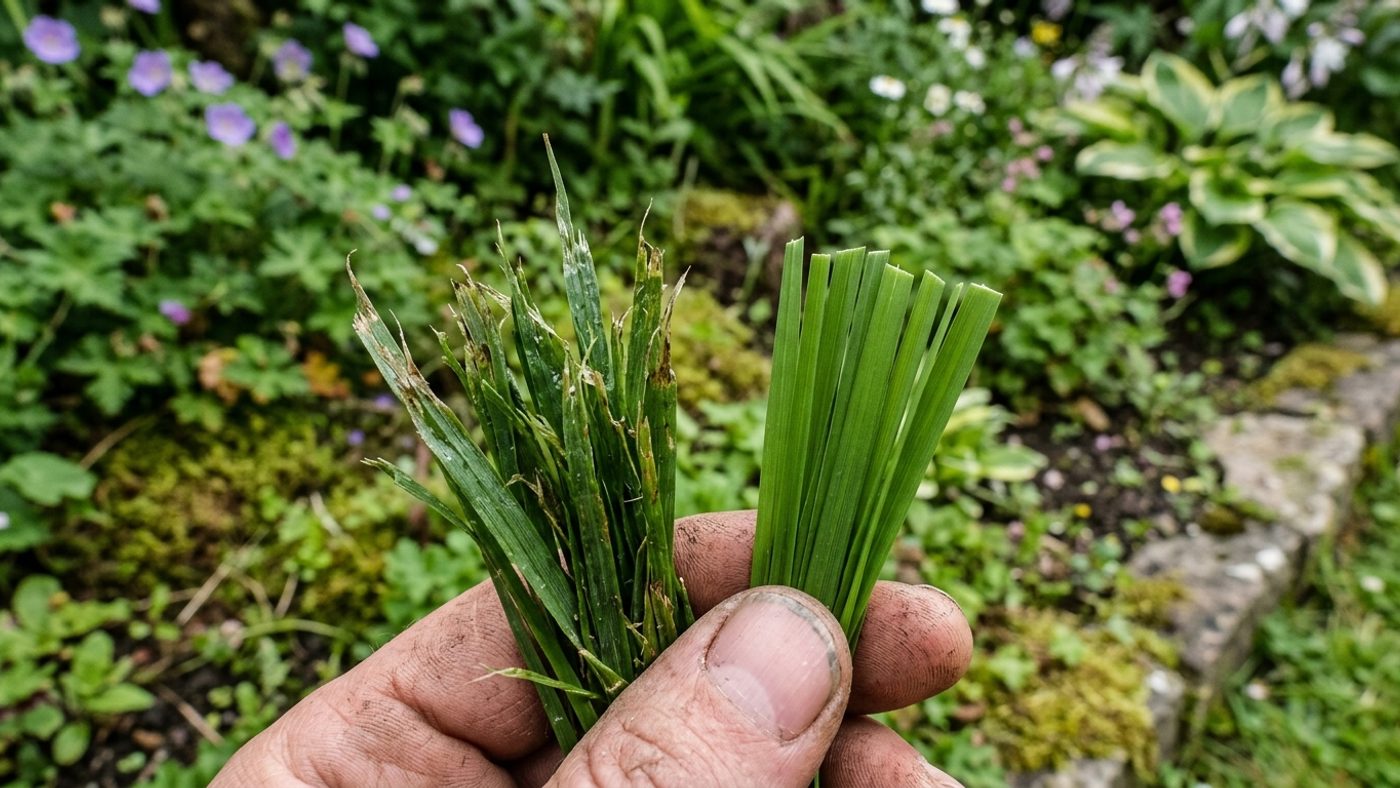
Wet grass blades are heavier and don't stand upright the way dry ones do; they flop and clump together under the weight of surface moisture. A mower blade moving through flattened, clumped grass doesn't slice cleanly through every stem, it tends to bend some blades out of the way and tear others rather than cut them. The result is a ragged, uneven finish, and torn grass tips brown off faster than a clean cut would, so the lawn can look patchy and stressed for days afterwards.
Mower clogging and strain
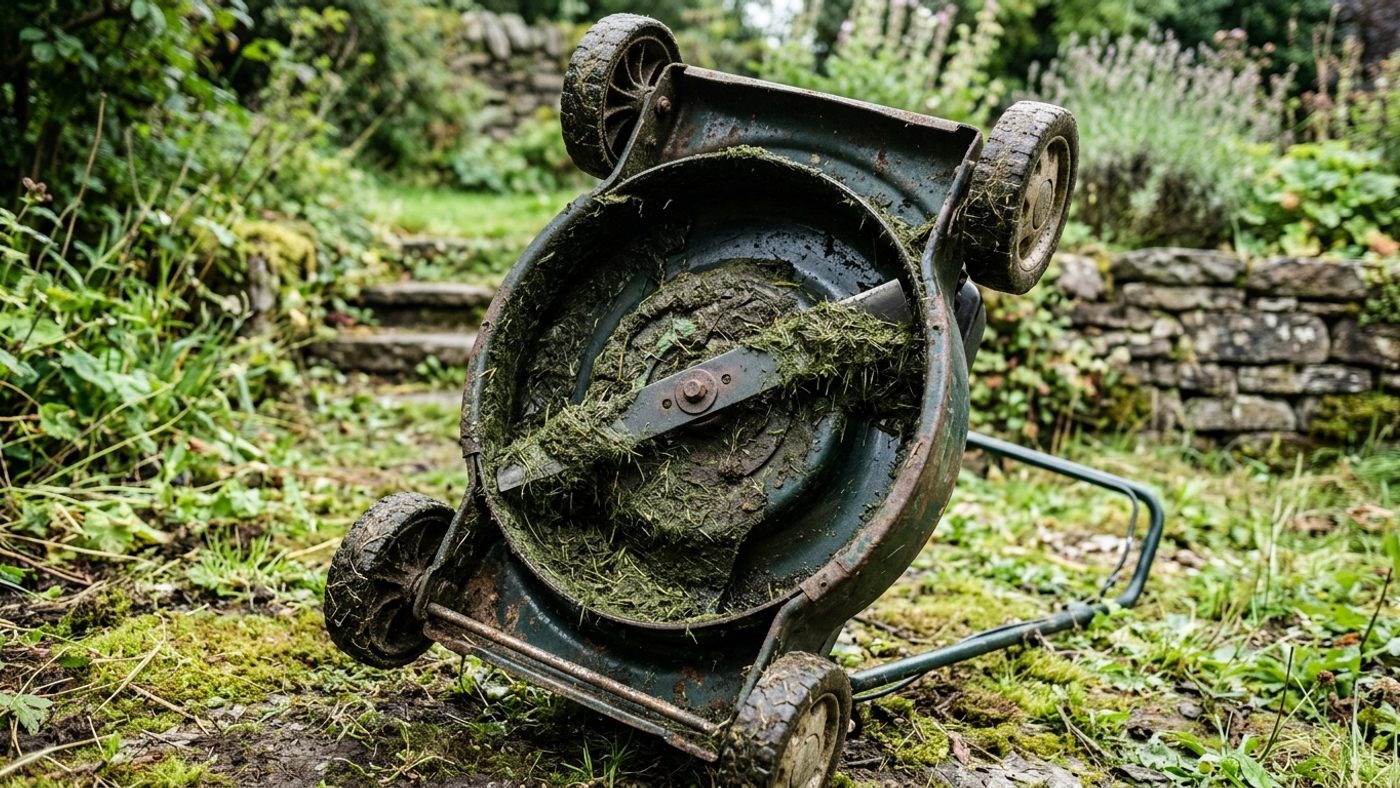
Wet clippings are sticky. Instead of flying cleanly into the collection box or scattering out to the side (side-discharge, a mower setting that spreads clippings across the lawn instead of bagging them), they gum up under the deck, clog the discharge chute, and pack around the blade itself. A mower working against that resistance has to work harder to keep turning, which strains the engine or motor, and on an electric or battery mower, wet grass and wet electrics are simply not a good combination from a safety point of view either.
Disease risk
Damp, humid conditions favour fungal lawn diseases such as red thread, and mowing through wet grass spreads fungal spores and damaged, vulnerable leaf tissue around the lawn on the blade and on your shoes. Cutting into already-stressed, torn grass tissue while it's still wet gives disease an easier opening than it would have on a dry cut.
Safety and control
Wet grass, wet paving, and wet slopes are slippery, and pushing a mower, or worse, riding one, over ground you can't get secure footing on is a real hazard, particularly on anything other than a flat lawn. Add in reduced visibility of tripping hazards hidden by longer, flattened wet grass, and the case for waiting isn't only about the lawn.
Does "just wait for a dry day" actually work in Scotland?
Met Office regional climate figures show Scotland is wetter than southern England overall, but the picture is not uniform, and the size of the gap depends heavily on which coast you're on.
| Region | Wet days, summer (Jun-Aug) | Wet days, winter (Dec-Feb) | Average annual rainfall |
|---|---|---|---|
| Eastern Scotland (East Lothian/Fife coast) | ~27 | ~30 | Under 700mm |
| Eastern Scotland (Grampian mountains) | 40+ | 55+ | Over 1,500mm |
| Western Scotland (Ayrshire/Clyde valley coast) | ~35 | ~45 (autumn) | Under 1,000mm |
| Western Scotland (west Highlands) | 40+ | 55+ | Over 3,500mm |
| Southern England (Thames Estuary/London) | ~25 | under 30 | Under 650mm |
| Southern England (South Downs/west) | ~25 | 35-40 | Over 950mm |
This splits by coast rather than applying to "Scotland" as a single climate: the table shows the sheltered east coast sitting close to the Thames Estuary's figures, because that stretch is sheltered from the rain-bearing westerlies that soak the rest of the country, while Ayrshire, the Clyde valley and the west Highlands sit directly in the path of Atlantic weather systems instead. The Met Office's own regional summaries add a further complication rainfall totals alone don't capture: they describe Eastern Scotland as one of the more windy parts of the UK and Western Scotland as one of the more exposed areas of the UK. Wind dries and flattens grass unevenly rather than helping it: a windy but recently-rained-on lawn can have a crusty, deceptively dry surface over ground that's still soft underneath, so it's worth checking the ground itself, not just how the grass looks, before deciding it's safe to mow.
So "wait for a dry day" is broadly workable advice on the drier eastern coastal strip, where dry windows aren't dramatically rarer than in much of England. It's a much less reliable strategy on the west coast and in upland areas, where a genuinely dry mowing window, ground dry enough not to compact or rut, can be scarce for days or weeks at a stretch, particularly in autumn. If you garden on that side of the country, building your mowing routine around occasional favourable windows rather than a fixed weekly slot is the more realistic approach, and adjusting technique for damp conditions matters more, more often. Fungal disease risk scales with the same regional split: a lawn that's rarely properly dry for long, as on the west coast or in the hills, gives red thread and similar damp-loving diseases more opportunity than a lawn on the drier east coast gets, on top of whatever damage mowing wet grass itself adds.
If you genuinely can't wait: what to do instead
Waiting is still the first choice whenever it's practical, but if the grass has got away from you during a wet spell and a proper dry window hasn't shown up, there are ways to reduce the damage.
- Raise the cutting height. Aim for the higher end of the normal range, 13-25mm for an ordinary lawn in summer, rising to as much as 40mm in spring and autumn, or higher still if you're mowing on damp ground. Taking less off the top in one pass reduces the tearing and clumping that wet grass is prone to, and that autumn allowance is worth leaning on hardest in the west and uplands, exactly where a genuinely dry autumn window is scarcest.
- Use a sharp blade. A dull blade is more likely to bruise and tear wet grass rather than cut it cleanly, compounding the ragged-cut problem.
- Switch to side-discharge rather than collecting. Wet clippings clog a collection box fast; scattering them (in small enough quantities that they don't smother the grass) reduces the strain on the mower and the amount of clogging you'll be clearing out afterwards.
- Go slower and avoid sharp turns. Slower forward speed gives the blade more time to cut cleanly through flattened, heavier grass, and avoiding tight turns reduces the amount of rutting on soft ground.
- Pick the driest part of the day. Late morning through early afternoon, once any dew or overnight rain has had a chance to lift, is usually a better window than early morning or evening, even on a day that isn't fully dry.
- Clear clippings off the lawn afterwards. Wet clumps left sitting on the grass block light and airflow to the leaf underneath, exactly the kind of damp, still condition that favours fungal disease.
There's no fixed, sourced number for exactly how long to wait, since it depends on how heavy the rain was, whether the sun's out afterwards or it stays overcast, and how exposed the lawn is to wind: a bright, breezy afternoon dries a lawn far faster than a still, grey one even with the same amount of rain behind it. As a practical guide rather than a rule, a light shower followed by sun or wind is often fine to mow within a few hours; a heavy, prolonged spell, or a grey, still day after it, is closer to waiting a full day, sometimes more if the ground itself stays saturated rather than just the grass surface. Checking the ground directly, walking across it and seeing whether your footprints spring back or stay pressed in, is a more reliable test than counting hours either way.
A strimmer is worth reaching for instead of a mower when the ground is too wet to risk but the grass badly needs taken down: it doesn't carry the same weight over the soil a mower does, so it avoids most of the compaction and rutting risk, even though the cut itself is rougher and won't leave a lawn-quality finish. It's a genuinely useful stopgap during a run of wet days rather than a full substitute for mowing.
Mower choice matters here too
Not every mower copes with damp grass equally. A cylinder mower, the type that gives the closest, most formal stripe, clogs and struggles badly on anything more than lightly damp grass, making it a harder-to-justify choice the further west or higher up you garden, where a properly dry cutting day is the exception rather than the rule. A rotary mower is more forgiving and the safer everyday default for exactly those gardens; on the drier east coast, where dry mowing days are closer to the English norm, a cylinder mower's fussier requirements are less of a practical handicap. A hover mower, which rides on a cushion of air rather than wheels, spreads its weight more evenly and doesn't leave wheel ruts the way a wheeled rotary or cylinder mower can, making it a genuinely useful option for a lawn that's boggy, sloped, or slow to firm up after rain. A petrol mower can also be more reluctant to start in damp, humid air, and a damp air filter or spark plug adds its own frustration on top of everything above: one more small reason a battery or electric mower (kept well clear of standing water) is worth considering for a garden that's frequently damp.
The first cut after a wet Scottish winter
Spring's first mow of the year is often the hardest case of all: grass that's grown long and soft over a wet winter, on ground that's had months to become saturated and has barely had a chance to firm up. Don't try to bring an overgrown, wet lawn back to its normal height in one pass. Cut high first, on the driest day available, then bring the height down gradually over the following few cuts once the ground has had a proper chance to dry and the grass has recovered its strength: a single hard cut on long, wet grass is one of the more reliable ways to scalp and rut a lawn in one go.
None of this fixes a lawn that stays soft and waterlogged for reasons beyond a wet week: poor drainage, compacted or heavy clay soil, or a low spot that collects water needs addressing at the soil level, covered separately in fixing a waterlogged lawn on clay soil. And if the grass itself is stressed from irregular watering rather than too much of it, general technique is covered in general watering technique.
Common questions
Is it worse to mow wet grass with an electric mower than a petrol one?
Yes, from a safety standpoint specifically. Wet grass, wet cable connections, and mains or battery electrics are a poor combination, and manufacturers generally warn against using corded electric mowers in wet conditions for that reason. Petrol and battery mowers avoid the mains-cable risk but still suffer the same clogging, compaction and uneven-cut problems as any mower on wet grass.
Will mowing wet grass just once actually cause lasting damage?
A single pass on lightly damp grass is unlikely to cause serious harm, particularly on a lawn that already drains well. The risk scales with how saturated the ground is and how heavy the mower is: a single pass with a ride-on mower on genuinely waterlogged turf is far more likely to leave lasting ruts than a light push mower on grass that's merely still damp from morning dew.
Should I mow before or after rain that’s forecast later in the day?
Before, if a choice is available. Cutting into a spell of drying weather rather than straight into rain gives the grass longer to recover and dry the fresh cut ends before the next wet spell arrives. Mowing right before heavy rain that then sits on freshly cut, torn ends is one of the more disease-favourable combinations you can create.
How can I tell if the ground itself is too wet, even if the grass looks dry on top?
Walk across the lawn first. If your footprints stay pressed into the turf rather than springing back, or if the ground feels spongy or squelchy underfoot, the soil is holding more water than the surface appearance suggests, and mowing is likely to compact or rut it even if the grass blades themselves look dry.
Does robotic mowing avoid the wet-grass problem?
Robotic mowers that cut little and often keep grass shorter overall, which reduces the amount of flattened, clumped material any single pass has to deal with, and many models include rain sensors that pause cutting during and after rainfall, a genuinely useful feature on the west coast or in the hills, where those pauses will trigger far more often than on a drier east-coast lawn. They don't remove the underlying soil compaction risk on genuinely waterlogged ground, though: a lightweight robot still adds weight to soft turf, just less than a push mower does.
Sources
5 sources, recorded with what each was used for
- RHS: Mowing: The core 'never mow wet or frosty grass' guidance, cutting-height figures by season (13-25mm summer, up to 40mm spring/autumn), and the turf-damage/soil-compaction mechanism. UK-wide guidance, not Scotland-specific.
- RHS: Drought care: General RHS lawn-care framing. UK-wide guidance, not Scotland-specific.
- Met Office: Eastern Scotland climate: East Lothian/Fife coast and Grampian mountains rainfall and wet-day figures, and the 'one of the more windy parts of the UK' finding
- Met Office: Western Scotland climate: Ayrshire/Clyde valley and west Highlands rainfall and wet-day figures, and the 'one of the more exposed areas of the UK' finding
- Met Office: Southern England climate: Thames Estuary/London and South Downs rainfall and wet-day figures, used as the comparison baseline for the east-coast-vs-southern-England finding