
A plant loses water constantly through its leaves as part of normal gas exchange, it has no way to switch this off entirely, even when nobody is coming to replace what's lost. Water lost through the leaves is normally pulled up from the soil to keep every cell in the plant firm and swollen against its own walls. That firmness is what holds leaves and stems upright; it's also what keeps the stomata (the pores that let a plant absorb carbon dioxide) working properly. When the soil dries out faster than the roots can draw on it, that supply falls behind demand, and the plant starts to run a deficit it can't recover from on its own.
Scotland's long summer daylight hours mean more of the day is spent in active light, and light is what keeps the stomata open and water moving out, which is part of why a bright windowsill pot can run down faster than its size suggests.
The earliest sign is often reversible: growing tips going limp on a warm afternoon, then looking fine again by the next morning as conditions cool and demand drops. That daily wilt-and-recover cycle is a plant coping, not yet a plant in trouble. It's the point after that, when the deficit doesn't clear overnight, where damage starts to compound. Foliage fades from its normal colour, then wilts and fails to recover; leaf margins and tips die back; leaves drop prematurely. Left long enough, and especially in prolonged heat, the damage moves beyond the leaves into dieback of shoots and branches. On holiday, nobody is there to catch a plant at that reversible, overnight-recovery stage, whatever system replaces you has to do that job unattended, for however many days you're away.
For reading soil and watering correctly day to day, see the general watering technique guide.
The options
Each option below suits a specific situation and fails in its own specific way, none replaces a person checking in.
| Method | Best suited to | Typical duration it can cover | Set-up effort | Reliability unattended |
|---|---|---|---|---|
| Upturned bottle / wick (string or fabric) | A handful of individual pots, short absences | Days, not weeks | Low | Low, flow rate is inconsistent and hard to predict |
| Capillary matting | Multiple small/medium pots on a windowsill, sink, or greenhouse bench | Up to around a week or two, reservoir-dependent | Low–moderate | Moderate, good for grouped pots, poor for anything not touching the mat |
| Self-watering container/reservoir | Individual containers, especially thirstier plants in pots | Days to a few weeks depending on reservoir size and heat | Low (if already using one) | Moderate–high, but only as good as the reservoir capacity vs weather |
| Drip irrigation kit with timer | Greenhouse, polytunnel, or a bench/bed of containers | Two weeks or more | Moderate–high | High, but only if every joint, dripper, and the timer itself is checked first |
| A neighbour or plant-sitter | Anything, any duration | Whatever you ask them to cover | Low (a spare key and clear instructions) | High, if they actually show up |
Cost follows a similar order: bottles and wicks are near-free improvisations, capillary matting is a modest one-off purchase, self-watering pots cost more per container but need no extra kit, and a basic timer-driven drip kit costs the most of the group, since it needs a tap connection, tubing, drippers, and a battery-powered controller where the others need none of that.
None of the container-based systems here transfer to open ground, a vegetable plot or bed needs a deep, thorough water and a layer of mulchA layer of material spread over the soil around plants to suppress weeds, retain moisture, and improve soil structure as it breaks down. Full definition → before you leave instead, covered under "Beds and borders" below.
Capillary matting
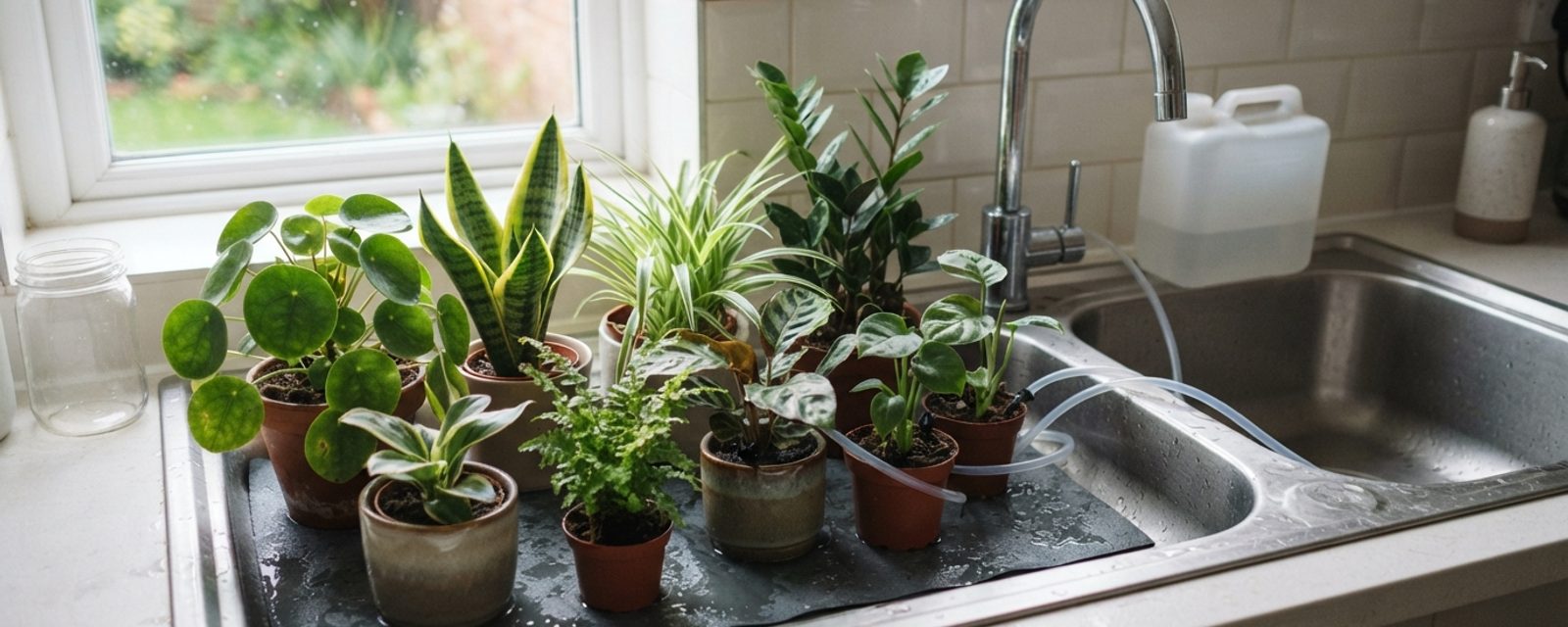
Capillary matting works by wicking: one end sits in a water reservoir (a sink, bath, or a tray of water), the mat itself stays wet, and pots stood on it, or with a wick of matting tucked into the pot, draw water up through their drainage holes by capillary action. It suits grouped pot plants on a windowsill, draining board, or greenhouse bench, not garden beds or borders, where there's no continuous wet surface for roots to draw from.
For it to work, the pot has to make real contact with the wet matting, press pots down slightly onto the mat for good contact, and clay pots need watering thoroughly first before they'll start drawing water up through the mat at all. It doesn't suit pots with broken crocks (the curved pieces of old pot traditionally used to cover a drainage hole) blocking the drainage holes, since that breaks the contact the whole system depends on. It's a short-term measure, suited to the length of a typical holiday, not an ongoing substitute for watering.
Simple drip irrigation kits with a timer
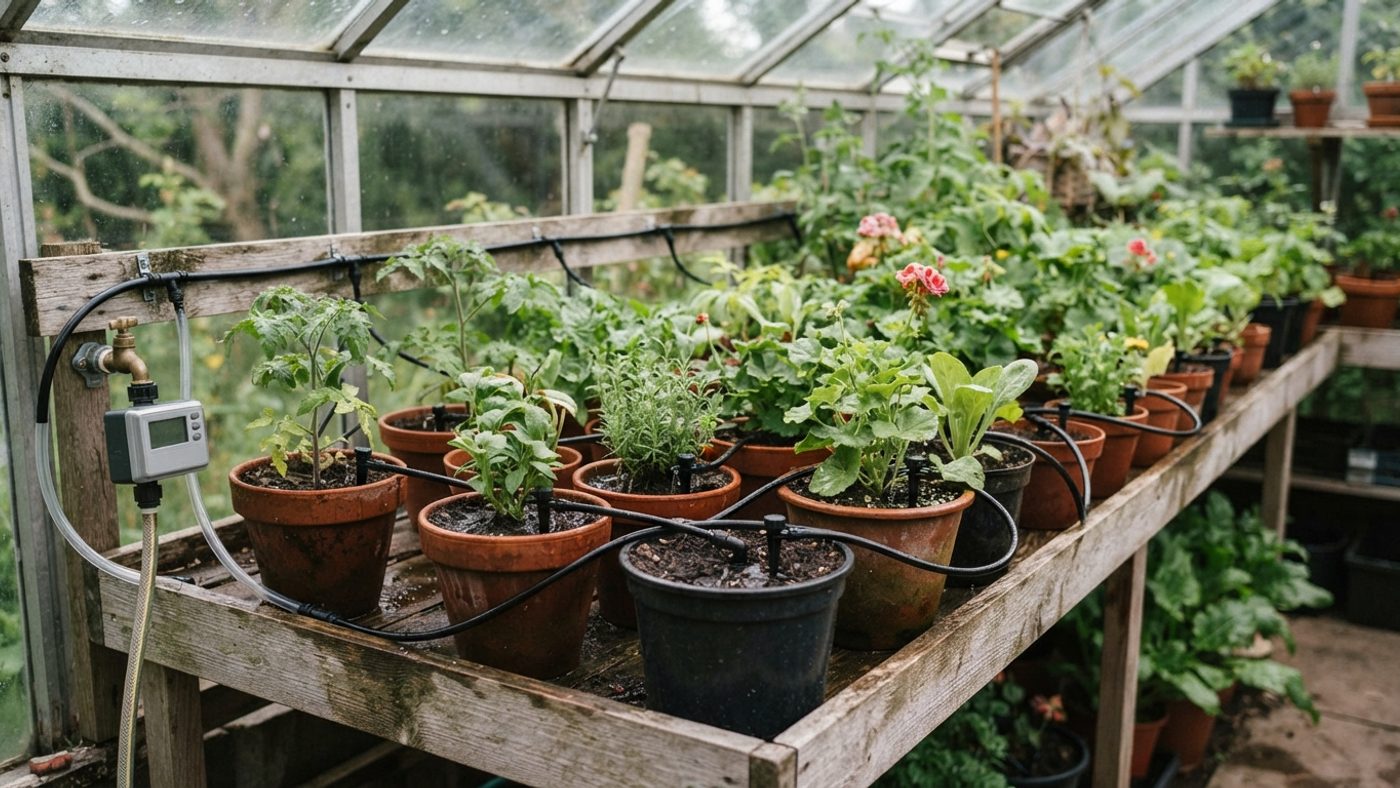
A basic drip or trickle kit runs a length of tubing from an outdoor tap (or a header tank, a raised reservoir that feeds the system by gravity where there's no tap nearby) to individual drippers positioned at each pot or plant, with a battery-powered timer opening and closing the water supply on a schedule. It suits a greenhouse, polytunnel, or a bench of containers, an automatic system worth setting up specifically for when you're away in summer. Unlike capillary matting, it can cover many more plants at once and doesn't depend on physical contact between pot and reservoir, each dripper delivers its own measured amount.
The trade-off is complexity: more parts means more places for the system to fail silently while nobody's there to notice, see the failure modes below, and it needs testing and running for a few days before you leave, not switching on for the first time as you're walking out the door.
Self-watering containers and reservoirs
Self-watering containers have a reservoir beneath or beside the growing medium that the plant draws from via capillary action or a wicking cord, topped up from an access point rather than watered from above. They suit plants that tolerate consistently moist compost and are better thought of as a long-term growing setup than something to repot into purely for a fortnight away, converting a plant into a self-watering pot just before a holiday isn't the quick fix it sounds like if you're not already growing in one. They're also a poor match for plants like citrus that need their compost to dry out between waterings, since a reservoir system tends to keep the root zone consistently damp rather than cycling wet and dry.
Low-tech options: wicks and upturned bottles
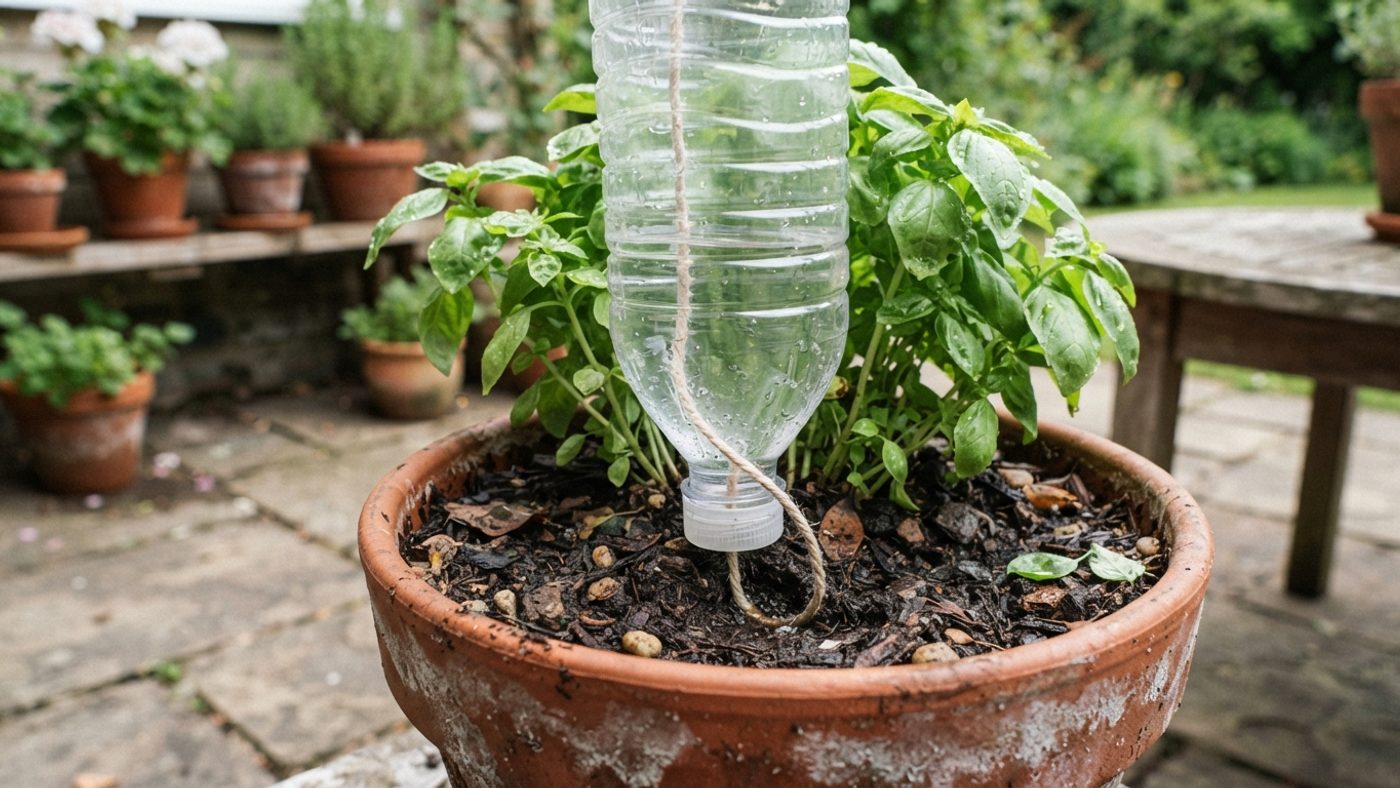
An upturned bottle pushed neck-down into the soil, or a length of cord/shoelace running from a bucket of water into the compost, is the cheapest and most commonly repeated holiday-watering tip. A wick made from cord or shoelace, run from a water reservoir into the pot, works by the same wicking action: capillary action along the fibres carries water into the compost, and larger containers or thirstier plants may need several wicks run into the same pot to deliver enough moisture. It's also the least precise system here, flow depends on wick material, how firmly it's packed into the soil, and how far it has to travel, none of which is easy to calibrate before you leave or adjust once you're away.
The upturned-bottle method sits on thinner ground. It's a plausible idea, a slow drip from a buried bottle neck, but nobody's pinned down how much water it actually delivers or how consistently, in the way the wick and capillary-matting methods above are understood. Treat it as an improvised backup for a few individual pots over a long weekend, not as something to trust for two unattended weeks.
Real failure modes worth knowing before you rely on any of this
Every system above fails in a specific, unglamorous way, usually the kind that isn't obvious until you're already on a plane.
Drip kits. A kinked or pinched length of tubing stops flow to everything downstream of the kink; a blocked dripper (from debris, or mineral buildup in hard-water areas, less of a factor across most of Scotland's soft mains water than in the hard-water parts of England) silently starves one plant while the rest of the system reports nothing wrong; a timer's battery dying partway through the trip means watering simply stops, with no alert.
Capillary matting. The edges and corners of the mat dry out first, so pots placed near the edge rather than the centre may not get consistent contact with moisture, a mat that looks wet in the middle can be dry exactly where a pot is standing.
Self-watering reservoirs. In a genuine hot spell, a reservoir sized for normal conditions can run dry well before two weeks are up, especially for larger, thirstier plants, the reservoir buys time, it doesn't remove the ceiling.
Wicks. A wick that slips out of the pot, dries out, or was never packed firmly enough into the compost simply stops transmitting water, and there's no visible sign of failure from outside the pot.
Trays and reservoirs generally. A tray or reservoir left full and undisturbed for two weeks in summer is also a still-water breeding site for midges, worth siting away from doors and seating areas, and emptying and refreshing it on your return rather than leaving it standing.
Water where it shouldn't be. An indoor reservoir or tray sized generously "to be safe" can overflow onto a windowsill or floor if it rains harder than expected into an open one, or if a mat or wick delivers less evenly than planned, worth setting up on a towel or tray rather than directly on flooring or furniture that water damage would matter to. Outdoors, keep any timer's battery compartment and cable connections under cover or in a weatherproof housing, not just resting in the open, a UK summer fortnight is rarely reliably dry for two straight weeks anywhere in Scotland.
Test any system for several days before departure, in the same conditions (sun, temperature) it'll face while you're away, and check it's still running just before you leave.
Does Scotland's climate actually reduce the risk?
Long-term (1991-2020) averages put summer rainfall noticeably higher at Edinburgh's Royal Botanic Garden than at Kew Gardens in London:
| Month | Edinburgh (Royal Botanic Garden) | Kew Gardens, London |
|---|---|---|
| June | ~66mm | ~50mm |
| July | ~72mm | ~45mm |
| August | ~72mm | ~55mm |
Edinburgh runs 30-60% wetter than Kew across those three months. Scotland's rainfall pattern isn't uniform, the west coast runs considerably wetter again than Edinburgh, while parts of the east such as Fife, Angus, and Aberdeenshire sit closer to Edinburgh's totals than to the west's, and some drier eastern spots can approach south-east England's figures in a given month. Edinburgh's figures are a reasonable middle-ground illustration, not a number that applies uniformly nationwide: an unattended pot or bed left outdoors in most of Scotland has a genuinely better chance of getting topped up by rain during a two-week absence than one in south-east England, but how much better depends on where in Scotland it is.
That's the normal-year picture, and it isn't guaranteed to hold every single year. Provisional figures for July 2026 show what an unusual year looks like: Scotland still received only around 69% of its own long-term average rainfall that month, a real shortfall, while parts of England and Wales fared considerably worse again, recording under 10mm of rain across the entire month against their own much higher normal totals, among the driest Julys on record there. The general pattern, Scotland wetter, England drier, still held in relative terms, but it's a reminder that "usually wetter" isn't "guaranteed wet," and a below-average, drier-than-usual month can still happen here. It also does nothing for anything under cover: a greenhouse, polytunnel, or windowsill pot gets no benefit from outdoor rainfall at all, and needs the same drip kit or capillary matting a grower anywhere else in the UK would use. The heatwave watering guide covers the broader picture, overwatering is usually the likelier mistake here day to day, but that doesn't remove the risk from a genuinely unattended fortnight in containers or under glass.
Matching the system to the situation
Houseplants and windowsill pots, one week or less. Grouped capillary matting on a sink or draining board, or a simple wick into a filled reservoir, covers most common houseplants. Moving pots off a bright, hot windowsill and into a cooler spot out of direct sun before you go cuts water demand further, and grouping plants together raises humidity around their leaves and slows moisture loss. Cacti, succulents, and other plants adapted to dry conditions can generally go two to three weeks without any system at all.
Containers and hanging baskets outdoors, two weeks. Outdoor containers across most of Scotland get a genuine assist from rainfall, but shouldn't rely on it alone, move them out of full sun and off south-facing walls, group them together, and use a drip kit or capillary system as the primary plan with rain as backup, not the reverse.
Greenhouse or polytunnel, any absence over a few days. A timer-driven drip kit is the option actually designed for this; nothing under cover benefits from rain.
Beds and borders. None of the systems in this article are built for open ground, capillary action and drip emitters both depend on a defined container or growing point, not an open bed. A thorough, deep watering before you leave, plus mulch to slow evaporation, does more good here than trying to rig a holiday system to a border. That same damp, sheltered mulch is also good slug and snail habitat, so it's worth a check on vulnerable young plants as soon as you're back.
Any of the above, for genuine peace of mind. A neighbour or friend with a key and clear instructions covers situations none of the mechanical options can, topping up a reservoir that's run low, noticing a burst pipe, or simply watering more on a hot day than a timer was set for.
If your drip kit draws from stored rainwater rather than a tap, the guide to setting up a water butt covers sizing and positioning, a butt can run low exactly when you need it most, in a dry spell, so it isn't a substitute for checking the reservoir before you leave.
Common questions
Will my plants definitely be fine for two weeks with a drip kit and no one checking on them?
Not definitely, a drip kit is the most reliable unattended option covered here, but it still depends on nothing kinking, blocking, or losing power for the full two weeks. Run it in beforehand rather than trusting it untested.
Is capillary matting any good for garden beds or borders while I’m away?
No, capillary matting works by wicking water into pots that are in direct contact with the wet mat. It has no way to reach an open bed or border with no defined container, so it’s suited to pots on a windowsill, sink, or greenhouse bench only. For borders, a thorough deep watering and mulch before you leave does more good.
Do I need any of this if I’m only away for a week in a typical Scottish August?
For most houseplants, a week without watering is manageable on its own, and outdoor containers across most of Scotland get a genuine assist from typically higher summer rainfall than southern England, though how much varies by region. It’s not a guarantee, though, Scotland can still run a drier-than-average month, so grouping pots out of full sun and using a simple wick or capillary system as backup is worth the low effort involved.
What’s the actual difference between a self-watering container and just standing pots in a tray of water?
A self-watering container has a built-in reservoir the plant draws from continuously, designed as an ongoing growing setup rather than a temporary fix. Standing pots on wet capillary matting or in a shallow reservoir is the improvised equivalent for a holiday, using the same wicking principle without repotting the plant into different growing equipment.
Are upturned bottles actually a reliable way to water plants while I’m away?
It’s less reliable than wicks or capillary matting: no figure exists for how much water an upturned bottle actually delivers, and flow depends heavily on the bottle, the soil and how it’s positioned. Treat it as a rough backup for a few individual pots over a few days, not a system to rely on for two unattended weeks.
Sources
11 sources, recorded with what each was used for
- RHS: Houseplants: Holiday Care Tips: Wick method, capillary matting method and limitations, self-watering container suitability, covering plants for short absences
- RHS: Watering Wisely: Automatic watering systems for containers and hanging baskets when away in summer
- Gardeners’ World: Holiday Care for House Plants: Capillary matting sink method, plant water-tolerance durations (one week for most houseplants, two to three weeks for drought-tolerant species)
- Gardeners’ World: How to Holiday-Proof Your Patio Pots: Low-tech outdoor container measures (sinking pots, shade, saucers)
- Gardeners’ World: Setting Up a Self-Watering System: DIY capillary-matting reservoir build, setup time, need for periodic topping up
- UC IPM: Water Deficit and Excess: Water deficit symptom mechanism (fading, wilting, marginal dieback, premature leaf drop)
- UC IPM: Water Management and Pest Problems: Early vs. severe drought-stress symptom progression, dieback and bark cracking under prolonged stress
- UC IPM: Estimating Irrigation Needs: Afternoon wilting with overnight recovery as an early, reversible stress indicator
- Met Office: Location-specific long-term averages, Edinburgh Royal Botanic Garden (1991-2020): June/July/August rainfall averages
- Met Office: Location-specific long-term averages, Kew Gardens (1991-2020): June/July/August rainfall averages, comparison point for the Scotland climate section
- Met Office: Weather and Climate summaries: July 2026 provisional rainfall figures for Scotland vs. England and Wales