
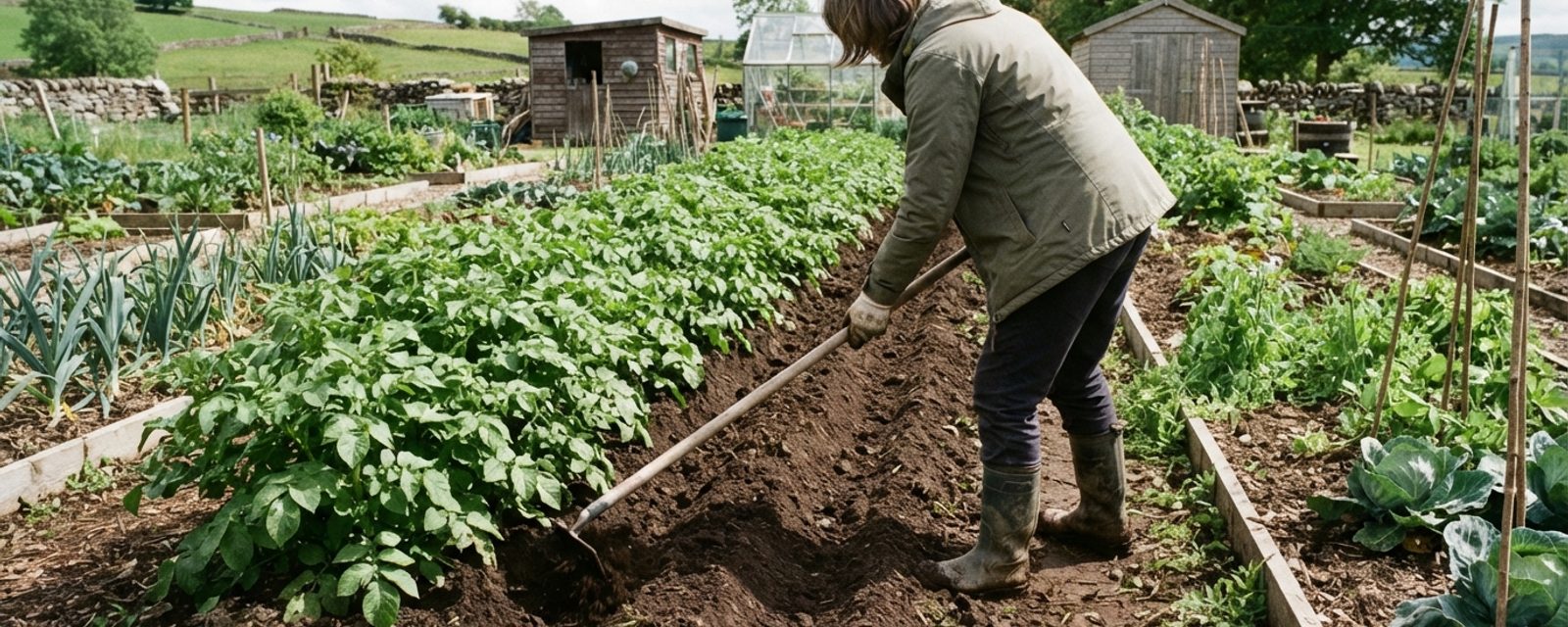
Potatoes don't grow the way most root vegetables do. A carrot or a parsnip is a swollen taprootA single, thick, dominant root growing straight down from a plant, storing energy and anchoring it, as opposed to a spreading mass of fine roots. Full definition →, growing straight down from the seed. A potato tuber is something else entirely, a swollen underground stem, produced at the tip of a horizontal shoot called a stolon that the plant sends out sideways from its main stem, just below soil level. Each stolon can produce several tubersA swollen underground stem or root a plant uses to store energy, which can also grow into a new plant, the classic example being a potato. Full definition →, and how many tubers you get, and how big they grow, depends partly on how much loose, dark soil those stolons have to work with.
That's the whole logic behind earthing upDrawing soil up around a plant's base as it grows, most often potatoes, to keep light off developing tubers and support tall stems. Full definition →.
Why darkness matters: the mechanism
A stolon tip only turns into a tuber if it stays underground and in the dark. If it breaks the surface and finds light instead, it doesn't die, it turns green. The tuber's outer cells start producing chlorophyll, the same pigment that greens up leaves, and that process runs alongside the plant's production of a natural toxin, solanine, part of a family of glycoalkaloid compounds that potatoes make as a defence against being eaten. Light-exposed potatoes turn green and accumulate solanine, and are potentially poisonous as a result.
Solanine isn't just unpleasant-tasting, it's genuinely toxic in enough quantity, causing nausea, vomiting, and gastrointestinal upset, with the green colouring acting as a visible warning sign because greening and solanine build-up happen together in the same light-exposed tissue. The concentration is highest in and just under the green skin, which is why cutting away a small green patch on an otherwise sound potato is a reasonable practical response, but a tuber that's substantially or uniformly green should be discarded rather than trimmed.
Earthing up does a second job, separate from keeping tubers dark: it keeps giving the stolons fresh, loose soil to extend into as the plant grows. More soil depth means more room for stolons to run and more tubers to set, which is the main reason earthing up is credited with increasing yield, not just protecting it.
When to start
Wait until shoots have grown enough that you can bury a good depth of stem without smothering the plant completely. Sources vary a little on the exact trigger height:
| Source | Start height | First earthing leaves showing |
|---|---|---|
| RHS | 23cm | top 10cm |
| Garden Organic | 15cm | top 5cm |
| Gardeners' World | 20cm | roughly half the stem |
The differences matter less than the principle: earth up before stolons have had a chance to form tubers near the surface, and never so early that you bury the whole plant and stop it photosynthesising. If shoots are still short and a late frost is forecast, a light covering of soil or fleeceA lightweight, breathable fabric laid or draped over plants to trap a little warmth and keep off frost, wind and some flying pests. Full definition → over the tips protects against frost damage in the same movement as the first earthing. Once the plant is past that first flush of growth, frost protection and keeping tubers dark become separate jobs, each needing its own attention through the rest of the season. A late frost is a real risk into late spring across much of Scotland, check the full regional breakdown on the frost dates page if it's a recurring problem on your plot.
Variety changes how much of this schedule you actually need. First earlies are often lifted as "new potatoes" within a couple of months of planting, long before a full ridge would ever be built, so one or two earthings is usually enough. MaincropThe main, usually latest-sown and longest-growing type of a crop, grown for bulk and storage rather than an early harvest. Full definition → varieties, left in the ground for the whole season to bulk up, need the complete two-to-three-round schedule and the full 20-30cm ridge, they have far more time for stolons to run, and far more time for a shallow ridge to erode or a stray tuber to surface, exactly the erosion risk that makes ridge shape matter more on Scotland's heavier clay soils.
How much soil, and how often
A draw hoe is the standard tool, its blade pulls soil toward you rather than pushing it, which makes forming a ridge along a row much less effort than working with a spade.
A useful refinement is to leave a shallow trough running along the top of the ridge rather than a sharp peak. That channels rainfall down into the ridge toward the root zone instead of shedding it off to the sides, worth doing anywhere, but especially on the heavier, slower-draining soils common across Scotland.
Container and raised-bed growing gets the same treatment in miniature: instead of drawing up garden soil, top up with fresh compost as the stems grow, following the same "leave the tip showing, repeat every few weeks" logic.
Scotland's wetter soils: what changes
The mechanism doesn't change north of the border, tubers still need darkness, and a ridge is still a ridge. What can change is the soil itself. Clay and clay-loam are common across Scottish gardens and allotments, and they hold water for longer than a free-drainingSoil that lets water pass through quickly rather than pooling, so roots aren't sitting in wet ground after rain. Full definition → loam does, which general UK growing advice doesn't always account for. On that kind of ground, two things are worth doing differently.
First, a flat-topped or trough-shaped ridge is worth more effort here than it would be in a naturally free-draining plot, because it stops rain simply pooling around the stem base in heavy soil, a sharp-peaked ridge sheds water to the furrows either side, which is fine in light soil but can leave a waterlogged trench running the length of the row in clay.
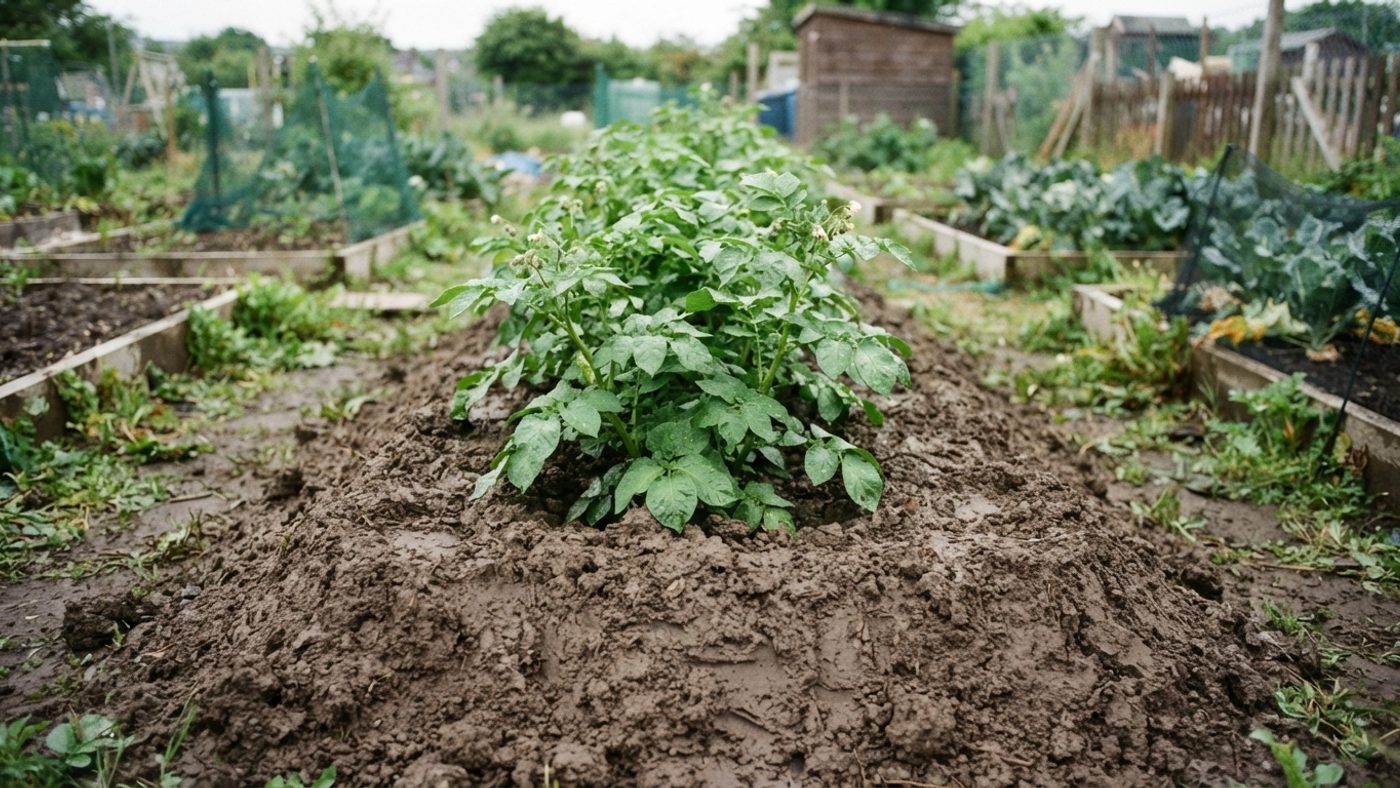
Second, don't compact wet clay into a dense ridge. Firming soil down when it's sodden squeezes out the air pockets tubers and roots need, and a compacted ridge drains worse, not better, than a loosely mounded one, it also directly undoes the second reason for earthing up in the first place, since a solid mass of compacted clay gives stolons far less room to extend into than the same soil left loose. If the bed is heavy and wet, it's worth working in organic matter at planting time to open the structure up, and earthing up with a lighter hand, draw the soil up without pressing it down hard.
Waterlogged, poorly drained soil around the stem base is also one of the conditions that favours potato blight. Discarded potato dumps and self-sown volunteer plants are the main early sources of blight infection in Scotland, and no variety grown here is fully resistant, so a plot with good drainage and no groundkeepers left over from a previous crop is doing real work against the disease before it even arrives. Getting drainage right during earthing up serves both goals at once: it protects the developing tubers from light and keeps the base of the plant less hospitable to infection.
Alternative methods
Earthing up isn't the only way to keep tubers dark. An alternative is to cover the row with a thick layer of straw, hay, leafmould, or grass clippings instead of soil, which blocks light just as effectively while also suppressing weeds and helping retain soil moisture. A more extreme version is a no-digA growing method that avoids turning the soil over, building fertility instead by adding organic matter on the surface. Full definition → method, shallow planting under a deep mulchA layer of material spread over the soil around plants to suppress weeds, retain moisture, and improve soil structure as it breaks down. Full definition → from the start, with the crop simply pulled out of the loosened mulch layer at harvest rather than dug.
Mulch has a genuine advantage on very heavy or waterlogged Scottish clay: it doesn't compact the way wet soil does, and it doesn't risk creating the same sodden ridge described above. It has a real disadvantage too, a thin mulch layer is easy for wind to disturb or for light to penetrate at the edges, so it needs to be applied generously (order of 15-20cm) and topped up through the season, and a thick mulch layer is slower to let the soil beneath it warm up in spring than dark, bare earth is. In a sheltered, well-drained bed, straw mulching is a reasonable substitute for earthing up or a way to avoid disturbing wet clay; in an exposed or slug-prone plot, traditional soil earthing is usually more reliable, since a firm ridge of compacted-enough soil puts real depth between a surface slug and a tuber in a way a loose straw layer, which slugs can move through easily, doesn't.
Closely spaced plants can also partly shade each other, and where earthing isn't practical, the crop planted close together will still produce a reasonable yield even without it, earthing up improves results, it isn't strictly all-or-nothing.
Common mistakes and troubleshooting
Earthing up too early, burying the whole plant. If the ridge covers all the foliage, the plant has nothing left to photosynthesise with and growth stalls. Always leave a visible tip of stem and leaves above the soil at every stage.
Leaving it too late. If stolons have already reached the surface and started greening before you earth up, the damage to that section of stolon is done, later soil won't reverse solanine that's already built up, though it will protect tubers that haven't yet been exposed. Check the row regularly through the bulking-up period rather than earthing up on a fixed date regardless of growth.
A ridge that's too narrow or too steep. A thin, sharply peaked ridge dries out fast in a dry spell and can slump or wash away in heavy rain, re-exposing tubers underneath, the same failure the flat-topped, trough-shaped ridge above is built to avoid on heavier Scottish soil. Aim for a broad-based ridge rather than a tall narrow one.
Wind stripping the ridge. On an exposed plot, wind alone can erode a loose ridge over a few weeks, quite apart from rain, worth watching for on any coastal or upland ground with little natural shelter. Firm the sides of the ridge a little more than you would in a sheltered garden, and check it after any spell of high wind rather than waiting for the next scheduled earthing.
Compacting wet soil. Especially relevant on Scottish clay, pressing down heavy, wet soil to firm the ridge squeezes out air and drainage, which can encourage rot at the stem base rather than protecting the crop. Mound it, don't pack it.
A tuber turns up green anyway. This usually means a stolon grew laterally rather than staying under the ridge, or the ridge eroded during the season. A small green patch can be trimmed away before cooking; a tuber that's substantially green throughout is better discarded than eaten.
Assuming earthing up alone prevents blight. It helps drainage and airflow at the stem base, but it isn't a control measure for the disease itself, see the potato blight page for that.
If you're still choosing seed potatoes, buying certified stock is worth doing, Scotland is a major producer of certified seed potatoes, grown and classified under its own Seed Potato Classification Scheme, which guards against a wider range of disease pressure than earthing up alone can, including potato cyst nematode, a soil-borne pest that certified growing land is tested for and that has nothing to do with light exposure or drainage. ChittingPre-sprouting seed potatoes in a light, cool, frost-free place before planting, so they go in the ground with short sturdy shoots already growing. Full definition → (pre-sprouting) seed potatoes before planting is covered separately in why chitting works, variety choice in the guide to the best potato varieties for Scotland, and when and how to lift the crop once the season's earthing is done in harvesting potatoes from earlies to maincrop.
Common questions
Do I really need to earth up potatoes, or can I skip it?
You can skip it in a closely spaced planting, where the foliage does some of the same job by shading the soil, but it's a poor substitute on an open row. If you do skip it, check the row more often than you otherwise would, since any tuber that surfaces without a ridge to catch it will start greening with nothing to warn you until you dig it up.
How many times do I need to earth up in a season?
Most guidance settles on two to three rounds: an initial earthing once shoots reach the 15-23cm range (sources vary on the exact figure), then repeat earthings every two to three weeks as the stems keep growing, until the ridge reaches its final height of around 20-30cm.
Is a green potato always dangerous, or can I just cut the green bit off?
Solanine concentrates in and just beneath the green skin. A potato with a small, localised green patch can usually have that section cut away and the rest used. A tuber that's green throughout, or bitter-tasting, should be thrown away rather than eaten, bitterness is itself a warning sign of higher solanine content.
Does earthing up protect against frost as well as light?
Early in the season, yes, mounding soil over young shoots when a late frost is forecast protects the growing tip in the same way it excludes light, and this overlaps with the first earthing-up pass. Once the plant is well established, frost protection and light exclusion become separate concerns.
Can I use straw or mulch instead of soil?
Yes, a thick layer (15-20cm or more) of straw, hay, leafmould, or grass clippings excludes light just as effectively as soil, suppresses weeds, and retains moisture, and it avoids the compaction risk of mounding wet clay. It needs topping up through the season and can be slower to let the soil warm in spring than bare earth.
Sources
7 sources, recorded with what each was used for
- RHS: How to grow potatoes: Earthing-up timing (23cm start, top 10cm left showing, 20-30cm final ridge, repeat every few weeks), frost protection, light exposure causing greening and solanine accumulation, container/compost method
- RHS: Solanum tuberosum: Tuber formation on underground stolons; drawing earth up to exclude light and prevent greening
- RHS: Potato blight and how to beat it: General blight conditions (wet environment required, attacks follow warm rainy weather)
- Garden Organic: How to grow potatoes: Earthing-up timing (15cm start, top 5cm showing), weed control and blight-protection benefit, straw/hay/leafmould mulch alternative, no-dig shallow-planting method
- Gardeners' World: How to grow potatoes: Earthing-up timing (20cm start, stems covered roughly half way), repeated earthing as plants grow
- Farm Advisory Service Scotland: Potato Diseases: Key Scottish blight inoculum sources (potato dumps, infected seed, self-sown volunteers); blight-favouring weather conditions; no variety fully resistant
- SASA: Scottish Seed Potato Classification Scheme: Scotland's standing as a major producer of certified seed potatoes, and the classification scheme certified stock is grown under