
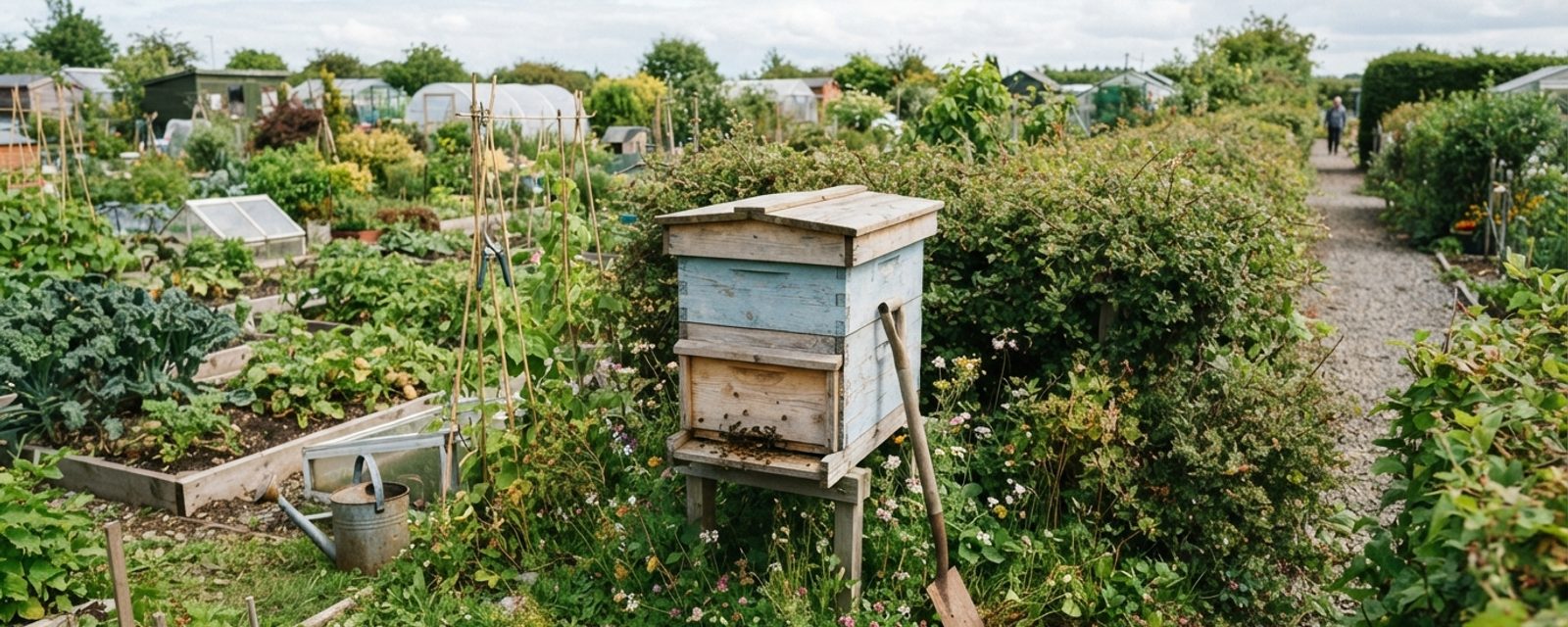
You've watched a neighbouring plot fill up with hive boxes over the summer, and now you're wondering whether you could do the same on yours. Or maybe you're further along than that, you've already got the email to your site committee half-drafted, trying to work out what to actually ask permission for. Here's the uncomfortable answer: there is no single Scottish rule on allotment beekeeping. Two sites in the same city can land on opposite conclusions, and the only way to know where yours stands is to ask it directly, in writing, before you order a single hive.
Why there's no national answer
The Community Empowerment (Scotland) Act 2015 sets out what every local authority allotment site's regulations have to cover. Section 115 requires councils to address "the keeping of livestock (including poultry)," but bees are never named anywhere in the Act, not in the mandatory list and not in the optional one. Whether a council treats a beehive as livestock is left entirely to local discretion. That gap is exactly why allotment beekeeping rules are inconsistent from one site to the next: some ban it outright, some run a formal permission scheme, and some have never addressed it in writing at all.
Chickens hit the same statutory gap for the same reason: livestock is named, but the Act leaves councils to decide what counts and what the answer is. Rent, cultivation standards, and what you're allowed to build come from the same 2015 Act, and the general rules around those are worth knowing regardless of whether you keep bees.
The same city, two different answers
On Edinburgh's council-run sites, Edinburgh Outdoors' rules are blunt: "Keeping livestock, including bees, is not allowed." Full stop, no application process.
A few miles away, sites run by the Edinburgh Allotments and Gardens Apprentice Association (EDAA), self-managed, separate from council sites, take the opposite position, with a detailed scheme: written consent from the Field Secretary plus committee approval; prior experience or a completed BBKA beginners course; BBKA membership with public liability insurance; BeeBase registration; a named mentor if inexperienced; hives sited and screened to minimise nuisance; a maximum of three hives; hives removed on leaving the plot.
Aberdeen City Council takes a middle path, via Garthdee Allotments: a limited number of beekeeping plots under a Risk Assessment Policy, with demonstrated knowledge and public liability insurance required, and unauthorised beekeeping able to end the tenancy.
| Site | Bees allowed? | Key conditions |
|---|---|---|
| Edinburgh Outdoors (council-run sites) | No | Outright ban, no application route |
| EDAA (self-managed Edinburgh sites) | Yes, with permission | Committee consent, experience or BBKA course, BBKA membership and insurance, BeeBase registration, max 3 hives |
| Aberdeen City Council (via Garthdee) | Yes, limited | Risk Assessment Policy, demonstrated knowledge, public liability insurance |
Most other Scottish councils haven't published a clear position on bees at all. Insurance, a starter course, and hive equipment are the recurring costs wherever a site requires them, budget before you commit.
Registration and disease reporting
BeeBase registration with the National Bee Unit is voluntary and free. Alongside that UK-wide register, Scotland runs its own bee-health inspection and diagnostic arm: SASA (Science and Advice for Scottish Agriculture) provides laboratory-based diagnostic support to the Scottish bee inspectorate, identifying the statutory pests and diseases American Foulbrood, European Foulbrood, Tropilaelaps mite, and Small Hive Beetle from samples the inspectorate takes. Inspections themselves are administered through RPID (Rural Payments and Inspections Directorate), part of the Scottish Government's Animal Health and Welfare DivisionPropagating a clump-forming perennial by digging it up and splitting it into several smaller pieces, each with roots and shoots attached. Full definition →, per gov.scot's own honey bee health guidance.
The legal duty that matters sits apart from any voluntary register: if you suspect any of the four notifiable pests or diseases above, you must notify your local bee inspector, under Orders made using the Bees Act 1980, regardless of BeeBase status; it usually leads to a site visit and, if confirmed, movement restrictions.
Public liability insurance is worth having even where your site doesn't require it, a beekeeping association membership is the usual route, and it's cheap against what an incident on a shared site could cost.
Siting: the flight path is the whole problem
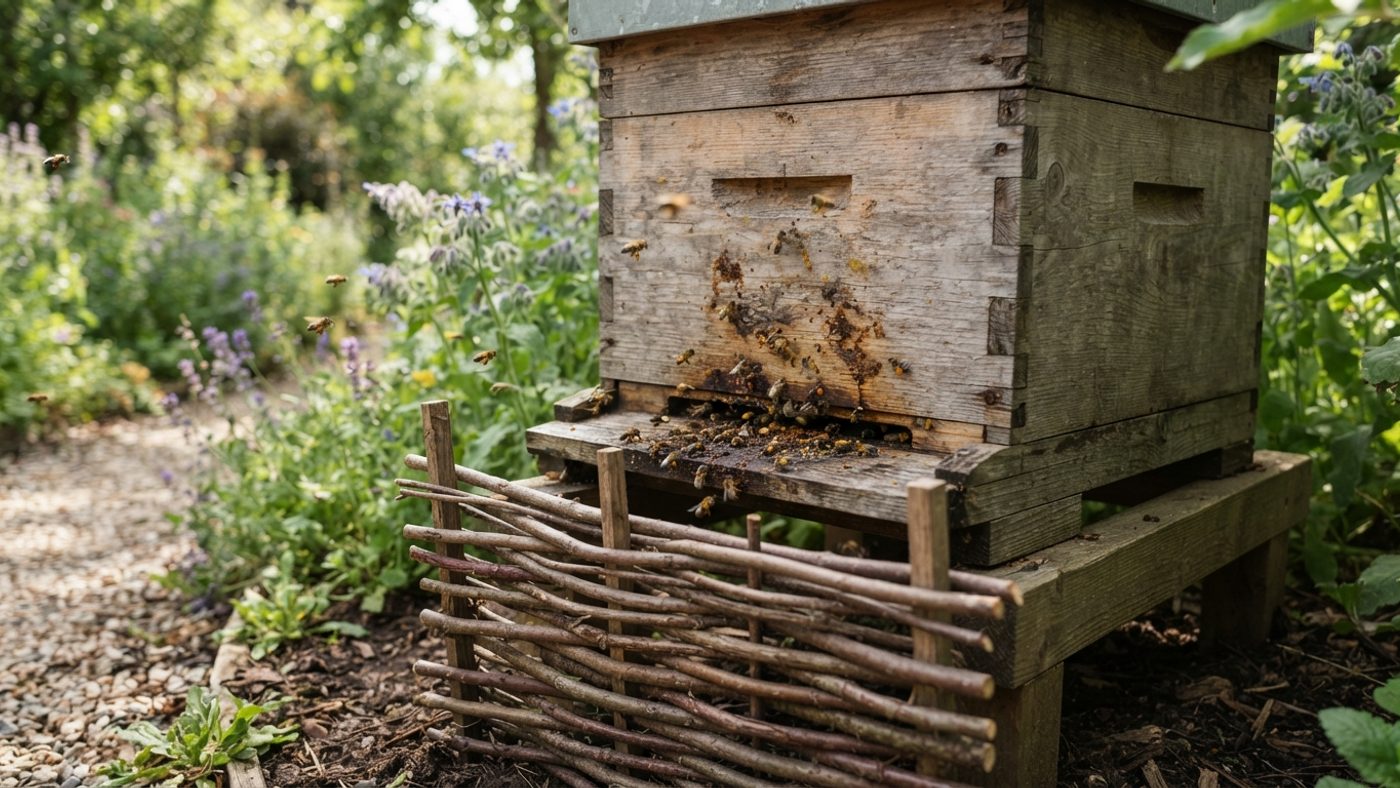
Foraging range is a red herring for neighbour impact, bees forage well beyond any single site's boundary, commonly several kilometres out, so a hive's effect on neighbours comes down to the few metres outside the entrance, not distance travelled. The Scottish Beekeepers' Association recommends orienting the entrance south or southeast for morning sun, with roughly 40cm of working space behind the stand. General good practice: don't point the entrance at a path or neighbouring plot, and put a screen, hedge, or fence at roughly head height in front of the hive so bees climb steeply before crossing the site.
Forage competition among multiple hives on one shared site is a real, separate constraint from nuisance. A water source near the hive matters for the same neighbour-facing reason, otherwise bees will use a shared site's water butts instead. Hives on an open site are also worth securing against theft and casual interference.
The conversation no rule requires
Nobody requires you to ask this before putting hives on a shared site, and that's exactly why it's worth doing anyway: ask directly whether anyone on the site has a known bee-sting allergy, before the hives go in. Allergy UK records around ten reported deaths a year across the UK from wasp or bee sting reactions combined, likely an undercount, and notes most people without occupational exposure are rarely stung, its own figure for wasp stings specifically is roughly once every 15 to 20 years. Small odds are still worth acting on given what's at stake.
What applies regardless of your own site's rules
| Requirement | What it covers | Applies to |
|---|---|---|
| BeeBase registration | National Bee Unit database of hive locations | Voluntary, not a legal requirement |
| SASA/RPID disease notification | Reporting suspected American Foulbrood, European Foulbrood, Tropilaelaps mite or Small Hive Beetle | Legal duty once suspected, under Orders made under the Bees Act 1980 |
| Community Empowerment (Scotland) Act 2015 | Requires councils to address livestock in site regulations | Doesn't name bees specifically — left to local discretion |
| Site-specific permission | Whether hives are allowed at all, and any conditions | Set independently by each council or site — never assume from another |
Common questions
Who actually decides whether I can keep bees, if there’s no national law?
Your own site committee or council. There’s no central register or national answer, so check your tenancy agreement or ask your site directly rather than assuming a neighbouring site’s rule applies to yours.
If my council allows chickens, does that mean bees are fine too?
Not necessarily. Edinburgh Outdoors names bees explicitly in its ban rather than leaving them to a general livestock clause, so the two decisions can go different ways even on the same site’s own rules.
Do I have to register my hive with anyone before I start?
No formal registration is legally required before you start, though several sites that permit bees, EDAA among them, make BeeBase registration a condition of their own permission scheme even though it isn’t a national legal requirement in itself. Worth doing regardless of whether your site asks for it, since it’s free and it’s how you’d be reached if a disease outbreak were reported nearby.
How far from the boundary does my hive need to be?
There’s no confirmed Scottish minimum distance. What matters more than raw distance is the flight path immediately outside the entrance, orientation, and screening, since bees forage well beyond any single site’s boundary regardless of where the hive sits within it.
What if my site’s rules say nothing about bees at all?
Silence isn’t permission. Get a written answer from your site committee before committing to hives, rather than assuming an unaddressed rule means yes.
Sources
9 sources, recorded with what each was used for
- Edinburgh Outdoors: Rules for Allotment Plot Holders: Edinburgh council-run sites' explicit ban on bees as livestock
- EDAA: Beekeeping at EDAA: The self-managed Edinburgh sites' detailed permission scheme
- Garthdee Allotments: Beekeeping ACC Advice Note: Aberdeen City Council's risk-assessment approach
- Community Empowerment (Scotland) Act 2015, section 115: The mandatory livestock provision, and the absence of bees from the Act’s text
- SASA: Bee Health: Scotland's devolved bee-health inspection and lab-diagnostic service
- gov.scot: Honey Bee Health Guidance — Inspections: RPID's role in inspections, and the legal duty to report suspected disease
- Scottish Beekeepers' Association: Setting Up a Hive: Hive orientation and working-space recommendation
- Allergy UK: Wasp and Bee Sting Allergy: UK sting-death figures and wasp-sting frequency
- Bees Act 1980: Statutory basis for notifiable pest/disease control