
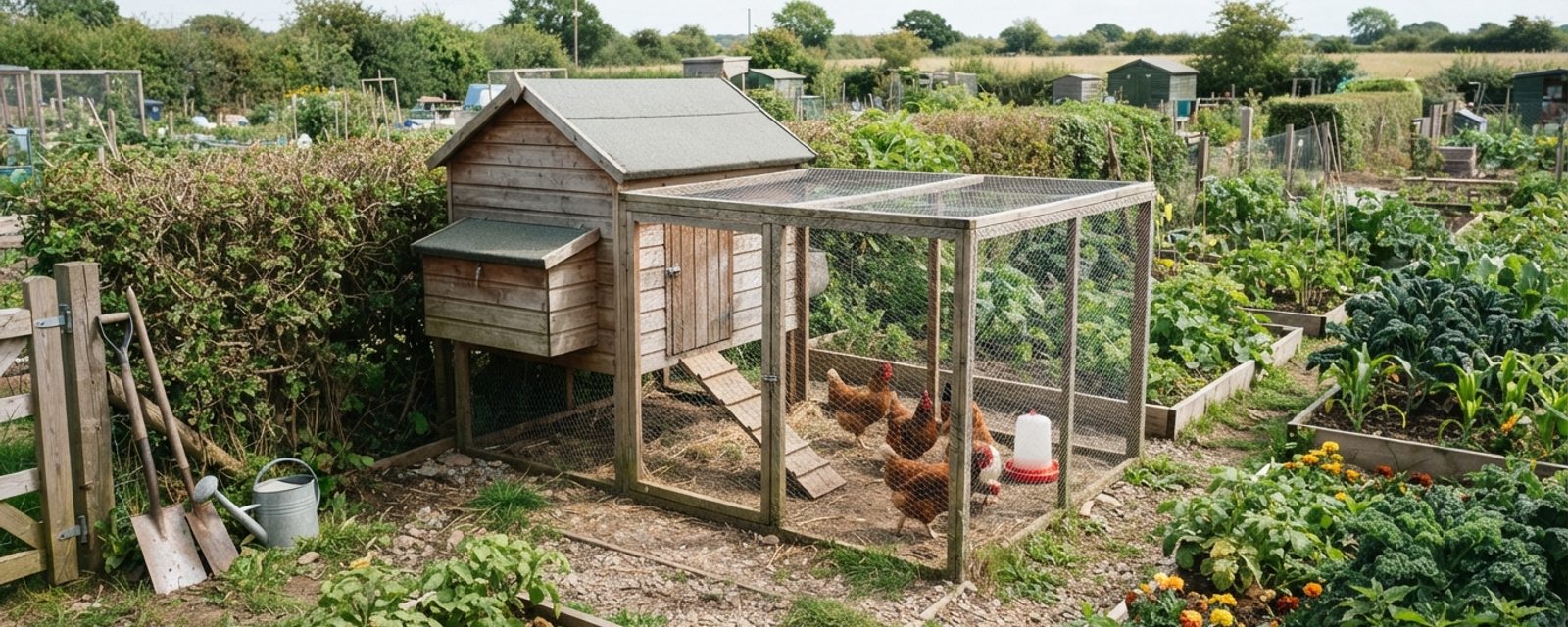
You've drafted the polite email to your allotment committee, or you've just noticed three hens pecking around the plot two down from yours and wondered why nobody mentioned this was an option. Either way, the question is the same: is this actually allowed, and if it is, what do you have to do before you buy a coop? Whether your site permits hens at all is a local decision, made site by site, with no national default either way. But once you do keep chickens anywhere in Scotland, several Scotland-specific legal duties switch on automatically, starting with a registration requirement that catches out people who assume it only applies to "real" flocks.
At a glance: what applies regardless of your site's own rules
| Requirement | What it covers | Applies to |
|---|---|---|
| Site permission | Whether hens are allowed at all, and any conditions (numbers, no cockerels) | Set locally by each site/council — no national default either way |
| Scottish Kept Bird Register | Legal registration of any bird you keep | Every keeper, even a single bird — replaces the old GB Poultry Register in Scotland |
| Welfare duty of care | Space, shelter, food, water, protection from suffering, a basic health plan | Every flock, regardless of size |
| Noise/nuisance law | Statutory nuisance action a council can take over a persistently noisy animal | Any keeper, independent of your site’s own rules |
| Avian flu biosecurity | Housing/biosecurity measures during declared prevention zones | Every keeper, seasonally, regardless of site permission or flock size |
Does your allotment even allow chickens?
There is no national rule saying allotments can or can't keep chickens. What there is, is a legal requirement that every site must have said something about it, one way or the other. Under the Community Empowerment (Scotland) Act 2015, every local authority allotment site's written regulations must include a provision on "the keeping of livestock (including poultry)," a mandatory item on the list alongside things like rent, cultivation standards, and what structures you're allowed to put up. The Act stops there, though, it doesn't say what the answer has to be, only that every site has to have written one down.
In practice that means the rule you're looking for exists somewhere, in your own site's tenancy agreement or committee regulations, and it's been decided locally rather than handed down from Holyrood. Some sites allow hens outright, some ban livestock altogether, and plenty sit somewhere in between, hens yes, cockerels no, or a cap on numbers. None of that is standardised or published anywhere you can easily compare across councils, so the only reliable way to find your answer is to ask your site committee or read the tenancy agreement your council actually issued you. If your site's rules are silent or vague on the point, raise it directly with the committee rather than assuming silence means yes.
The wider rules on allotment tenancies, sheds, cultivation standards, what counts as reasonable use of a plot, are set out in the allotment rules guide, including the same 2015 Act's separate rule permitting non-profit sale of surplus produce. If your hens end up laying more eggs than your household can use, giving away or selling the extra at the plot gate sits under that same non-profit allowance rather than a rule of its own, though egg sales carry their own separate marking and grading rules on top of that, which apply regardless of what your allotment tenancy says.
Register your birds, even if you only have one hen
This is the single most-missed step, and it applies no matter what your site's rules say about keeping hens in the first place. Anyone in Scotland who keeps birds, even a single bird, must register on the Scottish Kept Bird Register (SKBR). This is a legal requirement, not a recommendation, and it covers pet birds, poultry, game birds, racing pigeons, birds of prey, and waterfowl. There's no minimum flock size that exempts you: three allotment hens meets the threshold just as much as a commercial unit does.
This matters especially if you've heard older advice that registration only kicks in around 50 birds. That threshold belongs to a different system. The Scottish Kept Bird Register replaces the previous GB Poultry Register for bird keepers in Scotland, and if your premises was registered on the old GB register, you have to register again on SKBR, since the two aren't the same list. Keepers in England and Wales still use the GB Poultry Register; keepers in Scotland use SKBR instead, and the two systems aren't interchangeable, so allotment guidance written for a UK-wide audience can easily lead a Scottish keeper astray on this point. Registering is also how the Scottish Government contacts keepers directly when disease-control requirements change, which matters for the avian flu measures covered further down.
Registration is free and done online at the Scottish Kept Bird Register's own site, where you'll be asked for basic details about your birds and where they're kept. If you need help with the form, the SKBR helpline (01466 405101, or [email protected]) covers that. Once registered, keep your details current and expect to reconfirm them annually.
Welfare law applies to two hens just as much as 200
It's easy to assume welfare legislation is written for commercial farms and doesn't really touch a handful of allotment hens. That assumption is wrong. The Animal Health and Welfare (Scotland) Act 2006, section 38, is the legal basis for Scotland's welfare guidance for laying hens, its own guidance, separate from the equivalent framework used south of the border. Most of the detailed guidance is written with flocks of 350 or more birds in mind, because that's commercial scale, but the underlying duties don't have a small-flock exemption: the guidance is explicit that "biosecurity applies to flocks of any size, from smallholdings and crofts with one or two birds to commercial farm units," and just as explicit that "smallholders, crofters and backyard keepers should also have a plan setting out all the health and husbandry activities required for their flock," even if that plan ends up far shorter than a commercial producer's. In practice, that means an allotment keeper with three hens has a genuine legal duty of care, adequate space, shelter, food and water, protection from suffering, and some basic health and husbandry plan for the flock, not just a moral one.
Avian flu measures can apply to you regardless of site permission
Avian Influenza Prevention Zones are imposed and lifted across Scotland depending on the disease risk from wild birds, typically tightening over autumn and winter and easing off when the risk drops. When a zone is in force, it can bring housing and biosecurity requirements that apply to every keeper, regardless of flock size and regardless of whether your allotment site itself has any opinion on chickens at all. A housing order, when one is declared, generally means keeping birds under secure cover away from contact with wild birds and tightening hygiene at the entrance to their enclosure, but the exact requirements are set fresh each time a zone is declared, so check current guidance rather than assume last winter's rules still apply. Registering on SKBR is the direct route to being alerted if measures affecting your birds come into force.
Siting, noise, and neighbours: the practical case for or against
Even where a site technically allows hens, this is usually what actually decides whether the arrangement stays comfortable or turns into a committee complaint. Cockerels are the single most common reason a site either bans chickens outright or restricts permission to hens only. Noise from a cockerel carries much further than people expect and starts early, and there's little practical way to keep one quiet enough for a shared site. It isn't only a matter of your site's own goodwill, either: statutory noise nuisance law, which has covered Scotland the same way it covers the rest of Great Britain since 1996, treats "any animal kept in such a place or manner as to be prejudicial to health or a nuisance" as something a local authority can act on, regardless of what your allotment's own rules say. If your site allows hens but you're weighing whether to add a cockerel, assume the answer from neighbouring plot-holders will be no, because it usually is, and there's a legal backstop behind that "no" if it ever came to it.
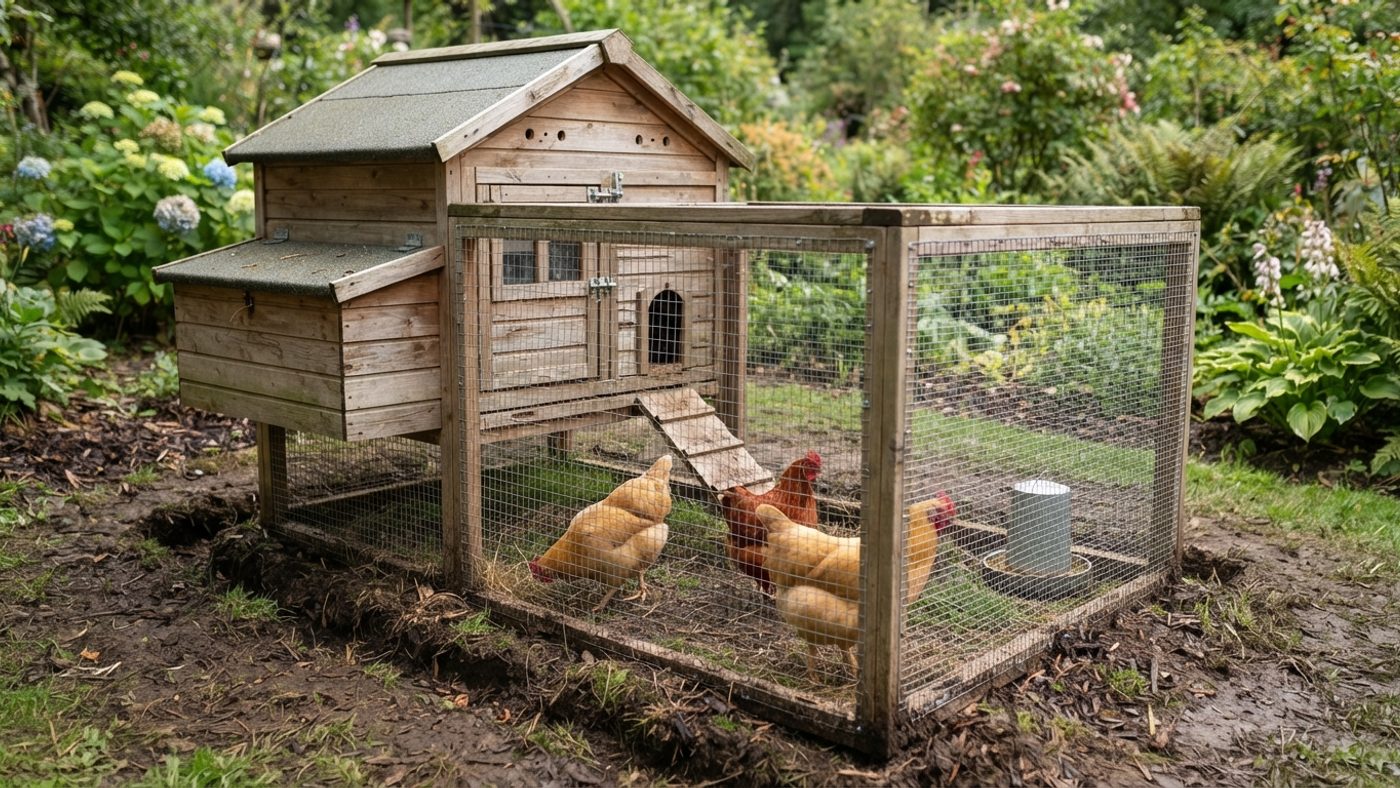
Beyond that, a secure, weatherproof house sited well away from neighbouring plot boundaries cuts down both noise and general friction with the people gardening next to you. An open allotment site is fox territory day and night in a way an enclosed back garden usually isn't, and in parts of Scotland where pine martens have spread back into lowland areas, they're an increasingly real threat to a poorly secured coop too, so the house and run need to actually withstand a determined predator rather than just look tidy, a flimsy setup is one of the most common reasons a first attempt at allotment hens ends after a few weeks. Feed needs to be stored properly too, since spilled or accessible feed is a common way any allotment site, hens or not, ends up with a rat problem. Manure and bedding need an actual plan rather than being left to pile up: hen manure is high in nitrogen and needs to age for several months before it's safe to use on beds, and the run itself is best sited away from salad crops and anything eaten raw, since fresh droppings can carry the same bacteria that make raw poultry manure a food-safety risk anywhere else.
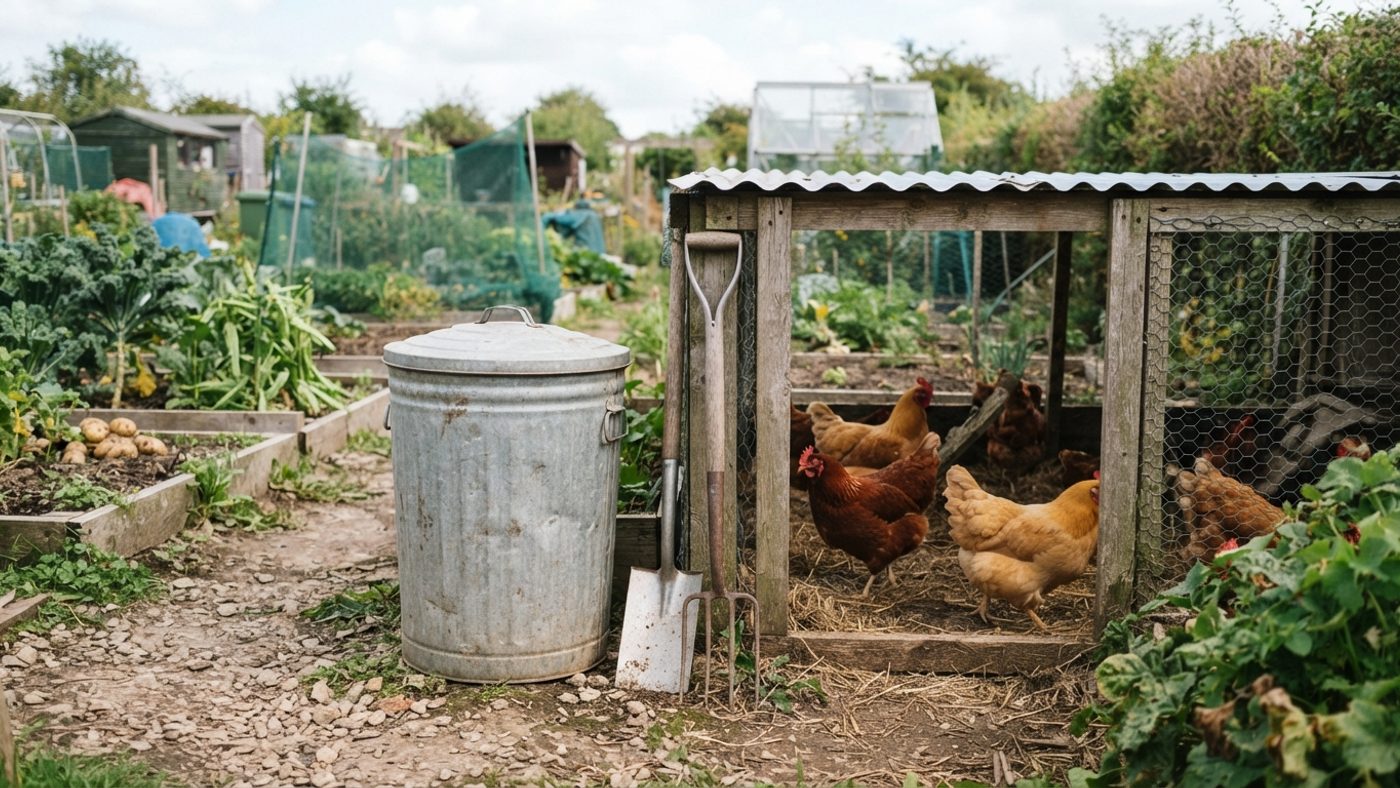
Foxes and Badgers in a Scottish Garden: What Actually Works, and What's Actually Legal → covers which fencing and deterrents genuinely hold a fox off a run, and the extra legal care needed if a badger sett turns out to be nearby.
Most of this doesn't come down to a fixed rule, it's the practical judgement that tends to make or break a hens arrangement on a shared site, worth thinking through before you ask your committee, not after they say yes.
Common questions
Can I keep chickens on my allotment in Scotland?
There’s no single answer for Scotland as a whole, it depends on your own site’s rules, which genuinely differ from council to council and even site to site within the same council. Don’t assume a neighbouring site’s answer applies to yours; get it confirmed in writing before you buy birds.
Do I need to register my allotment hens?
Yes. Anyone keeping birds in Scotland, including a single hen, must register on the Scottish Kept Bird Register. This is a legal requirement separate from your site’s own permission, and it applies regardless of how few birds you keep.
Can I keep a cockerel on an allotment?
It’s worth asking your site committee this as a separate question from "can I keep hens," rather than assuming one permission covers both. A site that’s happy with a small hen flock next to other plots will often draw the line at a cockerel specifically, since it’s the crowing rather than the birds themselves that tends to prompt a complaint.
How many hens can I keep on an allotment?
There’s no national limit; any cap comes from your own site’s rules, if it sets one. A few practical factors tend to set the real ceiling before any rule does: available space, how much manure and bedding you can realistically manage, and how tolerant your nearest neighbours are of the noise and smell.
What happens if my council allotment rules don’t mention chickens at all?
That shouldn’t happen, since the law requires every site’s regulations to include a livestock provision, but rules vary in how clearly they’re written and some are genuinely ambiguous in practice. If yours is silent or unclear, raise it directly with your site committee rather than assuming silence means permission, and get it confirmed in writing before you get birds.
Sources
5 sources, recorded with what each was used for
- Community Empowerment (Scotland) Act 2015, section 115: The legal requirement that every allotment site’s regulations include a provision on keeping livestock, including poultry
- Scottish Kept Bird Register, Scottish Government: The mandatory bird registration requirement, the any-number-of-birds threshold, confirmation that SKBR replaces the GB Poultry Register in Scotland, and the free online registration process
- Guidance on the welfare of laying hens and pullets, Scottish Government: Legal basis under the Animal Health and Welfare (Scotland) Act 2006, section 38, and the biosecurity/health-planning duties that apply to flocks of any size
- Environmental Protection Act 1990, Part III: The statutory nuisance provision covering an animal kept in a way that’s prejudicial to health or a nuisance, and its extension to Scotland from 1996
- Avian influenza outbreaks, Scottish Government: How Avian Influenza Prevention Zones and housing orders work