
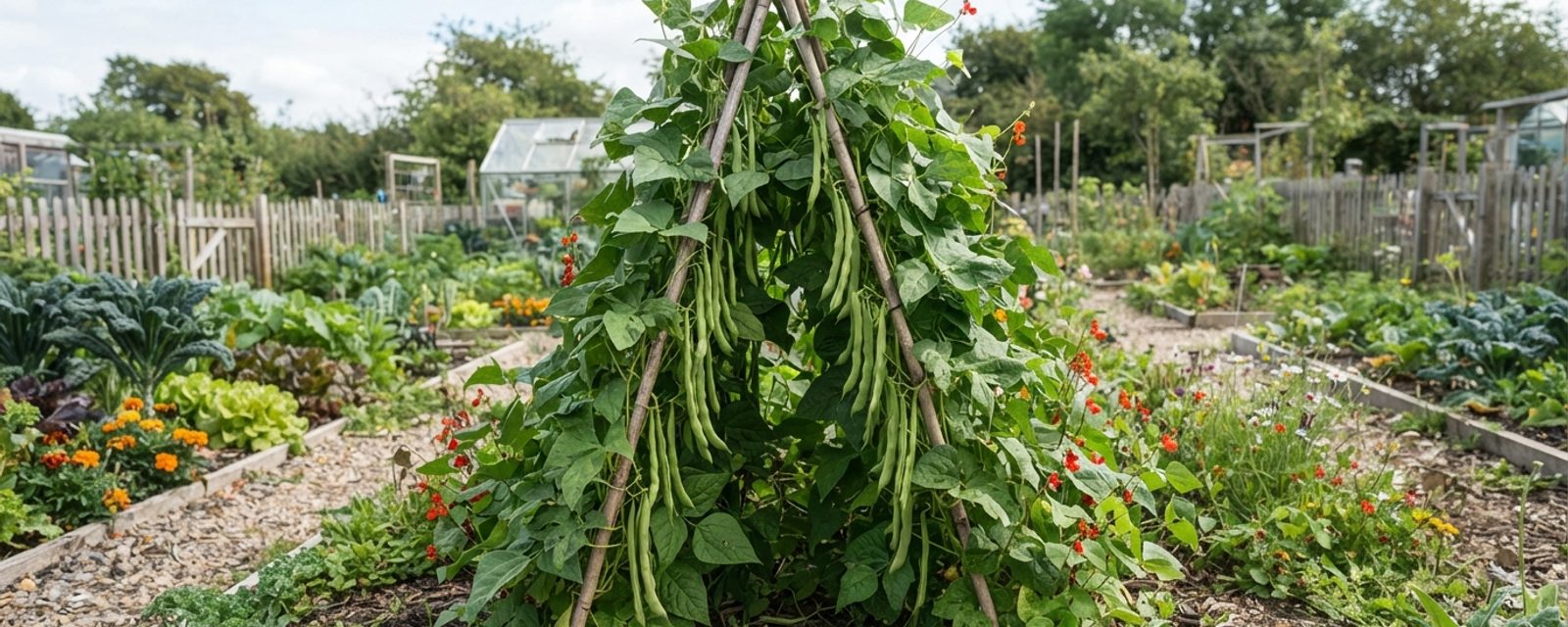
By the third week of July, most Scottish plots are still in the manageable phase, a handful of pods every couple of days, easy to keep on top of. Then the weather turns warm and settled for a stretch, the plants that were sulking through a cool June suddenly catch up, and by the second week of August you can go from picking a bowlful every other day to filling a trug every single morning. Runner beans in particular seem to cross a threshold: once a wigwam is fully in cropping mode, pods can go from barely worth picking to overgrown within days. Miss two picking sessions in a row during that window, a wet weekend, a few days away, and the plant has already moved from productive to problem.
The glut isn't really about volume. It's about a single mechanical fact that most growers understand only vaguely: a pod you don't pick doesn't just sit there waiting. It actively shuts the plant down.
Why leaving pods on the plant kills future cropping
Runner beans and French beans are grown for their immature pods, but botanically the plant's actual goal is to produce mature seed. Every pod is the plant's seed-bearing structure, and once beans inside a pod start to swell and the pod itself begins to toughen and turn stringy, the plant registers that a batch of seed is successfully on its way to being finished. RHS growing guidance is direct about the consequence for runner beans: "once this happens, plants will stop flowering and no more pods will form."
Picking a pod while it's still young and unfinished removes that signal. The plant hasn't achieved seed-set yet, so it keeps flowering and setting new pods in an attempt to get there. This is why the RHS recommendation for both crops is the same: pick every two to three days once cropping starts, without exception, for as long as you want the plant to keep producing. Skip that rhythm for a week and pods that were pickable on Monday are tough, stringy and full of visible bean-bumps by the following Monday, and worse, the plant has already started redirecting energy away from new flowers toward finishing those maturing seeds.
The runner bean growing guide and French bean growing guide both give this rule in brief. The fix for too many beans is never to pick less. It's to pick everything, on schedule, every single time, even the ones that are already a bit past their best, because leaving them on the plant to deal with later is exactly what stops the plant producing the beans you'll actually want to eat.
Aphids, black bean aphid especially, are worth ruling out too if flowering has stopped and there's no backlog of overgrown pods to explain it. A heavy colony on the shoot tips can suppress new flower production on its own, a separate cause from the pod-signal mechanism above but one that produces the same symptom.
How long is too long
There's a real, specific window between perfect and too far gone, and it's shorter than most people expect.
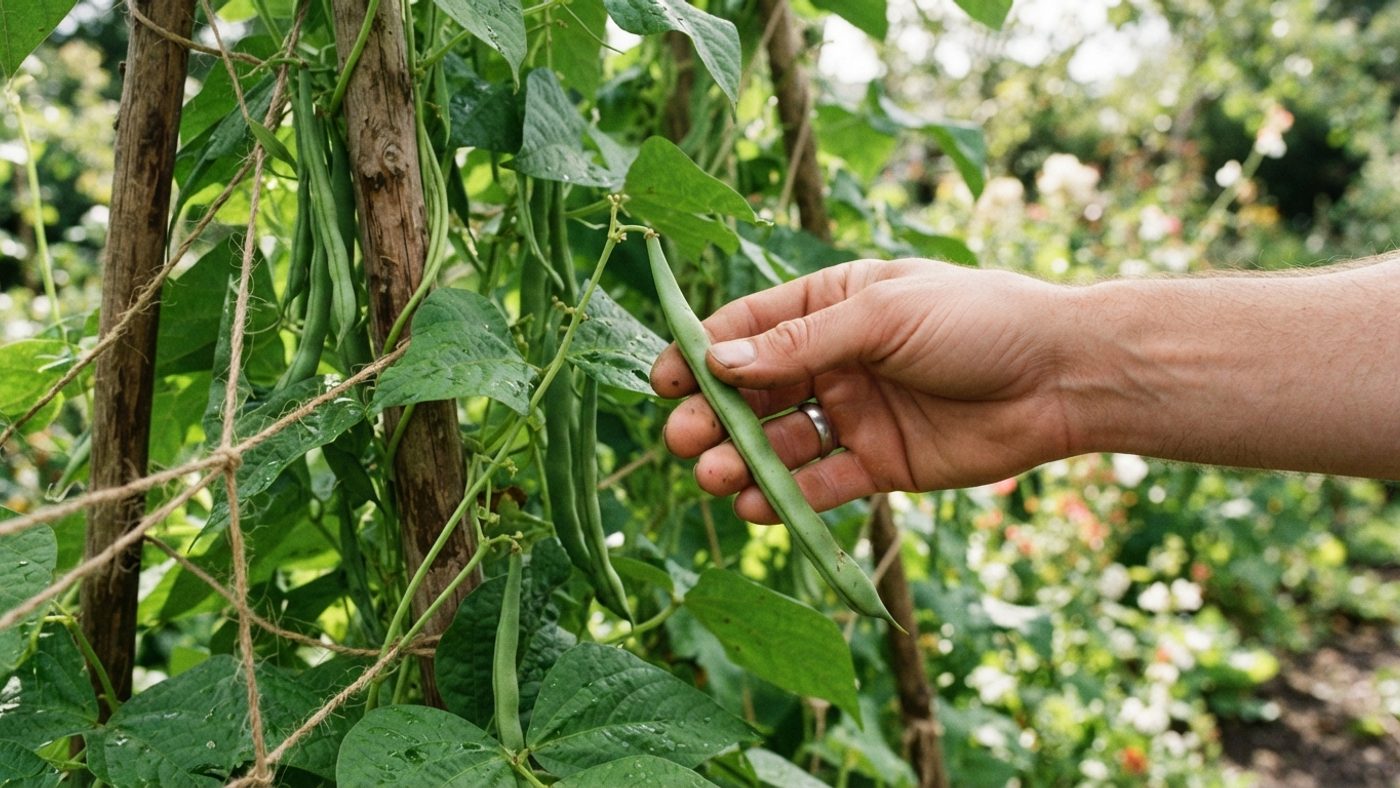
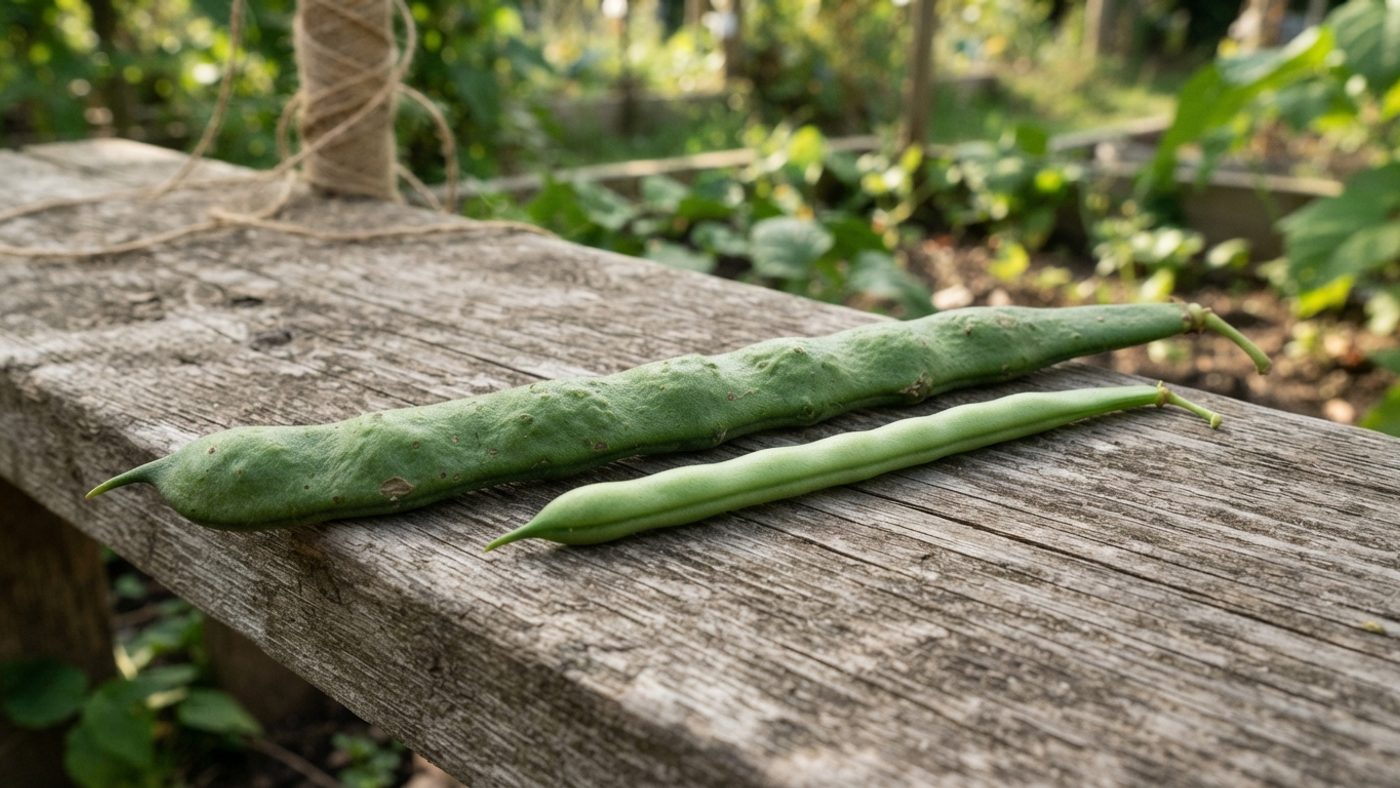
Runner beans are at their best at 20-25cm long, when the pod snaps cleanly and the beans inside are still small, pale and barely visible through the pod wall. Beyond that point the outer skin starts developing the fibrous strings along the seams that give overgrown runner beans their reputation for being tough and stringy. RHS doesn't give a day-count for this, but in practice a pod can cross that line within less than a week of warm growing conditions, exactly the kind of settled warm spell that tends to trigger a Scottish glut in the first place. Left further, the pod turns leathery, the beans inside swell and start to show clearly through the skin, and the texture is no longer pleasant however it's prepared. A stringless runner bean variety (Moonlight is one) doesn't extend the eating window much, but it does mean a slightly overgrown pod is still usable rather than a write-off, a genuine hedge against the uneven, weather-driven gluts a Scottish summer tends to produce (more on that below), where a run of poor pollinating weather followed by a sudden warm flush can leave several pods crossing the line at once even with disciplined picking.
French beans have an even narrower window because the pods are physically thinner. Pick at 15-20cm, before individual beans are visible as bumps through the pod. Once the beans show clearly through the skin, the pod has already crossed from tender to chewy, and it happens fast, RHS doesn't state a figure, but French bean pods thicken and toughen noticeably quicker than runner beans once they start converting from pod-growth to seed-fill, so the window is measured in days rather than a week.
Neither species gives you much grace period. The whole reason the pick-every-2-3-days rule works is that it matches the actual speed at which a pod moves from ideal to overgrown, any looser than that and you're not managing a glut, you're growing tough beans and stalling the plant at the same time.
Runner beans vs French beans at a glance
| Factor | Runner beans | French beans (climbing) | French beans (dwarf) |
|---|---|---|---|
| Ideal pick size | 20-25cm | 15-20cm | 15-20cm |
| Signs of overmaturity | Stringy seams, tough skin, beans visible through pod | Beans visible as bumps, pod stops snapping cleanly | Same as climbing |
| Cropping window | 8+ weeks from mid-summer, with regular picking | Mid-summer into early autumn | 8-10 weeks total, then finished |
| Picking frequency | Every 2-3 days | Every 2-3 days | Every 2-3 days |
| Pollination need | Insect (bumblebee) pollinated, weather-sensitive | Largely self-pollinating, less weather-dependent | Largely self-pollinating, less weather-dependent |
| Succession sowing value | Limited, crops continuously anyway | Limited, crops continuously anyway | High, stagger every 3 weeks |
| Typical fridge life after picking, unwashed | Around 3-5 days | Around 3-5 days | Around 3-5 days |
Spreading the glut with succession sowing
Regular picking controls how fast one planting deteriorates, but it doesn't stop every plant in a bed from hitting peak production in the same fortnight. For that, sowing timing matters more than picking discipline.
Dwarf French beans are the crop most worth staggering. A dwarf plant crops hard for a few weeks and then tails off, it doesn't have the extended season of a climbing plant, so a single sowing date means a single, concentrated glut window. Garden Organic recommends sowing dwarf French beans every three weeks for a continuous supply rather than one large flush. Applied to a Scottish outdoor sowing season, which only opens once the soil is reliably warm enough, generally later than a UK-wide guide assumes, that three-week interval leaves room for a couple of staggered sowings before the season closes in again, rather than the extra rounds a longer southern season has calendar space for. Each wave then hits its own 8-10 week cropping cycle out of step with the one before it, which smooths what would otherwise be one large flush into several smaller, more manageable ones.
Climbing French beans and runner beans don't respond to succession sowing the same way, because a single climbing plant crops continuously across a long window rather than in one concentrated burst, that's their whole advantage over the dwarf type. Staggering sowing dates for climbers mainly just staggers when the plants start, not how intensely they peak, and in a Scottish garden with a compressed growing season there usually isn't enough calendar left to make a second sowing worthwhile. For climbing types, the better lever is planting fewer plants than the standard spacing recommends if a glut has been a problem in previous years, since one wigwam picked religiously every two to three days will out-produce most households' realistic eating rate anyway.
The Scotland factor: why the glut can be uneven, not just intense
Runner beans need insects, mainly bumblebees, to trip the flower and complete pollination; without that visit, the flower drops instead of setting a pod. RHS advice on failed pod-set identifies "lack of pollinating insects, perhaps because of cold, wet or windy weather" as a direct cause of poor pollination, alongside the more familiar problem of dry soil at the roots causing flower drop independent of pollination at all.
A changeable Scottish summer produces exactly the conditions that disrupt this. A cool, breezy, showery stretch through late July can mean very few flowers get pollinated at all, plants keep flowering, but pods barely form. Then a settled warm spell arrives, bumblebee activity picks up, and a large proportion of the flowers open in that window all set pods at once. The result isn't a steady trickle of beans building gradually to a peak; it's closer to a dam breaking, a fortnight of little to show for it, then a sudden, dense flush of pods all reaching pickable size within days of each other. Sheltering plants from wind (a fence line or a hedge works better than an open, exposed bed) and keeping the site attractive to bumblebees with nearby flowering plants both help smooth this out, but a run of poor pollinating weather followed by a sudden flush isn't a sign anything's being done wrong, it follows directly from how weather-dependent insect pollination is, and a cool, breezy, showery stretch of the kind a Scottish summer regularly delivers is exactly the weather RHS names as suppressing bumblebee activity in the first place.
Keeping beans for a few days after picking
None of the UK growing authorities publish an exact shelf life for a picked bean pod, because it depends heavily on how the pod was handled at picking and how warm it's been kept since. What can be said with confidence: pods lose quality fastest through moisture loss, not spoilage, so the aim after picking is to slow that down. Left unwashed and kept loose or in a partially open bag in the coldest part of the fridge, both runner and French bean pods typically hold their snap and colour for around 3-5 days before the skin starts to wrinkle and soften and the pod loses the clean snap that signals freshness. Washing before storing, or sealing pods in an airtight bag, tends to shorten that window rather than extend it, since trapped moisture speeds up softening.
In practice, this short window is the real reason succession picking matters as much as succession sowing, beans don't bank well even for a week, so a bumper picking day creates pressure to deal with the harvest almost immediately rather than being able to let it sit.
Common questions
Why have my runner beans suddenly stopped producing new pods?
Almost always a backlog of overgrown pods, per the mechanism above. Clear every pod off the plant, including the tough ones you don’t intend to eat, and keep watering; new flowering usually resumes within a week or two once the backlog is gone. If clearing the backlog doesn’t bring flowering back, check the shoot tips for a blackfly colony instead.
Is it true that picking beans more often makes the plant produce more?
Yes, it’s a genuine mechanism rather than folklore, and it works the same way on both crops. The one practical wrinkle: picking harder than every 2-3 days doesn’t buy you anything extra, since a pod that’s 24 hours from pickable size hasn’t started swelling toward maturity yet either way. The frequency that matters is the one that catches every pod before it crosses into maturing, not the shortest interval you can manage.
Can I stagger runner bean sowing to avoid a glut, the way I would with French beans?
Not really. Runner beans and climbing French beans already crop over an extended period from a single sowing rather than all at once, so a second sowing mostly just gives you a later-starting plant rather than a smoother harvest. Succession sowing pays off with dwarf French beans, which crop hard for a few weeks and then stop, making a single sowing date genuinely concentrate the glut.
Why did all my beans seem to arrive at once this year?
A cool, breezy or wet spell during flowering reduces bumblebee activity, and runner beans in particular rely on insect pollination to set pods at all. If a settled warm period follows a poor one, a large batch of flowers can all get pollinated in the same few days, producing a dense flush of pods that all mature together rather than a steady spread. It’s a normal feature of a Scottish summer’s variability rather than a growing mistake.
How long can I actually leave picked beans before they go off?
There’s no official fridge-life figure published for fresh bean pods, but kept unwashed and loose in the fridge, both types generally hold their texture for roughly 3-5 days before softening and losing their snap. Because that window is short, it’s more reliable to pick on a strict schedule and plan to use beans quickly than to rely on being able to store a backlog.
Sources
4 sources, recorded with what each was used for
- RHS: How to grow runner beans: Harvest window (20-25cm), picking frequency (every 2-3 days), and the mechanism by which mature pods stop further flowering
- RHS: How to grow French beans: Harvest window (15-20cm), dwarf vs climbing cropping duration, confirmation that regular harvesting stimulates continued production
- RHS: Runner beans — failure to set pods: Role of pollinating insects (bumblebees), effect of cold/wet/windy weather on pollination, dry-soil flower drop
- Garden Organic: How to grow French bean: Succession sowing every three weeks for continuous dwarf French bean cropping