
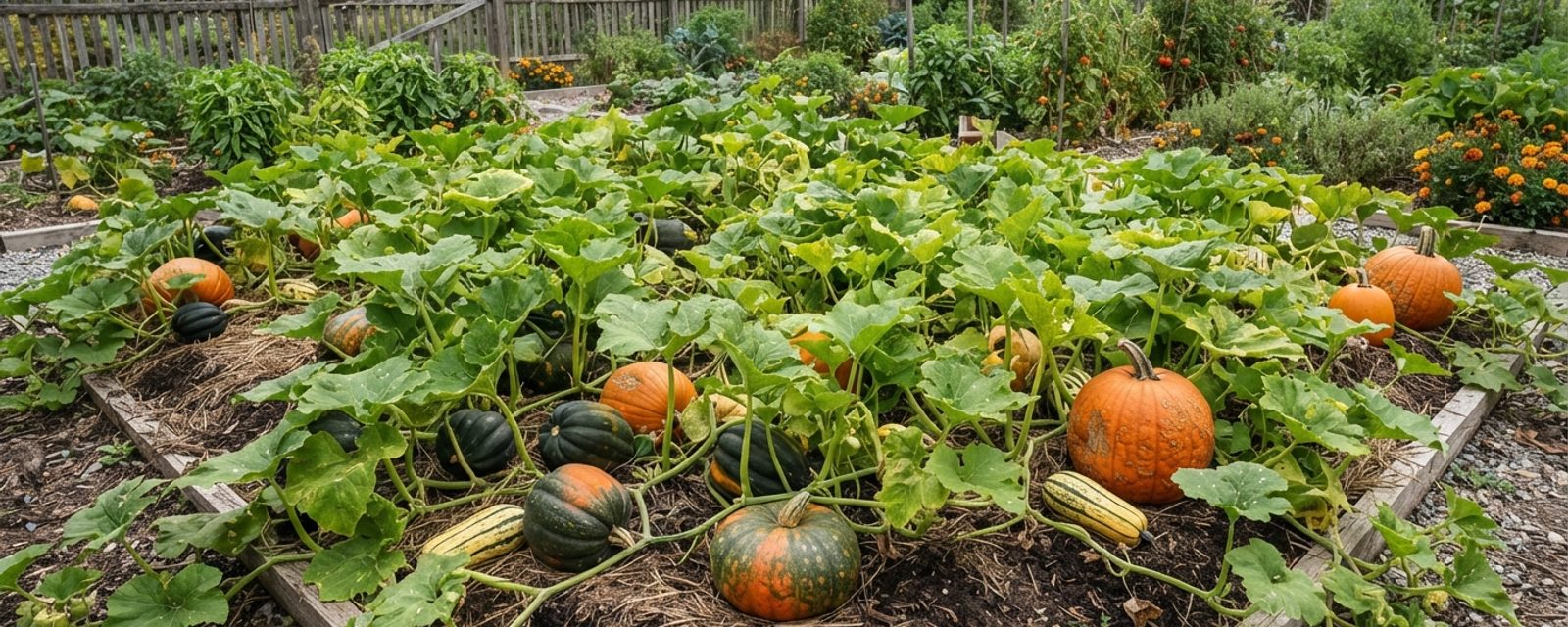
Most vegetable gluts are a picking backlog: a crop that keeps coming faster than you can use it, day after day, through a long season. A courgette plant hands you a problem every 48 hours. Squash and pumpkins break that pattern completely. A winter squash plant hands you nothing for months, and then, on one cold night in September or October, the forecast turns, and every plant in the patch needs dealing with at once. There's no missed picking window to catch up on, because there was never a rolling window in the first place. What you have instead is a handful of plants, each one sprawling across a metre or more of ground and each potentially carrying two, three, or more full-size fruit, all ripening on their own separate timetables, all now facing the same single hard deadline. Some fruit will be fully hardened and ready. Others will be close but not quite there. A few will still be pale and immature, having started too late or too shaded to catch up. Frost doesn't negotiate with any of that, it arrives on one night and forces a decision on every fruit in the garden simultaneously.
That's the real shape of a squash glut: not a backlog of picking, but a forcedCovering plants to exclude light and speed early, tender growth in the dark, most associated with rhubarb and sea kale in late winter. Full definition →, one-off harvest event.
How many plants actually makes sense
It's easy to plant three or four winter squash to be safe, especially after a poor courgette year makes gluts feel abstract and desirable. But a single trailing squash plant, the sprawling, vine-like kind that spreads across the ground rather than staying in a clump, needs up to 1.5m of space (a compact bush variety needs around 90cm), and one plant is capable of carrying several full-size fruit through to maturity. Multiply that by three or four plants and most gardens are looking at more mature squash in October than a household can plausibly use, store, or give away before it starts to spoil.
Neither RHS nor Garden Organic states a per-plant fruit figure for an ordinary garden. But there's a useful real-world anchor from a slightly different context: growers aiming for large show pumpkins deliberately limit each plant to two or three fruit, or just one for maximum size, removing the rest as they form so the plant's energy concentrates into fewer fruit. You're not trying to grow a giant pumpkin, but the same logic applies in reverse to the glut problem, a plant left to carry every fruit it sets is spreading its energy across more fruit than it can necessarily finish ripening well before the season runs out. One or two well-sited plants, rather than three or four for insurance, is very often plenty for a household, and it also means fewer fruit racing the clock at the far end of the season.
The sowing-to-frost arithmetic
Garden Organic puts the time from sowing to harvest at roughly 14 to 20 weeks. RHS gives two sowing options: indoors in a small pot in mid-to-late April at 18-21°C, or direct outdoors in late May or early June under a clocheA small, portable clear cover placed over an individual plant or short row to trap warmth and keep off wind, rain and pests. Full definition → or fleeceA lightweight, breathable fabric laid or draped over plants to trap a little warmth and keep off frost, wind and some flying pests. Full definition →. The indoor figure is warmer than most Scottish windowsills or unheated greenhouses hold reliably in April, which is exactly why a propagator or heat mat is worth the outlay here, it's the difference between hitting the earlier sowing date and being pushed toward the later, riskier one.
Run the numbers on each:
| Sowing method | Sowing window | Harvest window (14-20 weeks on) | Margin against upland frost (mid-to-late Sept) |
|---|---|---|---|
| Indoors, small pot | Mid-to-late April | Late July–mid-September | Comfortable, well clear |
| Direct outdoors | Late May–early June | Mid-September–mid-October | Thin to none |
Checked against local frost timing, that gap matters: this site's own regional frost dates page, built on Met Office station data, shows upland Highland and Grampian glens can see their first frost by mid-to-late September, while the Central Belt and most lowland areas typically hold off until late October. A late-sown crop in an upland or inland garden can find its harvest window and its frost date arriving in the same fortnight, with little to no margin either side.
This is the part of the squash glut that's specifically sharper in Scotland than further south: the difference between a leisurely, staggered ripening and a forced, simultaneous one often comes down to whether the crop was started indoors in April or left until direct outdoor sowing in early summer. A cold spring that delays sowing, or a decision to skip indoor starts, quietly narrows that margin further.
Choosing varieties to spread the risk
Courgettes and beans can be re-sown through the season to stagger the harvest. Winter squash can't, there isn't time left in the year for a second sowing to reach maturity once the first is underway, so the only real lever is choosing what to plant before the season starts.
Mixing fruit sizes and types is the practical answer. Smaller- fruited varieties mature faster and carry less risk against a Scottish autumn: Sweet Dumpling, which holds an RHS Award of Garden Merit, is high-yielding with numerous fruit per plant and stays harvestable through October and November, giving it useful flexibility at the tail end of the season compared with larger, slower-finishing keepers. A garden built entirely around one large trailing variety puts all its ripening eggs in the same narrow window; a mix of an early, smaller-fruited type alongside a slower keeper spreads that risk. Growing summer squash alongside winter squash sidesteps the maturity problem entirely for part of the harvest, since summer squash is picked young throughout the season and never needs to reach full hardened ripeness before frost threatens it. The full variety-by-variety comparison is in Best Squash Varieties for Scotland. It's a choice made at sowing time, months before frost is anywhere in view, not something to reach for once a glut is already sitting in the garden.
Triage when frost is forecast
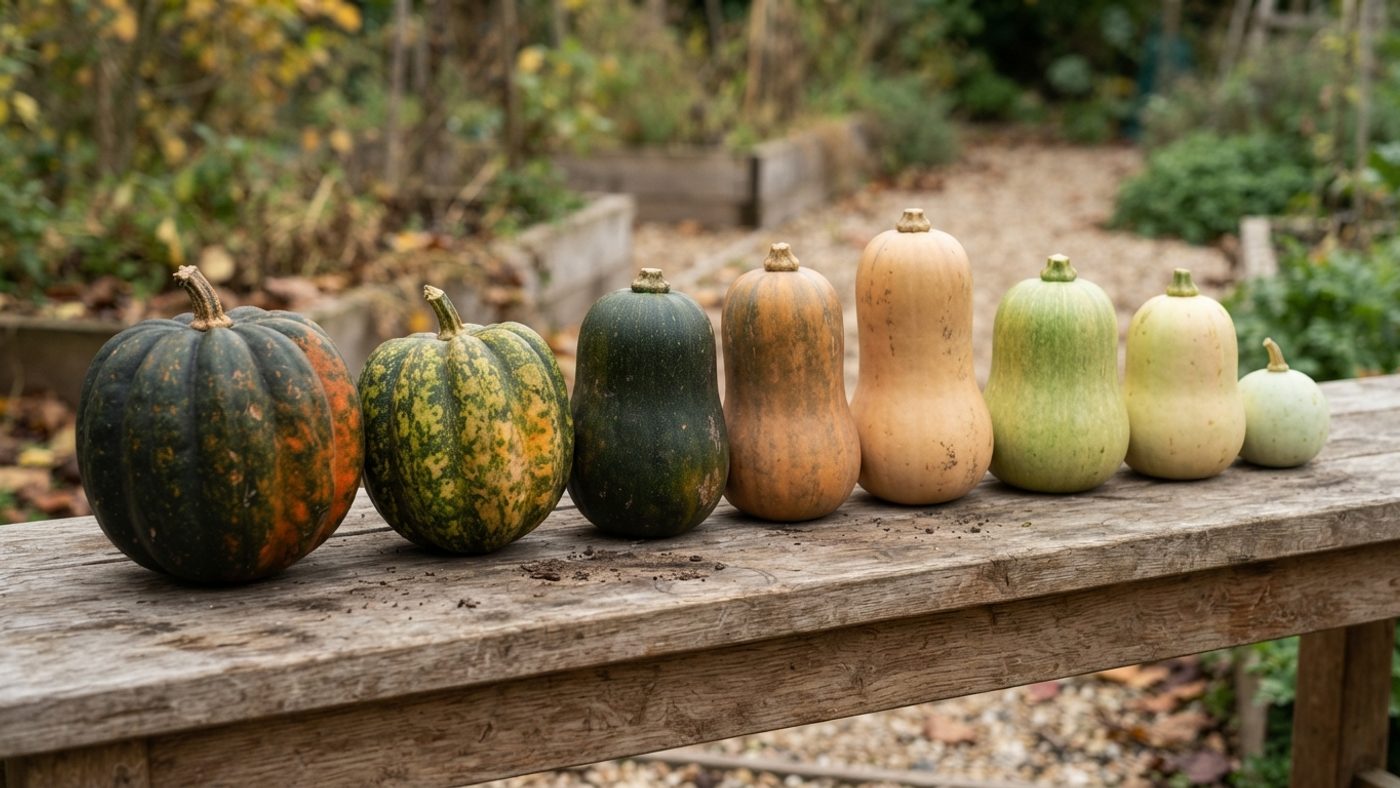
When a frost warning actually arrives with a mixed bag of fruit still on the plants, the fruit falls into three honest categories.
Fully mature fruit, hard skin, full colour, sounds hollow when tapped, should be cut with its stem intact and moved into curing straight away. Curing needs warm, bright, airy conditions for a week or more, which a damp Scottish autumn doesn't reliably provide outdoors, How to Store Squash & Pumpkins for Winter covers exactly where and how to cure it.
Fruit that's close but not quite fully coloured or hardened is worth protecting in place for a few more days if frost is forecast but not yet arrived, RHS advises covering fruit with straw, fleece, or cardboard rather than cutting it early. A short reprieve can let a nearly-ready fruit finish; once it's cut, it stops ripening for good, so there's no benefit to harvesting early to be safe.
Fruit that's still clearly small, pale, or unshaped won't be rescued by either approach. Once a fruit is frosted, or was never going to mature in time, it isn't going to become a long-storing squash regardless of what's done with it afterwards. It's still usable, a small, immature winter squash can be cooked the same way as a courgette, skin and all, rather than treated as a keeper, but it needs using within a few days, not curing or storing.
The one upside
A squash glut is a less wasteful kind than most. A courgette left unused is soft and spoiled within days; a properly matured, well-cured squash keeps for three months or more at cool, ventilated storage temperatures. Once it's through curing, a big simultaneous autumn harvest becomes a slow-release store of food rather than something that has to be dealt with overnight, the real work is getting the plant numbers and sowing timing right so that the harvest moment itself doesn't arrive as a crisis.
Common questions
How many winter squash plants should I grow for a normal household?
There’s no official per-plant yield figure, but given how much ground a trailing plant needs and how many fruit it can carry, one or two plants is enough for most households rather than the three or four often planted "to be safe."
Can I sow winter squash later if I missed the April window?
Yes, direct outdoor sowing in late May or early June is a recognised option, but the resulting 14-20 week harvest window lands closer to or past the first frost in upland and inland parts of Scotland, so the margin for error is much smaller.
What do I do with squash that’s still unripe when frost is forecast?
Fully mature fruit should be cut and cured immediately; near-ripe fruit can be protected in place with straw or fleece for a few extra days; clearly immature fruit won’t develop into a storable squash and is best used straight away.
Does succession sowing work for winter squash like it does for courgettes?
No, there isn’t enough of the season left to sow a second winter squash crop and have it mature before frost, so staggering the harvest has to be planned through variety choice at sowing time instead.
Will a squash that’s had a light frost still store?
No. Frosted pumpkins and squash can’t be stored and should be used immediately rather than cured.
Sources
4 sources, recorded with what each was used for
- RHS: Squash, grow your own: Ripeness indicators, cutting method (10cm stem), curing conditions, storage duration (three months or more), trailing (1.5m) vs bush (90cm) spacing
- RHS: Pumpkins, grow your own: Frost-before-harvest guidance, protecting fruit with straw/fleece/cardboard, "frosted pumpkins can't be stored," limiting fruit per plant for size
- RHS: Sweet Dumpling AGM: Sweet Dumpling's AGMThe RHS's Award of Garden Merit: a UK-wide trials award for reliable performance, not a Scotland-specific recommendation. Full definition → status and harvest flexibility into October/November
- Garden Organic: Pumpkins and Squashes: Sowing-to-harvest timing (14-20 weeks)