
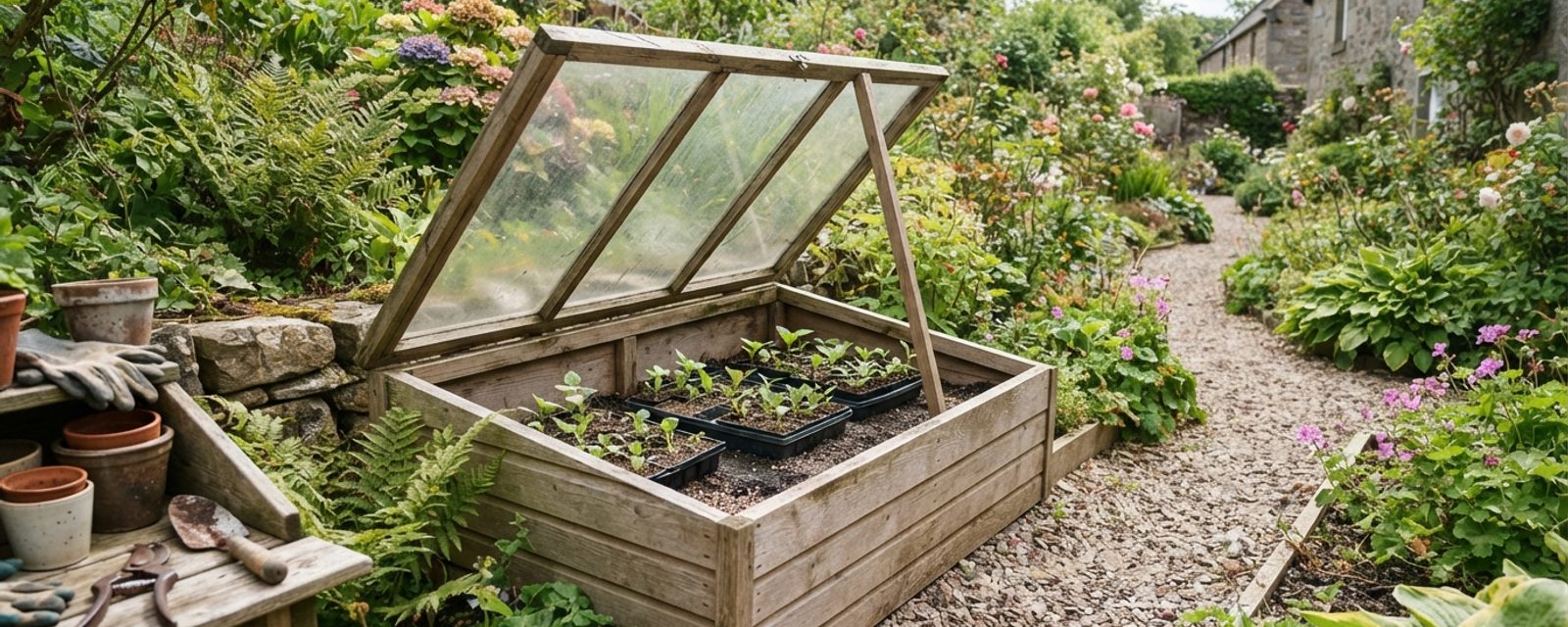
A cold frame is a low, glazed box: solar radiation passes through the glass or plastic lid, warms the soil and air inside, and the sealed lid then traps that heat before it can radiate back out and mix with the colder air outside. It's the same passive solar gain a greenhouse or a car windscreen relies on, just at a much smaller volume, and smaller volumes lose heat faster once the sun goes down, which is why the lid and the seal around it, not the glazing material, do most of the real work. A well-fitted lid also keeps wind-driven convection from stripping the warmed air away, and keeps heavy rain off plants that would otherwise sit in cold, waterlogged compost through winter.
A cold frame is usually 45-60cm deep, with a hinged or removable glazed lid that can be opened to varying degrees to control temperature. Get that timing wrong in either direction and the frame stops helping and starts working against you, cooking seedlings on a bright March afternoon, or holding in damp, fungal air on a still winter night.
Buy vs. build: a real comparison
A bought aluminium-and-glass cold frame is quick, needs no carpentry, and usually comes with better-fitted, more wind-resistant glazing than a first DIY attempt. The trade-off is cost and, often, a smaller usable footprint for the money. A timber-and-glass or timber-and-polycarbonate build costs less in materials, can be sized to exactly the bed or patch you have, and, built with solid sides rather than glazed ones, holds heat better on a cold night than an all-glass frame does. The cost is your own time, and a first build is rarely as weathertight as a manufactured one until you've fixed the gaps.
| Approach | Typical effort | Weatherproofing | Best for |
|---|---|---|---|
| Bought aluminium/glass frame | Assemble in an afternoon, no tools beyond a screwdriver | Good out of the box; glazed sides lose heat faster than solid ones | Quick start, small space, minimal DIY confidence |
| Bought polycarbonate frame | Assemble in an afternoon | More impact- and wind-resistant than glass but insulates only marginally better | Exposed sites, households with children or pets nearby |
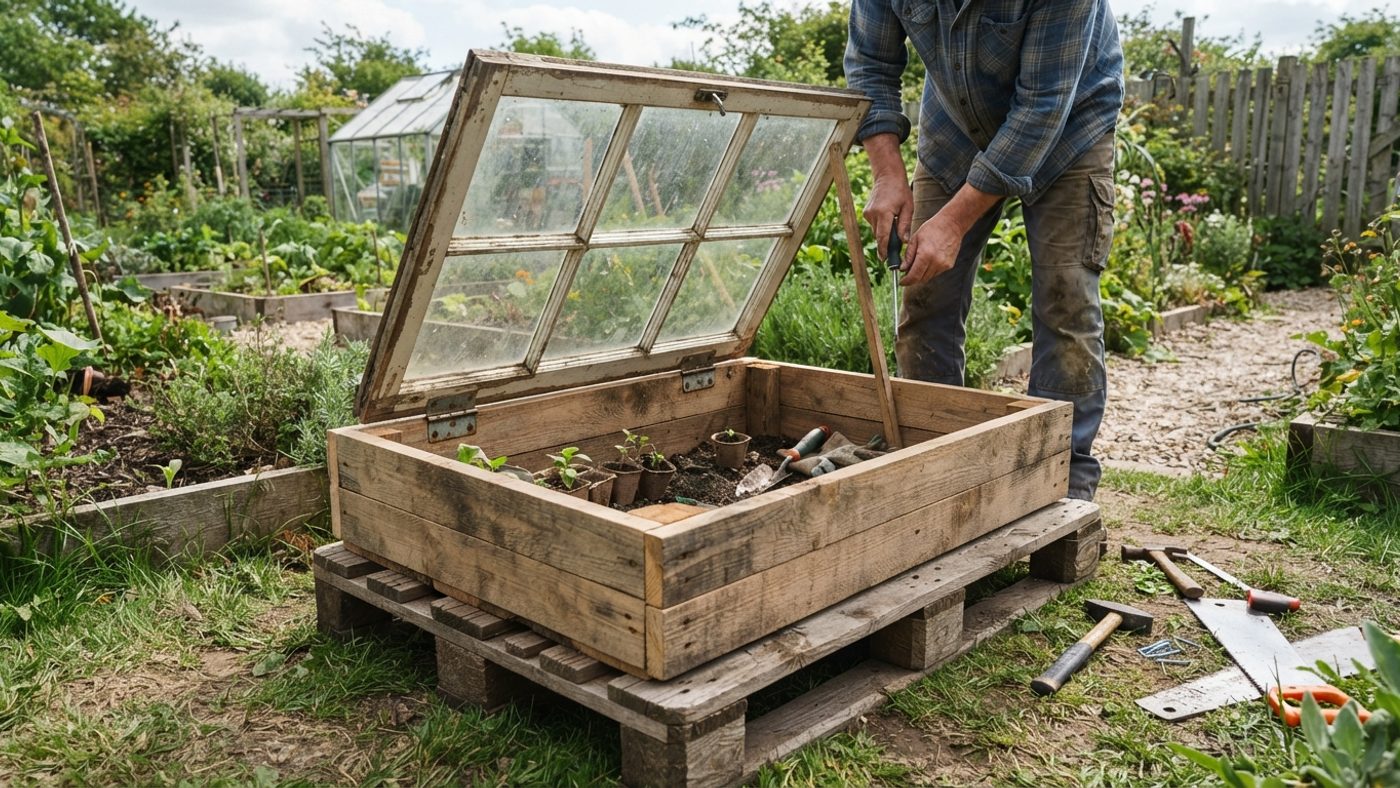
| DIY timber + salvaged window | A weekend build once materials are gathered | Depends entirely on how well you seal joints and hinge the lid; solid timber sides insulate better than glass | Gardeners with basic tools, a spare window, and a pallet to hand |
| DIY brick or block sides + glazed lid | Longest build, needs basic masonry | Best heat retention of any option here, per the RHS | A fixed, permanent spot you won’t need to move |
One low-cost design pairs a standard pallet (100 x 120cm) as the base with an old window (roughly 115 x 130cm) as the lid, and offcut timber for the sloped side supports, attached with metal braces and 7.5cm hinges hanging the window off the back; an electric drill is the only real tool it calls for. It's a genuinely low-cost route if you already have or can source the window and pallet secondhand. Where DIY struggles is wind: a lightweight frame, bought or built, is "cheap and easy to move, but vulnerable to wind damage and need[s] to be pegged down" — worth taking seriously before choosing a lightweight build, not just an afterthought once it's already in the garden.
If you're only hardening offGradually getting young plants raised indoors used to outdoor conditions over 7–14 days before planting out, so cold, wind and direct sun don't shock or damage them. Full definition → a modest number of trays each spring and have no spare materials, buying is the lower-effort choice, expect to pay more for the convenience of a ready-made frame, at whatever a garden centre or supplier is currently charging for the size and material you need. If you want a fixed, larger, better-insulated structure and don't mind a weekend's work, building is cheaper per square metre and gives you the option of solid sides, which no standard bought frame offers.
Siting: sun matters, but wind is the part most guides skip
Every general guide tells you to face a cold frame south or south-west for maximum light, on free-drainingSoil that lets water pass through quickly rather than pooling, so roots aren't sitting in wet ground after rain. Full definition → ground, ideally against a wall that adds a little reflected warmth and shelter. That's sound and worth following. What it usually leaves out is wind, and in a Scottish garden, wind is often the bigger threat to a light structure than a slightly poorer aspect.
"Places in the east and south of the UK tend to be drier, warmer, sunnier and less windy than those further west and north," per the Met Office's regional climate summaries, which puts most of Scotland on the exposed, wetter side of that line. How much that matters for a specific garden is genuinely site-specific rather than a flat Scotland-vs-England rule, as the long-term station averages below show:
| Station | Avg. wind speed (1991-2020) | Note |
|---|---|---|
| Glasgow (Bishopton) | 7.57 knots | Typical of Scotland’s more exposed stations |
| Heathrow | 7.31 knots | Southern England, but open, flat ground — nearly as windy as Glasgow |
| Kew Gardens | 5.30 knots | Sheltered London site — the real low end of the comparison |
Regional averages point toward more Scottish gardens being wind-exposed and wetter on the whole, but your own garden's actual exposure, hilltop, coastal, walled, hedged, matters more than which side of the border it's on, as Heathrow's figure shows.
Low-lying ground carries its own separate risk worth checking alongside wind: cold air is denser than warm air and drains downhill overnight, pooling in hollows and low spots to produce a frost pocketA low-lying spot where cold air drains and pools on still nights, making it noticeably more frost-prone than the surrounding area. Full definition → colder than the slope just above it. A cold frame sited at the bottom of a slope works against itself for exactly this reason, the piece on frost pockets and suntraps covers the mechanism in full, and how to tell whether your own garden has one.
In practice, that means:
- Peg or strap a lightweight aluminium or timber frame down, don't just set it on gravel or paving and trust its own weight, an unsecured lightweight frame is a real wind-damage risk.
- Site it in the lee of a wall, hedge, or fence where you can, even if that costs you an hour or two of direct sun a day; a frame that's blown open or knocked over on a February night undoes more good than the lost light costs you.
- Avoid the base of a slope or an enclosed hollow, for the frost-pocket reason above, a mid-slope or level site usually beats the lowest point of a garden even when the lowest point looks more sheltered.
- Choose polycarbonate over glass if the site is genuinely exposed, it won't insulate much better, but it won't shatter in a gust either.
- Still put drainage first: raise the frame slightly or set it on free-draining soil or gravel so it isn't sitting in standing water once autumn and winter rain sets in.
Ventilation and night insulation
Ventilation is the day-to-day skill a cold frame demands. On any bright day, even in early spring, a closed frame can overheat fast, prop the lid open a few centimetres in the morning and close it again as the temperature drops in the afternoon. A lid should be "robust and easy to open" and allow "varying degrees of ventilation, while protecting the contents from heavy rainfall."
An automatic vent opener takes over the day-to-day judgement call for anyone who can't check the frame twice a day: a wax-filled cylinder expands as the air warms and lifts the lid, then contracts and lowers it again as things cool. The wax "takes time... to expand," so the response lags behind a fast-changing day, and an autovent is worth treating as a supplement to manual checking on a genuinely bright or fast-changing day, not a full replacement for it.
On a genuinely cold night, a hard frost forecast, not just a chilly one, extra insulation helps. Fitting a layer of bubble plastic inside the frame cuts heat loss and draughts, with the trade-off that it also cuts the light and ventilation reaching the plants, so it's worth using only when frost is actually forecast, then removing it again once the risk passes. With frost arriving later and lingering longer into spring the further north and inland you are, a Scottish cold frame is likely to need that bubble insulation across a longer stretch of the calendar than the same frame would further south, a reasonable extension of the later-last-frost pattern covered below, though not a figure any single source states directly. An old blanket, sacking, or straw laid over the closed lid overnight does the same job for a one-off cold snap without permanently reducing the light inside.
A heavy snowfall calls for the same response as it does on a full-size greenhouse: clear it from the lid rather than leaving it to sit, the same "remove snow... to prevent damage and allow good light penetration" advice given for a greenhouse or conservatory roof applies just as well to a cold frame's glazed lid, at a smaller scale.
Slugs and snails
A cold frame's still, sheltered, humid conditions suit slugs and snails as well as they suit the plants inside it, the same wetter Scottish baseline covered under siting above, concentrated in a small enclosed box rather than spread across the open garden. Seedlings and soft young shoots are the most vulnerable stage, and targeted protection for exactly that stage gives the best results: transplant sturdy young plants grown on in pots rather than moving the most vulnerable seedling stage straight into the frame, and add a clocheA small, portable clear cover placed over an individual plant or short row to trap warmth and keep off wind, rain and pests. Full definition → as a further layer of physical protection for anything transplanted while it's still establishing.
Slug pellets, including ferric phosphate ones marketed as organic, are best avoided: they've been shown to have negative effects on wildlife in the garden. A nematode drench (marketed as "Nemaslug"), a microscopic organism watered into the soil that infects slugs with a fatal bacterial disease, is the preferred biological alternative, with no adverse effect on other garden animals. Encouraging natural predators nearby, birds, frogs, toads, hedgehogs, and ground beetles among them, is the other half of a sound approach, alongside the targeted protection above.
When to close it up for winter vs. use it for spring hardening off
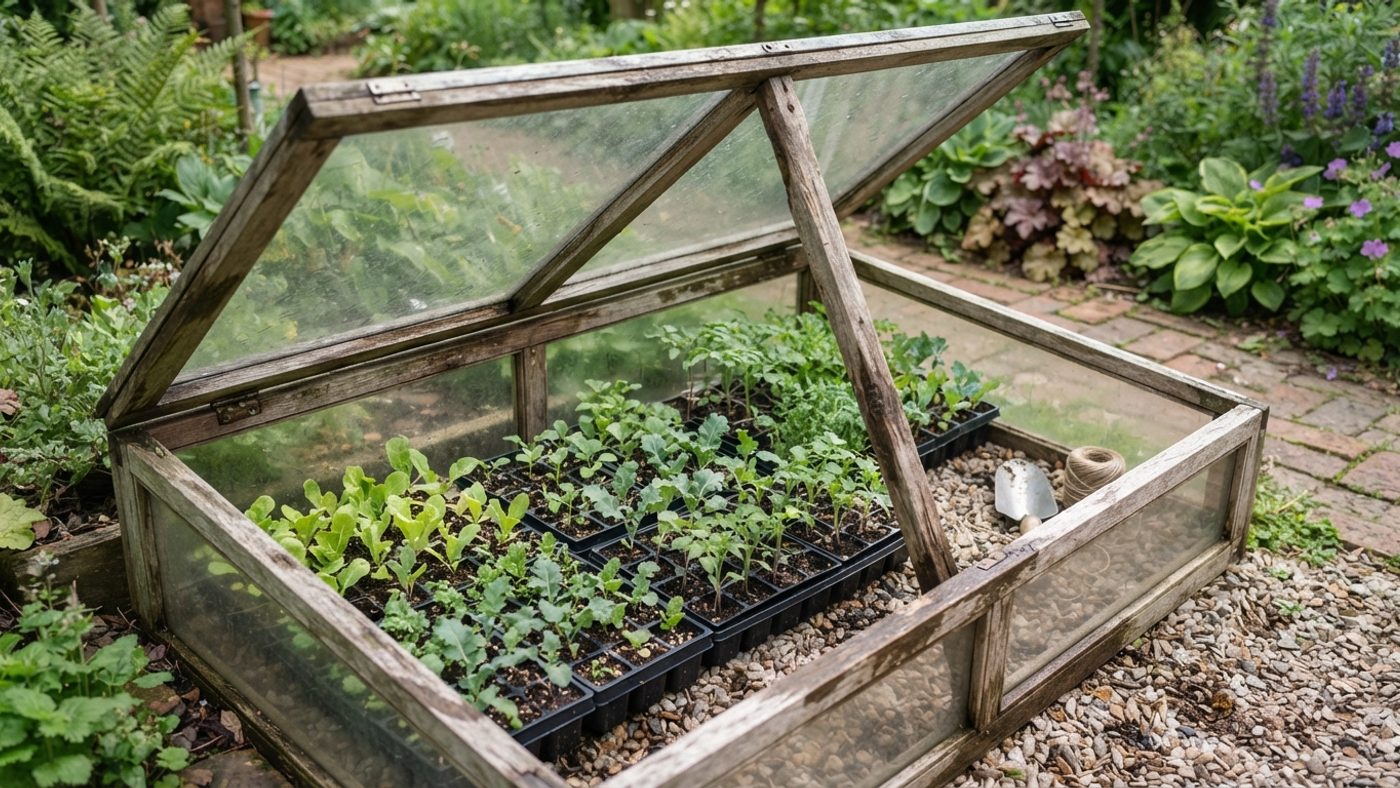
Hardening off in spring is about acclimatising plants you've already raised indoors or under heat to outdoor conditions, gradually, before they're planted out. Leave the lid open slightly during the day in week one and closed at night, then gradually raise the lid further over the following fortnight until it's left off entirely, right before planting out, roughly two to three weeks total, longer if the plants came from noticeably warm growing conditions. Hardening off toughens growth, it doesn't make a frost-tender plant frost-hardy, so the frame is a bridge to your last-frost date, not a way to dodge it. Tender crops shouldn't go out before the last frost, "usually late spring in the south of England, later in the north and Scotland." Starting the hardening-off process on a UK-wide "spring" calendar and planting out on the same date a Midlands guide suggests is a common way to lose a tray of seedlings to a late frost. Treat your own last-frost expectation, not a generic date, as the trigger for when hardening off should finish.
Closing up for winter is the opposite job, using the frame to protect plants that are already outdoors or already established, from cold and wet rather than easing them into it. OverwinteringKeeping a plant alive and intact through the cold months, whether left outdoors, moved under cover, or stored dormant. Full definition → alpines, autumn-struck cuttings, and late sowings sit under a mostly closed lid, opened only to ventilate on mild, still days and to stop damp, stagnant air encouraging grey mould. This is where solid-sided, well-insulated frames, timber or brick, earn their keep over an all-glass one. A frame built over a fresh manure base goes a step further, adding real heat from decomposition rather than just trapping the sun's, see the full technique and where it does and doesn't work in a Scottish winter in the piece on hotbed gardening.
On the fringes of the growing season, fleeceA lightweight, breathable fabric laid or draped over plants to trap a little warmth and keep off frost, wind and some flying pests. Full definition → or cloche cover raises temperatures by roughly 2°C, which "can make all the difference in May, June and September, and in cooler regions." In the north, tender crops are generally "best grown in greenhouses" rather than relied on outdoors, because outdoor conditions there are less reliable across the season. Aubergines and tomatoes, both genuine summer cold-frame crops, fall into exactly that tender category: a cold frame is real, useful extra warmth for them through a Scottish summer, but it isn't the same shelter a greenhouse gives, and it won't rescue a genuinely poor, cold summer the way full greenhouse growing can.
What to grow, by season
| Season | What to grow in the frame | Sourced timing |
|---|---|---|
| Late winter–early spring | Sow seeds that need cool conditions; start hardening off plants raised indoors | Hardening off runs 2–3 weeks, finishing at or after your local last-frost date (RHS) |
| Spring | Continue hardening off; root cuttings | Lid opened progressively over the fortnight before planting out (RHS) |
| Summer | Extra warmth for tender crops such as aubergines and tomatoes | RHS lists aubergines and tomatoes as summer cold-frame crops |
| Late summer–autumn | Sow corn salad, land cress, and oriental leaves (komatsuna, mibuna, mizuna, mustard, rocket) for cut-and-come-again harvests | Sown late summer/autumn, covered with a cloche, cold frame, or fleece for autumn and winter harvests (RHS) |
| Autumn | Protect cuttings and young plants moved in from open ground | RHS lists this as a standard autumn use |
| Winter | Overwinter alpines and tender annuals, shielding them from wet rather than trying to keep them warm | RHS notes cold frames shield alpines from winter rain and let annuals overwinter |
Sowing oriental leaves and corn salad in late summer and closing the frame down as the weather turns gives cut-and-come-again salad through autumn and into winter that would otherwise stop at the first hard frost. That's real, sourced, low-effort return for very little structure, though it's season extension at the shoulders of the year, not a claim that the frame keeps things growing through the depths of a Scottish winter.
Common questions
Do I need a cold frame if I already have a greenhouse?
They do different, overlapping jobs. A greenhouse gives more headroom and heat retention for genuinely tender crops through summer; a cold frame is lower-cost, needs no floor space indoors, and is specifically suited to hardening off plants moving from warm indoor conditions to the open garden, and to overwintering hardier plants that don’t need full greenhouse warmth. Many gardeners use both: greenhouse for raising and tender crops, cold frame as the halfway step.
What should a cold frame sit on?
Soil, gravel, or paving all work. The priority is that the site drains freely rather than pooling water, since a frame with wet feet all winter encourages rot and fungal problems more than cold does.
How do I stop my cold frame blowing over in Scottish weather?
Peg or strap it down and site it out of the prevailing wind where you can. How exposed any one garden actually is depends far more on local shelter (a wall, hedge, or fence) than on the general Scotland-vs-England picture: Met Office data shows a supposedly sheltered site like Heathrow can be nearly as windy as Glasgow.
When is it too early to start hardening off in a Scottish cold frame?
There’s no fixed UK-wide date. The whole process ties to your local last-frost date, which runs later and more variably in the north and Scotland than in southern England. Start the two-to-three-week hardening-off process working backwards from your expected local last frost, not a calendar date lifted from a guide written for further south.
Can I grow salad in a cold frame right through a Scottish winter?
Sowing cold-tolerant leaves such as land cress, corn salad, and oriental mustards in late summer and covering them will extend your harvest through autumn and into winter. That’s season extension at the margins, though, not a claim that the frame keeps things growing through the depths of winter.
Do slug pellets belong in a cold frame?
No — slug pellets, including organic ferric phosphate ones, have been shown to harm garden wildlife and are best avoided. A nematode drench ("Nemaslug"), targeted protection (sturdy transplants rather than tiny seedlings, cloche cover), and encouraging natural predators are the recommended approach instead.
Sources
12 sources, recorded with what each was used for
- RHS: Coldframes and Mini-Greenhouses: What a cold frame is, typical depth, lid adjustability, and the wind-vulnerability/pegging-down caution for lightweight frames
- RHS: Hardening Off Tender Plants: The 2–3 week hardening-off process, and that the last frost runs later and more variably in the north and Scotland
- RHS: Guy Barter’s guide to getting tender crops through cold spells: The ~2°C fleece/cloche effect at the fringes of the season, and that tender crops are best grown in greenhouses in the north
- RHS: Vegetables: Growing for Winter: Late-summer salad sowing (corn salad, land cress, oriental leaves) for cloche/cold-frame-covered autumn and winter harvests
- RHS: Greenhouse: Ventilation and Shading Tips: How automatic wax-cylinder vent openers work and their slow-response limitation
- RHS: Slugs and Snails: Targeted seedling protection, the current advice against slug pellets including ferric phosphate ones, the nematode biological control, and encouraging predators
- RHS: January — Greenhouse, Conservatory and Houseplants: Clearing snow from a glazed roof to prevent damage and keep light reaching plants
- Met Office: UK regional climates: The general east/south vs. west/north pattern in wind, rainfall and sunshine across the UK
- Met Office: Location-specific long-term averages — Glasgow, Bishopton (1991–2020): Average annual wind speed for the Scotland/Heathrow/Kew comparison
- Met Office: Location-specific long-term averages — Heathrow (1991–2020): Average annual wind speed for the Scotland/Heathrow/Kew comparison
- Met Office: Location-specific long-term averages — Kew Gardens (1991–2020): Average annual wind speed for the Scotland/Heathrow/Kew comparison
- Gardeners’ World: How to Make a Cold Frame: The pallet-and-salvaged-window DIY build: dimensions, hinges, braces, and tools