
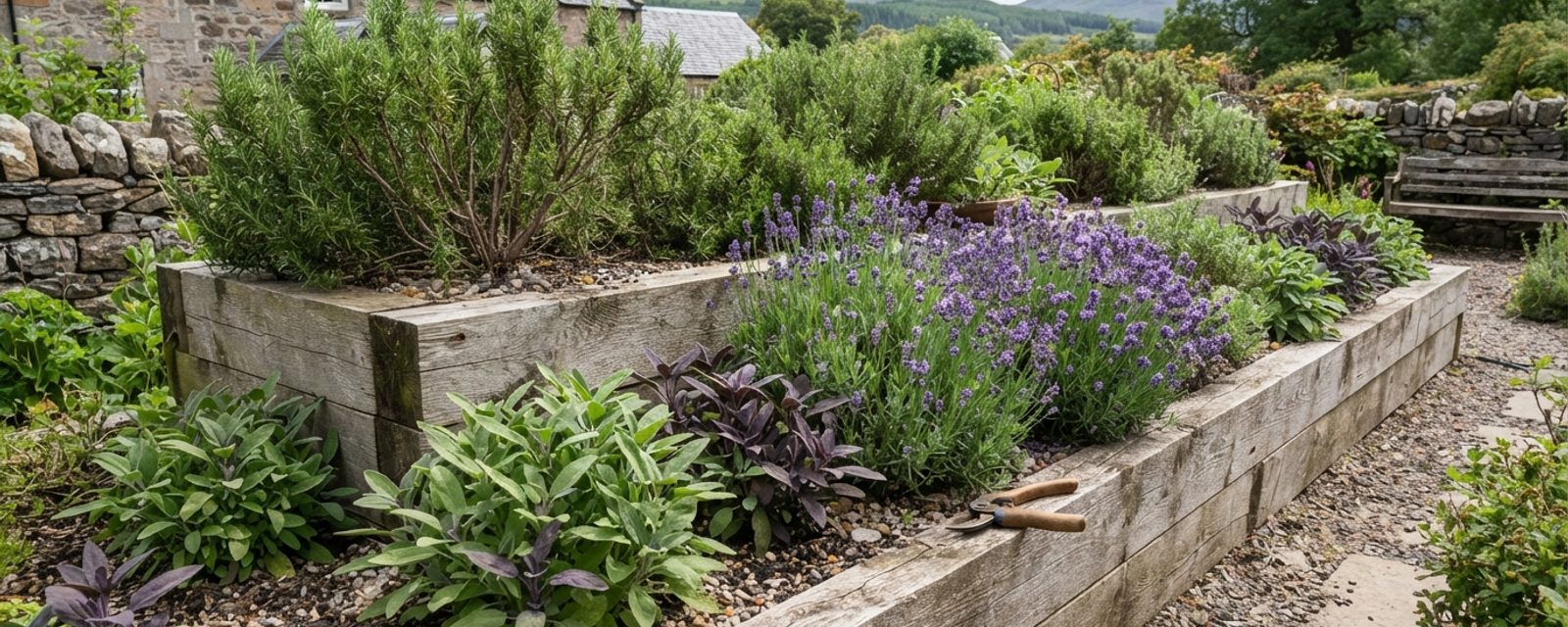
Wet roots kill Mediterranean herbs in Scotland far more often than cold air does. Rosemary, sage, thyme, lavender and winter savory all evolved on free-drainingSoil that lets water pass through quickly rather than pooling, so roots aren't sitting in wet ground after rain. Full definition →, often stony hillsides where winter rain runs straight through the soil profile; their root systems simply never adapted to sitting in cold, saturated clay for weeks at a time. A hard frost is something these plants are built to shrug off. A winter spent with their roots suffocating in waterlogged ground is not, and that is the ordinary condition of an unmodified Scottish border from November to March, especially away from the coast.
This is why a plant's official hardiness ratingThe RHS's H1a–H7 scale for how much cold a plant can survive outdoors, H1a being tender indoor-only and H7 hardy anywhere in the UK. Full definition → and its actual survival in a Scotland garden are two different questions. A herb rated hardy to -20°C can still rot and die in a badly drained bed, while a borderline herb rated hardy only to -5°C can come through a Scottish winter intact if it's raised, gritted, and mounded so its roots never sit wet. Designing a permanent herb border here is mostly a drainage-engineering problem, with hardiness tiering as the second layer on top.
Why drainage outranks cold tolerance
Scotland's winters run colder inland and upland than the south of England. Regional Met Office records show the west coast rarely sees hard, prolonged frost even though it carries the heaviest Atlantic rainfall, while the east coast runs colder but often drier. Whichever side of that split a garden sits on, Mediterranean herbs are adapted to summer drought and free-draining soil, not to permanently damp clay, so the wet-root risk exists on both sides of that split, worse on the wetter west and on heavy inland clay, but still real on a drier east-coast garden with poor drainage. When roots sit in cold, saturated soil, oxygen exchange collapses and the roots rot, and a rotted root system will kill a plant that never experienced a frost severe enough to damage its foliage. That's the mechanism behind the common experience of losing a "fully hardy" herb over a mild, wet winter while an exposed but well-drained plant survives a harder frost nearby.
How much this matters varies sharply across the country: Met Office station records put Inverness among the mildest spots on the Scottish mainland, milder even than Edinburgh, while an upland site near Braemar sits at the opposite extreme. The H3-H4 tier below is the one where that gap actually changes the answer, worth checking the fuller regional breakdown on the frost dates page for your own postcode before deciding how much of this border to risk in open ground versus a raised bed.
Exposed, windy sites carry a separate winter risk worth planning for alongside frost and wet roots: cold, drying wind can scorch evergreen foliage on rosemary, sage, lavender and bay, particularly upland or unsheltered gardens with no windbreak. Coastal exposure specifically cuts the other way, though: lavender is named on RHS's own list of shrubs recommended for open coastal planting, so the wind and salt that come with a milder coastal site aren't automatically a problem for a silver-leaved Mediterranean herb there, standing water is the bigger risk on a coastal site, not the coastal conditions themselves. A hedge, wall or fence on the windward side of the border helps on any exposed inland or upland site regardless of which herbs are planted.
The full soil and drainage reference for Scottish gardens covers how to assess your own ground, including the naturally acidic soil common across much of Scotland, before committing to a border design; lavender is confirmed tolerant of acid, alkaline or neutral soil, so pH is not the deciding factor for this border the way drainage is.
Hardiness tiers: what the numbers actually mean here
RHS hardiness ratings measure minimum air temperature tolerance, not border survival. Use the tiers below to sort herbs by cold risk, then apply the drainage guidance further down regardless of tier, H6 mint still needs containment, and H5 sage still wants a mounded, gritty bed on clay.
| Herb | H-rating | Temperature range | Context |
|---|---|---|---|
| Mint | H6–H7 | below -20°C | Hardy anywhere in Scotland, but needs its own contained bed, not a shared-border plant |
| Oregano | H6 | -20 to -15°C | Waterlogging, not cold, is the real winter risk |
| Chives | H6 | -20 to -15°C | Dies back fully and regrows from roots each spring; invisible over winter |
| Russian tarragon | H6 | -20 to -15°C | Distinct plant from French tarragon below despite the shared common name |
| Common sage | H5 | -15 to -10°C | Winter waterlogging is the dominant risk, not cold air |
| Common thyme | H5 | -15 to -10°C | Creeping habitA plant's characteristic shape and manner of growth, such as upright, spreading, creeping or bushy. Full definition → suits front-of-border edging |
| Winter savory | H5 | -15 to -10°C | Perennial structure herb, distinct from the annual summer savory |
| English lavender / lavandin | H5 | -15 to -10°C | Full cultivarA plant variety that arose or was bred under cultivation and is kept true by deliberate propagation, rather than a naturally occurring wild species. Full definition → comparison in the best lavender varieties guide |
| Rosemary (species and upright cultivars) | H4 | -10 to -5°C | Borderline inland/upland, reliable on the coast or lowlands with good drainage |
| Bay | H4 | -10 to -5°C | Established plants only; young bay is meaningfully more frost-tender than this rating suggests |
| French tarragon | H4 | -10 to -5°C | The more marginal of the two tarragons |
| Lavandula stoechas subsp. stoechas | H4 | -10 to -5°C | One of two French/Spanish lavender subspecies |
| Rosemary, Prostrate Group (e.g. 'Capri') | H3 | -5 to 1°C | Ground-hugging habit keeps more of the plant in contact with wet soil |
| Lavandula stoechas subsp. pedunculata | H3 | -5 to 1°C | A full tier below subsp. stoechas — a real botanical distinction between the two |
Laying out the border by height tier
Plant in spring, once the frost risk has passed and the soil is starting to warm, April to May suits most of this border, and is the window already given on the individual rosemary, lavender and bay guides.
Back of border (structure, 1–2.5m): Bay, kept clipped and compact given its young-plant frost sensitivity, and upright rosemary types such as 'Miss Jessopp's Upright' (1.5–2.5m). These anchor the border and read as evergreen mass through winter. Full pruning and shaping detail is on the rosemary and bay growing guides.
Mid-height (structure and volume): English lavender or lavandin, common sage, winter savory, and tarragon. Russian tarragon self-seeds and spreads more readily than French, so give it slightly more room to run. Lavender siting and pruning technique, including the mounding detail relevant here, is covered in full in the pruning lavender article.
Low and front-of-border (edging and spillover): Common thyme as a creeping mat along path edges, chives in compact clumps, oregano as low ground cover, and prostrate rosemary types like 'Foxtail' trained to spill over a wall or raised-bed edge.
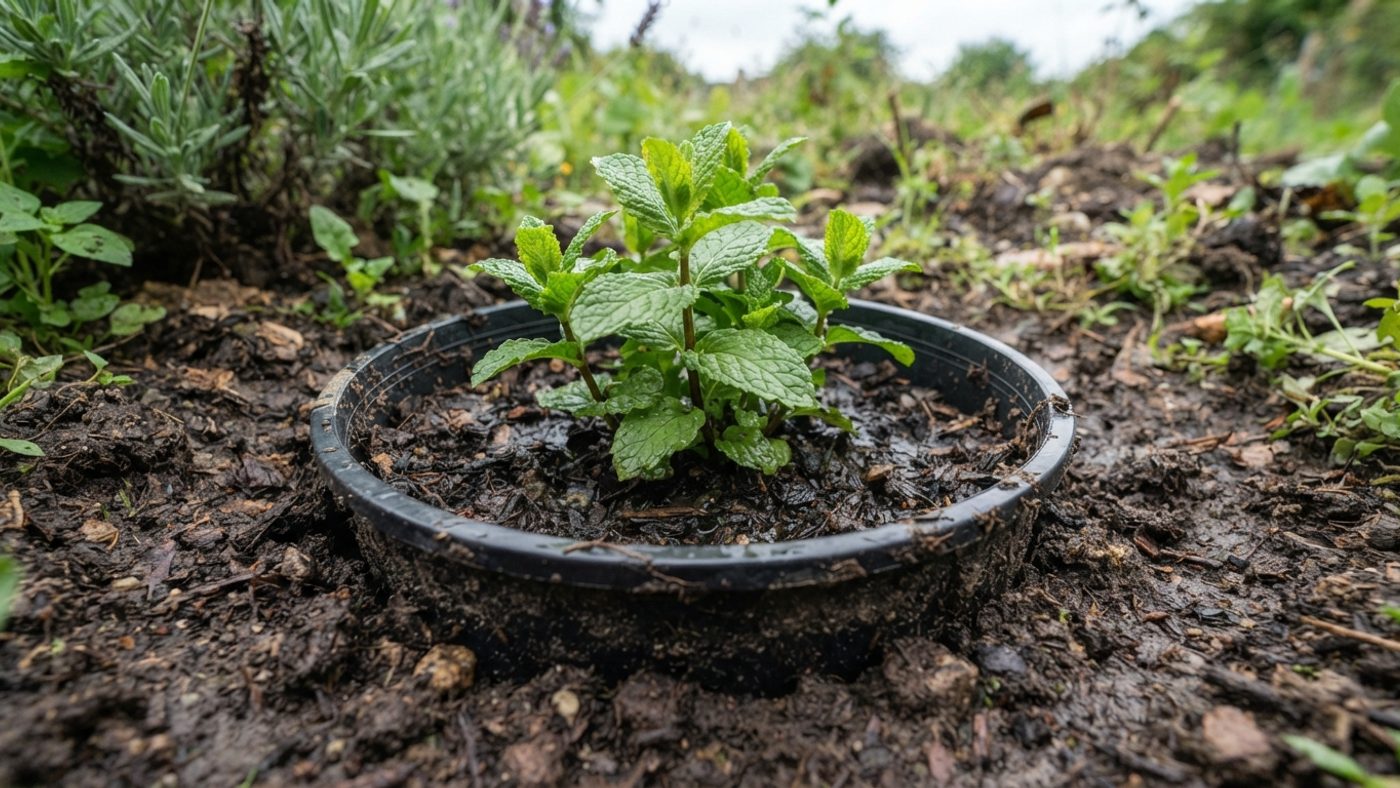
Kept separate: mint. Mint is the one herb in this border with no drainage problem at all, it prefers moisture and is the hardiest plant on this list. It's excluded from the shared bed anyway, because its running rootstockThe root system and lower stem a fruit tree is grafted onto, chosen to control the tree's eventual size rather than for its own fruit. Full definition → will colonise everything around it within a season or two. Keep it well away from the drainage-loving herbs above; the mint growing guide covers containment and harvest in detail.
Spacing, so you know how many plants to buy:
| Herb | Spacing | Tier |
|---|---|---|
| Rosemary (hedge) | 45cm apart | Back |
| English lavender / lavandin | 90cm as individual specimens, 30–45cm for a hedge | Mid |
| Common sage | 30cm apart | Mid |
| Winter savory | 20cm apart | Mid |
| Russian tarragon | 30cm apart | Mid |
| French tarragon | 20cm apart | Mid |
| Common thyme | 20–30cm apart | Low |
| Chives | 15–20cm apart | Low |
| Oregano | 20–30cm apart | Low |
Full spacing detail, including container spacing, is on each herb's own growing guide, linked above by tier.
Building the raised, free-draining structure
Because the dominant risk is wet roots, the structural fix is the same one regardless of which herbs you're placing: get the root zone above the water table and moving water through fast.
| Step | What to do |
|---|---|
| Mix | Three parts organic matter, two parts sharp sand, seven parts topsoil is the general raised-bed recipe. For this herb border, double the sand share to roughly three parts organic matter, four parts sharp sand, seven parts topsoil. |
| Grit | Work horticultural grit into that mix at up to 25% by volume across the whole bed, rather than treating it as a per-plant addition, this ratio suits every herb in this border. |
| Mound | On heavy or clay ground, raise the whole bed 20–30cm on a mound, ridge or frame rather than planting at grade. A mound with no escape route for water underneath just becomes a raised tub of wet clay in heavy ground, so break up or pierce the base layer, or set the bed over a rubble/gravel sump. |
| MulchA layer of material spread over the soil around plants to suppress weeds, retain moisture, and improve soil structure as it breaks down. Full definition → | Finish with a gravel mulch around 5cm deep, siting small plants on a slight mound within it so they aren’t swamped by the gravel itself. |
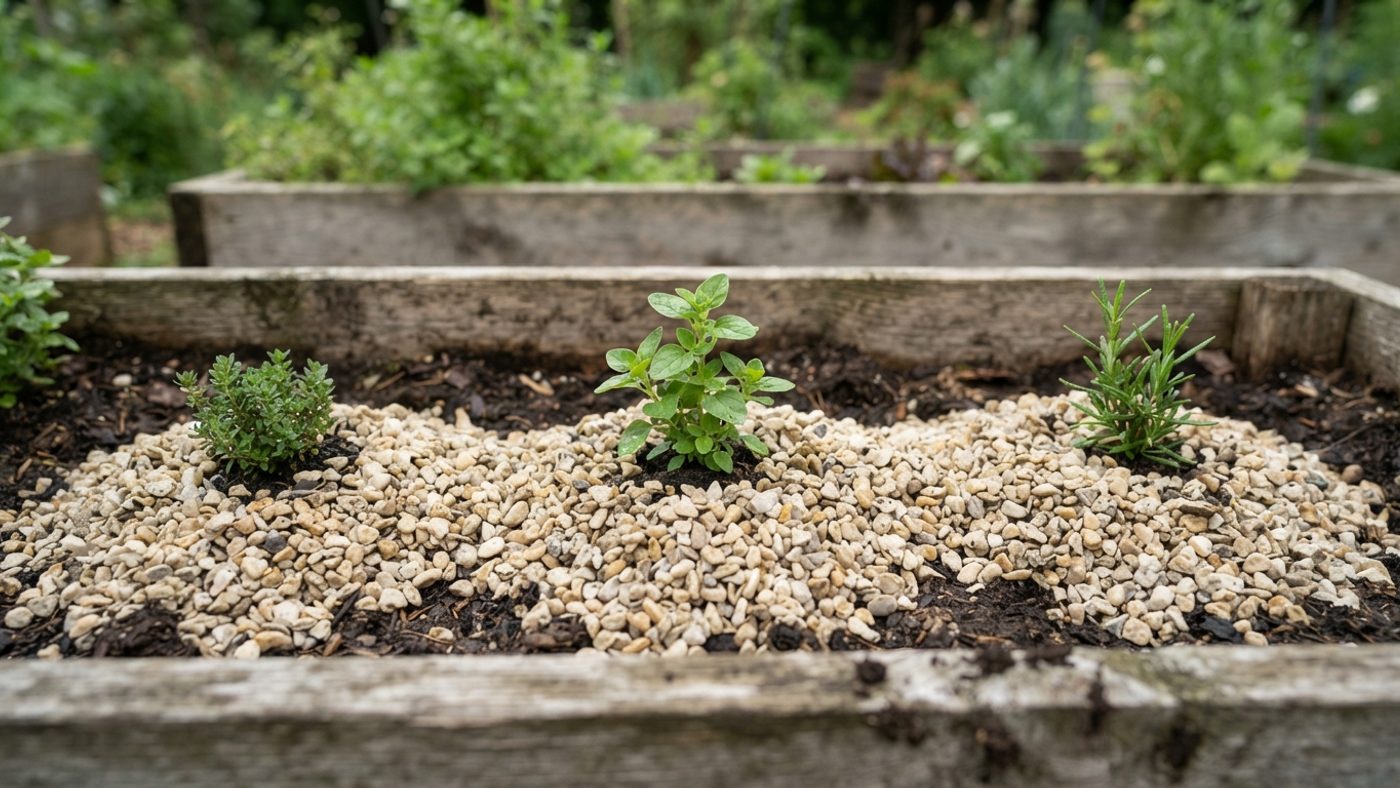
One caveat: a well-drained raised bed drains so efficiently that it can leave young plants short of water in a dry spell, particularly their first summer before roots are established, so water new plantings properly even though the whole point of the structure is to keep them dry over winter.
For the H3-H4 tier specifically, good drainage is the permanent fix, but young bay in particular is more frost-tender than its H4 rating suggests and is worth fleecing or moving under cover in a severe cold snap in its first winters, the bay growing guide covers the exact threshold.
For sizing the bed and calculating how much grit and soil to bring in, the bed area calculator and soil amendment calculator handle the arithmetic once you've picked a footprint.
Winter structure: why this border doesn't go bare
Every herb in the H4-H6 tiers above is evergreen or semi-evergreen, which means this border keeps foliage, form and colour through the exact months an unplanted bed would be bare soil. That's a general planting-design principle, not something specific to Scotland, but it matters more here given how much longer the bare months run: a common design rule of thumb suggests 60 to 80% evergreen content for year-round structure, and a border built almost entirely from evergreen Mediterranean herbs comfortably clears that bar.
The silver-grey foliage common to rosemary, sage, lavender and winter savory is worth noting for a second reason beyond appearance: these plants' reflective, often hairy leaves are a drought adaptation, the same trait that makes them intolerant of wet roots in the first place.
What's left out, and why
Basil, dill and coriander are tender annuals with no winter hardiness rating to speak of, they're grown fresh each year and were never candidates for a permanent structure. Summer savory looks like a companion to winter savory by name only; it's an annual, replanted yearly if wanted, while winter savory is the perennial that earns a place in the mid-height tier above. Parsley, despite some named cultivars carrying an H4 rating, is grown and harvested as a biennialA plant that completes its life cycle over two years: growth in year one, then flowering, seeding and dying in year two. Full definition → in practice and isn't treated as permanent border structure here.
Common questions
Can rosemary survive a Scottish winter outdoors, or does it need to come inside?
It doesn’t need to come inside if the bed is built right, but a large pot moved to a sheltered spot for winter is a reasonable fallback on a genuinely exposed, heavy-clay site where you’re not confident a raised bed will drain fast enough. Growing one plant of each in a pot the first winter, alongside the border planting, is a low-cost way to hedge your bet while you find out how the ground actually performs.
Why did my "fully hardy" herb die over a mild winter?
Check the base of the stem for blackened, mushy tissue before assuming the plant was simply unlucky, that’s root rot, not frost damage, and it means the spot itself held water rather than the herb being unsuited to it. If you catch it early, cutting back to any green, firm stem and improving drainage around the roots can sometimes save a partially rotted plant; once the rot has reached the main stem base, it usually won’t recover.
Can I grow mint in the same bed as my other herbs?
Not loose in an open shared border, mint spreads aggressively by runnersLong, trailing stems a plant sends out that root where they touch soil, producing a genetically identical new plant for free. Full definition → and will outcompete everything nearby within a season or two. Give it a separate contained bed or a sunken bottomless-pot barrier instead.
Do I need a raised bed for every herb, or just the borderline ones?
Good drainage benefits all of them, but it’s non-negotiable for the H3–H4 tier, hardy only down to about -5°C to -10°C, rosemary, bay, French tarragon and both Lavandula stoechas subspecies, where that thinner cold-hardiness margin leaves no room for wet-root stress on top of it. The H5–H6 tier, hardy down to -15°C or colder, tolerates ordinary border soil more forgivingly, provided it isn’t sitting wet all winter.
What’s the difference between the two "French lavender" subspecies?
Lavandula stoechas subsp. stoechas is rated H4, while subsp. pedunculata is rated a full tier lower at H3. They’re often sold under the same common name, but the pedunculata subspecies is the more marginal choice for an open Scottish border and benefits more from a sheltered microclimateThe local growing conditions in one specific spot that differ, sometimes substantially, from the wider area's average climate. Full definition →. Named-cultivar detail for both is in the best lavender varieties guide.
Sources
21 sources, recorded with what each was used for
- Met Office: UK climate averages: West-coast/east-coast rainfall and frost pattern
- Met Office: location-specific long-term averages: Inverness/Edinburgh/Braemar station comparison
- RHS: Plants for Coastal Areas: Lavender ('Hidcote') named as a recommended shrub for open coastal planting
- RHS: Rosmarinus officinalis plant page: Rosemary species H4 hardiness rating
- RHS: Salvia rosmarinus Prostrata Group 'Capri' plant page: Prostrate rosemary H3 hardiness rating
- RHS: Laurus nobilis plant page: Bay H4 hardiness rating and young-plant frost tenderness
- RHS: Salvia officinalis plant page: Common sage H5 hardiness rating
- RHS: Thymus vulgaris plant page: Common thyme H5 hardiness rating
- RHS: Satureja montana plant page: Winter savory H5 hardiness rating
- RHS: Origanum vulgare plant page: Oregano H6 hardiness rating
- RHS: Allium schoenoprasum 'Forescate' plant page: Chives H6 hardiness figure
- RHS: Artemisia dracunculus 'Russian' plant page: Russian tarragon H6 hardiness rating
- RHS: Artemisia dracunculus 'French' plant page: French tarragon H4 hardiness rating
- RHS: Lavandula stoechas subsp. stoechas plant page: H4 hardiness rating
- RHS: Lavandula stoechas subsp. pedunculata plant page: H3 hardiness rating
- RHS: Raised Beds: Raised-bed soil mix ratios and doubled sand proportion for herbs
- RHS: Gravel Gardens: Gravel mulch depth and mounding small plants
- RHS: Rosemary — grow your own: Rosemary-specific drainage detail, grit ratio, cold-survival threshold
- RHS: Lavender growing guide: Lavender's intolerance of waterlogged soil, mounding on heavy soil
- RHS: Using award-winning plants — silver foliage: Silver foliage as a drought adaptation
- RHS: Evergreen seasonal interest: Evergreen winter structure and the 60–80% planting guideline