
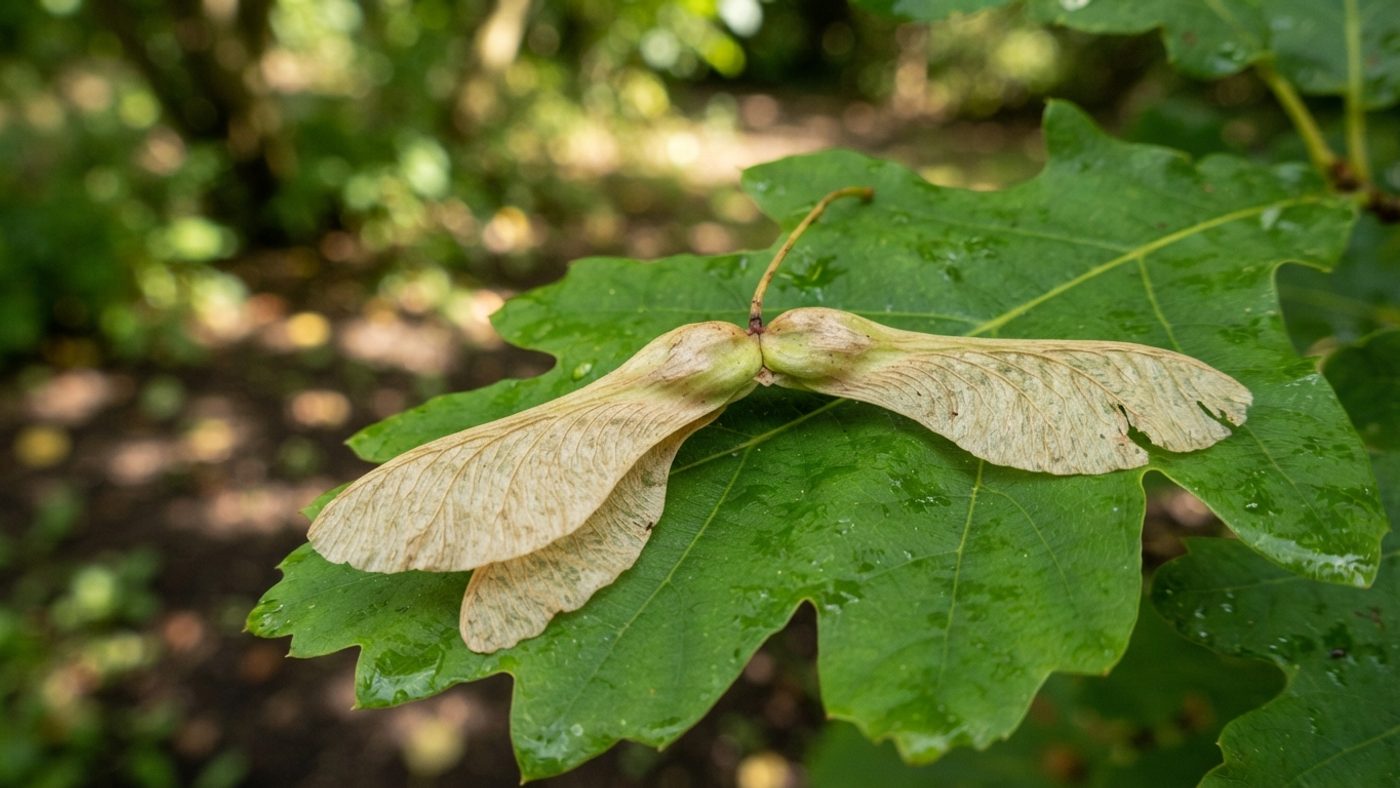
A single mature sycamore doesn't produce a modest scattering of seeds, it produces seed in very large numbers, and it does so from a young age. Seed-bearing in sycamore typically starts once a tree reaches somewhere between 25 and 30 years old, and from then on it settles into mast years roughly every two to three years, when seed output spikes well beyond an average year. Every one of those seeds is a winged samara, the paired "helicopter" fruit that spins as it falls, and that wing is precisely what makes sycamore's seed problem a garden-wide one rather than a strictly under-the-canopy one: wind carries the samaras well beyond the tree's own drip line, the ring of ground directly under its outer branches, so seedlings turn up in beds, gravel, lawns and borders that have no sycamore anywhere directly above them.
Why garden beds are the perfect landing spot
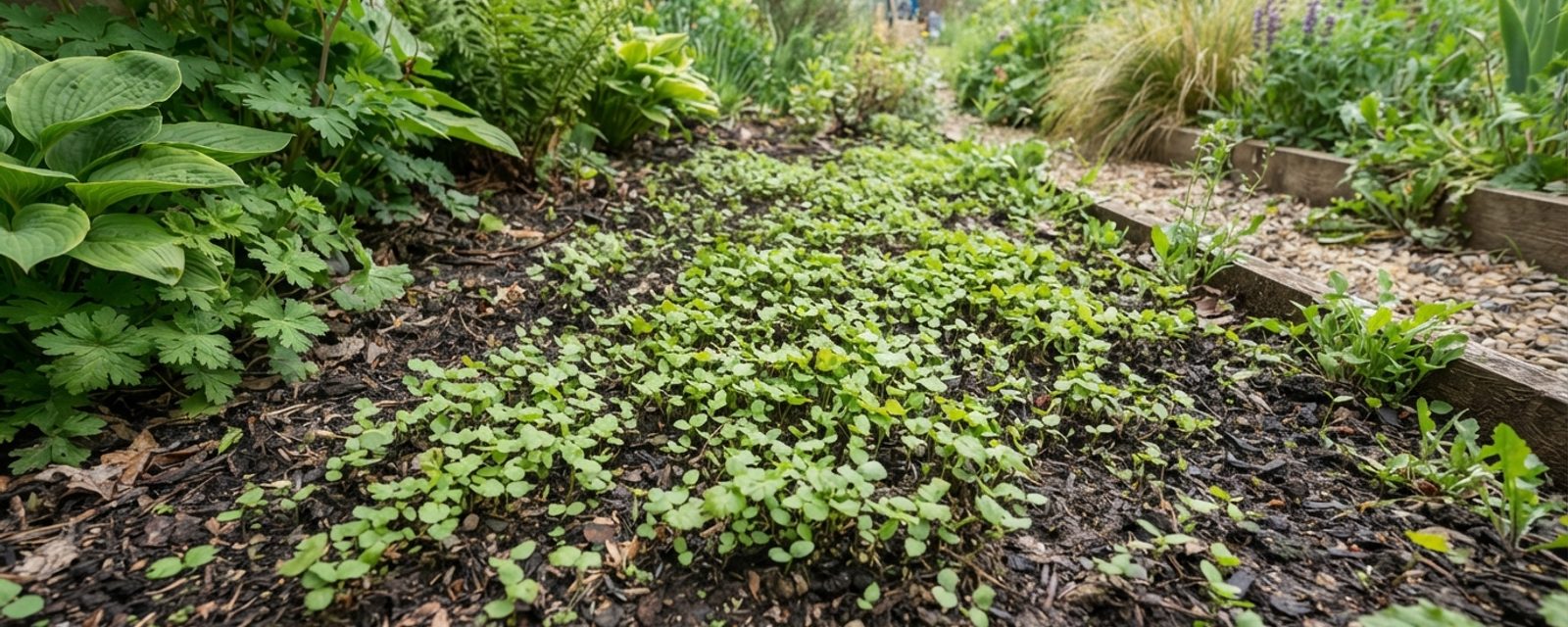
The seed itself isn't the whole story, where it lands matters just as much. Sycamore is classed as a pioneer species, adapted to colonising open or disturbed conditions rather than the shaded floor of an established woodland, and it will regenerate freely and prolifically wherever conditions suit. A cultivated bed is, from the seed's point of view, close to ideal: bare soil between plants, ground turned over by digging and weeding, and none of the leaf litter and root competition that keep a woodland floor sparser. A lawn gets off comparatively lightly for the same reason in reverse: regular mowing cuts new seedlings down before they can put on any growth, so turf never gives them the settled bare ground a bed or border does. That's also why gravel gets hit almost as hard as a bare bed, there's no soil to dig a fork into, so a seedling rooted between the stones usually has to be pulled by hand or lifted with the gravel disturbed around it, rather than hoed off in one pass the way a bed allows.
Telling a seedling apart from the rest
At the very earliest stage, a sycamore seedling shows a pair of simple, smooth-edged seed leaves (cotyledons), not yet the shape most gardeners think of as a maple leaf, and easy to confuse with ash, field maple or Norway maple seedlings germinatingA seed sprouting: breaking dormancy and putting out its first root and shoot, given the right warmth and moisture. Full definition → in the same bed. The lobed, toothed, unmistakably maple-shaped leaf that gives sycamore away doesn't appear until the first true leaves open on a reddish stem just after that. Compare an uncertain seedling against photos of young sycamore leaves before deciding whether to pull it or leave it, rather than relying on a written description alone.
Removing seedlings while they're still easy
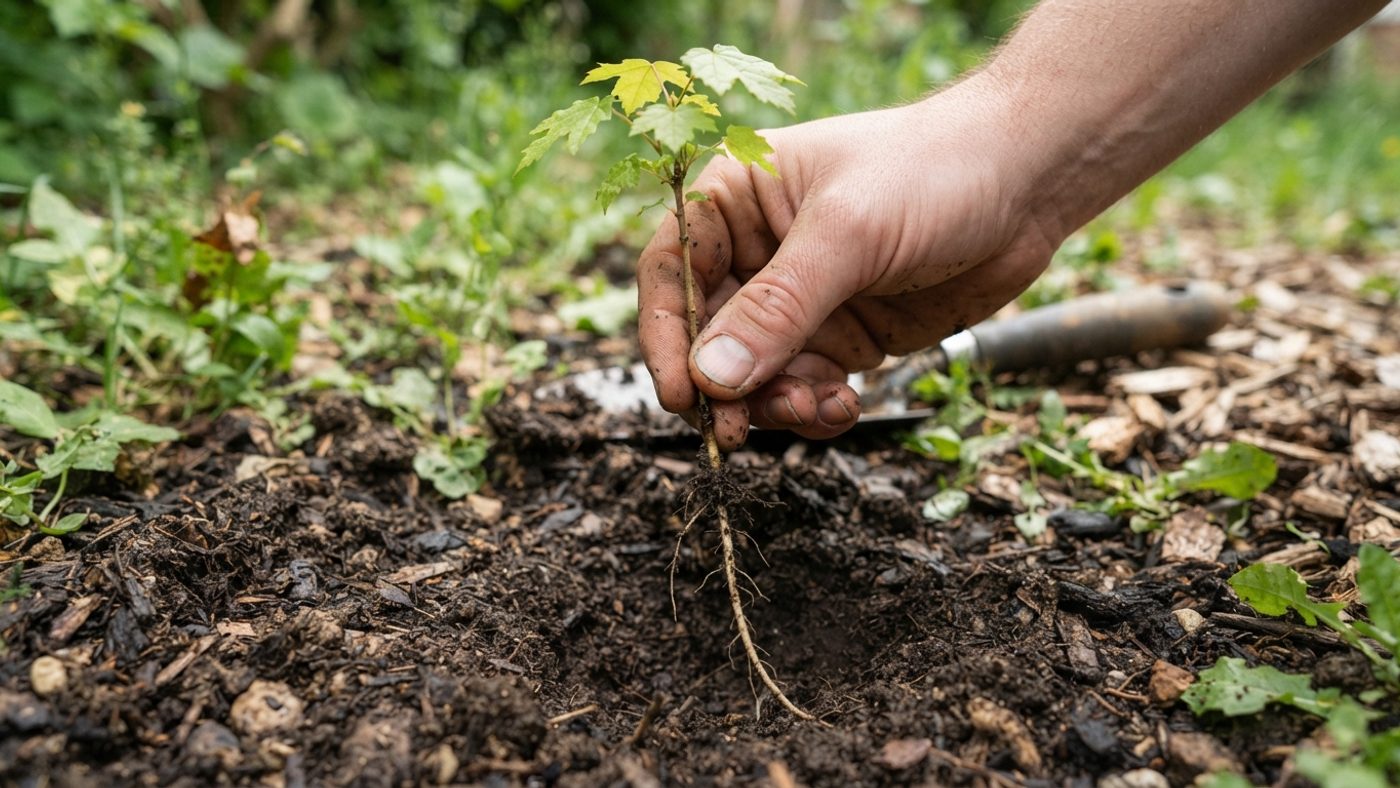
The good news is that a first-year sycamore seedling is one of the easier weeds to deal with. Because it has grown from a seed rather than sprouted from an existing root system, a young seedling hasn't yet built the kind of extensive root network that makes established growth so persistent, and digging out as much of the root as possible is enough to stop it coming back. Seedlings are, in general, much easier to remove than suckersA shoot that grows from a plant's roots or lower trunk, separate from the main framework, usually removed before it diverts energy. Full definition →, the new shoots some trees and shrubs throw up directly from an established root system rather than from seed, and considerably less prone to regrowing afterwards.
That window doesn't stay open long, though. Left through a full growing season, a sycamore seedling puts down a taprootA single, thick, dominant root growing straight down from a plant, storing energy and anchoring it, as opposed to a spreading mass of fine roots. Full definition → and starts to establish in earnest, and pulling it becomes a matter of digging rather than lifting. A seedling snapped off at soil level without its root can resprout from what's left behind, so treat the first spring and summer after germination as the point to act, not a "get to it eventually" job. A daisy grubber or narrow hand fork, worked in alongside the stem rather than pulled straight up, is usually enough to lift a taproot intact once hand-pulling alone starts snapping stems.
| Seedling age | What's typically needed |
|---|---|
| Newly germinated, first season | Hand-pull or hoe while soil is workable; root usually lifts whole |
| One growing season+ | Dig out, following the taproot down; hand-pulling alone often snaps the stem and leaves the root to resprout |
| Sapling, multiple seasons | Cut back and dig out the stump as for an established shrub |
MulchA layer of material spread over the soil around plants to suppress weeds, retain moisture, and improve soil structure as it breaks down. Full definition → is worth adding to the routine rather than relying on removal alone. A layer at least 5cm deep smothers annual weed seedlings generally, sycamore included, and applying it after a removal pass reduces how many new seeds get the bare soil they need to germinate in the first place. A seedling pulled before it has a taproot is fine for the compost heap. One that's already developed a taproot is safer binned than composted, since a heap that never heats up fully can let a chunk of viable root survive and resprout wherever the finished compost ends up.
Is it worth keeping any of them?
Not every seedling needs to go, and the wildlife case for hand-pulling every last one is weaker than it might seem. Sycamore isn't native to Britain, it was introduced from continental Europe and naturalised across the UK by the mid-1800s, but it's been established for long enough to support a genuine range of wildlife in its own right: its flowers are visited by pollinating insects, its leaves and seeds feed various birds and caterpillars including the sycamore moth, and it's a reliable host for aphids, which in turn draws in the birds and insects that feed on them.
Sycamore's reputation among woodland conservation professionals has historically been more contested than that of a native tree, but there's growing recognition of its ecological value and its potential contribution to forest resilience. One current, specific angle: in woodlands where ash is dying back to ash dieback disease (Hymenoscyphus fraxineus), sycamore has been identified as a species being considered to fill the gaps this leaves, on the basis that it shares similar ecological requirements with ash and can support many of the same associated species. Scotland's own approach favours natural regeneration over active replacement planting in ash dieback-affected woodland, letting whatever regenerates naturally, sycamore included where it's present, take the space rather than planting a chosen substitute. Sycamore's use is still debated where it's introduced deliberately, and guidance on sites of special scientific interest favours keeping it to a low proportion of canopy cover. For an ordinary garden, the practical takeaway isn't to plant sycamore on purpose, but that a self-set seedling isn't purely a weed either: a stray sapling in a spot where you'd genuinely welcome a fast-growing shade tree is a legitimate thing to leave, checked against a tree-ID guide first so you know what you're keeping.
Managing it long-term, not fixing it once
Removing the parent tree usually isn't a realistic answer to a seedling problem, and often isn't a desirable one either, a mature sycamore is typically doing useful work in a garden as shade, shelter and a wildlife resource, and felling a large tree is disruptive and, depending on its size, may need permission from the local authority. A more realistic expectation is ongoing management, built into a normal spring and early-summer weeding round: check beds for new seedlings while they're still small enough to hand-pull, expect a noticeably heavier flush in a mast year, and keep bare soil mulched so fewer of next year's seeds get the open ground they need. That keeps the job small and routine rather than letting it become an annual clearance project, for as long as a seed source stands nearby or within wind range, which for a wind-dispersed seed can mean a neighbour's tree as much as your own.
If you're dealing with a neglected plot rather than an established garden bed, self-seeded sycamore saplings are also a common find when clearing an overgrown allotment plot.
Common questions
Why do I suddenly have so many sycamore seedlings this year?
Sycamore produces particularly heavy seed crops in mast years, which recur roughly every two to three years, so a bed can go from a handful of seedlings one spring to a much heavier flush the next even with no change in how the garden’s been managed.
Do sycamore seedlings need a sycamore tree in my own garden to appear?
No. The winged samaras are wind-dispersed, so seedlings regularly turn up well away from the nearest parent tree, including in gardens with no sycamore of their own.
Is it worth checking for seedlings under gravel or between paving, or should I just leave those?
Worth checking, since a seed that lands there germinates just as readily as one in open soil, it just has less to root into. A seedling coming up through gravel or a paving gap is often easier to pull whole precisely because there’s less soil holding the root, but leave it too long and the same taproot problem applies, and levering it out risks disturbing the surface around it.
Should I just remove the parent sycamore to stop this happening?
Rarely worth it for this reason alone. Even a successful felling only stops seed from that one tree, wind-blown samaras from a neighbour’s sycamore, or one further down the street, can still reach a garden with none of its own, so the seedling problem often continues regardless. Ongoing seedling management deals with the actual issue more reliably than removing a tree does.
Is sycamore actually bad for garden wildlife, given it’s not native?
No, despite being non-native to Britain, it supports pollinators, aphids and the birds and insects that feed on them, and various moth caterpillars, so it isn’t accurate to treat every seedling as purely unwanted.
Sources
7 sources, recorded with what each was used for
- Forest Research: Sycamore in future treescapes: Sycamore’s ecological value, forest resilience context, and its consideration as a replacement species for ash in areas affected by ash dieback, including the contested professional view and canopy-cover guidance on SSSIs
- Forest Research: Tree Species Database, Sycamore (SY): Seed-bearing age, mast year cycle, pioneer-species behaviour and regeneration on disturbed ground
- Woodland Trust: Sycamore: Sycamore’s prolific self-seeding, wildlife value (aphids, pollinators, moths, birds), and UK introduction/naturalisation history
- RHS: Trees and shrubs: removing suckers & seedlings: Seedling removal technique, root development compared with suckers, and ease/timing of removal
- RHS: Non-chemical weed control: Mulch depth and effectiveness against annual weed seedlings
- RHS: Acer pseudoplatanus (sycamore) plant profile: Growing conditions, seedling/leaf identification, pollinator value and non-native status/origin
- Forestry and Land Scotland: Ash Dieback: Scotland’s ash dieback management approach favouring natural regeneration over replacement planting