
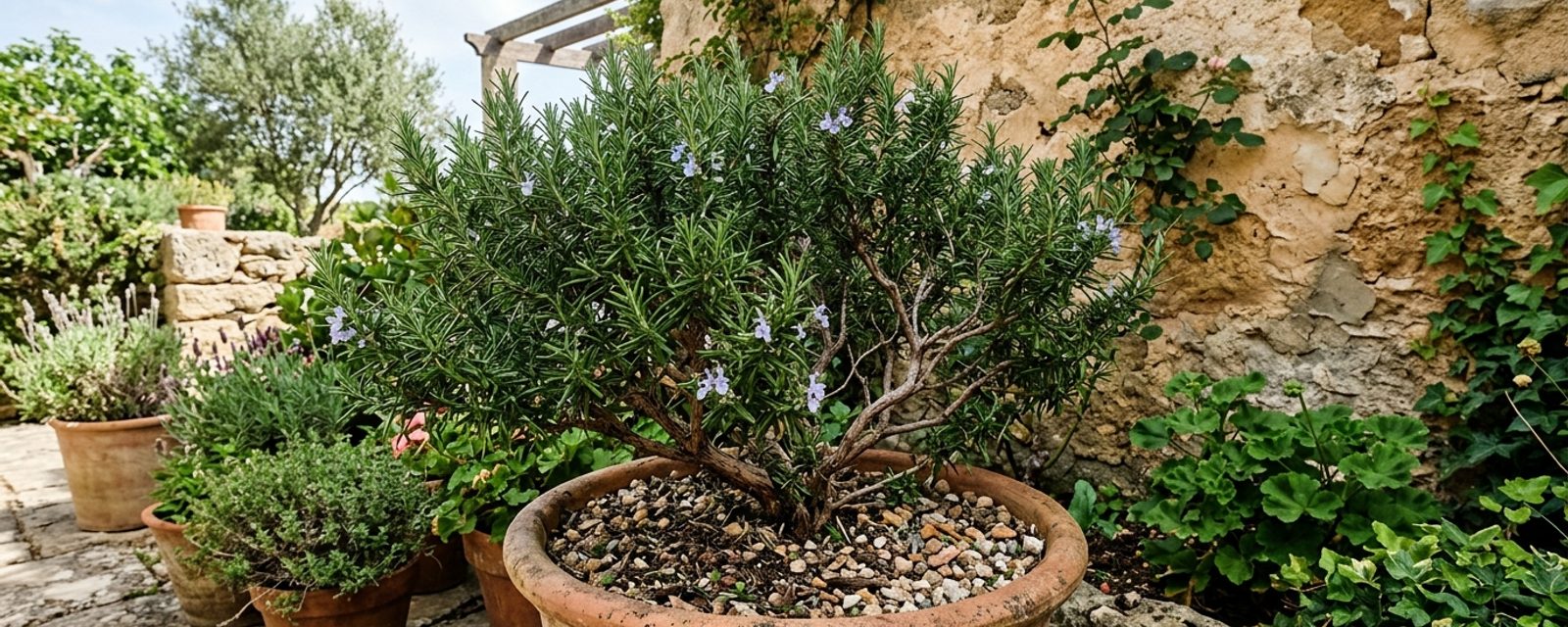
Salvia rosmarinus
Rosemary is hardy enough to survive a Scottish winter's cold; what kills it is cold, wet soil around the roots, and the single most important thing you can do for it is dig grit into the planting hole.
It's a low-maintenance evergreen shrub that gives you aromatic leaves for cooking every month of the year, pale blue flowers in spring that the bumblebees work systematically, and a scent that releases every time you brush past it. Once established against a warm wall in soil that drains freely, a rosemary bush will stand for a decade.
Why rosemary needs drainage in Scotland
Rosemary is a drought-tolerant plant from the Mediterranean: it evolved to survive dry summers, not wet winters, which is exactly what a Scottish garden asks of it in reverse. A south-facing wall reflects heat and keeps the ground drier on top of whatever grit you've worked in, while the same plant in heavy clay that stays saturated through winter will rot at the roots and die before spring.
Cold-Hardy Herb Border Design → works through how to tier rosemary and other Mediterranean herbs by hardiness in a permanent border.
Varieties
An upright form gives you the most leaves for cooking; a prostrate form works well in containers and over walls. Miss Jessopp's Upright and Foxtail both carry the RHS Award of Garden Merit, a UK-wide award, not a Scottish one.
★ Our pick for Scotland
Miss Jessopp's UprightAGM
Rosmarinus officinalis
An upright form with strongly aromatic leaves and pale blue flowers. Good for hedging and cooking.
Why this one: Its upright habit gives more usable leaf per plant for cooking than the trailing Foxtail or ground-hugging Prostrate rosemary, both grown more for their spreading habitA plant's characteristic shape and manner of growth, such as upright, spreading, creeping or bushy. Full definition → than for the kitchen.
Also worth considering
FoxtailAGM
Prostrate
A trailing form that spills over walls and edges. Good for containers.
Prostrate rosemary
R. officinalis Prostratus Group
Low spreading form, H3The RHS's H1a–H7 scale for how much cold a plant can survive outdoors, H1a being tender indoor-only and H7 hardy anywhere in the UK. Full definition → hardiness (a step down from the upright/semi-prostrate AGMThe RHS's Award of Garden Merit: a UK-wide trials award for reliable performance, not a Scotland-specific recommendation. Full definition → varieties). Good ground cover on well-drained banks.
Best Rosemary Varieties for Scotland → compares all named rosemary varieties head-to-head, with the practical detail that doesn't fit in a summary card.
Site and planting
Rosemary needs full sun and well-drained soil, and will tolerate poor dry soil. Choose the sunniest, most sheltered spot you have. A south-facing wall is ideal. The reflected heat keeps the soil drier and the plant healthier.
Plant in spring, once the soil is starting to warm up. Dig a hole wider than the rootballThe mass of roots and the soil or compost clinging to them, as it comes out of a pot or out of the ground when a plant is lifted. Full definition →. Mix a generous handful of horticultural grit into the bottom of the hole and into the backfillThe soil (sometimes improved with grit or compost) used to fill the gap around a plant's roots after it's placed in its planting hole. Full definition → soil. Do not add compost or manure. Rosemary wants poor gritty soil, not rich damp soil.
Space plants 45cm apart if planting a hedge. Water in well after planting and then leave it. Rosemary does not need regular watering once established.
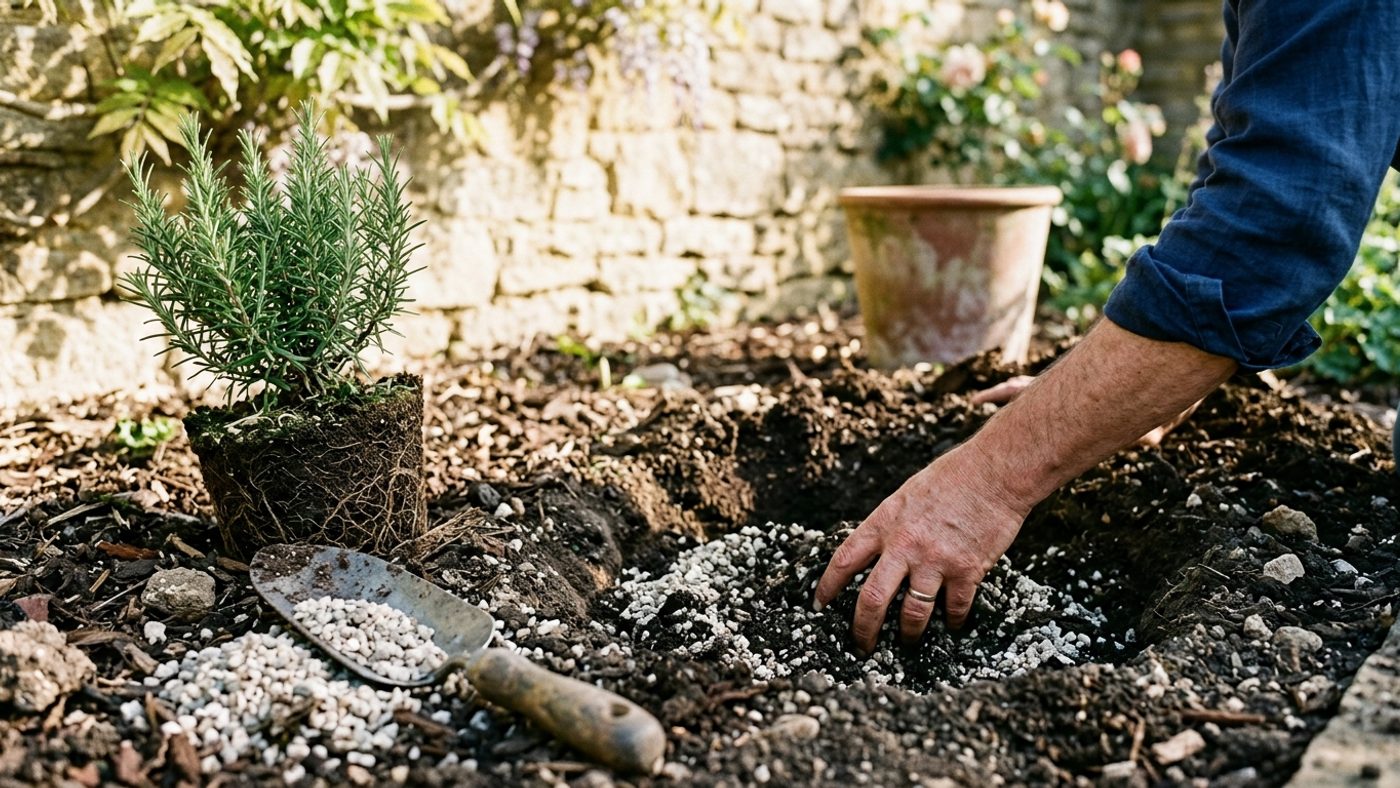
For containers, use a terracotta pot with plenty of drainage holes. Fill with a mix of two-thirds peat-freeCompost made without peat, which is harvested from a slow-forming, carbon-storing wetland habitat that peat extraction damages. Full definition → multi-purpose compost and one-third horticultural grit. Raise the pot onMoving a plant into a larger pot as its roots fill the current one, giving it more room and fresh compost before it becomes pot-bound. Full definition → feet over winter so water can drain freely. A pot gives you complete control over drainage, which is the variable that matters most in a Scottish winter.
Care through the season
Once established, rosemary needs almost no care. Do not water it except during prolonged drought. Do not feed it. Rich soil and fertiliser produce soft sappy growth that is more vulnerable to frost damage.
Pruning: trim lightly after flowering in late spring or early summer. Cut just the spent flower stems and any straggly shoots. Never cut into old brown wood. Rosemary does not regrow from bare stems. Regular light trimming keeps the bush dense and productive. Replace the plant every five to ten years as it becomes woody and less productive.
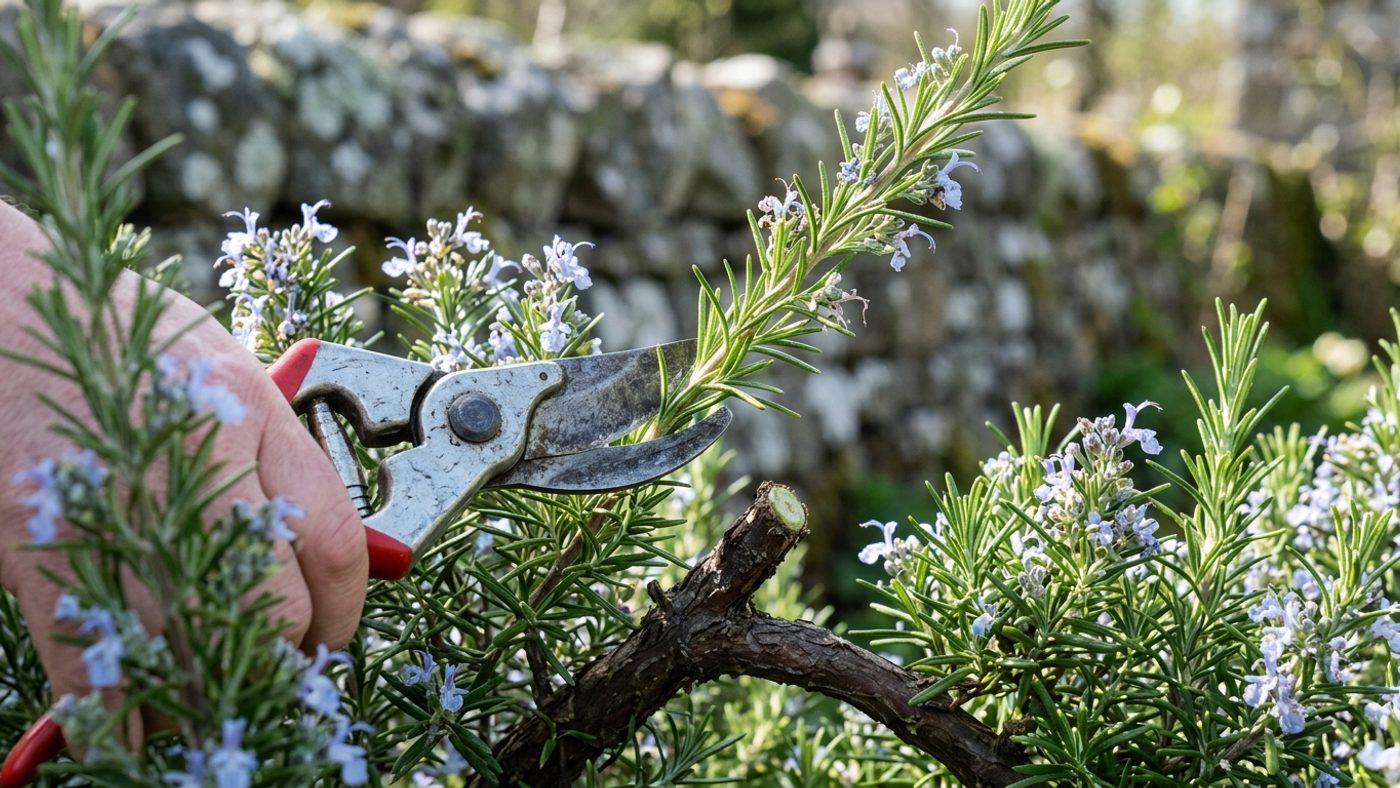
Harvesting: pick sprigs as you need them, all year round. The soft new growth in late spring and summer has the best flavour, but rosemary leaves are usable through winter. Cut whole sprigs rather than stripping individual leaves. The plant responds to regular harvesting by producing more new growth.
Propagation: take semi-ripe cuttings in summer. Cut a 10 to 15cm piece from a non-flowering shoot. Strip the lower leaves, dip in rooting hormone if you have it, and insert into a pot of gritty compost. Keep in a sheltered spot. Roots form in a few weeks. This is also your insurance policy. Take a cutting of your existing plant every few years so you have a replacement growing before the old bush reaches the end of its life.
Common problems
- Root rot from cold wet soil is the main cause of rosemary death in Scotland. Leaves turn brown, usually starting at the base. Improve drainage or move to a drier spot. If the whole plant is affected, it is probably too far gone.
- Rosemary beetle is a small metallic green-and-purple beetle that eats the leaves. Pick them off by hand and drop them into soapy water. Check the undersides of leaves for clusters of small grey larvae.
- LeggyDescribes a plant that's grown tall, thin and sparse rather than bushy, usually from too little light or not being pinched out. Full definition → bare stems mean the plant was not pruned regularly. Light annual trims keep it dense. Do not cut into old woodWhether a plant fruits on stems grown the previous year (young wood) or on older, established branches (old wood), which decides how it's pruned. Full definition →. Start a replacement plant from a cutting if the old one is too woody.
See more problems
- Yellowing leaves usually mean the soil is too wet. Stop watering. If the plant is in heavy ground, lift it and replant with more grit. Yellow leaves on a rosemary are a drainage problem, not a feeding problem.
- Sage and Ligurian leafhoppers cause coarse pale mottling on the leaves; growth and vigour aren't affected.
- Xylella fastidiosa is a serious bacterial disease not currently found in the UK, but rosemary is named as one of its high-risk host plants. It causes leaf scorch, wilting and dieback, symptoms easily mistaken for drought or frost damage. There is no cure, so a genuinely suspected case should be reported to the relevant plant health authority rather than treated. Most gardens will never see it.
Common questions
Is rosemary hardy in Scotland?
Yes, and the thing that actually kills it here is wet roots in winter, not the cold itself: drainage matters more than chasing maximum sun, so grit in the planting hole and a sheltered spot (ideally against a south-facing wall) do more than all-day sunshine. Full sourced breakdown: <a href="/tools/garden-myths/rosemary/">Rosemary Myths →</a>
How do I prune rosemary?
Trim lightly after flowering and never cut into old, bare wood: rosemary does not reliably regrow from it, so a hard cut into old wood usually kills that branch rather than renewing it. Full sourced breakdown: <a href="/tools/garden-myths/rosemary/">Rosemary Myths →</a>
Can I grow rosemary in a pot?
Yes, and a pot even gives you full control over drainage, but the roots are less insulated than they would be in the ground, so container rosemary genuinely needs winter protection: raise it on pot feet and move it against a sheltered wall for the coldest months. Full sourced breakdown: <a href="/tools/garden-myths/rosemary/">Rosemary Myths →</a>
Why are the leaves on my rosemary turning brown?
Usually root rot from wet soil. If the plant is in the ground and sitting in cold wet clay through winter, the roots are drowning. If the damage is not widespread, improve drainage around the plant and prune out the dead branches. If the whole plant is browning, it is probably too far gone. Start a new one in a better-drained spot.
Sources
1 sources, and what each was used for
- RHS: evergreen shrub habit, spring planting, -8C hardiness and winter protection advice, wet-roots aversion and root rot, raised beds/containers on clay, 45cm spacing and 30cm container minimum, propagation, harvest window, AGM varieties