
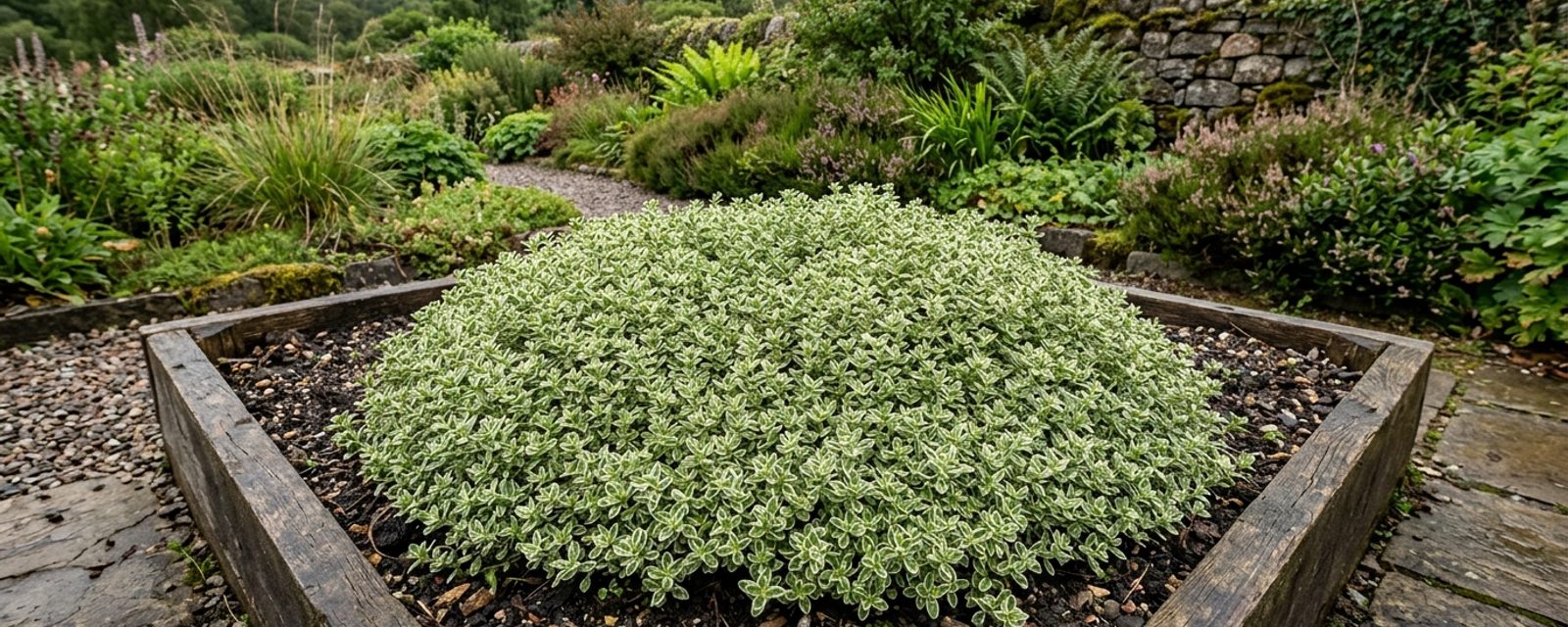
Thyme evolved on Mediterranean hillsides: thin, stony, fast-draining soil, baking sun, and roots that rarely sit in water for more than a few hours after rain. That physiology doesn't change when the plant is moved to a Scottish garden, and it's the reason thyme's real weak point here isn't frost. The most widely available thyme varieties withstand UK frosts without special protection; cold wind and wet winters, not low temperature alone, are what actually kill thyme plants over a Scottish winter. A root system adapted to drain in seconds simply can't function sitting in cold, waterlogged clay for weeks on end: oxygen can't reach the roots, and rot sets in long before frost would ever be the limiting factor.
Quick answer
For most Scottish gardens, Silver Queen is the best all-round thyme: it holds the RHS Award of Garden Merit, is rated H5 (hardy to around -15C), and combines good flavour with real winter toughness. For a groundcover or path-edging use where flowering and bee-appeal matter more than harvesting leaves, Coccineus Group or Doone Valley are the better pick. Avoid Lemon Curd on an exposed, high-altitude, or very windy site: it's rated H4The RHS's H1a–H7 scale for how much cold a plant can survive outdoors, H1a being tender indoor-only and H7 hardy anywhere in the UK. Full definition → (hardy to around -10C), a step down from every other variety in this comparison.
That reframes the variety question. Rather than asking "which thyme survives a Scottish frost" (nearly all of them do), the useful question is which varieties tolerate a damp, exposed site well enough that drainage and shelter, not fleeceA lightweight, breathable fabric laid or draped over plants to trap a little warmth and keep off frost, wind and some flying pests. Full definition →, become the deciding factor. It's the same pattern rosemary shows in a Scottish garden: drainage over frost protection. All seven varieties below share another trait worth knowing before choosing: they go woody after three to four years and are best replaced from fresh cuttings rather than rescued. For planting, pruning and propagation technique, see the full growing guide.
The 7 varieties compared
| Variety | AGMThe RHS's Award of Garden Merit: a UK-wide trials award for reliable performance, not a Scotland-specific recommendation. Full definition → | Hardiness | Habit | Best for |
|---|---|---|---|---|
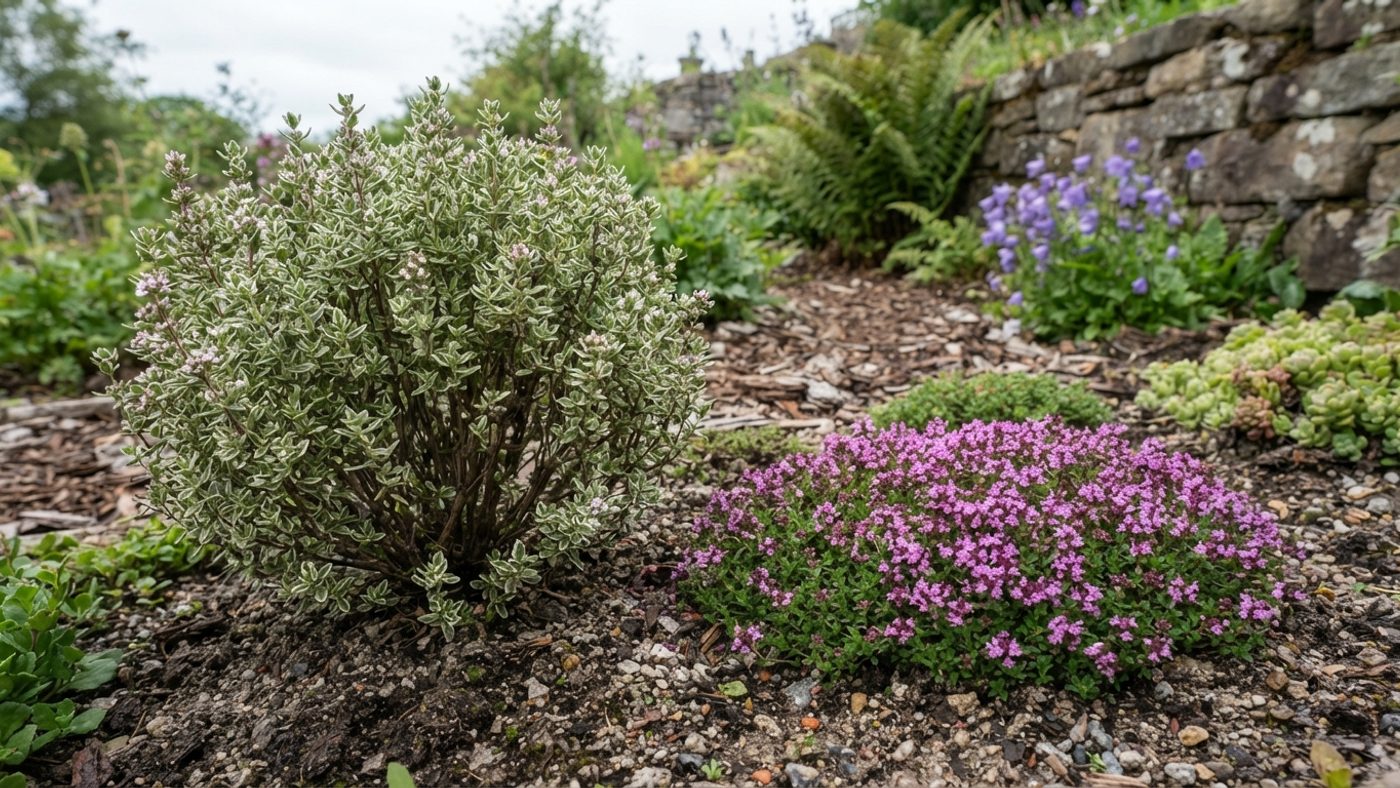
| Silver Queen | Yes | H5 (to -15C) | Bushy dwarf shrub, ~30cm, variegated cream-edged leaves | All-round best pick; culinary use with ornamental value |
| Common thyme | No | H5 | Bushy upright shrub | Standard culinary default, plain green leaf |
| Coccineus Group | Yes | H5 | Creeping mat, 5-10cm tall | Groundcover, path edging, bee-friendly flowers |
| Lemon Curd | No | H4 (-10 to -5C) | Mat-forming shrub, 0.1-0.5m | Sheltered spot or container only |
| Broad-leaved thyme | No | H5 | Small spreading subshrub, to 25cm | Easier harvesting, rounded larger leaves |
| Caraway thyme | No | H5 | Low mat-forming subshrub | Distinct caraway flavour, path crevices |
| Doone Valley | No | H5 | Mat-forming subshrub, to 10cm | Groundcover with yellow-splashed variegation |
Six of the seven share H5 hardiness, so for most of this list winter survival outdoors isn't really in question if drainage is sorted. Lemon Curd is the outlier: it's the only variety here rated H4, roughly 5C less cold-tolerant than the rest, and belongs in a container that can be moved to shelter, or against a south-facing wall, rather than out in an open bed on an exposed site.
"Coccineus Group" and "subshrub" are both worth a quick note before the comparisons: a Group is a cluster of closely related cultivarsA plant variety that arose or was bred under cultivation and is kept true by deliberate propagation, rather than a naturally occurring wild species. Full definition → sold under one name rather than a single distinct plant, and a subshrub is a low, semi-woody plant, exactly what thyme's wiry, evergreen structure is.
Silver Queen and Common thyme: the known quantities
Silver Queen carries the AGM and combines genuine lemon scent with variegated foliage that colours attractively through winter. Common thyme is the plain-leaved culinary default, with no AGM but a well-established reputation for flavour. Both are H5 and both sit at the top of this comparison for reliability. Silver Posie is a similar variegated, lemon-scented, H5 shrub often sold alongside Silver Queen at nurseries, but it doesn't carry the AGM, the main reason it isn't Silver Queen's equal on this list.
Coccineus Group: not just ornamental
Coccineus Group has a genuine culinary use despite its low, mat-forming habit: its flowers are edible, even though the habit (5-10cm tall, spreading 0.1-0.5m) makes it awkward for the kind of regular leaf-harvesting a cook wants from Common thyme. It holds the AGM, is H5 hardy, and its dark pink, tubular summer flowers are a strong bee draw. Where the brief is groundcover, a gravel path edge, or filling gaps between paving, Coccineus Group is one of the strongest options on this list.
Lemon Curd: the hardiness exception
On a sheltered, south-facing raised bed in a mild coastal spot, Lemon Curd's lower hardiness rating is unlikely to matter much. On an exposed, high-altitude, or wind-scoured site, it's a real liability, and a container that can be brought under cover for winter is the safer way to grow it rather than risking it in open ground.
Broad-leaved thyme: the practical culinary alternative
Thymus pulegioides is a popular culinary thyme because its rounded leaves are larger than Common thyme's and carry a good flavour. That larger leaf size makes it noticeably easier to strip and chop for the kitchen than the fine leaves of most creeping types. It's H5 hardy and spreads to about 25cm, sitting between the upright bushiness of Common thyme and the flat mats of the creeping varieties.
Caraway thyme: a different flavour entirely
Thymus herba-barona offers something none of the other six varieties do: a genuinely different flavour profile, with a distinctive caraway scent and taste rather than the lemon or plain thyme notes found elsewhere on this list. Its low, mat-forming habit suits path edges and paving crevices, where the foliage releases scent underfoot.
Doone Valley: variegation with a different look
Doone Valley's yellow-splashed foliage gives a distinctly different appearance from Silver Queen's white-edged variegation, paired with lavender-pink flowers opening from red buds. It's H5 hardy, mat-forming to around 10cm, and needs very good drainage with neutral-to- alkaline soil, which makes gritty raised beds or troughs a better fit than heavy garden soil.
Other named cultivars worth knowing exist
This comparison doesn't cover the full range of named thyme cultivars sold in the UK. Gardener's World names several more: T. citriodorus 'Archers Gold' and 'Variegata' (both lemon-scented), T. nitidus 'Peter Davis' (grey-green leaves, suited to sunny rockeries), 'Caborn Wine and Roses' (a larger-leaved creeping type good for paving), and T. pulegioides 'Bertram Anderson' (golden foliage, mild flavour, path edging). None currently carry a confirmed AGM.
One more worth naming for a Scottish garden specifically: wild thyme (Thymus polytrichus subsp. britannicus), native to Britain including Scotland's own coasts and mountains, found growing wild from dunes to high ground. Its hardiness rating is H4, the same as Lemon Curd, a reminder that being native to Scotland's hills doesn't automatically translate into a higher garden hardiness rating: the H-scale measures cultivated performance in an ordinary garden bed, not survival on an open hillside, and the same shelter and drainage precautions given for Lemon Curd above apply here too. It's a low, mat-forming creeper like Coccineus Group, with small dark green leaves and purple summer flowers, and needs the same free-drainingSoil that lets water pass through quickly rather than pooling, so roots aren't sitting in wet ground after rain. Full definition →, sunny conditions as every other variety here.
Drainage and shelter: the real decision, whatever variety you pick
Whichever variety is chosen, the same conditions govern success. Full sun and free-draining conditions matter most; on heavy or damp soil, a container or raised bed is the practical fix rather than trying to amend the ground. On open ground, work horticultural grit through the top 20-30cm of soil before planting; in a pot, a soil-based compost cut with up to 25% grit does the same job. MulchingA layer of material spread over the soil around plants to suppress weeds, retain moisture, and improve soil structure as it breaks down. Full definition → with gravel or grit rather than bark or garden compost is worth doing too, since organic mulches hold moisture against the woody stems and encourage rot at the base. Space plants 20-30cm apart, giving upright forms like Common thyme and Broad-leaved thyme more room than low creeping types like Coccineus Group or Caraway thyme. No exact pH figure is published for thyme as a crop, though individual varieties are described as wanting neutral-to-alkaline soil; free drainage, not a specific pH number, is the target worth chasing here. Once established, all seven varieties are drought-tolerant and need no watering beyond rainfall, since it's excess moisture at the roots, not dry soil, that causes the damage over a wet Scottish winter.
Root rot, which follows waterlogged soil and overwatering, is the dominant real risk for every variety on this list, well ahead of any pest, so the drainage and mulching advice above is also the main defence against it. Slugs can damage young shoots, and rosemary beetle and sage and Ligurian leafhoppers both feed on thyme's Mediterranean-shrub relatives and are worth watching for.
Winter protection for thyme should focus on damp rather than cold: clochesA small, portable clear cover placed over an individual plant or short row to trap warmth and keep off wind, rain and pests. Full definition → in high-rainfall areas, and containers moved somewhere sheltered, do more good than fleece. Scotland's rainfall varies sharply by region, generally far higher on the west coast and uplands than in the east, so that advice carries more weight the wetter and more exposed a garden is. The frost dates tool covers regional timing in full.
Which one for your situation
Best overall: Silver Queen (see the table above for the full rating). It's the most consistently available named variety from UK nurseries, which counts for a lot when the alternative is hunting round for a mat-forming specialist cultivar most local garden centres don't stock.
- Exposed or high-altitude site: avoid Lemon Curd's H4 rating; any of the other six H5 varieties is a safer bet.
- Groundcover, path edging, or bee-friendly planting: Coccineus Group or Doone Valley outperform the upright forms.
- Want a different flavour from standard thyme: Caraway thyme is the one variety here with a genuinely distinct taste.
- Easier kitchen harvesting: Broad-leaved thyme's larger leaves are simpler to strip and chop than Common thyme's fine foliage.
- Straightforward culinary default with no fuss: Common thyme remains the standard choice, though it lacks Silver Queen's AGM and variegated interest.
Common questions
Does a raised bed remove the need for a gravel mulch?
Not entirely. A raised bed improves drainage around the whole root zone, but a gravel or grit mulch on top is still worth adding, since it specifically keeps moisture off the base of the stems, which is where rot usually starts, and it also suppresses weeds while a young plant establishes.
Is creeping thyme edible?
Coccineus Group, the creeping form covered here, has edible flowers, despite sometimes being treated as purely ornamental. Its low, mat-forming habit makes it less practical than upright varieties for regular leaf harvesting, but it isn't off-limits in the kitchen.
Why does Lemon Curd need more shelter than other thyme varieties?
Lemon Curd is rated H4, tolerating down to around -10C to -5C, compared with H5 (down to -15C) for every other variety in this comparison. That roughly 5C gap means it’s better suited to a sheltered spot, south-facing wall, or a container that can be moved under cover for winter, rather than an open, wind-exposed bed.
Do I need different varieties for cooking versus groundcover?
Yes, broadly. Upright, bushier forms like Common thyme, Silver Queen, and Broad-leaved thyme are easier to harvest for the kitchen. Low, mat-forming types like Coccineus Group and Doone Valley suit path edges and groundcover better than they suit regular cutting.
Does thyme actually need frost protection in Scotland?
Not usually. The most widely available thyme varieties withstand UK frosts without special protection. The bigger risk is wet roots and cold wind over winter, which is why drainage and a sheltered site matter more than fleece for this crop.
Sources
12 sources, recorded with what each was used for
- Thymus 'Silver Queen' (v): Hardiness, AGM status, description
- 10 award-winning herbs: Silver Queen AGM confirmation
- Thyme: grow your own: Common thyme description, drainage/site guidance, spacing
- Thymus Coccineus: Habit, hardiness, AGM, edible flowers
- Thymus 'Lemon Curd': Hardiness rating, habit
- Thymus pulegioides: Broad-leaved thyme description, culinary use
- Thymus herba-barona: Caraway thyme hardiness and flavour profile
- Thymus 'Doone Valley' (v): Habit, soil needs, hardiness
- Thymus 'Silver Posie': Habit, hardiness, AGM status
- Thymus polytrichus subsp. britannicus (wild thyme): Native range, hardiness, habit
- Great varieties of thyme to grow: Additional named cultivars, wind/wet-winter risk
- How to grow thyme: Mulching guidance, winter risk factors