
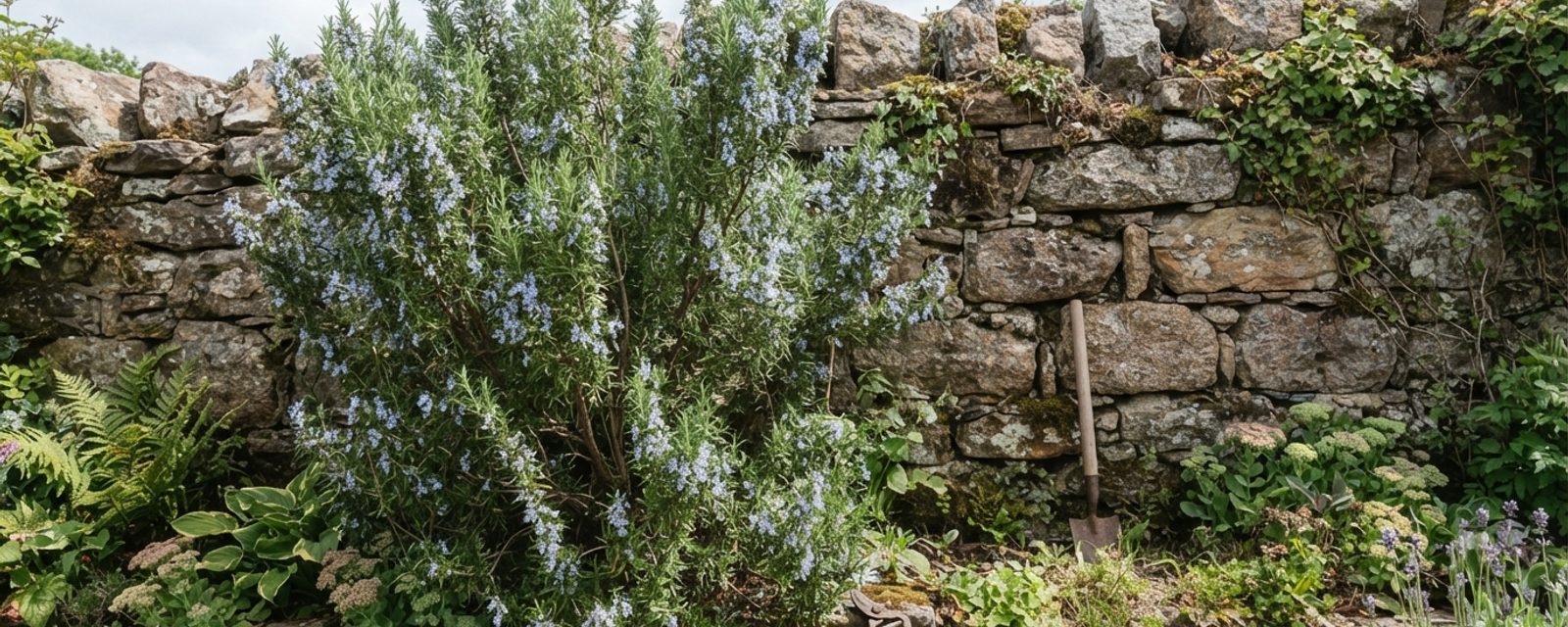
Rosemary evolved on Mediterranean hillsides to survive baking, bone-dry summers, not the cold, waterlogged winters a Scottish garden hands it in return. That mismatch, not frost, is what actually decides whether a rosemary bush lasts a decade or rots out in its second winter, and it's also what separates the varieties worth planting here from the ones that just look similar on a label.
Quick answer
For most Scottish gardens, Miss Jessopp's Upright is the best all-rounder: RHS Award of Garden Merit, hardy to H4The RHS's H1a–H7 scale for how much cold a plant can survive outdoors, H1a being tender indoor-only and H7 hardy anywhere in the UK. Full definition →, upright growth that keeps its foliage clear of wet ground. If you want a lower, spreading plant for a wall or container edge, Foxtail carries the same AGMThe RHS's Award of Garden Merit: a UK-wide trials award for reliable performance, not a Scotland-specific recommendation. Full definition → and H4 hardiness in a semi-trailing form. Skip fully prostrate, ground-hugging types such as Capri unless you can guarantee sharp drainage and some shelter, Capri's own RHS rating is H3, a step down in hardiness from the upright and semi-trailing AGM varieties, and its stems sit closest to the wet ground that kills rosemary here.
Six named varieties turn up across RHS and Gardener's World coverage with enough detail to compare properly for a Scottish garden: three carry the RHS Award of Garden Merit, three don't. The AGM itself is a UK-wide recognition of garden merit, not a Scottish recommendation, and each variety's own individual RHS plant page, not just the general rosemary guide's summary list, is the one that settles which named types actually hold the award and which don't.
The comparison
| Variety | AGM | Hardiness | Habit | Ultimate size (H×S) |
|---|---|---|---|---|
| Miss Jessopp's Upright | Yes | H4 (-10 to -5°C) | Upright, columnar | 1.5-2.5m × 1-1.5m |
| Rosea | Yes | H4 | Upright | 0.5-1m × 0.5-1m |
| Foxtail | Yes | H4 | Semi-prostrate, arching | 0.5-1m × 0.5-1m |
| Severn Sea | No | H4 | Spreading, arching branches | 0.5-1m × 0.5-1m |
| Green Ginger | No | H4 | Bushy, upright | 0.5-1m × 0.5-1m |
| Capri (a Prostrate Group cultivarA plant variety that arose or was bred under cultivation and is kept true by deliberate propagation, rather than a naturally occurring wild species. Full definition →) | No | H3 (-5 to 1°C) | Fully prostrate, mat-forming | 0.1-0.5m × 0.5-1m |
Only Miss Jessopp's Upright, Rosea and Foxtail carry the AGM, checked on each variety's own individual RHS plant page, since general-purpose retail and gardening coverage doesn't always draw the same line. Severn Sea in particular is widely sold and written up as a classic rosemary hedging variety, Gardener's World names it alongside Miss Jessopp's Upright with no distinction drawn between them, but its own RHS page carries no AGM. The same applies to the Prostrate Group and its cultivar Capri: often grouped with the AGM varieties in general retail listings, but neither one's own RHS page shows the award.
The hardiness split matters more here than the AGM does. Miss Jessopp's Upright, Rosea, Foxtail, Severn Sea and Green Ginger are all rated H4, hardy through most of the UK, down to about -10°C, regardless of whether they hold the AGM. Capri and the wider Prostrate Group sit a step down at H3, hardy only in coastal and relatively mild parts of the UK, down to about -5°C. That's the more useful number for choosing between them in a Scottish garden than the award is.
Why growth habit changes how exposed a plant is
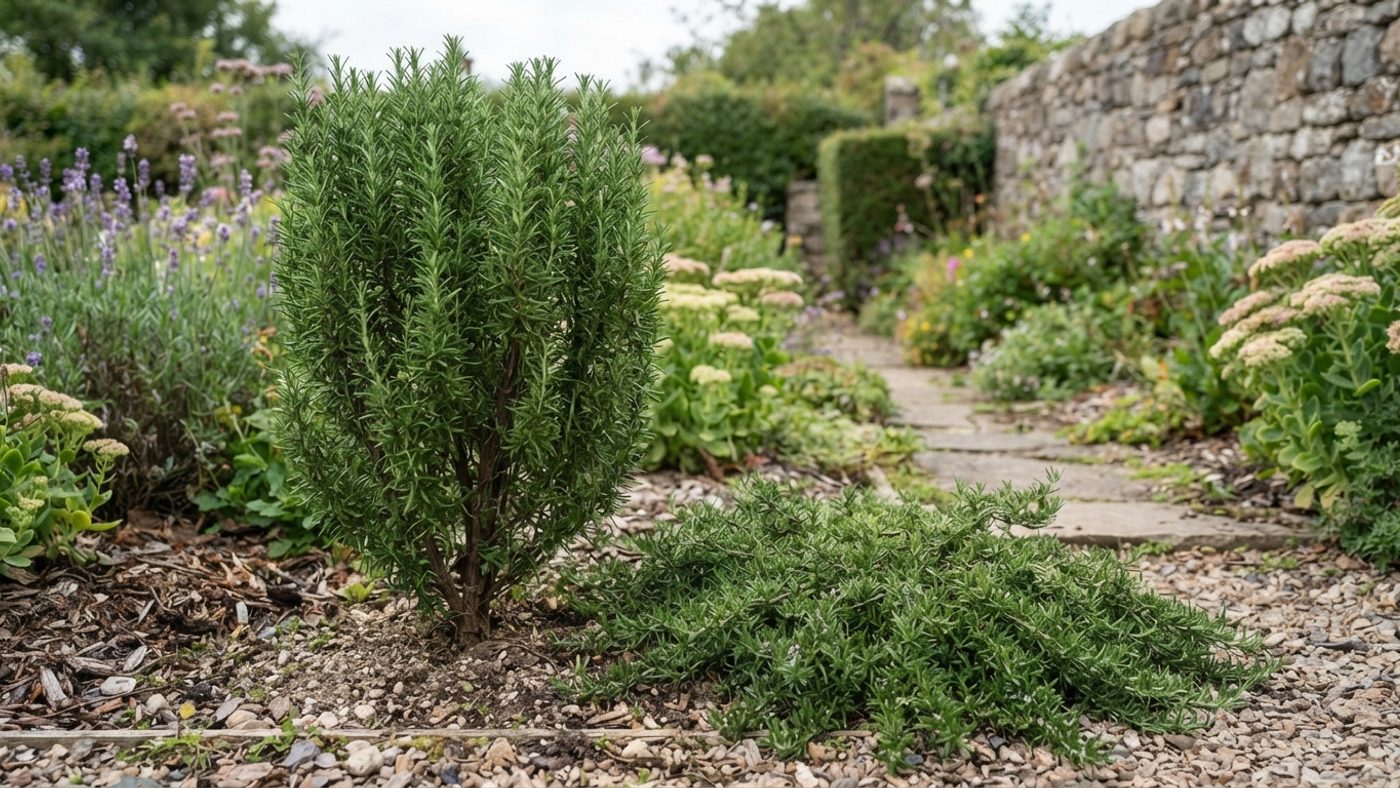
An upright variety like Miss Jessopp's Upright holds its foliage and lower stems clear of the ground. A fully prostrate variety like Capri or the wider Prostrate Group does the opposite by design, it's bred to hug the ground and spread sideways, which means its stems and the base of its growth sit in direct, prolonged contact with whatever the soil surface is doing. On a well-drained bank that's exactly the ground-cover effect the Prostrate Group is planted for, and RHS's own description of the H3 band, "coastal and relatively mild parts of the UK", isn't a description that rules Scotland out; it's a description of a type of site, not a region, and a milder coastal garden here can sit inside it as much as one anywhere else in the UK. Away from that kind of site, the same ground-hugging habit puts more of the plant in contact with wet winter soil than an upright form ever does, on top of the lower H3 rating itself.
All six varieties want full sun and the most sheltered spot available, against a south or west-facing wall for preference, which matters more in Scotland than it would further south, given the lower light levels and shorter winter days. Wind is worth planning for too: an exposed, gale-scoured site stresses any rosemary, upright or prostrate, on top of whatever the soil is doing underneath it, so the same sheltered wall that helps with drainage and light also cuts the wind the plant is dealing with.
Foxtail sits in between: semi-prostrate, arching over as it matures rather than lying flat from the start, and it still carries the H4 rating and the AGM. It's a reasonable compromise for a container or a wall edge where a fully upright habitA plant's characteristic shape and manner of growth, such as upright, spreading, creeping or bushy. Full definition → isn't wanted, without dropping into Capri's lower hardiness band.
None of these are true from seed, rosemary cultivars don't come reliably true from a seed packet, so a named variety needs to be bought as a plant, and often that means a specialist herb nursery or a larger garden centre rather than the unnamed "rosemary" seedling stock sold loose at a supermarket or DIY shed, which won't carry a cultivar name at all. Once you have one, semi-ripe cuttings taken in summer are the standard way to get a true-to-name replacement for free, useful insurance for any of these six given how few years a rosemary bush stays productive before it gets woody.
Plant in spring, once the soil is starting to warm, so the roots have a full growing season to establish before facing a Scottish winter; a newly planted, still-shallow-rooted specimen of any variety is more exposed to winter wet than an established one, which matters most for the already less hardy Capri and Prostrate Group. On heavy clay, working horticultural grit into the planting hole and backfillThe soil (sometimes improved with grit or compost) used to fill the gap around a plant's roots after it's placed in its planting hole. Full definition → is the single most effective fix regardless of variety, and none of these six varieties changes that. A container in any variety is more exposed to a hard freeze than the same plant in open ground, raise it on pot feet and move it against a sheltered wall or under cover during the coldest snaps, since a frozen rootballThe mass of roots and the soil or compost clinging to them, as it comes out of a pot or out of the ground when a plant is lifted. Full definition → in a pot has nowhere for the cold to dissipate the way it does in the ground. Regular light pruning after flowering keeps any of them dense rather than leggyDescribes a plant that's grown tall, thin and sparse rather than bushy, usually from too little light or not being pinched out. Full definition →, never cut into old brown wood, which rosemary won't regrow from, and the full growing guide covers planting, drainage and pruning technique in detail.
Pests and disease risk by variety
Growth habit affects one more thing: how easily you can spot trouble.
Root rot from waterlogged soil is what RHS and Gardener's World both point to as rosemary's main cause of failure in a cold, wet climate, and it affects any of these six varieties. A prostrate variety hides the early signs longer, the base of the plant, where root rot typically shows first as browning, is harder to inspect on a mat-forming plant lying against the soil than on an upright bush where the lower stems are visible above ground.
Rosemary beetle and its larvae feed on the leaves of any rosemary variety; RHS notes they're commonly found on the undersides of leaves from autumn through spring. An upright or semi-prostrate variety with foliage held clear of the ground is easier to check systematically than a low mat where the leaf undersides are pressed close to soil and mulchA layer of material spread over the soil around plants to suppress weeds, retain moisture, and improve soil structure as it breaks down. Full definition →.
Sage and Ligurian leafhoppers cause coarse, pale mottling on the leaves without affecting the plant's growth or vigour, cosmetic on any variety, not worth treating.
One rarer risk worth knowing rather than watching for day to day: Xylella fastidiosa isn't currently found in the UK, but rosemary is named as a high-risk host if it does arrive, and the symptoms (leaf scorch, wilting, dieback) look a lot like drought or frost damage. There's no cure, so a genuinely suspected case should be reported rather than treated, but almost no Scottish garden will ever see it.
Which one for your situation
| Your situation | Pick | Why |
|---|---|---|
| Hedge or steady kitchen supply | Miss Jessopp's Upright | Largest (up to 2.5m), columnar, most usable leaf per plant, AGM + H4 |
| Container on a patio or balcony | Foxtail or Rosea | Compact (0.5-1m), AGM + H4, and a pot gives full drainage control |
| Trailing over a wall/raised bed edge | Capri or Prostrate Group | Only on genuinely free-drainingSoil that lets water pass through quickly rather than pooling, so roots aren't sitting in wet ground after rain. Full definition →, sheltered ground, its H3 rating and ground-hugging habit both count against it elsewhere |
| Similar spreading look, more hardiness | Foxtail | Semi-prostrate and arching rather than flat, but AGM + H4 |
| Something beyond flavour or hedging | Green Ginger (scent) or Rosea (pink flowers) | Neither trades away hardiness, both are still H4 |
For the trailing/prostrate pick specifically: give it a south-facing raised bed or a large gritty container rather than open clay ground. Its H3 rating and ground-hugging habit both point the same direction, better than average drainage and shelter, or choose Foxtail instead if that's not available. Rosea's pale pink flowers are the outlier among these six; the rest are the usual rosemary blue that bumblebees work in spring.
Common questions
Does the RHS Award of Garden Merit mean a variety is suited to Scotland?
No. The AGM is a UK-wide recognition of reliable garden performance, assessed across UK growing conditions generally, not a Scottish-specific recommendation. An AGM variety in badly drained clay will still struggle, and a non-AGM variety like Severn Sea in a genuinely well-drained, sheltered spot can do perfectly well.
Is a trailing or prostrate rosemary a bad choice for Scotland?
Not automatically, but it needs better conditions than an upright variety to succeed. Capri and the wider Prostrate Group are rated H3 (hardy only in coastal and relatively mild parts of the UK) against H4 for the upright and semi-prostrate AGM varieties, and their ground-hugging habit puts more of the plant in contact with wet soil through winter. Grow a prostrate variety in a raised bed, gritty container, or against a warm, sheltered wall rather than in open ground, or choose Foxtail for a similar spreading effect with a fuller hardiness grade in hand.
What's the difference between Foxtail and Miss Jessopp's Upright?
Both carry the RHS AGM and both are rated H4, but the habit is different: Miss Jessopp's Upright grows to 1.5-2.5m tall in a columnar shape, suited to hedging or a stand-alone specimen with plenty of usable leaf. Foxtail stays much smaller (0.5-1m) and arches over into a semi-prostrate dome as it matures, better suited to a container, a wall edge, or somewhere a tall upright shrub isn't wanted.
Does rosemary need a specific soil pH in Scotland?
Neither RHS nor Gardener's World publishes a numeric pH figure for rosemary, both describe its soil needs in terms of drainage and fertility (poor to moderately fertile, well-drained) rather than a pH range. Getting the drainage right matters far more for rosemary in Scotland than adjusting soil pH does.
Sources
9 sources, recorded with what each was used for
- How to grow Rosemary: General growing guide; named varieties list; hardiness figure; drainage/wet-roots warning; no numeric soil pH published
- Salvia rosmarinus 'Miss Jessopp's Upright': Confirmed AGM, H4 hardiness, upright/columnar habit, 1.5-2.5m x 1-1.5m ultimate size — independently confirmed by the hub via direct WebFetch
- Salvia rosmarinus 'Foxtail': Confirmed AGM, H4 hardiness, semi-prostrate arching habit, 0.5-1m x 0.5-1m ultimate size
- Salvia rosmarinus 'Rosea': Confirmed AGM, H4 hardiness, upright habit, mauve-pink flowers, 0.5-1m x 0.5-1m ultimate size
- Salvia rosmarinus Prostrata Group: Confirmed no AGM, prostrate mat-forming habit
- Salvia rosmarinus (Prostrata Group) 'Capri': Confirmed no AGM, H3 hardiness, trailing habit — independently confirmed by the hub via direct WebFetch
- Salvia rosmarinus 'Green Ginger': Confirmed no AGM, H4 hardiness, bushy upright habit, gingery scent
- Salvia rosmarinus 'Severn Sea': Confirmed no AGM, H4 hardiness, spreading arching habit, used for low hedging
- How to grow rosemary: Named varieties including Severn Sea; cold/waterlogging warning for immature plants; clay-soil amendment advice; rosemary beetle behaviour