
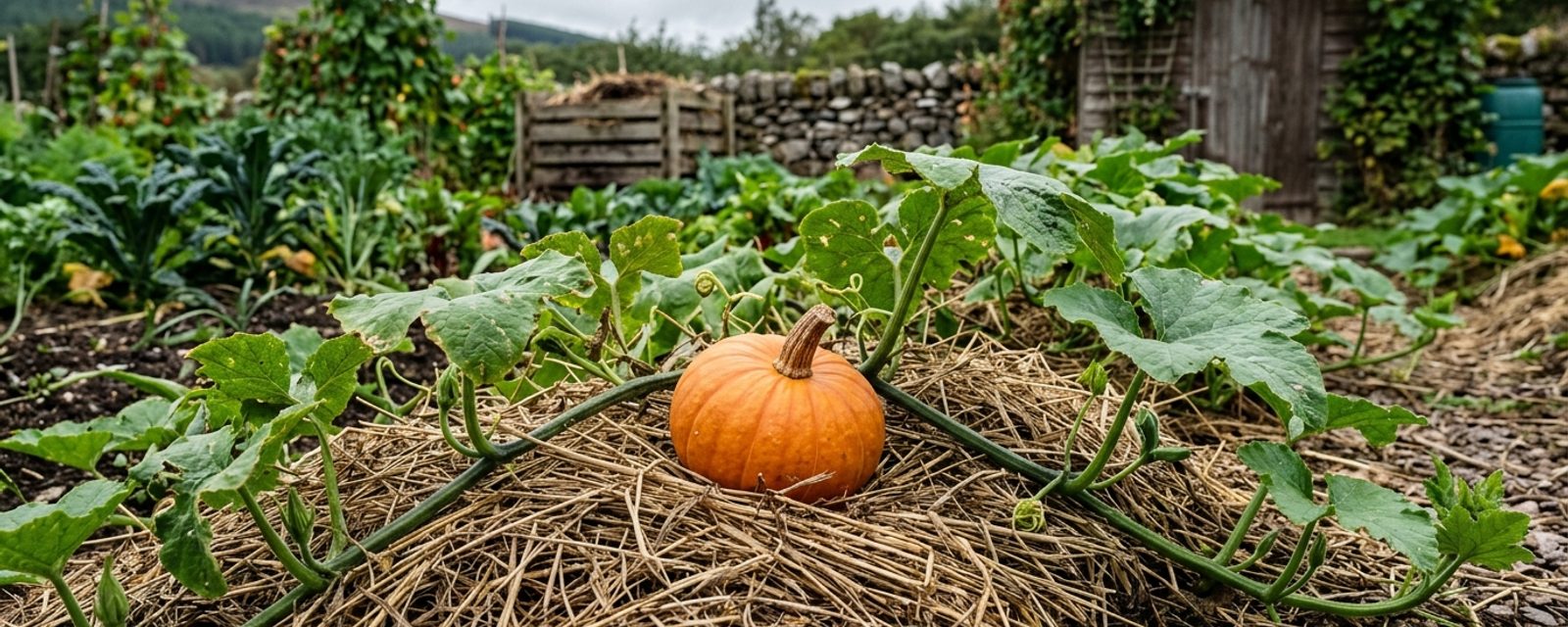
Cucurbita pepo or C. maxima (a type of winter squash)
Pumpkins are technically a type of winter squash, grown here for a carved or decorative crop as much as an eaten one, with a giant-fruit technique worth knowing even if you never try it.
RHS's own description of what pumpkins want, long and hot, is close to the opposite of a typical Scottish summer. That doesn't rule the crop out, but it does put the variety you choose at the centre of whether you get a real harvest at all.
Preparing the ground
Choose a warm, sunny site sheltered from cold winds, with fertile, moisture-retentive soil that doesn't waterlog: shelter matters as much as sun here, since this is a genuinely tender crop at both ends of the season. Prepare planting holes about 30cm wide and deep, mixing the native soil with organic matter such as garden compost, or mulchA layer of material spread over the soil around plants to suppress weeds, retain moisture, and improve soil structure as it breaks down. Full definition → the surface for a no-digA growing method that avoids turning the soil over, building fertility instead by adding organic matter on the surface. Full definition → bed. Container-grown pumpkins need a pot at least 45cm wide, and plenty of space around it for good air circulation, which matters for fungal disease as much as the soil prep does.
Sowing
Sow indoors mid-to-late April, one seed on its side, 1cm deep, in a 7.5cm pot at 18-21°C, repotting as roots fill the space. Outdoors, sow late May to early June, after the last frost and having warmed the soil under clochesA small, portable clear cover placed over an individual plant or short row to trap warmth and keep off wind, rain and pests. Full definition → or fleeceA lightweight, breathable fabric laid or draped over plants to trap a little warmth and keep off frost, wind and some flying pests. Full definition → for two weeks beforehand, 2.5cm deep, two or three seeds per site thinned to the strongest.
Planting out
Plant out after the last frost, once hardened off. Space bush varieties 90cm apart and trailing varieties 1.5m apart. Some varieties send out stems considerably further than that once established, up to 4m, so plan the surrounding space with that growth in mind rather than just the initial spacing figure. Protect young plants from slugs and snails, especially in damp weather.
Varieties
Neither variety below carries the RHS Award of Garden Merit: none of RHS's five named pumpkin varieties do, so the picks here rest on named traits rather than an award.
RHS also lists 'Cargo', 'Hundredweight' and 'Atlantic Giant', all large or giant-fruited types needing more heat and a longer season than Charmant or Jack be Little.
★ Our pick for Scotland
Charmant
6-8kg, smallest-fruited of the four full-size varieties, resistant to powdery mildew
The only pumpkin RHS names with disease resistance built in.
Why this one: The only RHS-named pumpkin variety with disease resistance stated as its own trait, and the smallest-fruited of the four full-size varieties, which puts less demand on a shortened Scottish season than Cargo, Hundredweight or Atlantic Giant. Its own individual plant page describes it as a spreading, trailing plant with a 1.5-2.5m spread, not compact — plan bed space accordingly.
Also worth considering
Jack be Little
Palm-sized fruit, bright orange skin
The smallest-fruited variety RHS names, which by the same logic already established for squash's winter types means the shortest, most reliable ripening window on this crop: less growth to complete before an early Scottish autumn cuts the season short.
Best Pumpkin Varieties for Scotland → compares all named pumpkin varieties head-to-head, with the practical detail that doesn't fit in a summary card.
Care
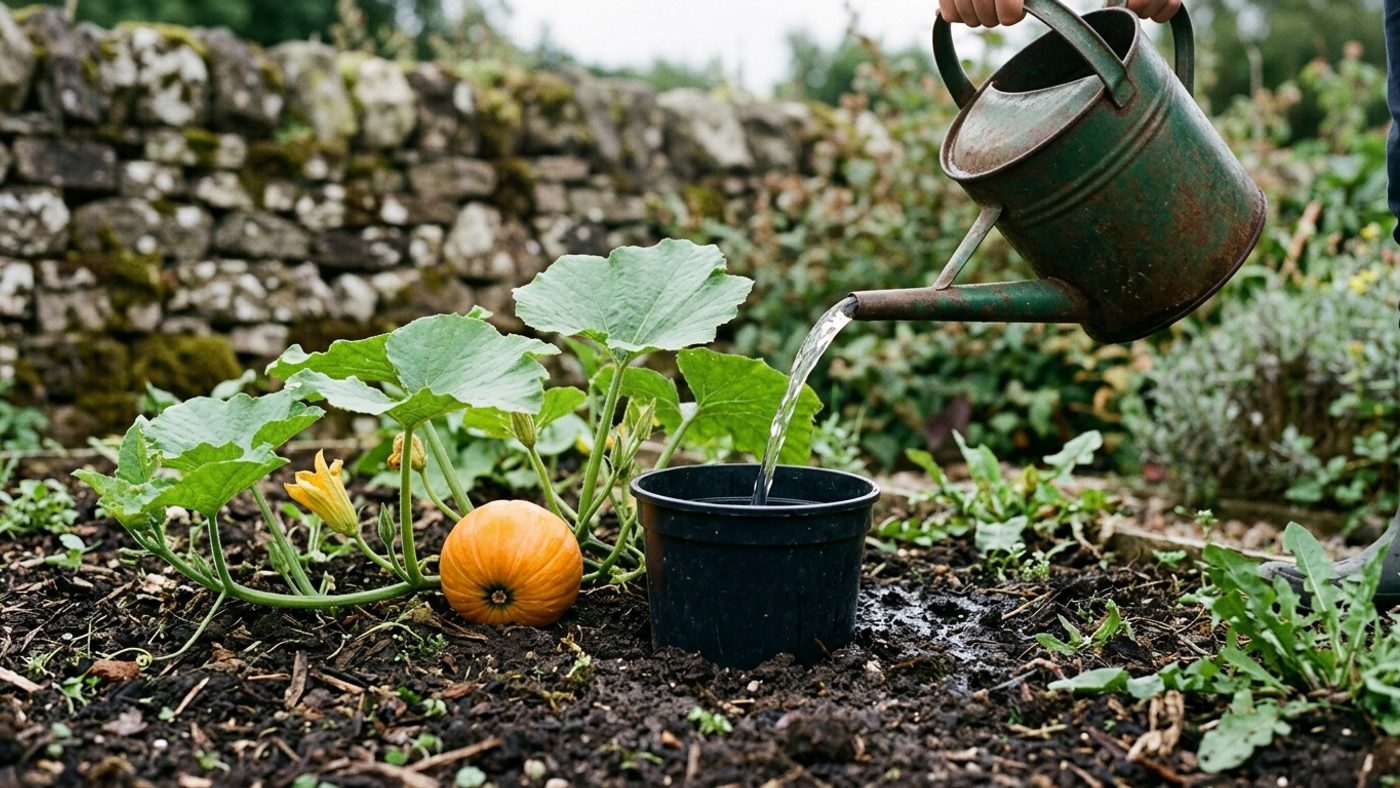
Pumpkins need plenty of water, especially once fruiting starts. Sink an empty pot into the ground beside each plant and water into that to direct moisture to the roots, using rainwater where you can, and water early morning or evening on hot days to cut down evaporation. Mulch thickly after planting, keeping a gap around the stem to prevent rot. Feeding usually isn't necessary unless you're aiming for particularly large fruit or growing in a container, in which case an organic-based, high-potassium liquid fertiliser every 10-14 days from when fruit start swelling helps. Set developing fruit on a tile, brick or piece of wood to keep them off damp soil.
The giant pumpkin technique
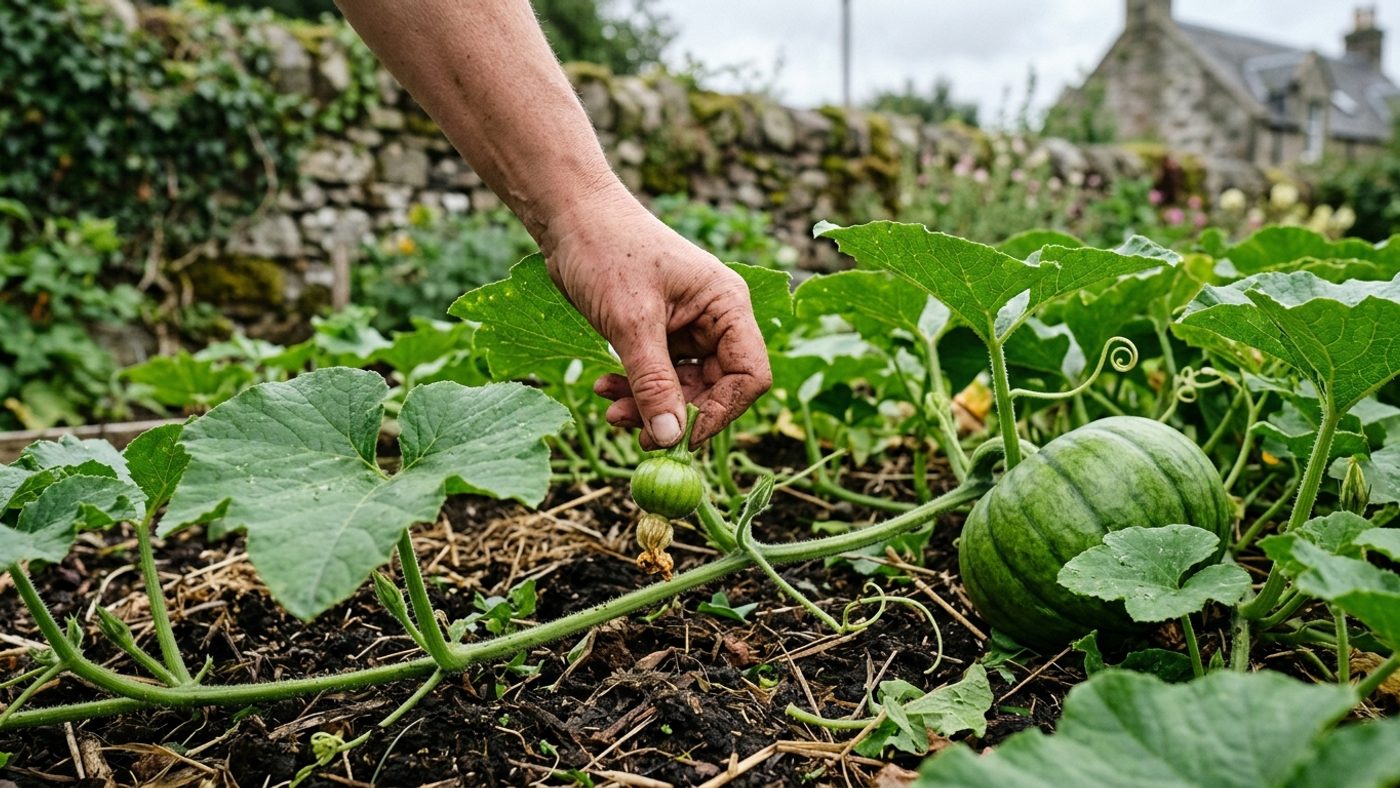
If size matters more than total number, limit fruit to just two or three per plant, and for the very largest pumpkins, just one, removing any further flowers or fruit as they start to form. With fewer fruit competing for it, all the plant's energy goes into swelling the ones you've kept, rather than spreading thinly across many smaller pumpkins.
Training
Plants can sprawl naturally or be trained in circles using canes. Trailing types with smaller fruit, such as Jack be Little, suit vertical supports such as arches, wigwams or trellises, with netting to support developing fruit as they swell. Larger-fruited varieties are better left to grow flat on the ground, where the weight of a maturing fruit isn't a problem for a support structure to bear, and where the 4m-plus stems some varieties send out have room to spread.
Harvesting
Allow fruit to fully colour on the plant before an autumn harvest. Cut with at least 10cm of stem still attached: cutting closer leaves a soft area on the fruit that's prone to rotting. Protect any pumpkins still on the plant from frost with straw, fleece or cardboard, since a frosted pumpkin can't be stored.
To cure for storage, lay harvested fruit in the sun for a week to 10 days, outdoors or under cover, to harden the skin. Store afterwards in a well-ventilated place at 10-15°C, with fruits spaced so they don't touch. Most varieties keep for at least three months, up to six in ideal conditions.
How to Store Squash & Pumpkins for Winter → goes deeper on why curing has to happen before storage, and how long each type actually keeps.
Common problems
- Slugs and snails damage young plants and flowers.
- Powdery mildew is a genuine risk on this crop; Charmant is bred specifically to resist it.
- Grey mould causes fuzzy fungal decay of plant tissue.
Common questions
Is a pumpkin actually a type of squash?
Yes: RHS states this directly, though it still runs a separate pumpkin guide because the practical concerns genuinely differ, including a giant-fruit growing technique and no AGMThe RHS's Award of Garden Merit: a UK-wide trials award for reliable performance, not a Scotland-specific recommendation. Full definition → varieties at all. Full sourced breakdown: <a href='/tools/garden-myths/pumpkins/'>Pumpkin Myths →</a>
Will any pumpkin variety mature in a Scottish garden?
Not reliably: giant varieties like Hundredweight or Atlantic Giant need a long, hot growing season most of Scotland doesn't supply, so a compact or small-fruited variety is the realistic choice. Full sourced breakdown: <a href='/tools/garden-myths/pumpkins/'>Pumpkin Myths →</a>
Does growing more pumpkins per plant give a bigger total harvest?
No, the opposite for size: the giant-pumpkin technique limits fruit to just one to three per plant, removing all other flowers and fruit, so the plant's energy concentrates into the ones left. Full sourced breakdown: <a href='/tools/garden-myths/pumpkins/'>Pumpkin Myths →</a>
How do I know a pumpkin is ready to harvest?
By colour and sound, not size: fully coloured and hollow when tapped, then cut with at least 10cm of stem attached, since cutting closer leaves a soft spot prone to rotting in storage. Full sourced breakdown: <a href='/tools/garden-myths/pumpkins/'>Pumpkin Myths →</a>
Sources
2 sources, and what each was used for
- RHS: the pumpkin-as-winter-squash classification, size categories, soil prep, sowing method and temperature for indoor/outdoor routes, spacing by habit, watering (including the sunk-pot trick), mulching, feeding, the giant-pumpkin fruit-thinning technique, training, harvesting method and frost protection, curing and storage conditions, five named varieties (none AGM), grey mould, slug and snail damage, general courgette/squash/pumpkin problem cross-references
- Garden Organic: independently corroborates sowing method, pinching outRemoving the soft growing tip of a stem to stop upward growth and make the plant branch out sideways instead. Full definition → trailing stems at 60cm, the tile-under-fruit technique, and cutting with a stalk and curing before storage; gives a different germinationA seed sprouting: breaking dormancy and putting out its first root and shoot, given the right warmth and moisture. Full definition → temperature (13C) against RHS's 18-21C, shown as a genuine difference