
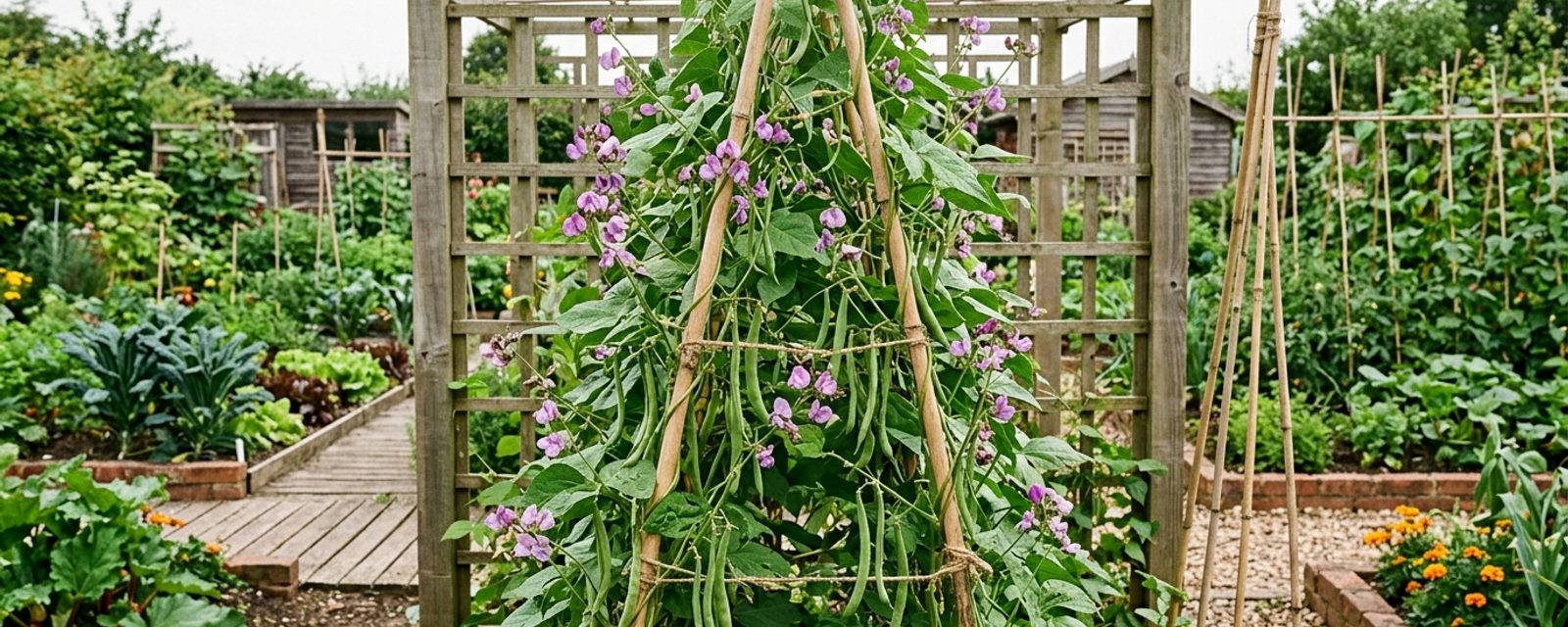
Your plot decides this one before you do. If it's an exposed hillside allotment or a coastal garden that catches every gust off the water, a 2-metre wigwam of climbing beans is a liability waiting for the first August gale, canes down, pods in the mud, weeks of cropping lost in one afternoon. If your season is short and your growing space sheltered, going dwarf-only means you're picking beans in July but finished by August, watching a south-facing wall's climbing potential go unused. The six RHS-recommended French bean varieties split cleanly along this line, and which side you land on should follow your site, not your taste in pods. For sowing dates, building a support that survives the season, and week-by-week care once plants are in, the full growing guide covers that ground.
Quick answer
Cobra is the best overall pick for most Scottish gardens: a climbing variety that crops continuously for months from a small footprint, provided you can give it a support structure built to survive wind. Choose Boston or Sprite instead if your plot is exposed or you want beans without any staking, and pick Purple Teepee if you want dwarf habit with a distinctive dark pod, accepting it's the one variety here without the RHS Award of Garden Merit (AGMThe RHS's Award of Garden Merit: a UK-wide trials award for reliable performance, not a Scotland-specific recommendation. Full definition →).
Why habit matters this much
A support structure for climbing beans has to carry several kilograms of foliage and pods through repeated wind loading, not just one storm, across a cropping season that runs into autumn, on an exposed hillside allotment or a coastal plot, that's the real cost of the extra crop a climber gives you, not a small print detail. What separates the six varieties below isn't that trade-off itself, it's exactly how tall each climber grows, how it crops, and what it's more or less likely to catch along the way.
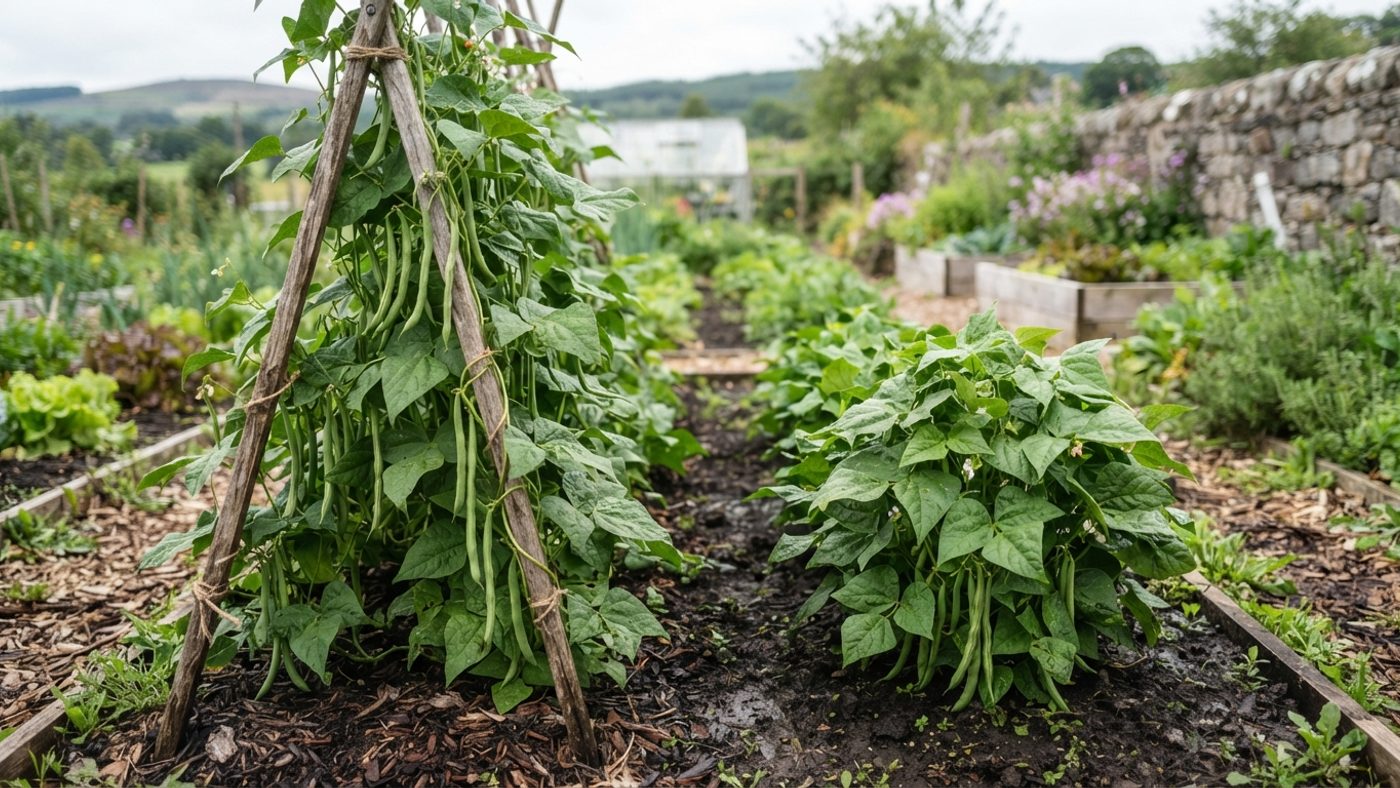
The six varieties, compared
All six are rated H2The RHS's H1a–H7 scale for how much cold a plant can survive outdoors, H1a being tender indoor-only and H7 hardy anywhere in the UK. Full definition →, tolerant of low temperatures but not surviving a frost, 1 to 5°C being their minimum comfort range. That rating is why none of them should go outside, even hardened offGradually getting young plants raised indoors used to outdoor conditions over 7–14 days before planting out, so cold, wind and direct sun don't shock or damage them. Full definition →, until well after your last frost date, which the growing guide covers for your part of Scotland. None of the six carries any documented disease resistance; every disease note on their own listings is phrased as "may be susceptible to," not resistant to. Rust, the risk named on five of the six, and the mildews named on Cobra's page both spread fastest in damp, still air, treat all six as needing the same watchfulness in a wet summer rather than picking one for its immunity.
| Variety | Habit | Height | Spread | AGM | Disease susceptibility noted |
|---|---|---|---|---|---|
| Cobra | Climbing | 1.5–2.5m | 0.1–0.5m | Yes | Chocolate spot, downy mildew, foot and root rot, halo blight, powdery mildew |
| Algarve | Climbing | 2.5–4m | 0.5–1m | Yes | Runner and French bean rust |
| Golden Gate | Climbing | 2.5–4m | 0.5–1m | Yes | Runner and French bean rust |
| Boston | Dwarf | 0.1–0.5m | 0.1–0.5m | Yes | Runner and French bean rust |
| Sprite | Dwarf | 0.1–0.5m | 0.1–0.5m | Yes | Runner and French bean rust |
| Purple Teepee | Dwarf | 0.1–0.5m | 0.1–0.5m | No | Runner and French bean rust |
Algarve and Golden Gate's extra height over Cobra means more support structure and more sail area in wind for a similar footprint. Algarve is also named "quick-maturing", worth knowing if you're weighing it against Cobra's longer "continuous heavy cropper" season. Beyond the numbers in the table: Golden Gate's pods are flat and yellow, "very eye-catching," while Algarve's are flat and pale green, and Cobra's are round rather than flat, described as "sweetly flavoured stringless pods." Boston gives a heavy crop of 15cm dark green cylindrical pods and can be grown in containers on a patio. Sprite, described as "fast-maturing," produces long, pencil-thin, stringless pods and, like Purple Teepee, crops best when grown close together in wide bands or blocks rather than single rows, so the plants support each other. Purple Teepee's dark purple pods turn green on cooking.
Watch for slugs and bean seed fly at the seedling stage across all six, and black bean aphid (blackfly) and aphids more generally once plants are established, Algarve, Boston, Sprite and Purple Teepee are specifically flagged on their own listings as vulnerable to slugs, snails and blackfly. Cobra is the one exception to the rust pattern: unlike the other five, its listing doesn't name rust at all, listing chocolate spot, downy mildew, foot and root rot, halo blight and powdery mildew instead. Botrytis (grey mould) is a named risk for French beans generally in damp, still conditions regardless of variety, worth watching in a cool, damp summer when foliage stays wet for longer between dry spells.
Which one for your situation
Best overall: Cobra. It's the shortest of the three climbing varieties, which eases the structural demands of the support without sacrificing cropping length, described as a continuous heavy cropper over a long season. For a garden with reasonable but not extreme shelter, and a support built to the growing guide's specifications, it's the variety that gives you the most beans for the structure you put up.
Choose Boston or Sprite instead if your plot is genuinely exposed, coastal, hilltop, or a garden where gales are a recurring feature rather than an occasional event. Both are dwarf, need no support at all, and Sprite in particular is bred to lean on its neighbours when planted in blocks rather than rows, which suits a windier site. You trade the long cropping window of a climber for a start that's over sooner, so plan on succession sowings to keep pods coming.
Choose Golden Gate over Cobra if you want a taller climber and don't mind the extra support demands, its flat yellow pods are a genuine visual departure, and at 2.5–4 metres it will fill a taller frame than Cobra ever will, but that height is exactly why it's the wrong call on an exposed site.
Choose Algarve over Golden Gate if you'd rather have flat, pale green pods than yellow ones, height, spread and hardiness match Golden Gate, and it also tolerates chalk, clay, loam or sand soil. It also flags slug, snail and blackfly vulnerability specifically, which Golden Gate's page doesn't mention, worth the extra vigilance if slugs are already a problem on your plot.
Choose Purple Teepee if pod colour is the deciding factor and you're comfortable that it's the one variety on this list without an AGM, its own listing simply doesn't show one, though its dwarf habit, hardiness and cultivation needs otherwise match Boston and Sprite.
On soil, no pH figure is published for French beans specifically, if you're amending soil for this crop, don't work to an assumed number; the guidance is simply "fertile, moisture-retentive soil in good light" across all six varieties, in a warm, sunny spot.
Common questions
Do any of the recommended French bean varieties resist rust or other diseases?
No. All six carry only susceptibility notes on their own listings, not resistance. Rust (called "runner and French bean rust") is named on five of the six; Cobra is the exception, with a different list instead, chocolate spot, downy mildew, foot and root rot, halo blight and powdery mildew.
Which variety is best for a windy or coastal Scottish garden?
Boston or Sprite. Both are dwarf, need no staking, and Sprite is specifically suited to being grown in blocks so the plants brace each other, useful where gusts are a regular feature rather than a one-off.
Is Purple Teepee worth growing without an AGM?
Its height, spread, hardiness and disease-susceptibility notes match Boston and Sprite exactly, the AGM is the one line where it differs from the rest of the list, and its own dark purple pods that turn green on cooking are the reason to grow it over an AGM-holding dwarf.
What pests should I watch for regardless of variety?
Slugs and bean seed fly at the seedling stage, and black bean aphid (blackfly) and aphids more broadly once plants establish. Algarve, Boston, Sprite and Purple Teepee are specifically named as vulnerable to slugs, snails and blackfly. Botrytis (grey mould) is also a named risk for the crop generally in damp, still conditions.
Should I choose based on pH or soil type?
No pH figure is published for French beans, so don't work to an assumed number. All six varieties share the same soil guidance: fertile, moisture-retentive soil in good light, with Algarve and Golden Gate additionally noted as tolerant of chalk, clay, loam or sand.
Sources
8 sources, recorded with what each was used for
- Phaseolus vulgaris 'Cobra': Habit, height/spread, hardiness rating, disease susceptibility, pod description, AGM status
- Phaseolus vulgaris 'Algarve': Habit, height/spread, hardiness rating, disease susceptibility, pod description, cultivation needs, AGM status
- Phaseolus vulgaris 'Golden Gate': Habit, height/spread, hardiness rating, disease susceptibility, pod description, AGM status
- Phaseolus vulgaris 'Boston': Habit, height/spread, hardiness rating, disease susceptibility, pod description, cultivation needs, AGM status
- Phaseolus vulgaris 'Sprite': Habit, height/spread, hardiness rating, disease susceptibility, pod description, cultivation needs, AGM status
- Phaseolus vulgaris 'Purple Teepee': Habit, height/spread, hardiness rating, disease susceptibility, pod description, cultivation needs, no AGM
- French beans: grow your own: Confirmation that these six varieties comprise the current full recommended list for French beans
- How to grow French beans: General cultivation context used to cross-check soil and light guidance