
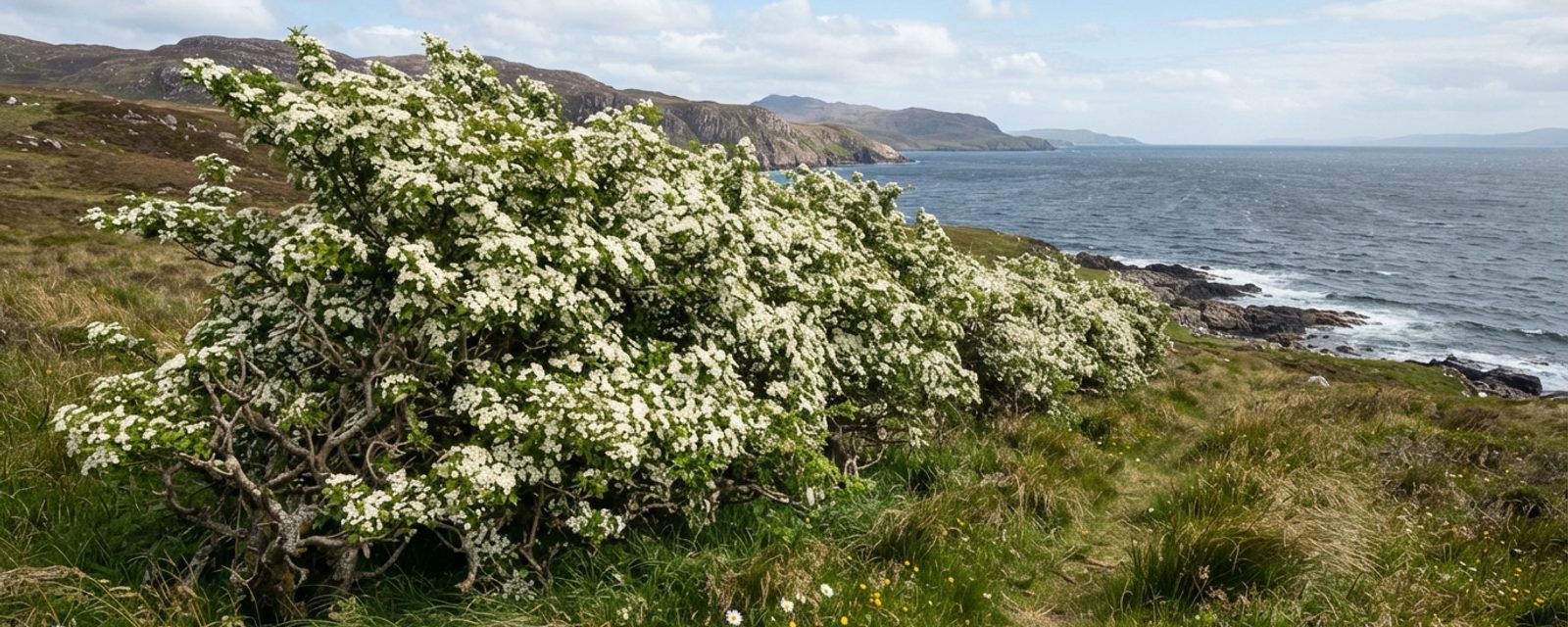
A young hedge dies from the outside in: wind strips moisture faster than damaged roots can replace it, salt scorches the leaf margins, and a plant that's still rocking in loose soil after autumn gales never gets the chance to root at all. Species choice has to start with exposure, not looks.
Why wind and salt kill new hedges before anything else does
A newly planted hedge is at its most vulnerable in its first one to two winters, and the damage is mostly mechanical and physiological rather than something a fungicide or feed will fix.
Wind desiccation happens because leaves lose water through their stomata faster than a small, still-establishing root system can pull replacement moisture from the soil, especially when the ground itself is cold or frozen, so roots can barely take up water at all. The foliage effectively dries out while standing in wet ground. Evergreens are hit hardest because they're losing moisture through leaves all winter, with no dormant leaf-drop to reduce the surface area exposed to the wind.
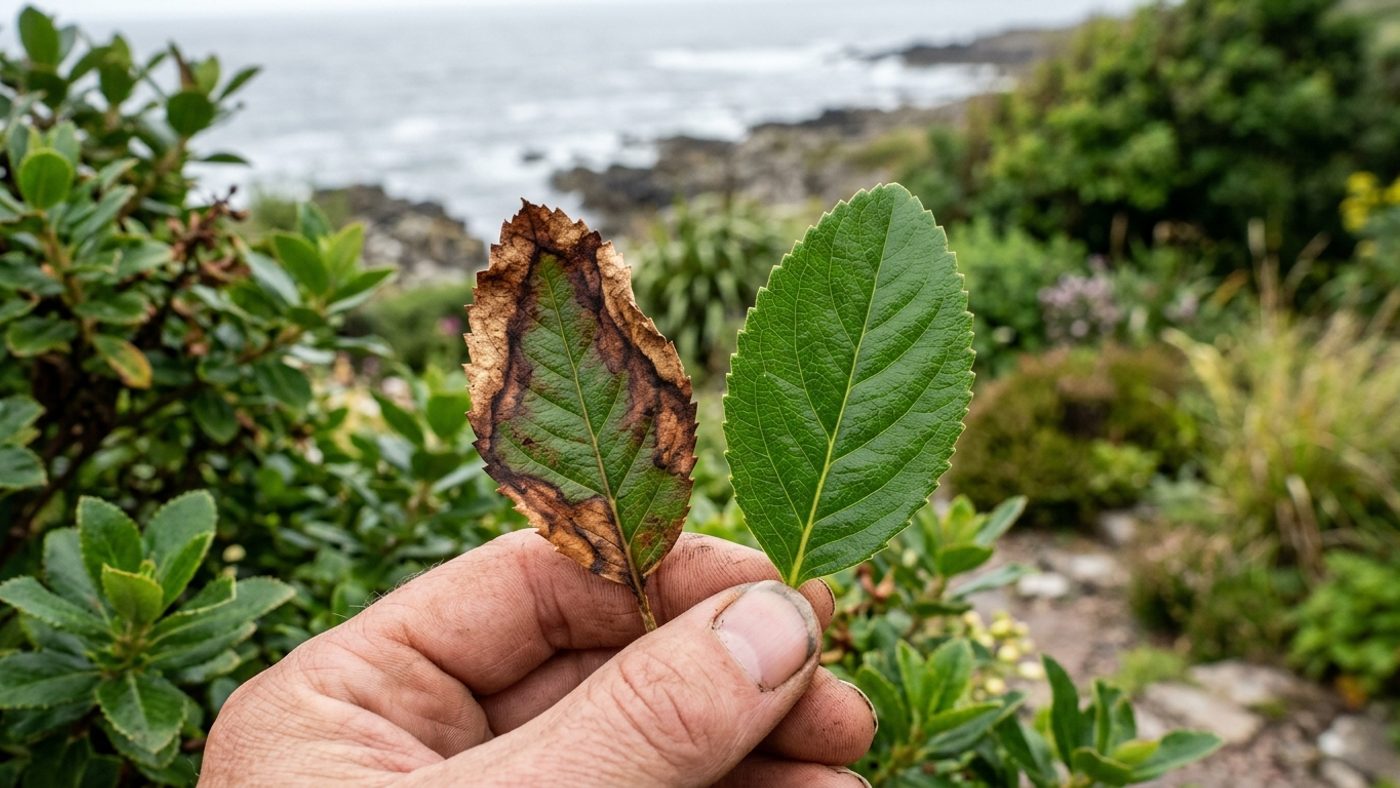
Salt deposition works differently: wind-blown sea spray settles on foliage and draws water out of leaf cells osmotically, which is what produces the scorched, browned leaf margins typical of storm-damaged coastal planting. It's a chemical burn, not a cold injury, which is why some plants that handle hard frost badly (like many Mediterranean-origin evergreens) can still shrug off salt, and vice versa.
Wind-rock is the third mechanism and it's purely mechanical: repeated buffeting rocks the stem base, opening a gap around the root ballThe mass of roots and the soil or compost clinging to them, as it comes out of a pot or out of the ground when a plant is lifted. Full definition → in the soil. That gap fills with air and water, roots that were starting to knit into the surrounding ground get torn again before they can establish, and a plant that would otherwise have survived the cold simply never anchors.
All three mechanisms point the same way: on an exposed Scottish site, the species question has to be answered before the planting-date question, because the right hedge for a sheltered Central Belt garden can be the wrong hedge for a site on the west coast, the islands, or anywhere upland and open to the prevailing south-westerlies.
This guide covers a single or double-row boundary hedge. For a larger, tree-scale planting on an exposed field or croft edge, a shelter belt is a different structure with its own species list and staggered-row layout: see Shelter Belt Planting for Exposed Gardens →.
Reading UK guidance the right way round
Mainstream hedge advice does account for wind and salt: RHS's hedge-selection page has a "seaside" category and a separate "cold, exposed inland" category, and RHS keeps dedicated pages for both windbreak planting and coastal planting, with hawthorn and hornbeam both named as tolerant of exposed conditions. On a sheltered plot, that's plenty: exposure is one line in a longer checklist alongside soil type, shade, thorniness for security, and wildlife value, and a gardener can afford to weigh it against the others.
On the west coast, the Northern and Western Isles, or any upland or open plot that catches a clear run of the prevailing wind, that order stops working: exposure decides which species are even eligible before soil type or wildlife value get a vote.
Two figures worth holding apart rather than merging, because they measure different things at different scales:
| Context | Wind-speed reduction reaches | For a 2m hedge, that's roughly |
|---|---|---|
| Garden windbreak (RHS) | Up to 10x hedge height, leeward side | 20m, worth knowing before siting a hedge to shelter a patio or border |
| Farm hedgerow (NatureScot) | Up to 30x hedge height, landscape scale | 60m, a farm/field-scale figure, not a garden-siting one |
The two numbers aren't in conflict; they're answering different questions. For a garden, the RHS figure is the one to plan a hedge's position around.
There's also a genuinely counter-intuitive mechanism worth understanding before choosing a species: RHS windbreak guidance is explicit that an effective windbreak should be semi-permeable, filtering roughly 50-60% of the wind rather than blocking it outright. A solid barrier, a dense conifer hedge with no gaps, or a wall, doesn't stop wind so much as deflect it, and that deflected air creates turbulent eddies on the sheltered side that can do as much damage as the open wind would have. A hedge that lets some wind filter through is doing its job better than one that looks more solid.
Species comparison for exposed and sheltered Scottish gardens
| Species | Evergreen/deciduous | Wind tolerance | Coastal/salt tolerance | Cold hardiness |
|---|---|---|---|---|
| Hawthorn | Deciduous | High | Good | High |
| Blackthorn | Deciduous | High | Good (full salt-wind exposure) | High |
| Beech | Deciduous (holds dead leaves through winter) | High inland | Not confirmed | High |
| Hornbeam | Deciduous (also marcescent) | High inland | Not confirmed | Very high |
| Holly | Evergreen | High | Moderate, needs some shelter from direct sea-wind | High |
| Sea buckthorn | Deciduous | High | Very high (full salt-wind exposure) | High |
| Elaeagnus x ebbingei | Evergreen | High | High | Moderate |
| Escallonia | Evergreen | Moderate | High | Moderate, not reliable in hard inland frost |
| Griselinia littoralis | Evergreen | Moderate | High, needs some shelter from direct sea-wind | Low, frost-tender |
Hawthorn (native) is on both the RHS "cold, exposed inland" and coastal-tolerant lists, thorny, dense, and one of the core native species in Scotland's hedgerow mix. Blackthorn (native) suckersA shoot that grows from a plant's roots or lower trunk, separate from the main framework, usually removed before it diverts energy. Full definition → readily, a plus for a wildlife hedge and a drawback for a tidy garden boundary. Beech and hornbeam's marcescence (retained brown winter leaves) adds a wind-shelter benefit as a hedge; treat both as proven for inland/upland wind, not for direct salt spray, since neither is on RHS's coastal or seaside lists. Sea buckthorn is nitrogen-fixing, produces orange berries, and is spiny and tough, a strong first-line choice for the most exposed coastal ground.
A caution on the last pairing in the table: a lot of general "great hedge for coastal Scotland" advice recommends Griselinia or Escallonia on salt tolerance alone and doesn't flag their frost limits. On an exposed site that's windy and salty and prone to hard frost, both are a weaker bet than hawthorn, blackthorn, or holly, which give up little on wind or salt tolerance and add far more cold hardiness.
Spacing and planting method
Spacing depends on whether you're planting a single row (a lighter, quicker screen) or a double row (denser, faster to thicken up, but needs more plants and more ground).
| Method | Spacing between plants | Row spacing | Best for |
|---|---|---|---|
| Single row | 30-60cm apart (closer for small-leaved/formal hedges, wider for larger shrubs) | - | Boundary hedges, formal or informal, most garden situations |
| Double row, staggered/zig-zag | 30-45cm apart within each row | 40-50cm between rows | Thicker screening or windbreak hedges, faster establishment of a dense barrier |
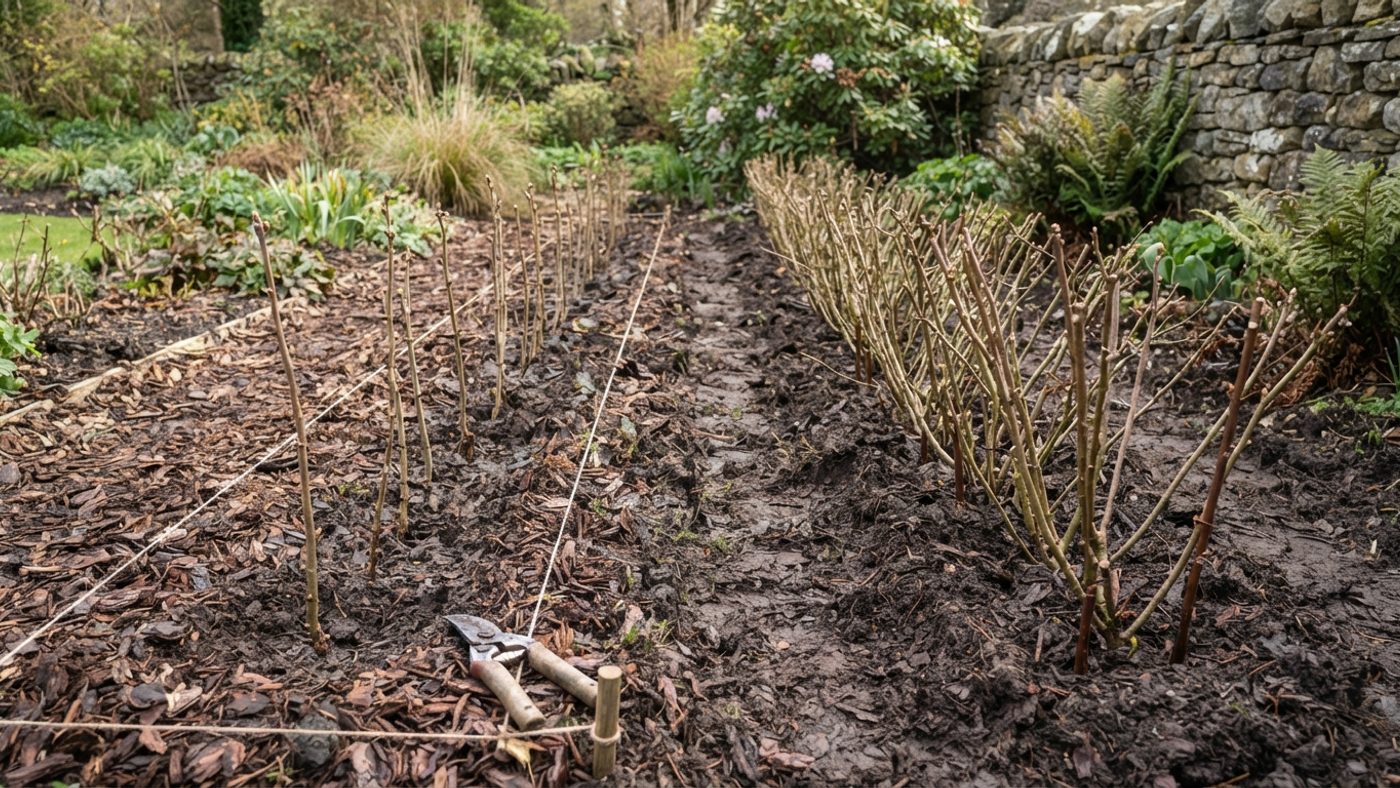
Keep a new hedge back roughly 1-1.5m from a neighbouring boundary line so it has room to grow without immediately overhanging next door, worth getting right from the start, since a hedge that ends up too tall too close to a boundary can become a legal dispute later (more on that below).
Timing. Bare-rootA plant, usually a fruit tree or hedging, sold with its roots exposed rather than in a pot, and only available while dormant. Full definition → and root-wrapped deciduous plants (hawthorn, blackthorn, beech, hornbeam whips are typically sold this way) are cheaper but only available and only safe to plant during the dormant season, November to March. Container-grown stock costs more but can go in at any time of year, watered in well and kept from drying out if planted outside the dormant window. On an exposed site, dormant-season planting is worth prioritising anyway; it gives roots a full winter and spring to establish before the plant has to cope with summer moisture stress on top of wind exposure.
Whips are the standard cheap starting size for a new hedge, young plants around 60cm tall. They establish easily and, planted at the closer end of the spacing range, knit together into a thick base faster than larger, more expensive stock, at the cost of needing more of them per metre.
Ground prep and planting. Dig over a strip roughly 60-90cm wide and one spade-blade deep along the hedge line, clearing perennial weeds; these will compete hard with a young hedge for water and nutrients if left in. On sandy or heavy clay ground, work organic matter into the excavated soil (not into the bottom of the planting trench itself, where it can cause the ground to settle and leave roots sitting in a hollow). BackfillThe soil (sometimes improved with grit or compost) used to fill the gap around a plant's roots after it's placed in its planting hole. Full definition →, firm in, and mulchA layer of material spread over the soil around plants to suppress weeds, retain moisture, and improve soil structure as it breaks down. Full definition → to about 7.5cm deep to suppress weeds and help retain soil moisture, genuinely useful on a windy site, where the ground dries out faster than it looks like it should.
Aftercare. Water through dry spells in the first one to two growing seasons, keeping the root area moist but not waterlogged, and keep a weed-free strip roughly 45cm either side of the hedge line while it establishes. On an exposed site, a temporary windbreak mesh or hessian screen staked along the windward side for the first winter or two can make a real difference to establishment, buying time for roots to anchor before the hedge has to filter full-strength wind on its own.
Check newly planted whips after hard frost or a stormy spell too; freeze-thaw and wind-rock both loosen the soil around the stem base, and refirming it back down with your heel stops that gap reopening and undoing the rooting-in the plant has already managed. In the following spring after planting, cut the shrubs back to around 60cm above a bud: it looks like a setback, but it's what forces a whip to bush out low and dense rather than growing tall and thin. Once the hedge is established, ongoing trimming is a different job with its own timing rules, driven by nesting-season restrictions rather than establishment risk.
When to Cut a Hedge: Safe Timing, the Nesting-Bird Law, and How Often Each Type Needs It → covers those ongoing timing rules in full once your hedge is established, including how often each hedge type actually needs cutting.
Before you plant: cost, protection, and the neighbour question
Cost. Bare-root whips are the budget option by a wide margin, a handful of pounds each rather than the considerably higher per-plant cost of container-grown stock, which matters because a decent-length exposed-site hedge, planted at the closer end of the spacing range to establish a thick base faster, can easily need several dozen plants for a modest garden boundary. Buying bare-root in the dormant season is the way most gardeners keep a long hedge run affordable. Choosing stock grown from UK or local provenance, where a supplier states it, also gives young plants a better chance of being suited to the climate they're going into rather than a milder one.
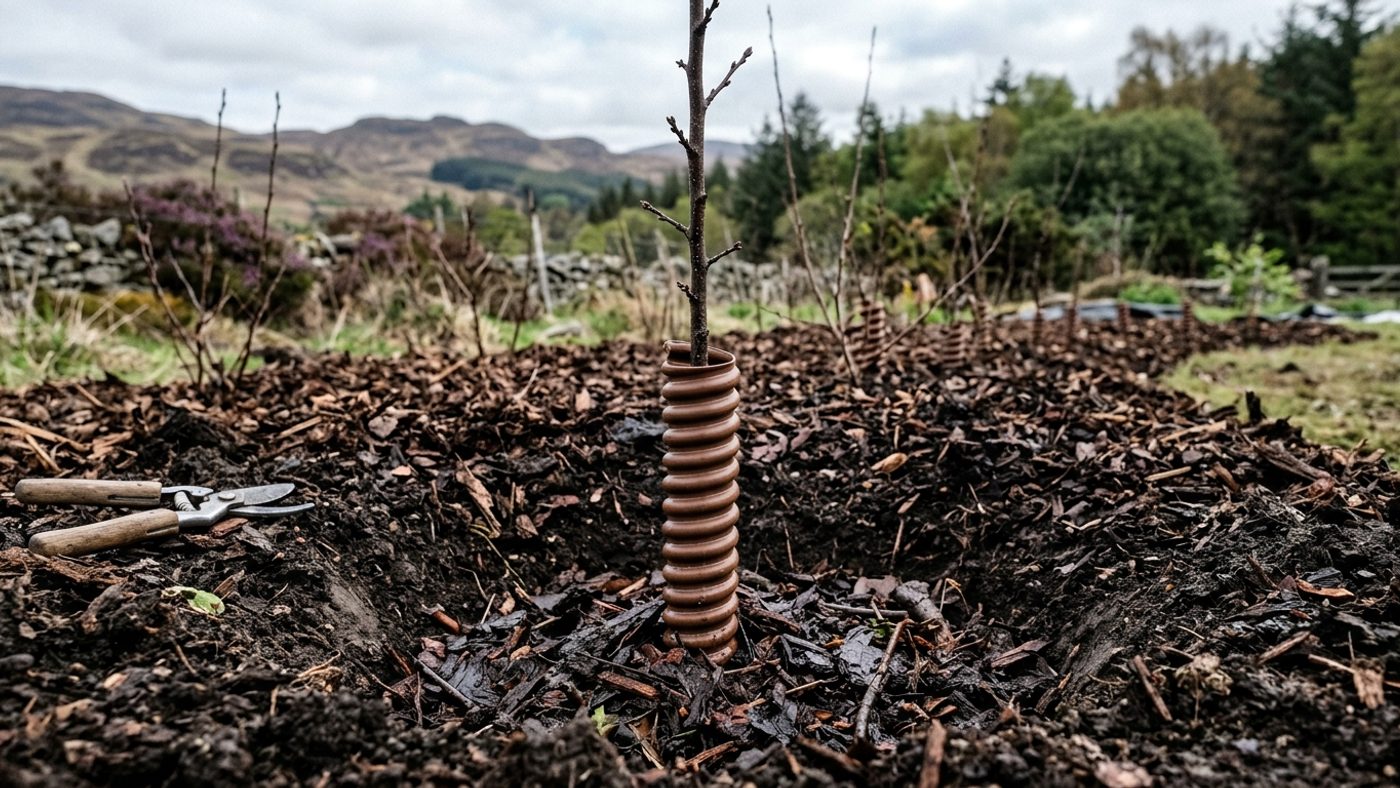
Rabbits and deer. A spiral guard or a length of mesh around each whip until the bark toughens is standard, low-cost protection against browsing, worth budgeting for on any rural, woodland-edge, or open-ground site, since a whip that's been stripped of bark in its first winter has the same result as one that's failed to establish from wind or salt.
Neighbouring boundaries. The High Hedges (Scotland) Act 2013 lets a local authority intervene where a hedge of two or more trees or shrubs grows over 2m tall and is blocking a neighbour's light. It only applies once a dispute has been raised and other routes tried first, but it's the reason to plan for a boundary hedge's eventual height, not just today's 60cm whip, when deciding how close to plant it and which species to use. It's most often invoked over fast-growing evergreen conifer hedges (leylandii being the classic case) rather than the slower native species this guide focuses on, but the 2m/light-blocking trigger applies to any qualifying hedge regardless of species.
Choosing for a mixed native hedge
A hedge doesn't have to be one species. Scotland's native hedgerow stock, hawthorn, blackthorn, elder, hazel, is typically found as a mix rather than a monoculture, and an estimated 22,000km of hedgerow exists in Scotland, most of it classified as a UK Biodiversity Action Plan Priority Habitat. Staggering species spreads the flowering and fruiting season out rather than concentrating it: blackthorn blossoms first, before its leaves even open, typically in March; hawthorn follows in May with a heavier show of blossom; holly flowers in the same April-May window and carries berries into winter. A mixed native hedge built around a hawthorn and blackthorn base, with hazel, holly, or rowan worked in, feeds pollinators and birds across a longer stretch of the year than a single-species hedge, and it hedges your bets against any one species struggling on a given stretch of ground. Hazel and rowan are both reasonably wind-tolerant but not on RHS's coastal-tolerant lists, so treat them the same way as beech and hornbeam: fine inland and upland, not a proven choice for direct salt spray. For an exposed site, keep the exposure-tolerant species (hawthorn, blackthorn, holly) as the majority and treat hazel and rowan as fill-in for the more sheltered sections.
Drainage matters as much as exposure for beech specifically: its shallow roots rot in soil that stays wet through winter, which rules it out on the poorly-drained peaty ground common across upland and west-coast Scotland regardless of how well it copes with wind. Hawthorn and blackthorn tolerate wetter, heavier ground better, so on a site that's both exposed and boggy, they're the safer bet over beech for reasons that have nothing to do with salt or wind at all.
Common questions
How far apart should I plant a new hedge?
For a single-row hedge, 30-60cm between plants is standard, with closer spacing for small-leaved or formal hedges and wider spacing for larger shrubs. For a denser double-row hedge, stagger plants 30-45cm apart within each row, with the two rows 40-50cm apart.
When is the best time to plant a hedge in Scotland?
For bare-root and root-wrapped deciduous species (most native hedging), the dormant season, November to March, is both the cheapest and, on exposed ground, the most reliable window, since it gives the hedge a full winter and spring to establish roots before summer heat and wind stress arrive. Container-grown plants can be planted at other times of year but need more careful watering in if planted outside the dormant season.
What's the fastest-establishing hedge species for a windy garden?
Whips of native, exposure-tolerant species like hawthorn and blackthorn establish quickly and cheaply when planted close together in the dormant season. For faster evergreen screening on a coastal but not severely frosty site, Elaeagnus x ebbingei is a quick-growing option, though it gives up some cold hardiness compared to hawthorn.
Can I grow an evergreen screen hedge on an exposed Scottish site?
Yes, but the species choice narrows considerably. Holly is the most cold-hardy evergreen option with reasonable coastal tolerance (with some shelter from direct sea-wind). Escallonia and Griselinia littoralis both tolerate salt well but are markedly less frost-hardy, so they suit a milder coastal garden better than an exposed site that also gets hard winter frost.
Is a mixed native hedge better than a single species for a Scottish garden?
For wildlife value and resilience, generally yes: a mix of hawthorn, blackthorn, and other native species spreads flowering and fruiting across more of the year and reduces the risk of the whole hedge struggling if one species doesn't suit a particular stretch of ground. For a strict formal or topiary hedge, a single species (beech, hornbeam, or box) gives a more even, manageable finish.
Sources
8 sources, recorded with what each was used for
- RHS: Hedges - Selection Tips: Seaside and cold-exposed-inland species categories, named species per category
- RHS: Hedges - Planting Guide: Bare-root vs container timing, whip sizing, spacing figures, soil prep, backfill, mulch depth, aftercare watering
- RHS: Windbreaks and Shelterbelts: Semi-permeable windbreak design (50-60% filtering), tenfold-height leeward wind reduction, coastal-tolerant tree/shrub list
- RHS: Plants for coastal areas: Salt-tolerant shrub list split between full sea-wind exposure and those needing some protection
- RHS: How to grow beech: Beech's soil and drainage requirements, waterlogging as the main risk to its shallow root system
- Woodland Trust: How to Plant and Maintain Hedges: Single-row and double-row zig-zag spacing figures, boundary-distance guidance, formative pruning after the first year
- NatureScot: Thematic document - Hedgerows: Scottish hedgerow extent (approx. 22,000km), native species mix (hawthorn, blackthorn, elder, hazel), UK BAP Priority Habitat status, wind-speed reduction up to 30x hedge height downwind of a farm hedgerow
- gov.scot / legislation.gov.uk: High Hedges (Scotland) Act 2013: Definition of a "high hedge" (2+ trees/shrubs, over 2m, blocking light) and the local-authority dispute process