
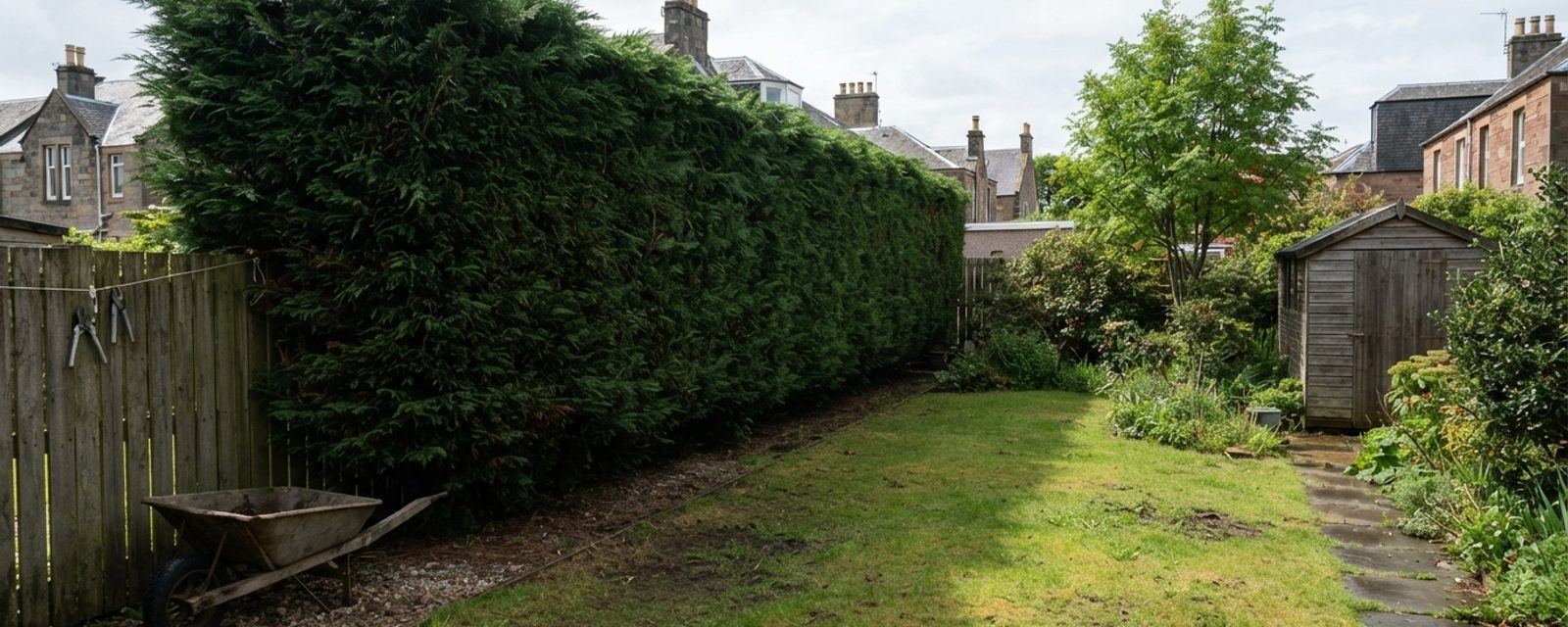
Standing at the back window with the kitchen lights on at three in the afternoon, it's hard not to trace the problem to one thing: the wall of leylandii next door that's crept past the roofline over the past decade. The lawn hasn't seen direct sun in years. The obvious question follows immediately, is there anything actually enforceable here, or is this just something to live with?
In Scotland, there is a specific answer. The High Hedges (Scotland) Act 2013 gives councils a defined power to intervene in hedge disputes between neighbours, but it comes with real preconditions, a real process, and real limits on what it can force a neighbour to do. None of it starts with the council, it starts next door.
Talk to the neighbour first
The Act expects you to have tried to sort this out directly with your neighbour before a council will even accept an application. That's not just good practice, it's a formal precondition. Councils look for evidence of "all reasonable steps" to resolve the matter informally. The Scottish Government's guidance to local authorities gives an illustrative benchmark for this, rather than a fixed legal test: at least two genuine, documented approaches to the neighbour within the six months before you apply. A letter, a note of a conversation, a diary entry, something that shows you tried and it didn't resolve things.
It's also, separately, just the more sensible route. A conversation costs nothing and can resolve a dispute in an afternoon that a council process would take months to work through.
"Documented" doesn't need to mean formal, a dated email, a text message, or a note of what was said and when is enough to show a genuine attempt was made. What matters is that there's a record, not the format it's in.
What counts as a "high hedge" under Scots law
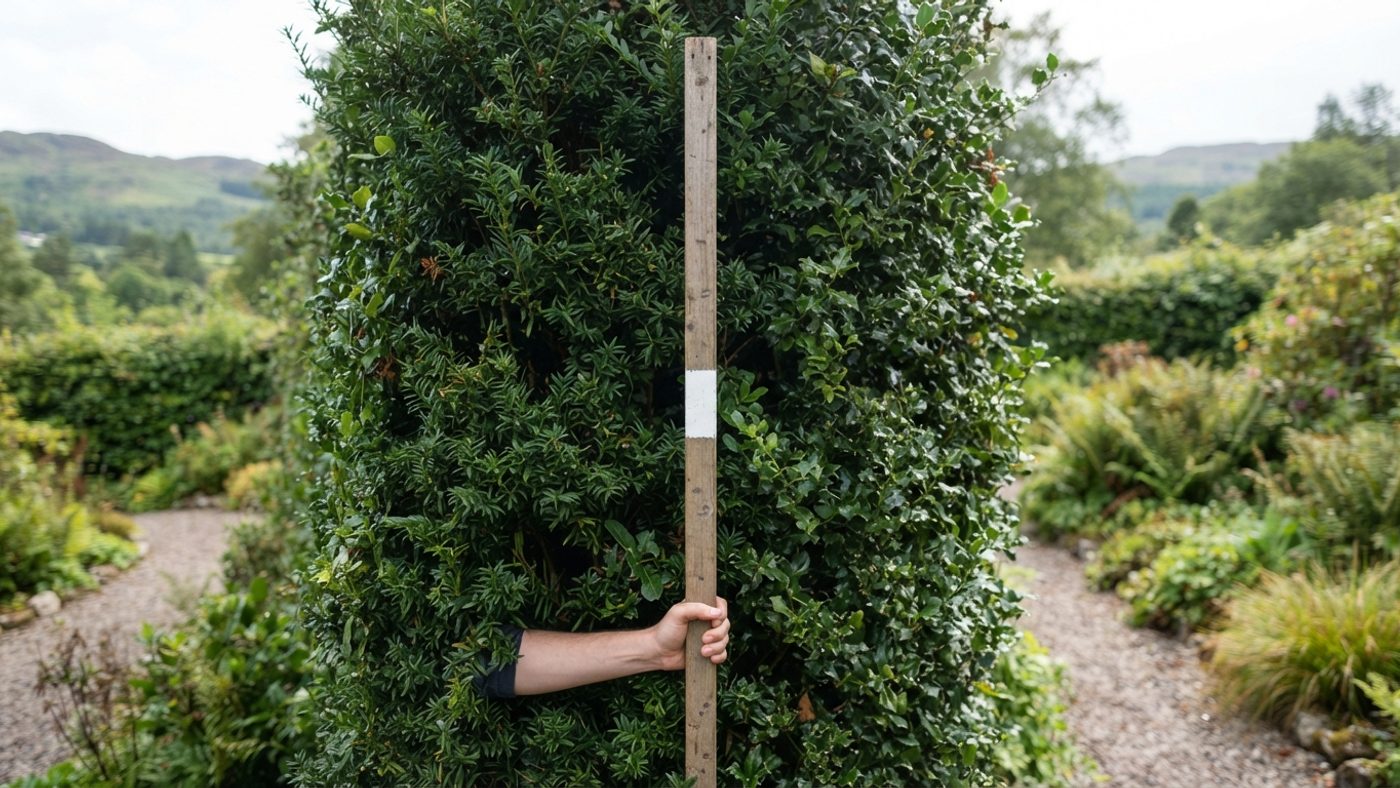
The Act's definition, from Section 1 of the legislation, is precise. A high hedge is:
- formed wholly or mainly by a row of two or more trees or shrubs
- rising to a height of more than 2 metres above ground level
- forming a barrier to light
A hedge with gaps that significantly reduce its overall effect as a barrier at heights above 2 metres is excluded from the definition. Roots are explicitly excluded from consideration under the Act, this is a law about light, not about root damage to drains or foundations, which is a separate legal matter entirely.
Two things fall outside scope entirely. Single trees are excluded, no matter how tall or shading, one tree is not a hedge under this Act. And other vegetation that isn't a row of hedge planting doesn't qualify either. The guidance is direct about why: single trees and non-hedge vegetation were deliberately kept out of scope to keep the law workable, rather than turning it into a general-purpose tool for any garden dispute involving plants.
The purpose behind the Act is to let councils resolve disputes where a high hedge is having an adverse effect on the "reasonable enjoyment" of a neighbouring domestic property. When the Scottish Government consulted on this in 2009, over 95% of respondents favoured having a government-backed route available for when informal approaches fail.
Two practical wrinkles are worth flagging separately from the Act itself. If the trees or shrubs are covered by a Tree Preservation Order, or sit within a conservation area, cutting them can need separate consent from the council on top of anything a high hedge notice requires, check with the planning department before assuming a notice is the only permission that matters. And if it's genuinely unclear whose hedge it is, or the hedge sits on or straddles a boundary, that's a land-ownership question the Act doesn't resolve on its own; the council will still need to establish who owns the hedge before a notice can be directed at anyone.
Scotland vs England and Wales
Scotland's Act is a separate piece of legislation from the regime covering England and Wales, which sits in Part 8 of the Anti-social Behaviour Act 2003.
| Scotland (High Hedges (Scotland) Act 2013) | England & Wales (Anti-social Behaviour Act 2003, Part 8) | |
|---|---|---|
| Plant type covered | Any row of 2+ trees or shrubs, evergreen or deciduous | Line of 2+ trees or shrubs that are evergreen or semi-evergreen specifically; deciduous hedges are excluded entirely |
| What the hedge must obstruct | Barrier to light only | Barrier to light or access |
| Height threshold | More than 2 metres | More than 2 metres |
| Decision/appeal body | Council decision; appeal to the DPEA within 28 days | Council decision; appeal to the Secretary of State (via the Planning Inspectorate) within 28 days |
The plant-type difference is real: south of the border, a deciduous hedge is excluded from the law regardless of how much shade it casts, while Scotland's Act makes no such distinction. In practice, the hedges that generate most complaints, on both sides of the border, are fast-growing evergreens like leylandii, which qualify under either regime, the deciduous point mainly matters for the less common dispute involving something like a beech or hornbeam hedge.
Making the application
Once the informal route has genuinely been tried and failed, the application goes to the local council. It needs to include a completed application form, evidence of the resolution attempts made, a description and map of the hedge and the affected property, and the fee. Both owners and occupiers (including tenants) of the affected property can apply, it doesn't have to be the homeowner personally.
On fees: there is no national standard figure, and the amount is set by each council to cover its own reasonable costs of handling applications. Angus Council, for example, charged £275 for a High Hedge Notice application at the time of writing (2026), a figure that can and does change. Other councils will differ, sometimes significantly, and the only way to know the current figure for a specific area is to check that council's own published schedule, councils are required to publish theirs, and to offer concessions for low-income applicants, pensioners, and disabled people.
What the council can actually order
If an application succeeds, the council issues a high hedge notice.
It is not an order to fell the hedge or cut it to ground level, and it doesn't automatically mean cutting to exactly 2 metres either:
- What a notice can require: a one-off "initial action", remedial work sized to remove the actual light-barrier problem, which could mean a reduction to somewhat above 2 metres, to below 2 metres, or occasionally more, depending on the site. Ongoing "preventative action" (regular maintenance) can also be required, so the problem doesn't simply recur in a couple of growing seasons.
- What it doesn't default to: felling, ground-level clearance, or a fixed exactly-2-metre cut. The guidance sets the height by what actually fixes the light problem in that garden, not by a standard figure.
The notice sets a compliance period, which must start at least 28 days after the notice takes effect. The overall timeframe can also depend on practical constraints such as the bird-nesting season (roughly March to August, when disturbing an active nest is a separate wildlife-protection issue), which the council has to work around regardless of the Act's own deadlines. No single published figure covers the whole process end to end, but adding up the application, the neighbour's chance to respond, the council's assessment, and the compliance period itself points to a matter of months rather than weeks before any appeal; an appeal to the DPEA (see below) can add roughly a further 12 weeks on top, the target timeframe the DPEA sets itself for reaching a decision.
If the notice isn't followed
If a hedge owner doesn't comply with a notice, the council has the power to carry out the work itself and recover the costs from the hedge owner. Obstructing someone authorised to carry out that work is a criminal offence. A notice remains in force until the council formally withdraws it, it doesn't lapse on its own once the work is done, since the preventative-action element is ongoing.
Appeals: the DPEA
Either party, the person who applied, or the hedge owner, can appeal the council's decision to the DPEA (Directorate for Planning and Environmental Appeals) within 28 days of that decision. A DPEA reporter can cancel the notice, vary its requirements, uphold it as issued, or issue a notice in a case where the council had refused one. Appeals are usually decided on written submissions rather than a hearing, and the DPEA aims to reach a decision within around 12 weeks.
The hedge owner's side of this
A hedge owner facing a complaint isn't as exposed as it might sound. If a neighbour applies to the council, the hedge owner gets a chance to respond before any notice is issued, this isn't a decision made without their input. If a notice is issued, they can appeal it to the DPEA on the same 28-day basis as the applicant. And the notice itself is specific, not open-ended: it states exactly what work is required and by when, rather than leaving the hedge owner guessing at what would satisfy the council.
One thing worth stating plainly here: routine trimming of your own boundary hedge needs no council permission under this Act, it only becomes relevant at all once a neighbour formally applies and the council issues a notice.
Two other things worth knowing if you're the one holding the secateurs. First, a practical horticultural point that matters more than anything in the notice itself: leylandii and most conifers won't reshoot from bare brown wood once you cut back past the last of the green growth. A notice that requires a hard reduction needs to be done in stages over more than one season where possible, or the result is a dead brown skirt rather than a tidy lower hedge, worth raising with the council or a tree surgeon if the required cut looks like it will go past the green. Second, the Act only deals with light, not overhanging branches or roots crossing onto a neighbour's land, that's generally understood as a separate common-law matter, with a neighbour generally able to cut back growth that crosses their boundary, up to the boundary line, regardless of whether the Act applies at all, though the detail can turn on the specific circumstances, so treat this as a starting point for a conversation rather than a full statement of the law.
The best way to avoid any of this is prevention: keeping a boundary conifer hedge topped annually, well before it approaches 2 metres, costs far less time and risk than a hard reduction ordered years later.
Common questions
Do I need council permission to trim my own hedge?
No, ordinary hedge maintenance isn’t covered by the Act at all. It only comes into play once a neighbour formally applies and the council issues a notice.
Can the council force my neighbour to cut their hedge to exactly 2 metres?
Not necessarily. A high hedge notice sets a reduction target aimed at fixing the specific light-barrier problem, which may be above or below 2 metres depending on the circumstances of the case. There’s no automatic default to exactly 2 metres.
What if my neighbour’s hedge is deciduous, not evergreen, does the Act still apply?
Yes, in Scotland. Unlike the England and Wales regime, the High Hedges (Scotland) Act 2013 doesn’t restrict its definition to evergreen or semi-evergreen planting, a qualifying deciduous hedge over 2 metres that forms a barrier to light can still be covered. In practice, though, most disputes involve fast-growing evergreens like leylandii.
Do I have to try talking to my neighbour before applying to the council?
Yes. Councils won’t accept an application without evidence of it, and the guidance’s benchmark is at least two documented approaches within the six months beforehand, keep any letters or notes of conversations.
How much does an application cost, and how long does the process take?
Fees are set by each council individually rather than nationally, so they vary, Angus Council charged £275 at the time of writing (2026) as one verified example, though this can change. The full process, from application through the neighbour’s response, the council’s decision, and any compliance period, realistically takes months rather than weeks.
Dealing with a different hedge problem? See conifer hedge browning and box hedge dying.
Sources
8 sources, recorded with what each was used for
- High Hedges (Scotland) Act 2013, Section 1, legislation.gov.uk: The statutory definition of "high hedge," the height threshold, the light-barrier requirement, the gaps exclusion, and the exclusion of roots
- Anti-social Behaviour Act 2003, Part 8, legislation.gov.uk: The England/Wales comparison: the evergreen/semi-evergreen restriction and the light-or-access standard
- High Hedges (Appeals) (England) Regulations 2005, legislation.gov.uk: The England/Wales appeal route (Planning Inspectorate on behalf of the Secretary of State, 28-day window)
- High Hedges (Scotland) Act 2013: revised guidance to local authorities (2019), Introduction, gov.scot: The purpose of the Act ("reasonable enjoyment"), the exclusion of single trees and non-hedge vegetation, and the 2009 consultation figure
- High Hedges (Scotland) Act 2013: revised guidance to local authorities (2019), page 3, gov.scot: The pre-application requirement, the two-approaches-in-six-months benchmark, application contents, and the fee/concessions rules
- Angus Council: Noise, neighbours, pets and pests: The £275 High Hedge Notice application fee as a concrete, council-verified example
- High Hedges (Scotland) Act 2013: revised guidance to local authorities (2019), page 5, gov.scot: Initial/preventative action, the reduction-height flexibility, the 28-day compliance period start, non-compliance enforcement, and the obstruction offence
- High Hedges (Scotland) Act 2013: revised guidance to local authorities (2019), page 7, gov.scot: The DPEA appeal route, the 28-day appeal window, and the roughly 12-week decision timeframe