
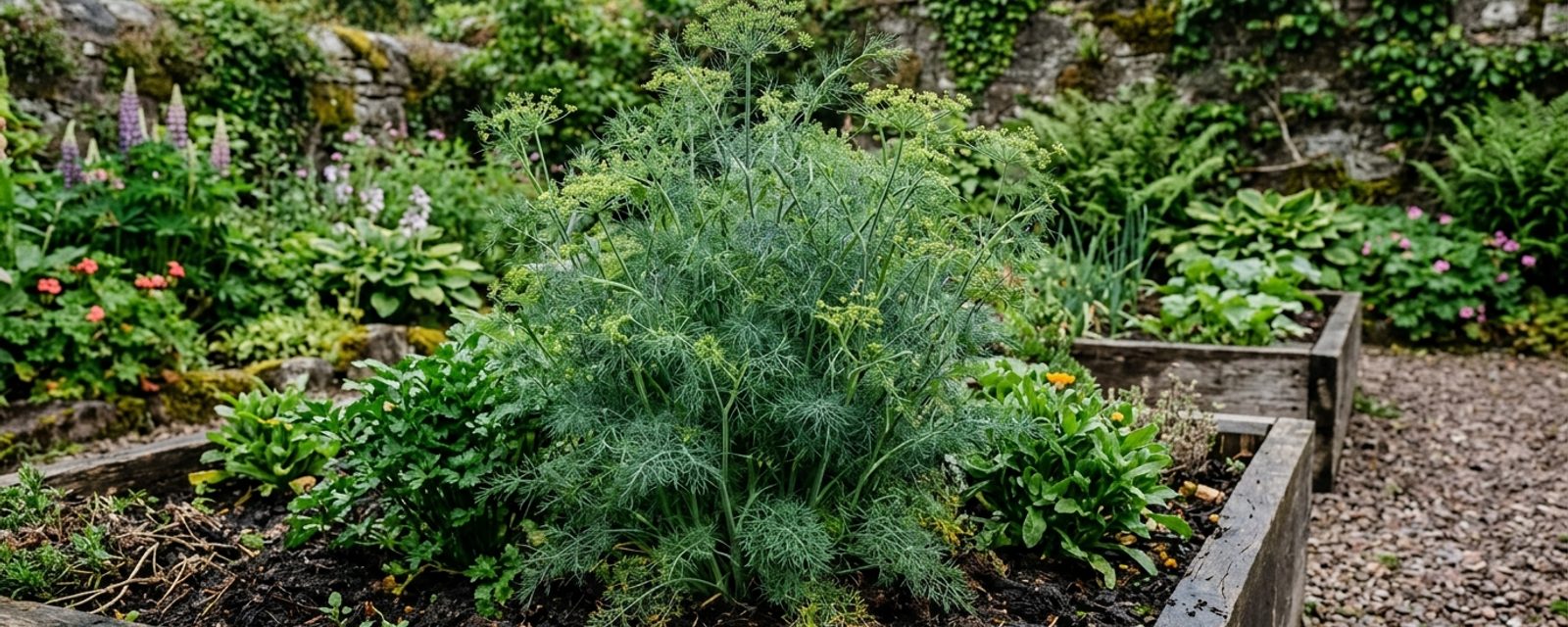
If your dill has gone over sideways after the last spell of wind, or it's thrown up a flower head after producing barely a handful of leaves, the plant isn't the problem, the variety choice usually is. Standard, unnamed dill seed is bred for nothing in particular: not height, not boltingA plant switching early into flowering and seed production, usually triggered by stress, after which leaves, roots or bulbs turn bitter or unusable. Full page → resistance, not leaf yield. Named cultivarsA plant variety that arose or was bred under cultivation and is kept true by deliberate propagation, rather than a naturally occurring wild species. Full definition → exist precisely to fix those weak points, and which one you need depends on what's actually going wrong in your plot.
Quick answer
For most Scottish gardens, Domino is the best overall pick: it holds the RHS Award of Garden Merit, is compact, slow to bolt, and has good standing ability against wind. Growing mainly for seed rather than leaf, choose Mammoth instead, it flowers freely and grows tall, which is exactly what seed production needs. In a container or on a very exposed, windy site where even Domino's stockier growth feels risky, Bouquet is the more compact option still worth a look.
Bolting and wind pull in different directions
Bolting risk and wind exposure work against each other here. A cooler Scottish summer tends to reduce bolting, since heat and dry spells are the main triggers, but an exposed site raises the odds of a tall plant going over in wind regardless of how well it's resisting bolting. Staking with canes helps with the wind side of that, but it isn't the only answer, the varieties below deal with the two risks in genuinely different ways: some through height and standing ability, some through slow-to-bolt breeding, and Domino through a bit of both at once. For sowing dates, spacing and step-by-step bolting prevention, see the full growing guide.
The six varieties worth comparing
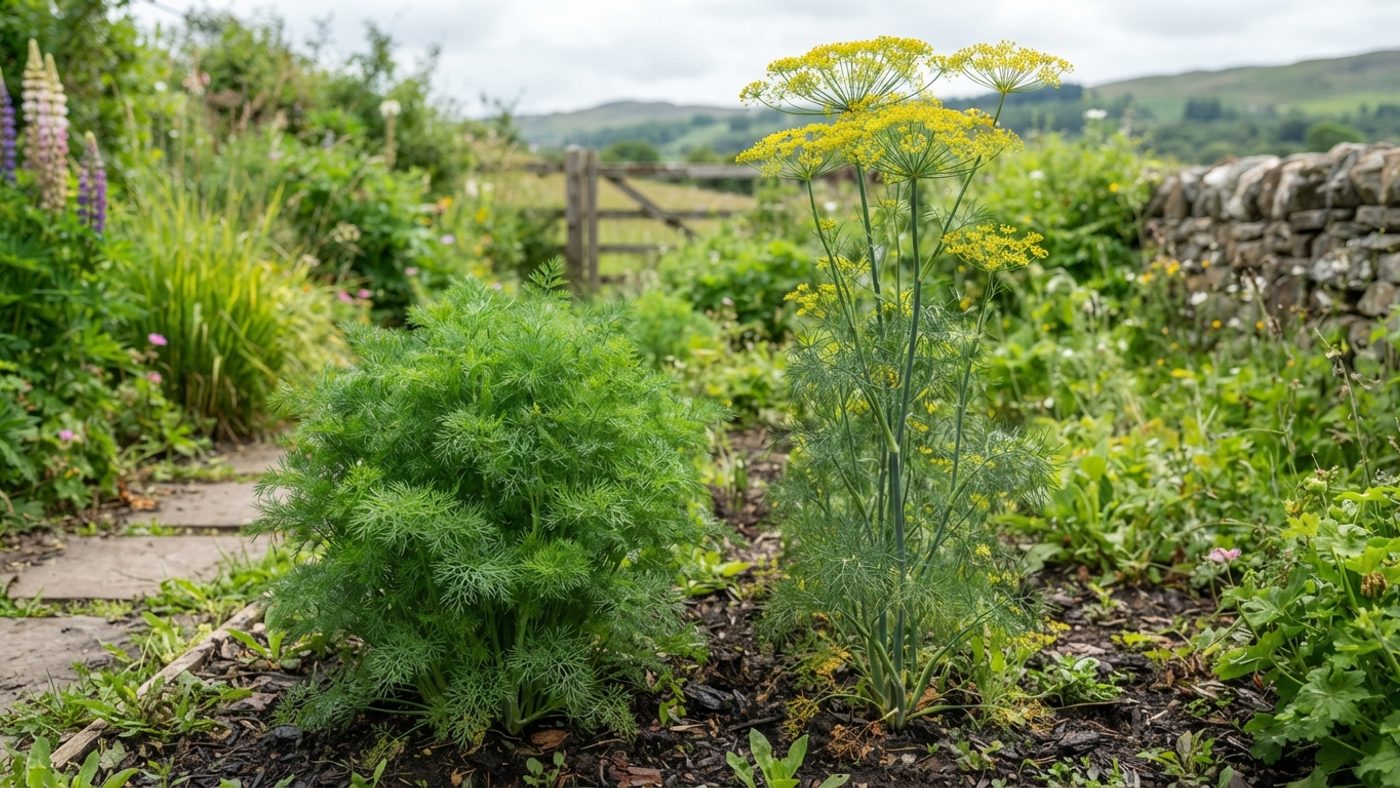
Six varieties turn up in the standard dill variety list; two of them, Diana and Tetra, are named there but don't have a fuller individual plant profile published, which is itself worth knowing before you go looking for one. Bouquet doesn't appear on that general summary at all, but does have its own individual plant page on RHS, and Gardener's World separately names it as a strong container and seed variety.
| Variety | AGMThe RHS's Award of Garden Merit: a UK-wide trials award for reliable performance, not a Scotland-specific recommendation. Full definition → | Hardiness | Max height | Best suited to |
|---|---|---|---|---|
| Domino | Yes | H2The RHS's H1a–H7 scale for how much cold a plant can survive outdoors, H1a being tender indoor-only and H7 hardy anywhere in the UK. Full definition → (tolerates low temps, not freezing) | 0.5–1m | Leaf harvest, general garden use, wind-prone sites |
| Dukat | No | H4 (hardy through most of UK) | 0.5–1m | Vigorous leaf production, easy-going sites |
| Mammoth | No | H4 | 1–1.5m (Gardener's World states 90cm) | Seed production |
| Bouquet | No | H4 | 0.1–0.5m | Containers, small spaces, seed production in a small footprint |
| Diana | No | Not published individually | Not published individually | Compact growth, slow to bolt (per RHS's general summary only) |
| Tetra | No | Not published individually | Not published individually | Bushy growth, slow to bolt (per RHS's general summary only) |
Domino: the standing-still-in-the-wind pick
Domino carries the RHS Award of Garden Merit. It's bushy and compact with abundant, aromatic leaves, slow to bolt, and its "standing ability" (how well it stays upright rather than flopping over) is rated good, a trait that matters directly on exposed ground since it means the plant resists lodging rather than just growing short enough to dodge the worst of the wind. Its stated harvest window runs May to September, longer than any other variety here gives a figure for, and it tolerates both exposed and sheltered sites in full sun on well-drained soil.
Dukat: the leaf-volume option
Dukat is rated H4, noticeably hardier than Domino's H2 rating, and is vigorous, producing lots of well-flavoured leaves, with a columnar, upright, bushy growth habitA plant's characteristic shape and manner of growth, such as upright, spreading, creeping or bushy. Full definition →. Since dill is grown fresh from seed each year rather than overwinteredKeeping a plant alive and intact through the cold months, whether left outdoors, moved under cover, or stored dormant. Full definition →, that extra hardiness rating matters less for surviving winter and more for shrugging off an unseasonably cold snap during an early spring sowing. It's also independently described as vigorous, favoured for abundant foliage, slow to bolt and easy to grow. If your priority is simply volume of leaf for the kitchen and you're not fussed about an award, Dukat is a strong, low-fuss choice.
Mammoth: the seed producer
Mammoth is the tallest of the group with an individual profile, reaching 1–1.5m with a spread of 0.5–1m, rated H4. It's vigorous and flowers freely, the same trait that makes it a poor choice for sustained leaf picking is exactly what makes it good for seed, since flowering is the seed stage. Gardener's World states a shorter figure, around 90cm, for the same variety, treat 90cm to 1.5m as the realistic range rather than a single number. Its height also means it's the variety most likely to need staking on an exposed site. Letting it flower and seed freely also means it self-seeds readily if left standing, deadheadRemoving spent flowers before they set seed, which redirects a plant's energy into further flowering rather than seed production. Full definition → spent flower heads once you've collected the seed you want, or expect volunteer dill turning up nearby next year.
Bouquet: the compact, container-friendly option
Bouquet has the smallest footprint of any variety with a full profile, both height and spread rated at just 0.1–0.5m, versus Domino's 0.5–1m height. It's rated H4 and suited to ground or containers, tolerating exposed or sheltered sites: a dwarf form with compact, ferny foliage, around 30cm tall and 20cm spread, good for containers and window boxes, and explicitly good for seed as well as leaf, making it one of the few varieties that doesn't force a strict choice between the two.
Diana and Tetra: named, but thinly documented
Diana is named as compact and slow to bolt, and Tetra as bushy and slow to bolt, on the general dill page, but neither has a populated individual plant profile the way Domino, Dukat, Mammoth and Bouquet do. There's no published hardiness rating or size figure for either beyond that one-line description. Worth knowing if you're choosing seed from a catalogue: you're working with less information than for the other four, and UK seed catalogues stock Domino, Dukat and Bouquet far more commonly than Diana or Tetra.
Fernleaf and Herkules: worth a mention, not a full entry
Two more names turn up elsewhere but not in RHS's own coverage: Fernleaf, a dwarf variety growing to about 45cm rated very good for pots, and Herkules, a tall variety up to 1.2m producing plenty of leaf. Neither has an individual RHS plant page or any hardiness/AGM data, so they're mentioned here as options to be aware of rather than varieties to compare properly against the six above.
Choosing by situation
- Growing mainly for leaf, general garden bed: Domino, for the combination of traits none of the others match on their own, it's the only one with both an AGM behind it and a stated harvest window (May–September) long enough to plan a kitchen supply around.
- Growing mainly for seed: Mammoth. It's bred to flower freely, which is what you want for seed heads, not what you want if you're after weeks of leaf picking.
- Container or small space: Bouquet. Smallest published footprint of the profiled varieties, and unlike Mammoth, it still works for seed if you want both.
- Exposed, windy site, still want reliable leaf: Domino first, for the standing ability; Bouquet as a fallback if you'd rather keep height down altogether rather than rely on staking.
- Just want volume of leaf, not fussed about awards: Dukat, on the strength of its vigorous, abundant foliage and slow-to-bolt habit.
Whichever variety you land on, aphids and slugs and snails are the two pests worth watching for on young plants, slugs and snails especially on damp ground, where dill's feathery young foliage offers little resistance. None of the varieties above differ in susceptibility; it's worth checking under leaves regularly on any of them until plants are established, whatever variety you've chosen.
Storing what you harvest
Dill leaf doesn't keep well once cut, it wilts and loses flavour within days in the fridge. Freezing chopped dill, either loose in a bag or packed into ice cube trays with a little water or oil, is a standard way to hold it beyond the growing season, and drying is the other common option, though drying tends to lose more of the delicate flavour than freezing does.
How much dill do you actually need?
Because dill's leaf-picking window is short before the plant bolts or is deliberately let flower for seed, one or two plants rarely gives more than a few weeks of regular kitchen use. For a household that uses dill often, through a summer of new potatoes, pickling, or curing salmon, three to four plants sown a few weeks apart, a simple succession sowing recommended for continuous leaf, gives a steadier supply than one large sowing that all matures and bolts at once.
Common questions
Is Domino worth paying more for over standard dill seed?
Named-variety seed generally costs more than an unlabelled packet, and for Domino that difference buys a plant bred for specific traits rather than a random mix of leaf yield, height and bolting speed. Standard species dill isn't selected for any of those, so results from it vary far more between packets and seasons.
Can I grow Bouquet in a window box rather than a full container?
Yes. Gardener's World describes it as suited to containers and window boxes specifically, and its own spread figure is only 0.1-0.5m, the smallest of the profiled varieties.
Why does Mammoth flower so readily when I want leaves, not seed?
Mammoth is bred and described as flowering freely, which is what makes it good for seed production — it isn't a fault, it's the trait the variety was selected for. If you want sustained leaf instead, Domino or Dukat suit that better.
Should I bother sourcing Diana or Tetra seed specifically?
They're real named cultivars described as compact/slow-to-bolt (Diana) and bushy/slow-to-bolt (Tetra), but with far less published detail than Domino, Dukat, Mammoth or Bouquet, and they're less commonly stocked in UK seed catalogues. Domino or Dukat are the safer choice if you want a variety you can find easily and know more about in advance.
Does soil pH matter when choosing between these varieties?
Not by any published figure — no pH target is stated for dill by variety. Free-drainingSoil that lets water pass through quickly rather than pooling, so roots aren't sitting in wet ground after rain. Full definition →, fertile soil matters more than a particular pH number.
Sources
6 sources, recorded with what each was used for
- Dill: Grow Your Own: General variety list (Domino, Diana, Tetra, Dukat, Mammoth) and their headline descriptions
- Anethum graveolens 'Domino': Domino's AGM status, hardiness rating, height/spread, standing ability, harvest window and site tolerance
- Anethum graveolens 'Dukat': Dukat's hardiness rating, height/spread, growth habit and site tolerance
- Anethum graveolens 'Mammoth': Mammoth's hardiness rating, height/spread and flowering/seed-production trait
- Anethum graveolens 'Bouquet': Bouquet's hardiness rating, height/spread and site tolerance
- How to Grow Dill: Bouquet's container suitability and seed use, Fernleaf and Herkules descriptions, Dukat's slow-to-bolt note, Mammoth's alternative height figure, and succession-sowing advice