

Courgette flowers are wind- and insect-pollinated, and fruit only forms once a male flower's pollen reaches a female flower while both are open on the same day, a narrow window that closes fast if temperatures drop, air stays still, or rain keeps pollinators grounded. A cool, damp Scottish spell can tip that balance; when it does, hand-pollinating with a male flower (covered in the full growing guide) fills the gap the bees leave. The same crowded, humid foliage that a cool spell encourages is also what powdery mildew exploits, while cucumber mosaic virus spreads separately, carried by aphids rather than damp air. None of this means courgettes fail here, they don't, but it does mean variety choice has more to do with disease resistance and vigour under marginal warmth than with fruit colour or shape.
Quick answer
Defender is the strongest all-round choice for most Scottish gardens, combining excellent resistance to cucumber mosaic virus with a reliable, heavy crop. Tuscany is the better pick on a site with a history of powdery mildew, and Astia suits container growing on a small patio or balcony where space, not disease, is the limiting factor.
What the five AGM varieties actually offer
Five named courgette varieties carry an Award of Garden Merit: Defender, El Greco, Lorea, Tuscany and Astia. Only two of the five have any published disease-resistance claim at all. Defender shows excellent resistance to cucumber mosaic virus. Tuscany shows strong resistance to powdery mildew and is described as suited to cooler climates. Astia has a hedged, partial claim, "some resistance" to powdery mildew, not full resistance. El Greco and Lorea carry no resistance claim of any kind. Powdery mildew (favoured by crowded, damp foliage, see the full growing guide for spacing and watering technique) and cucumber mosaic virus (aphid-spread) are two separate risks, and only three of the five varieties have anything published against either. Slugs are the other major early-season threat to young plants, but none of the five carry any published slug resistance, protecting seedlings comes down to technique, covered in the full growing guide, not variety choice.
Comparing the five AGM varieties
| Variety | Habit | Height / spread | Disease resistance | Maturity / harvest | Best for |
|---|---|---|---|---|---|
| Defender | Compact bush, open centre | 0.1–0.5m / 0.5–1m | Excellent resistance to cucumber mosaic virus | No earliness claim | All-round reliability |
| El Greco | Compact bush, upright | 0.1–0.5m / 0.5–1m | None claimed | No earliness claim | Flavour, no resistance edge |
| Lorea | Bush, spreading wider (up to 1.5m) | 0.5–1m / 1–1.5m | None claimed; may be susceptible to aphids, powdery mildew, downy mildew, grey mould | Semi-late; July–October | Larger plots, longer harvest |
| Tuscany | Compact bush | 0.1–0.5m / 0.5–1m | Strong resistance to powdery mildew | July–October, no earliness claim | Sites with mildew history |
| Astia | Bush with some trailing side-growth | 0.5–1m / 1–1.5m | Some resistance to powdery mildew (partial) | No earliness claim | Containers, small spaces |
All five stay as a bush rather than climbing; Astia is the only one with some trailing side-growth, meaning it spreads a little further along the ground than the other four, worth knowing in a small bed, though it isn't a problem in a large container.
Defender
Described as popular and reliable, with an open habit that produces heavy, solid, mid-green fruit. The open growth habitA plant's characteristic shape and manner of growth, such as upright, spreading, creeping or bushy. Full definition → also helps air move through the foliage, which works alongside its cucumber mosaic virus resistance rather than against it, see the powdery mildew page for how airflow affects risk. It's the only one of the five with a resistance claim tied specifically to a virus rather than a fungal disease.
El Greco
A vigorous, erect variety with glossy, slightly speckled fruit and a flavour rated highly, with no bitterness. It carries AGMThe RHS's Award of Garden Merit: a UK-wide trials award for reliable performance, not a Scotland-specific recommendation. Full definition → on the strength of yield, reliability and flavour, not disease resistance, since none is claimed. Worth choosing for taste and vigour on a site with no particular mildew or CMV history.
Lorea
The largest plant of the five (spread up to 1.5m), with pale green, cylindrical fruit and a semi-late harvest running July to October. No resistance is claimed, and it's listed as potentially susceptible to aphids, powdery mildew, downy mildew and grey mould, the fullest susceptibility list of the five, and the same still, humid air that favours powdery mildew on a crowded Scottish plot favours downy mildew and grey mould too. Worth weighing against its longer cropping window if disease pressure is a known issue on the plot.
Tuscany
Slender, dark green fruit with high yields, and the only one of the five explicitly tied to cooler-climate suitability. Its strong powdery mildew resistance makes it the clearest disease-driven choice for a site that's struggled with mildew before, or one that's sheltered but humid, a combination that favours the fungus even when temperatures stay mild.
Astia
A compact cultivarA plant variety that arose or was bred under cultivation and is kept true by deliberate propagation, rather than a naturally occurring wild species. Full definition → bred for large containers, producing heavy crops of straight, uniform, dark green fruit. Its bushy-trailing habit is the only one among the five tagged as trailing as well as bushy. Its mildew resistance is partial, not full like Tuscany's.
The one named early-maturing courgette is Parador, which does not carry AGM. For a short Scottish season, an early start under cover (see the full growing guide for sowing dates and timing) does more to bring the harvest forward than variety choice among the five above.
When a different variety wins
Defender covers most gardens. Beyond the mildew-history and container cases already flagged above, two more situations are worth knowing:
- Longer harvest window on a larger plot: Lorea, cropping July to October, accepting the lack of any resistance claim.
- Flavour as the top priority with no known disease pressure: El Greco.
Climbing types for vertical growing
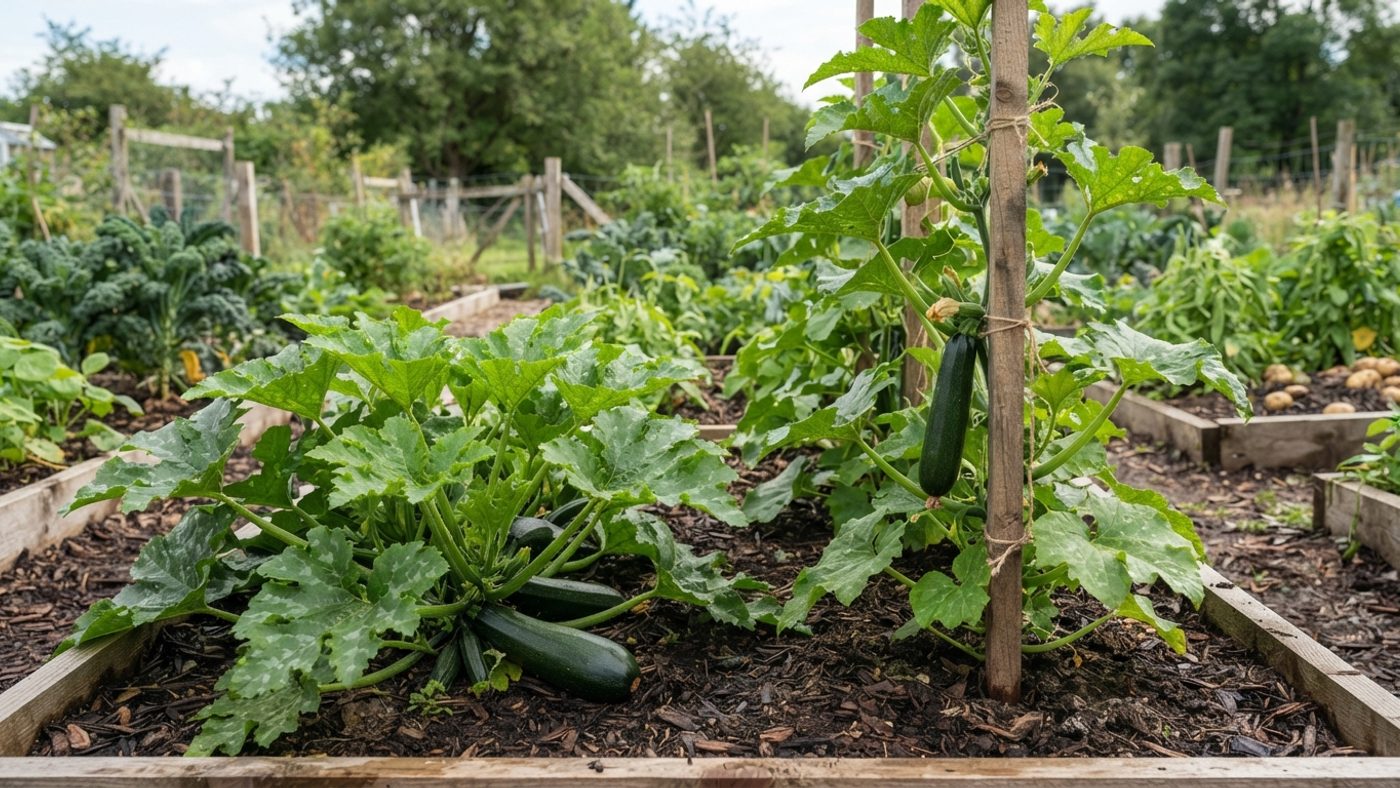
None of the five AGM bush varieties above are true climbers, Astia's trailing side-growth still stays low. For anyone short on ground space, Tromboncino and Black Forest are climbing courgette types that can be trained up a stake. Neither has a Scotland-specific or disease-resistance claim to report, so treat them as a space-saving option rather than a disease-resistant one. No specific soil pH figure is published for courgettes of any variety; the general fertile, well-drained soil guidance in the full growing guide applies across all of the above.
Common questions
Which courgette variety is most disease-resistant for Scotland?
Of the AGM varieties, Defender (cucumber mosaic virus) and Tuscany (powdery mildew) are the only two with a stated resistance claim.
Can courgettes get powdery mildew in Scotland's cooler, wetter climate?
Yes, powdery mildew is favoured by humid, still air around crowded foliage, a condition that occurs even in cooler summers. See the powdery mildew page and the full growing guide for spacing and airflow advice.
Is Astia good for growing courgettes in pots in Scotland?
Astia is bred specifically for large containers and produces heavy crops of straight, uniform fruit, with partial resistance to powdery mildew.
Does AGM mean a courgette variety is resistant to disease?
Not necessarily. Two of the five AGM courgette varieties, El Greco and Lorea, carry no disease-resistance claim at all.
What's the best courgette variety for a short Scottish growing season?
Parador is the earliest-maturing named type, though it doesn't carry AGM. Among the AGM varieties, Defender and El Greco crop over the standard season rather than the later Lorea/Tuscany window.
Sources
7 sources, recorded with what each was used for
- Cucurbita pepo 'Defender': Habit, height/spread, cucumber mosaic virus resistance claim
- Cucurbita pepo 'El Greco': Habit, height/spread, absence of resistance claim
- Cucurbita pepo 'Lorea': Habit, height/spread, harvest window, susceptibility notes
- Cucurbita pepo 'Tuscany': Habit, height/spread, powdery mildew resistance, cooler-climate description
- Cucurbita pepo 'Astia': Habit, height/spread, partial powdery mildew resistance
- Grow Your Own – Courgettes: Confirms the six recommended varieties and Parador's non-AGM status
- How to Grow Courgettes: Defender disease-resistance corroboration; Tromboncino and Black Forest as climbing types