
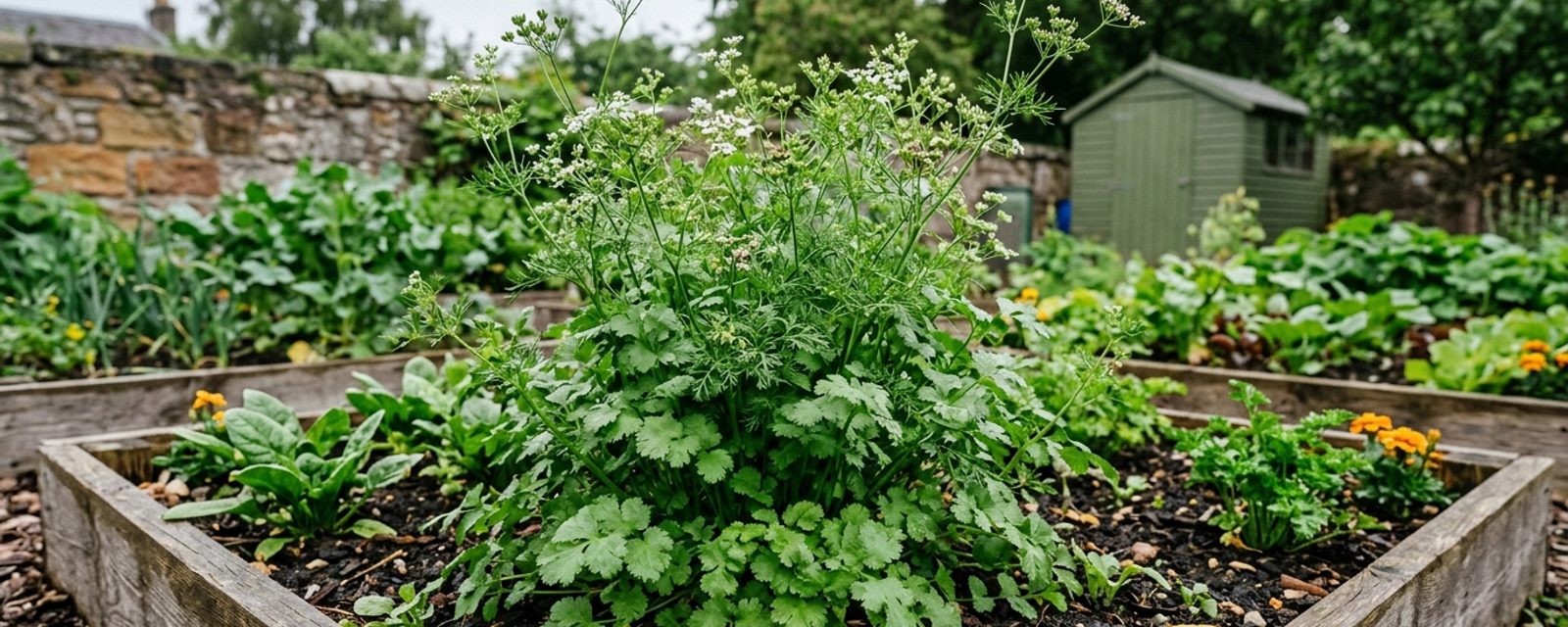
Most annual herbs bolt for one straightforward reason: heat, usually paired with dry soil, tells the plant its growing season is ending and it should rush to flower and set seed before it dies. That's a mechanism a Scottish garden can work around, because a cool, changeable summer rarely delivers sustained heat. Coriander doesn't play by that rule. Its boltingA plant switching early into flowering and seed production, usually triggered by stress, after which leaves, roots or bulbs turn bitter or unusable. Full page → is triggered by cold spells and shifts in day length as well as by heat and dry soil, the same kind of stress signal a plant reads either way, whether that stress is a heatwave or a cold snap, telling it the growing window is narrowing and it should flower and set seed while it still can. That means a chilly snap in June or the lengthening days of early summer can push a plant to flower just as readily as a heatwave would. The variety you choose has to do work that Scotland's climate won't do for it.
Quick answer
Calypso is the strongest all-round choice for a Scottish leaf harvest, holding the RHS Award of Garden Merit for slow bolting combined with the longest summer cropping period among the four AGMThe RHS's Award of Garden Merit: a UK-wide trials award for reliable performance, not a Scotland-specific recommendation. Full definition → varieties. Cruiser is the better call in a smaller bed or container, where its compact habit matters more than a few extra weeks of cropping. If the goal is seed rather than leaf, variety choice matters less than spacing and sowing timing, any of the four works, since seed production is treated as a technique difference, not a cultivarA plant variety that arose or was bred under cultivation and is kept true by deliberate propagation, rather than a naturally occurring wild species. Full definition → one.
Timing plays into all of this too: sowing indoors from February and outdoors from spring through autumn, in small successional batches (see the full growing guide and the Planting Calendar tool for the exact windows), is what gives any of these varieties the best chance against bolting, whichever cause is behind it on a given week. Slugs and snails are a risk to young seedlings of any variety at this stage, worth checking for regardless of which one is sown.
Leaf or seed: two different jobs, one variety list
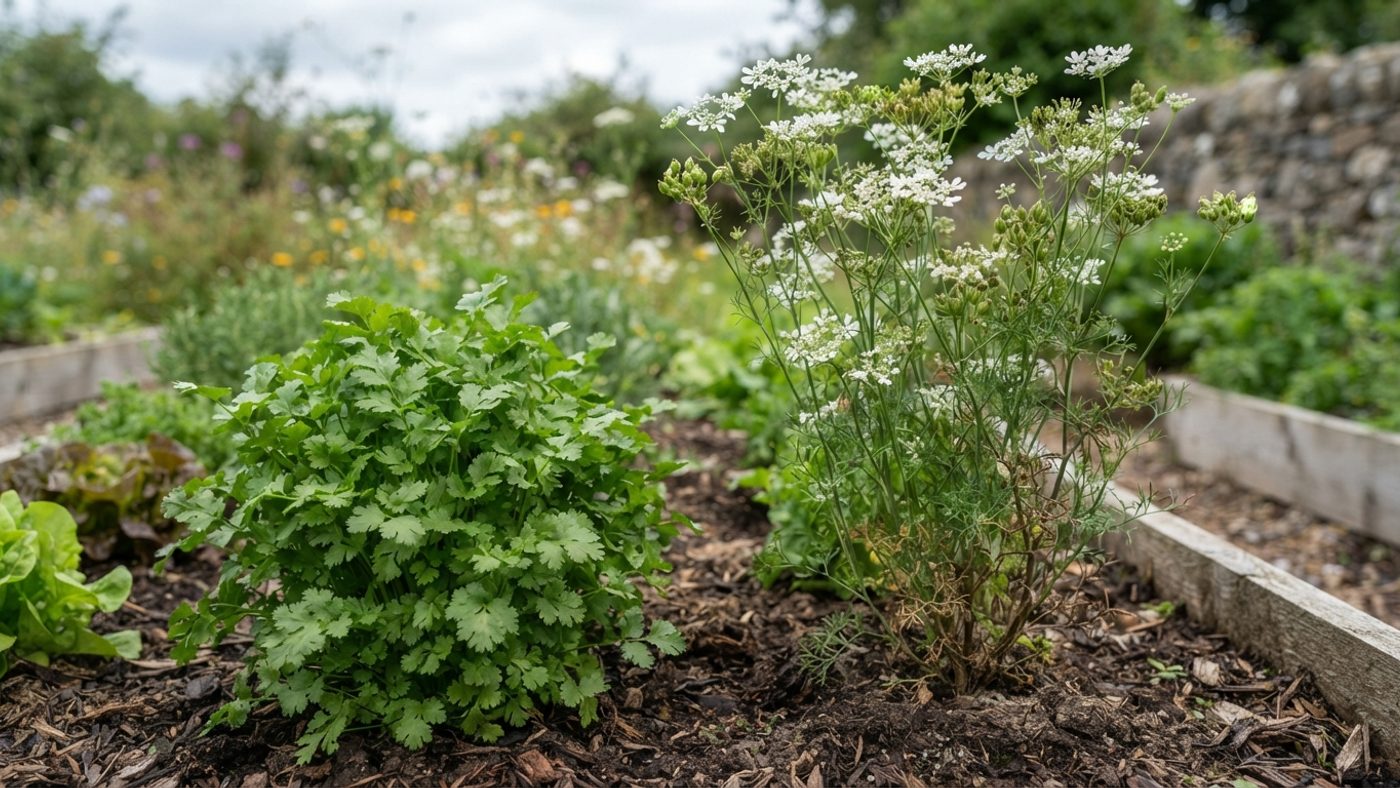
Coriander sold as a single named cultivar gets used for two genuinely different goals, and the plant behaviour that counts as success is opposite in each case. For leaf production, bolting is the failure mode: a plant that runs to flower stops producing the tender young leaves that are the point of growing it. For seed production, flowering isn't a failure at all, it's the entire goal, since the aromatic seeds only form once the plant has bolted and set flower.
The growing instructions reflect this split directly, not as a variety choice but as a technique one. For leaf harvests, flower stems get removed as soon as they appear, and seed is sown in small successional batches roughly 5-10cm apart so there's always a fresh young batch coming on. For seed harvests, the advice reverses: sow once in full sun in spring or early summer so there's enough season left for the seed to ripen, thin to a wider 20cm, and let the plant flower and set seed on its own timeline rather than cutting it back.
That matters for variety choice because none of the four AGM coriander varieties is bred specifically for seed. All four are leaf-production picks first, the "slow to bolt" and "long cropping" language attached to them describes leaf-harvest performance. If the goal is a seed or spice crop, the practical choice is simpler than the leaf decision: pick whichever variety is easiest to source, give it the wider spacing and full-sun spot recommended, and let it do the thing the leaf-growing advice spends its effort trying to prevent.
The four AGM varieties compared
| Variety | AGM | Habit and leaf | Bolt behaviour | Hardiness ratingThe RHS's H1a–H7 scale for how much cold a plant can survive outdoors, H1a being tender indoor-only and H7 hardy anywhere in the UK. Full definition → |
|---|---|---|---|---|
| Calypso | Yes | Standard leaf type | Slow to bolt; longest summer cropping period of the four | Not stated |
| Cruiser | Yes | Compact; large, tasty leaves | Slow to bolt | Not stated |
| Confetti | Yes | Bushy; finely dividedPropagating a clump-forming perennial by digging it up and splitting it into several smaller pieces, each with roots and shoots attached. Full definition →, carrot-like foliage, milder and slightly sweet | Not explicitly rated for bolt speed | H5 (survives most UK winters) |
| Filtro | Yes | Columnar upright; bright green, vigorous | Not bred for slow bolting; flower stems need removing to keep leaf growth going | H2 (tolerant of low temperatures, not hard frost) |
Calypso: the best overall pick
The cropping-period claim is what separates Calypso from Cruiser: both are rated slow to bolt, but Calypso is the one carrying the longer summer cropping period on top of that. Given that coriander in Scotland loses the "cooler climate helps" advantage that protects other herbs from bolting, the variety bred hardest against that specific weak point is the sensible default, a direct answer to bolting, coriander's single biggest problem.
Cruiser: the compact alternative
Where Calypso earns its place through cropping duration, Cruiser earns its place through size: in a container or a small raised bed where Calypso's longer season isn't as useful as a plant that doesn't sprawl, Cruiser is the better fit.
Confetti: the mild, feathery option
Confetti's feathery, carrot-like foliage isn't just a different look from Calypso and Cruiser's broader leaves, the flavour is also described as milder with a slight sweetness, a genuine point of difference if the standard sharp coriander taste is the reason a household avoids the herb (Calypso and Cruiser aren't distinguished by flavour the same way). Confetti's H5 hardiness rating is the strongest of the four, useful for an exposed site or an unheated clocheA small, portable clear cover placed over an individual plant or short row to trap warmth and keep off wind, rain and pests. Full definition → where the plant needs to shrug off cold generally, though it describes cold tolerance rather than bolt speed specifically, bolt resistance isn't rated for Confetti the way it is for Calypso and Cruiser.
Filtro: vigorous, but needs active management
Filtro isn't positioned as bred against bolting the way Calypso and Cruiser are, its own plant page instead recommends removing flower stems before they develop, to keep leaf growth going rather than relying on the variety to resist bolting on its own. It also carries the lowest hardiness rating of the four (H2: tolerant of low temperatures, but not hard frost, weaker than Confetti's H5), worth weighing for anyone relying on an unheated cloche or an early-season sowing. Filtro suits a grower who wants volume and doesn't mind the extra step of pinching outRemoving the soft growing tip of a stem to stop upward growth and make the plant branch out sideways instead. Full definition → flower stems.
Leafy Leisure: a fifth option worth knowing
Outside the four AGM varieties, Gardener's World names Leafy Leisure as "a vigorous cultivar producing masses of leaves and slow to bolt" in its own coriander growing coverage. It isn't AGM-rated, but the stated profile, vigorous, high-leaf-volume, slow to bolt, sits close to Cruiser's, and it's a reasonable substitute where Cruiser specifically isn't available.
Which variety for your situation
| Situation | Best pick | Why |
|---|---|---|
| Open ground, want the longest leaf harvest | Calypso | Longest summer cropping period among the AGM varieties, slow to bolt |
| Container or small raised bed | Cruiser | Compact habit, large leaves, slow to bolt |
| Want a milder flavour | Confetti | Explicitly described as milder and slightly sweet |
| Want high leaf volume, don't mind pinching out flowers | Filtro | Vigorous, plentiful leaf, needs active flower-stem removal |
| Growing specifically for seed/spice | Any of the four | Seed production is a spacing and timing difference, not a variety choice |
| Polytunnel or season-extended growing | Calypso or Cruiser | The two varieties actually bred against bolting matter most where the aim is to stretch the cropping window rather than just get one flush of leaves |
Buying and storing coriander seed
Coriander is "also sometimes known as cilantro" for the same species, it isn't evidence of a different cultivar bred for a different market, just an alternative name for the plant, most commonly used in North America. Anyone buying seed under either name from a UK supplier is buying the same species; the variety name on the packet (Calypso, Cruiser, Confetti, Filtro or otherwise) is what actually distinguishes the plant's behaviour, not whether the packet says coriander or cilantro.
All four AGM varieties are widely stocked by UK seed suppliers under their own names, so sourcing isn't the deciding factor between them the way it can be for a more specialist cultivar, the choice comes down to which trait (cropping period, compact habit, flavour, leaf volume) actually matters for the space and use in question, as covered above. No figure is published for how many years coriander seed stays viable in storage. As a general rule of thumb for any seed packet, sowing the freshest stock available and checking germinationA seed sprouting: breaking dormancy and putting out its first root and shoot, given the right warmth and moisture. Full definition → with a small test batch before committing a full bed is the safer approach than assuming an old packet will perform as well as a fresh one.
A true alternative worth knowing about, rather than a coriander variety at all, is Vietnamese coriander (Persicaria odorata), a different plant entirely that doesn't bolt the way true coriander does and is sometimes grown as a flavour-adjacent substitute by gardeners who've given up on Coriandrum sativum specifically.
Common questions
Which variety should I choose if I'm growing coriander for seed rather than leaves?
Variety matters less here than technique. None of the four AGM varieties is bred specifically for seed production, the bolt-resistance and cropping-period traits attached to Calypso and Cruiser describe leaf-harvest performance. For a seed crop, sow in full sun in spring or early summer, thin to a wider 20cm spacing, and let the plant flower rather than pinching it back.
Is cilantro a different variety of coriander?
No. It's an alternative name for the same plant, not a different cultivar or a different plant part. A seed packet labelled cilantro and one labelled coriander are the same species; what actually determines the plant's behaviour is the variety name on the packet, such as Calypso or Confetti.
Are Confetti or Filtro worth choosing over Calypso and Cruiser?
Yes, for different reasons. Confetti suits anyone who wants a milder, slightly sweet flavour and a hardier plant, though it isn't rated for bolt speed the way Calypso and Cruiser are. Filtro suits anyone who wants high leaf volume and doesn't mind actively removing flower stems, since it isn't bred to resist bolting on its own the way Calypso and Cruiser are.
Does growing in a container change which variety I should pick?
Yes. Cruiser's compact habit and large leaves make it the better fit for a container or small raised bed, where Calypso's longer cropping period matters less than not sprawling. Slugs and snails are a particular risk to young seedlings regardless of variety, worth checking for on any container-grown batch.
Sources
7 sources, recorded with what each was used for
- Coriander: grow-your-own: Bolting triggers, spacing for leaf vs seed growing, sowing/thinning advice for seed production, the four AGM variety names and one-line descriptions
- Coriander (species overview): Confirms "cilantro" as an alternative name for the same plant
- Coriandrum sativum 'Cruiser' AGM: Cruiser's compact habit and leaf description
- Coriandrum sativum 'Confetti' AGM: Confetti's habit, foliage, hardiness rating (H5), culinary use
- Coriandrum sativum 'Calypso' AGM: Calypso's bolt-resistance and cropping-period claim
- Coriandrum sativum 'Filtro' AGM: Filtro's habit, foliage, hardiness rating (H2), flower-stem management advice
- How to grow coriander: Independent variety mention of Leafy Leisure, confirms seed harvesting as a secondary use of flowering plants