
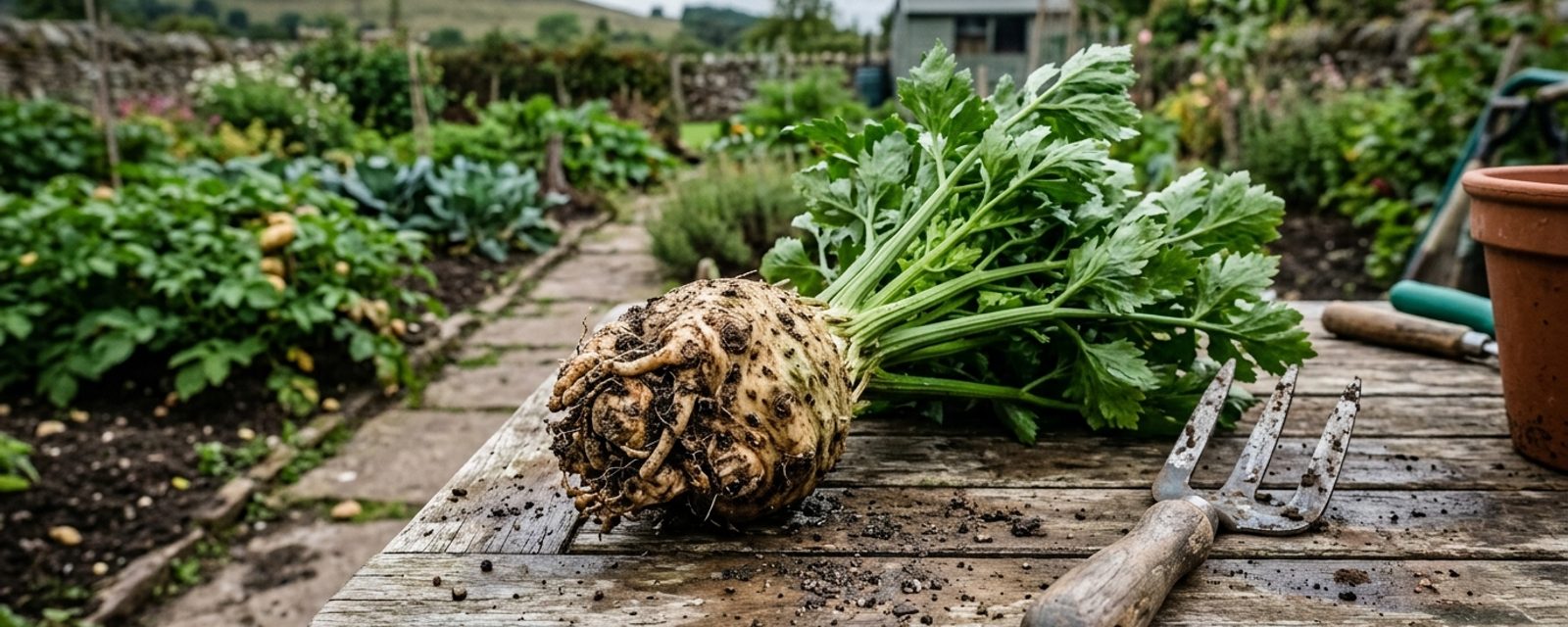
Apium graveolens var. rapaceum
Celeriac is one of the most patience-testing crops you can grow in Scotland — a slow, knobbly root that needs its whole season handled with more care up front than almost anything else in the vegetable bed.
Celeriac's real limiting factor here isn't cold or wet, the usual Scottish caution — it's time. The root needs six to eight months to bulk up to a useful size, which means the growing season has to start early and under heat, not drift the way a faster crop can afford to. Get that start right and the rest of the crop is forgiving: it tolerates a poor summer and heavier soil better than most vegetables, and it will sit in the ground through winter waiting to be lifted.
Sowing and raising plants
Sow indoors under heat from February to March — celeriac is not direct-sown outdoors. Cover the seed with only a light sprinkling of compost rather than burying it properly. Move seedlings to individual pots once they're large enough to handle, and sow as early as the window allows: the longer the season you can give it, the larger the root you'll get.
Planting out: don't bury the crown
Prepare the site before you plant: choose a sunny or lightly shaded spot and work in plenty of garden compost or other well-rotted organic matter, since this is a crop that spends most of a year in the same patch of ground and needs it to hold moisture for all of it.
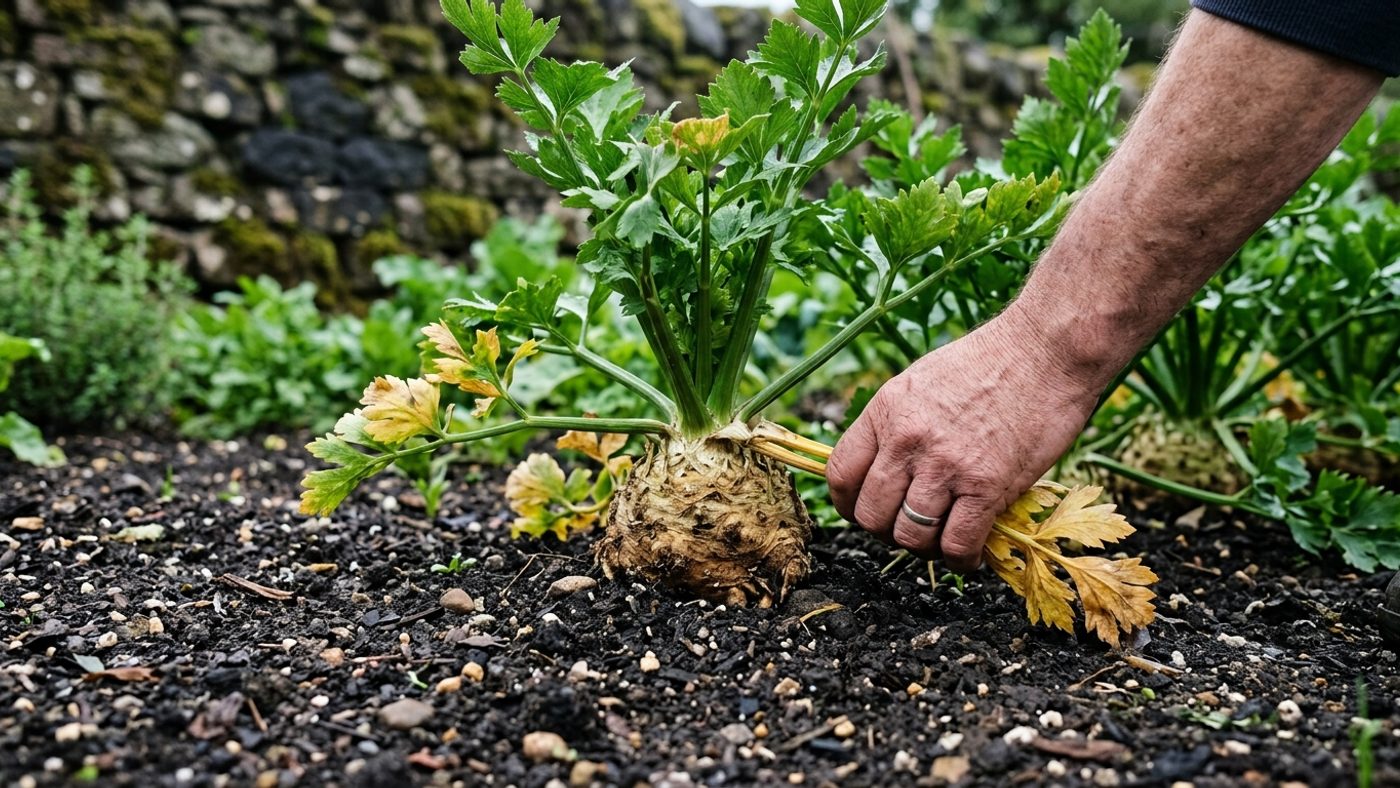
Plant out in late May or early June, once frost risk has passed and after hardening offGradually getting young plants raised indoors used to outdoor conditions over 7–14 days before planting out, so cold, wind and direct sun don't shock or damage them. Full definition →, spacing plants 25-30cm apart in rows 40-45cm apart. The crownThe base of a perennial plant where roots and shoots meet, often sold and planted as a ready-made dormant plant rather than grown from seed. Full definition →, the swollen stem base that will become the root, needs to sit at soil level. This is the opposite of trench celery: don't earth upDrawing soil up around a plant's base as it grows, most often potatoes, to keep light off developing tubers and support tall stems. Full definition → or blanch it. As the plant matures, clear away old outer leaves to expose the crown further and help it swell, rather than mounding soil over it.
Varieties
RHS also lists 'Ibis' (fast-growing, good disease tolerance, stores well) and 'Monarch' (subtle nutty flavour, stores well) with AGMThe RHS's Award of Garden Merit: a UK-wide trials award for reliable performance, not a Scotland-specific recommendation. Full definition →, plus two non-AGM heirloom and storage types, 'Brilliant' and 'Giant Prague'. The award is UK-wide, not a Scottish one.
★ Our pick for Scotland
AsterixAGM
Early-maturing, disease and boltingA plant switching early into flowering and seed production, usually triggered by stress, after which leaves, roots or bulbs turn bitter or unusable. Full page → resistant
Reaches cropping size earlier than other varieties.
Why this one: Asterix's earliness is the single most useful trait against this crop's real weakness in Scotland: a growing season that's often too short for celeriac to bulk up properly. Reaching cropping size sooner buys back some of the time a longer, colder run-up to summer takes away.
Also worth considering
PrinzAGM
Large, disease and bolting resistant
The bigger-rooted option where the season does run long enough, at the cost of Asterix’s earliness.
Best Celeriac Varieties for Scotland → compares all named celeriac varieties head-to-head, with the practical detail that doesn't fit in a summary card.
Watering and soil
Keep the soil consistently damp for the whole season. This matters more here than the usual watering advice: a dry spell doesn't just slow celeriac down, it produces roots that turn woody or hollow, and nothing above ground gives you any warning before it's happened. Rich, moisture-retentive soil with plenty of organic matter worked in helps, and a mulchA layer of material spread over the soil around plants to suppress weeds, retain moisture, and improve soil structure as it breaks down. Full definition → keeps that moisture from disappearing on a dry, sunny stretch. Scotland's typically wetter, heavier ground is a genuine partial advantage here — but it won't cover for a proper dry spell in summer.
Harvesting
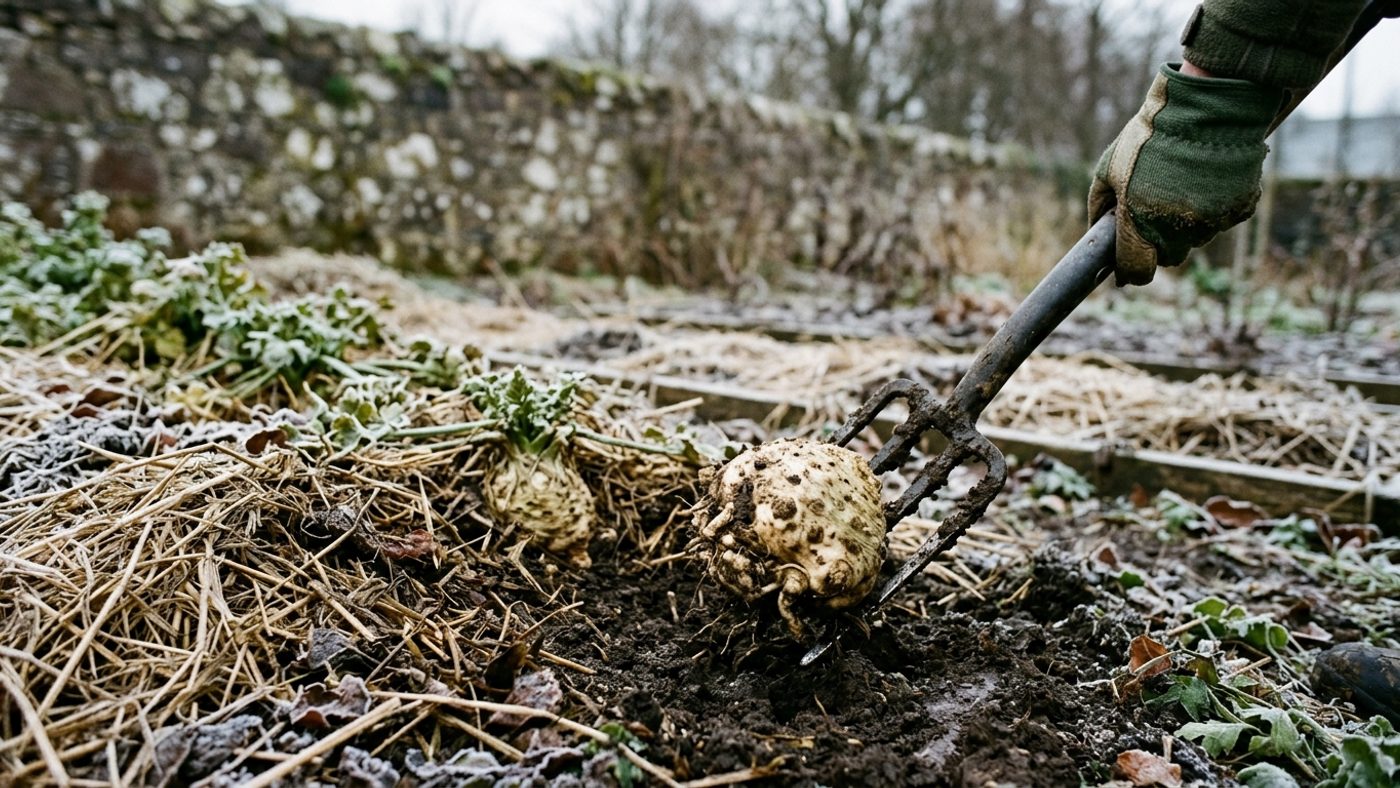
Lift roots from October through to March as you need them. Celeriac is hardy enough to stay in the ground all winter, and flavour improves the longer it's left, so there's no rush to lift the whole crop at once. A thick mulch before the hardest frosts protects the roots and keeps them liftable right through to spring.
Storing
The simplest option is to leave roots where they are and lift them as needed: celeriac stores perfectly well in the ground under a mulch, and that's the lower-effort choice if you have the bed space to spare over winter. If you need the ground back, lift the whole crop and store the roots somewhere cool in boxes of peat-freeCompost made without peat, which is harvested from a slow-forming, carbon-storing wetland habitat that peat extraction damages. Full definition → potting compost instead. Either way works; the choice is about what your plot needs, not the root itself.
Common problems
- Running out of season is this crop's biggest real risk in Scotland. Sow as early as the window allows, under heat, and choose an early-maturing variety such as Asterix if the sowing does slip.
- Slugs and snails are a particular risk to young seedlings. Raise plants in pots rather than direct-sowing, and keep an eye on them until they're well established.
- Bolting can be triggered by a cold snap while plants are young, especially if they're planted out or exposed to cold before they're properly hardened off. Don't rush plants outdoors ahead of the recommended late May/early June window.
See more problems
- Celery leaf miner tunnels into leaves and causes pale blisters. Remove and burn affected leaves as soon as you spot them, or grow under fine insect-proof netting from the start.
- Woody or hollow roots are the result of a dry spell, not a soil or variety problem. Consistent watering is the fix, not a different growing method.
Common questions
Why does celeriac need to be sown so much earlier than other vegetables?
Because celeriac takes six to eight months from sowing to a usable root, one of the longest runs of any vegetable here, so it has to be started indoors under heat in February or March to get enough season to bulk up before autumn. Full sourced breakdown: <a href='/tools/garden-myths/celeriac/'>Celeriac Myths →</a>
Should I earth up celeriac like celery?
No: the opposite. Celeriac's crown needs to sit at or above soil level throughout, and the right technique is clearing old outer leaves away from it as the plant matures, not mounding soil up the way you would for trench celery. Full sourced breakdown: <a href='/tools/garden-myths/celeriac/'>Celeriac Myths →</a>
Is it true celeriac roots go bad if left in the ground over winter?
No. Celeriac is hardy enough to stay in the ground and be lifted as needed right through to March, with the flavour improving the longer it stays: a thick mulch before the hardest frosts is the only extra protection it needs. Full sourced breakdown: <a href='/tools/garden-myths/celeriac/'>Celeriac Myths →</a>
How much watering does celeriac actually need?
More than most vegetables tolerate skipping: a dry spell produces roots that turn woody or hollow with nothing visibly wrong above ground until the root itself is ruined, so keep the soil consistently damp all season and mulch to help it stay that way. Full sourced breakdown: <a href='/tools/garden-myths/celeriac/'>Celeriac Myths →</a>
Sources
2 sources, and what each was used for
- RHS: sowing months and method, heated-propagator requirement, transplant timing and trigger, spacing, harvest window, six named varieties with exact AGM status, pest and disease list, soil and moisture requirements
- gardenersworld.com: corroborates transplant timing (late May/early June), spacing (25-30cm), harvest window (Oct-March) and consistent-moisture requirement independently of RHS; adds that celeriac tolerates poor summers and heavier soils better than many crops, and that the crown must not be buried when planting out