
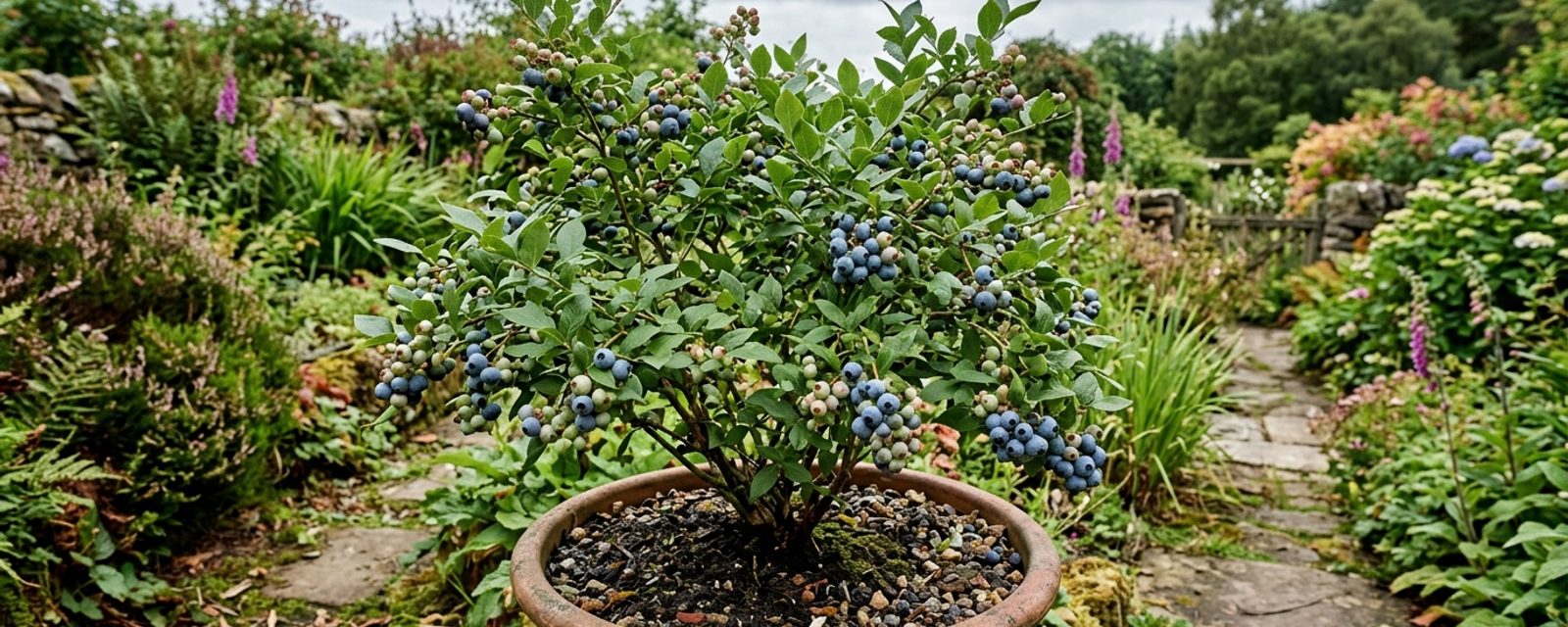
Vaccinium corymbosum
Blueberries need genuinely acid soil, not just tolerance of a wide range, and a container of the right compost genuinely beats fighting ordinary garden soil to get there.
This is the strictest soil requirement of any fruit you're likely to grow, but it comes with its own built-in solution. A large pot of ericaceous compost is an equally valid route to a real crop, not a fallback for a garden that doesn't already have the right ground.
Soil and site
Acid soil is essential, ideally pH 4.5-5.5, more acidic than almost any other crop you'll grow. Test garden soil before assuming it works. Where it doesn't, grow blueberries in a large pot of peat-freeCompost made without peat, which is harvested from a slow-forming, carbon-storing wetland habitat that peat extraction damages. Full definition → ericaceous compost instead: at least 30cm wide for a young plant, 45-50cm for a larger one. In the ground, space plants 1-2m apart depending on the variety's ultimate size.
Care
Use rainwater from a butt rather than tap water wherever possible: tap water is usually alkaline, especially in hard water areas, and will gradually raise the compost's pH if used regularly, working against the acid soil the whole plant depends on. Save tap water for genuine drought emergencies only. For the chemistry behind this, and whether it's worth the effort on your own water supply, see tap water vs rainwater.
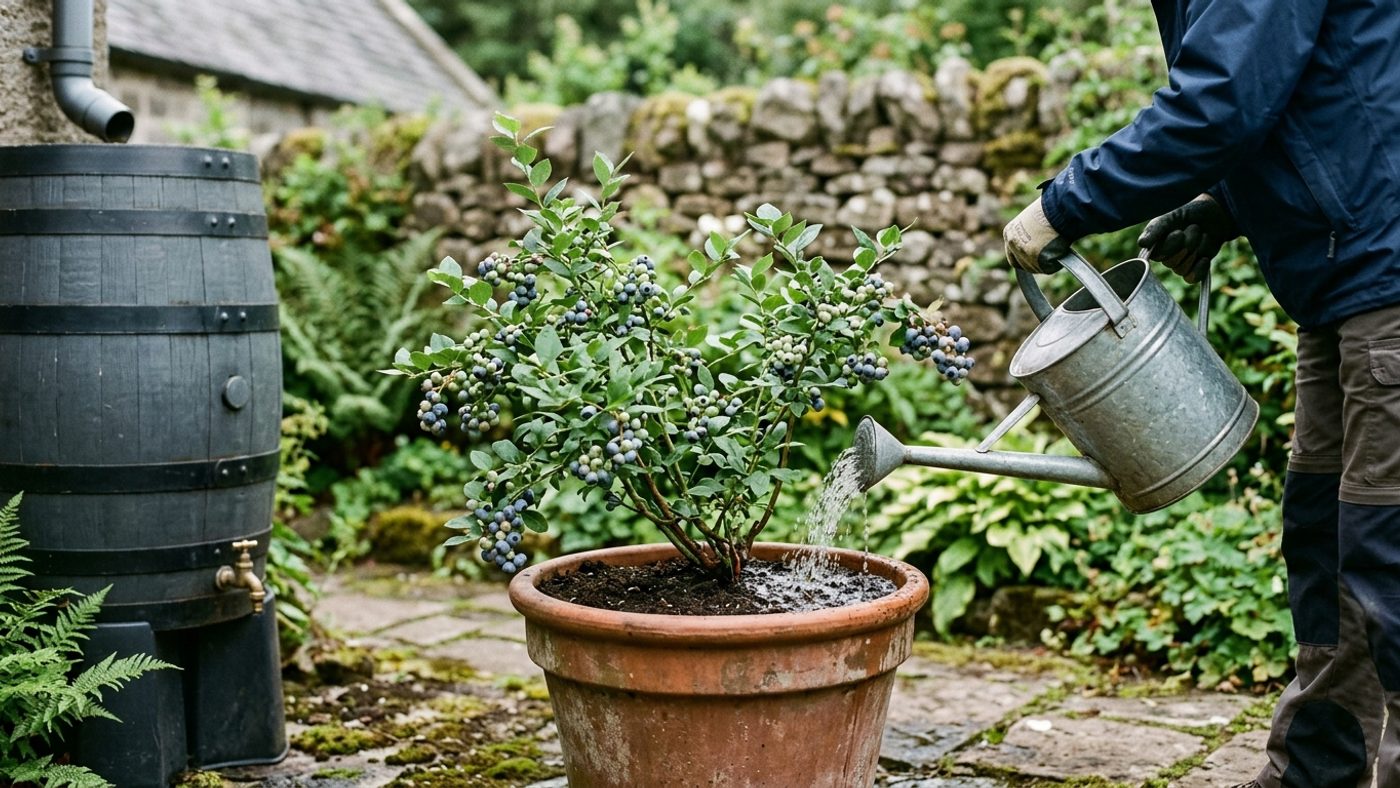
Feed ground-grown plants with an ericaceous granular fertiliser in early spring; container plants need a liquid ericaceous feed every two or three weeks from April to August. MulchA layer of material spread over the soil around plants to suppress weeds, retain moisture, and improve soil structure as it breaks down. Full definition → each spring with 5-7.5cm of low-pH organic matter: composted pine bark, composted bracken, composted pine needles or leafmould, not the general-purpose compost most other fruit is happy with.
Pruning
Prune any time from November to March, ideally in late February or early March. Aim to keep a mature bush at roughly one-third old stems, one-third middle-aged and one-third young, removing up to a quarter of the oldest, thickest stems each time to keep the plant productive. Older wood carries less fruit each year, so this rotationMoving each crop family to different ground each year, on a multi-year cycle, so pests and diseases that build up in soil don't get a repeat host. Full definition → is what keeps a bush cropping well rather than gradually declining. Take out any dead, damaged or crossing branches at the same time.
Pollination
Most blueberries are partially self-fertileA plant that can set fruit using its own pollen, without needing a second, different variety nearby to cross-pollinate it. Full definition →, so one plant produces a crop on its own. A second, different variety nearby increases the harvest, and Duke and Spartan's RHS plant pages go further, each recommending three different cultivarsA plant variety that arose or was bred under cultivation and is kept true by deliberate propagation, rather than a naturally occurring wild species. Full definition → together for the best possible yield, a refinement for maximising the crop, not a requirement to get any fruit at all. Small creamy-white flowers appear in late spring and early summer, ahead of the fruit that follows through mid-summer.
Varieties
RHS names 6 recommended blueberry varieties in total; Duke and Spartan, the two checked in depth, both carry AGMThe RHS's Award of Garden Merit: a UK-wide trials award for reliable performance, not a Scotland-specific recommendation. Full definition →. Ozarkblue, RHS's third named variety, is a late-season type with large berries, no AGM, and its own page names it 'suitable for areas with hotter summers' — a reason to steer past it in Scotland specifically. Bluetta, Sunshine Blue and Pink Lemonade are three further named varieties, none carrying an AGM.
★ Our pick for Scotland
DukeAGM
Early-mid season · H6The RHS's H1a–H7 scale for how much cold a plant can survive outdoors, H1a being tender indoor-only and H7 hardy anywhere in the UK. Full definition → · flowers late, crops early
Flowers late but crops early: RHS's own words state this makes it suited to colder or northern areas, independently confirmed by Gardener's World describing it as good for a shorter summer season.
Why this one: RHS's variety listing states directly: 'flowers late but crops early, so suitable for colder/northern areas'. Gardener's World, in its own separate words, calls it 'good for areas with a shorter summer season': two sources landing on the same variety for the same underlying reason.
Also worth considering
SpartanAGM
Early-mid season · large, sweet berries
Named by RHS for large, sweet, early-to-mid-season fruit, independently corroborated by Gardener's World as an early cropper with large, sweet berries, a reliable second early option alongside Duke.
Best Blueberry Varieties for Scotland → compares all named blueberry varieties head-to-head, with the practical detail that doesn't fit in a summary card.
Harvesting
Berries ripen from mid-summer onwards, changing from green to dusky blue when ready. They don't all ripen together, so check back every few days and pick only the deepest blue fruit, leaving greener berries to keep ripening rather than stripping the bush in one go.
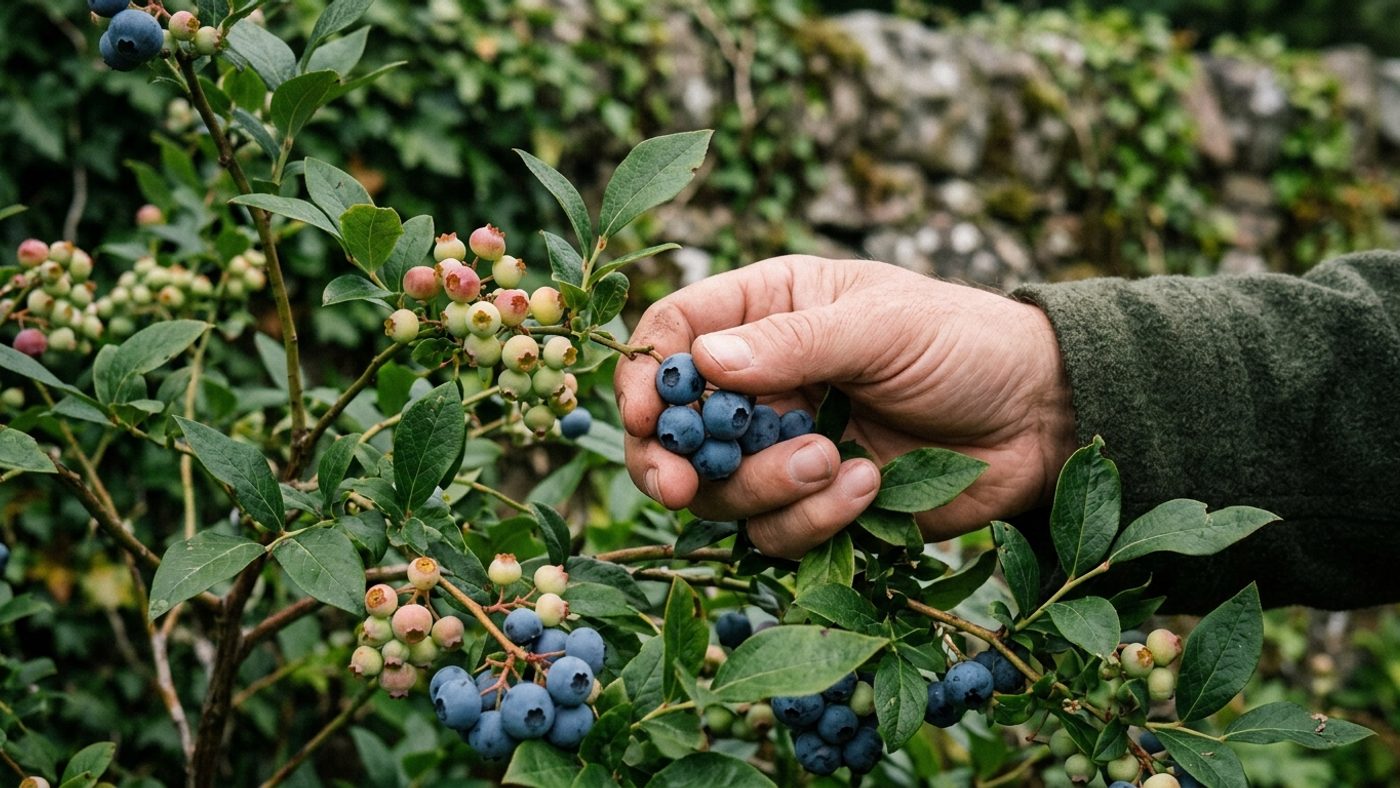
A fully productive plant, around seven years old, yields 2.25-5kg. No dedicated storage guidance is published for this crop, so treat a picked batch the way you would any soft fruit: eat fresh, freeze what you won't use within a few days, or cook it down for jam.
Common problems
Blueberries are generally healthy and trouble-free given the right soil and consistent watering, a genuinely easier baseline than most soft fruit.
- Nutrient deficiencies, especially iron and manganese, show as yellowing leaves and are usually a sign the soil or compost isn't acidic enough rather than a feeding problem to fix with more fertiliser.
- Vine weevil grubs damage roots and are a particular risk for container-grown plants.
- Aphids distort new growth and shoots.
See more problems
- Powdery mildew can appear in conditions that are too dry or too wet.
- Phytophthora root rot follows waterlogged or poorly drained soil; good drainage is the real prevention.
- Spotted wing drosophila lays eggs directly in ripening fruit; pick promptly as berries ripen to reduce the risk.
- Xylella fastidiosa is a serious bacterial disease not currently found in the UK, spread by sap-feeding insects; blueberries are a named host. There's no cure or chemical treatment, so a suspected case should be reported to the relevant plant health authority rather than treated at home.
Common questions
My garden soil isn't acidic. Does that rule out blueberries?
No: grow them in a large pot of peat-free ericaceous compost instead of trying to acidify open ground. Full sourced breakdown: <a href="/tools/garden-myths/blueberries/">Blueberries Myths →</a>
Does it matter what water I use on blueberries?
Yes: use rainwater rather than tap water, which is usually alkaline and will gradually raise the compost's pH and undo the acid soil the plant depends on. Full sourced breakdown: <a href="/tools/garden-myths/blueberries/">Blueberries Myths →</a>
Do I need two blueberry bushes to get fruit?
No: most varieties are partially self-fertile and crop from a single plant; a second variety only increases the harvest. Full sourced breakdown: <a href="/tools/garden-myths/blueberries/">Blueberries Myths →</a>
Should I pick a whole bush of blueberries at once?
No: berries ripen gradually rather than together, so check back every few days and pick only the deepest blue, fully ripe fruit each time. Full sourced breakdown: <a href="/tools/garden-myths/blueberries/">Blueberries Myths →</a>
Sources
4 sources, and what each was used for
- RHS: getting started, acid soil requirement (pH 4.5-5.5) and the container alternative, partial self-fertility with cross-pollinationPollen moving from one plant to a different, compatible variety, needed for fruit to set on any variety that isn't self-fertile. Full definition → improving yield, 3 of 6 named varieties, planting depth and container sizing, spacing, watering (rainwater over tap water and why), feeding, mulching with low-pH organic matter, pruning method (one-third old/middle/young stems, remove up to a quarter of the oldest), harvesting method and yield, and named problems
- RHS: H6 hardiness, AGM, the 'plant three different cultivars' pollination note (a variety-specific nuance beyond the general page's one-plant framing), disease susceptibility, size and maturity timeline
- RHS: size, flowering and fruiting timing, the same three-cultivar pollination note, growing requirements
- gardenersworld.com: independently corroborates acid soil pH (4-5.5), rainwater-over-tap-water reasoning, container growing method, Duke's shorter-season suitability and Spartan's early cropping in its own words, pruning timing, and vine weevil as a specific container-blueberry risk