

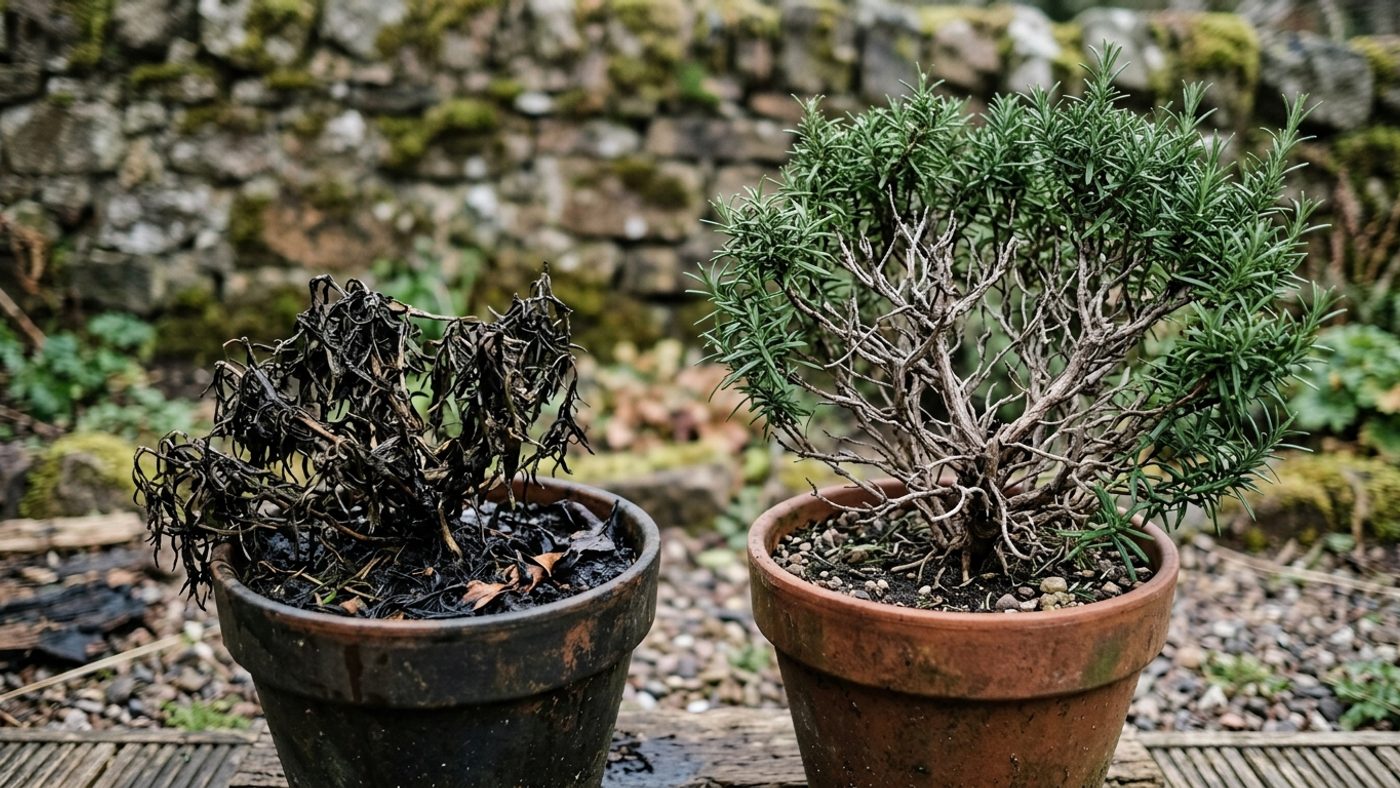
Two different rosemary plants end up in front of a gardener asking the same question. One is a collapsed, blackened mess where a healthy shrub stood in October: soft, slimy stems, no green left anywhere, dead sometime over the winter without any obvious cause. The other is very much alive but hollow in the middle: a ring of leafy green growth around the outside, bare grey-brown wood in the centre, no needles anywhere on the old stems, and it's been getting woodier every year. These are two different problems with two different answers, and neither one is really about pruning technique.
What you're actually looking at
Before writing a plant off, check rather than guess: scratch a small patch of bark on a stem with a thumbnail. Green underneath means that stem is alive; brown and dry means it's dead. Try it on a few stems, working from the tips down to thicker wood, since a plant can be part-dead and part-recoverable at once. If the base and the roots scratch dark and soft too, the plant as a whole isn't coming back.
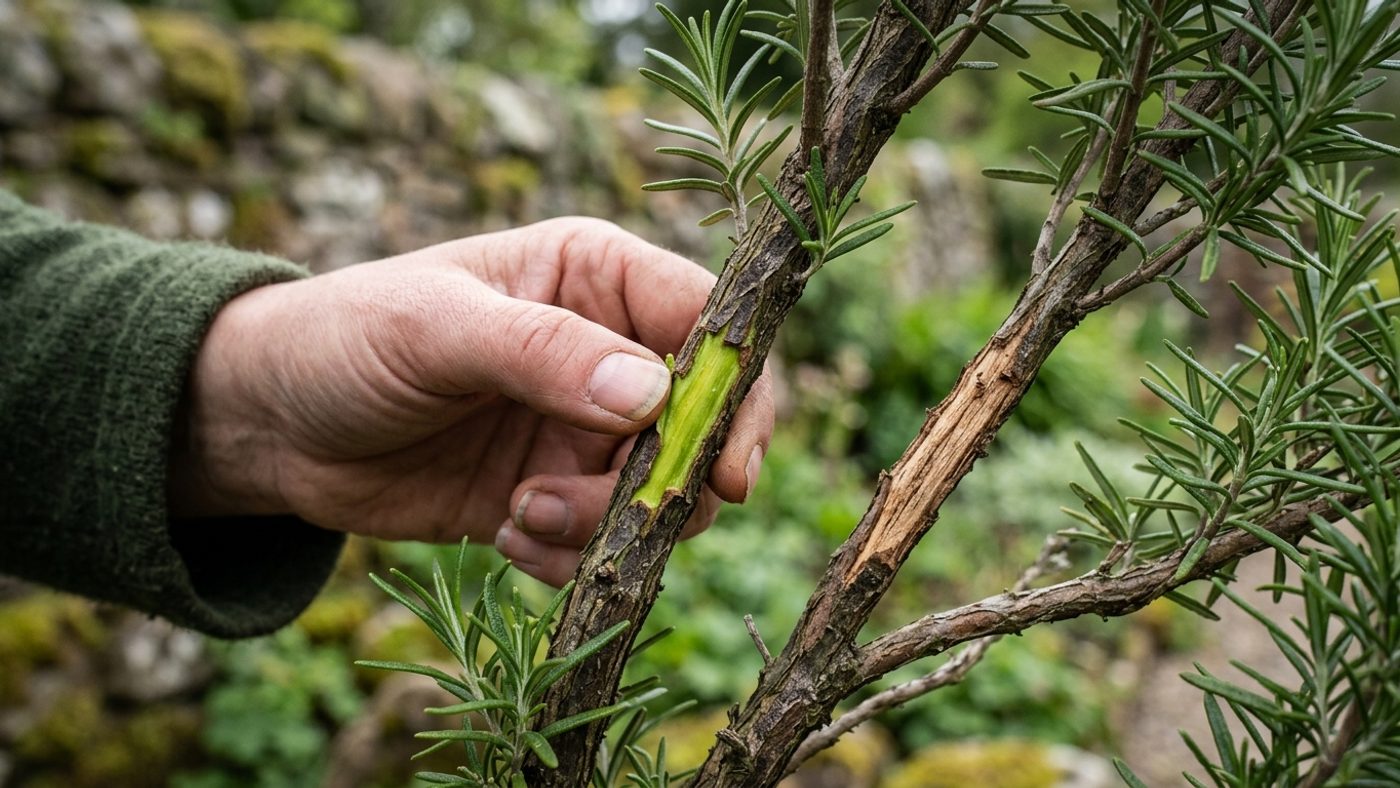
If it's fully dead, collapsed, blackened, mushy at the base, that's almost always root rot from sitting wet over winter, not frost damage. Rosemary tolerates real cold reasonably well; it does badly with wet roots, and a lot of what looks like "the cold got it" is actually "the water got it."
If it's alive but woody and bare in the middle, that's ordinary ageing in a shrub that's gone a few years without a proper annual trim, and the fix is more limited than it looks: rosemary doesn't reliably regrow from cuts into old, leafless wood. A hard prune back into that bare wood, a "renovation cut," the technique that works on many other overgrown shrubs by forcingCovering plants to exclude light and speed early, tender growth in the dark, most associated with rhubarb and sea kale in late winter. Full definition → fresh growth from old stumps, is more likely to leave dead stumps than force fresh growth on rosemary specifically. Reviving a plant in that state usually means propagating a replacement from it, not cutting the existing one hard and hoping.
Both problems trace back to the same root cause: rosemary is a Mediterranean shrub that's only marginally suited to a lot of Scottish gardens, and how it's sited and overwinteredKeeping a plant alive and intact through the cold months, whether left outdoors, moved under cover, or stored dormant. Full definition → decides its survival far more than any pruning decision does.
Rosemary's real limit in Scotland, and it isn't just cold
Rosemary is rated hardy through most of the UK, down to winter minimums of -10°C to -5°C, the RHS calls this an H4The RHS's H1a–H7 scale for how much cold a plant can survive outdoors, H1a being tender indoor-only and H7 hardy anywhere in the UK. Full definition → rating. That sounds like it should cope with a Scottish winter without much trouble, but two things in the same rating matter more than the headline number. First, H4 is specifically described as hardy "apart from inland valleys, at altitude and central/northerly locations", ruling out a meaningful share of Scotland by name, not just the obviously cold spots. Second, it separately notes that "plants in pots will be at increased risk" regardless of the rating. The RHS's own growing guide gives one further figure: well-established, ground-grown plants can survive down to about -8°C, near the harsher end of the H4 band, but a young plant, and anything still in a container, is more exposed than either number implies.
The bigger issue is water, not the thermometer. Rosemary "hates having wet roots, especially in winter," and free-drainingSoil that lets water pass through quickly rather than pooling, so roots aren't sitting in wet ground after rain. Full definition → soil is what keeps that root rot from happening in the first place. In general, Scotland's west and north run wetter than its east and south, and inland or upland ground holds more of that water than a well-drained coastal plot. A rosemary planted straight into ordinary garden soil that stays damp through a Scottish winter is fighting the plant's real weakness, cold on top of it or not.
None of that makes rosemary impossible to grow well here, plenty of Scottish gardens manage it for years, more reliably in a sheltered, well-drained spot on the drier east coast than on the wetter, more exposed west. It's still a plant that needs deliberate siting and overwintering decisions here, not just correct pruning.
Soil type itself is rarely the problem: rosemary is listed as tolerating acid, alkaline or neutral soil, which matters in a country where a lot of garden soil runs naturally on the acid side, pH isn't the thing to fix here, drainage is.
Siting: ground, raised bed, or pot
Where a rosemary goes decides how much winter risk it's carrying before a single cut is made.
| Option | Drainage control | Winter protection |
|---|---|---|
| Open ground, ordinary soil | Fixed by whatever's already there | None, fully exposed to a wet winter in place |
| Raised bed or mound | Good, if built with grit worked in | Still fixed in place, but drains faster after rain |
| Container | Full control over the growing medium | Can be moved under cover, but the pot itself is the most winter-vulnerable of the three |
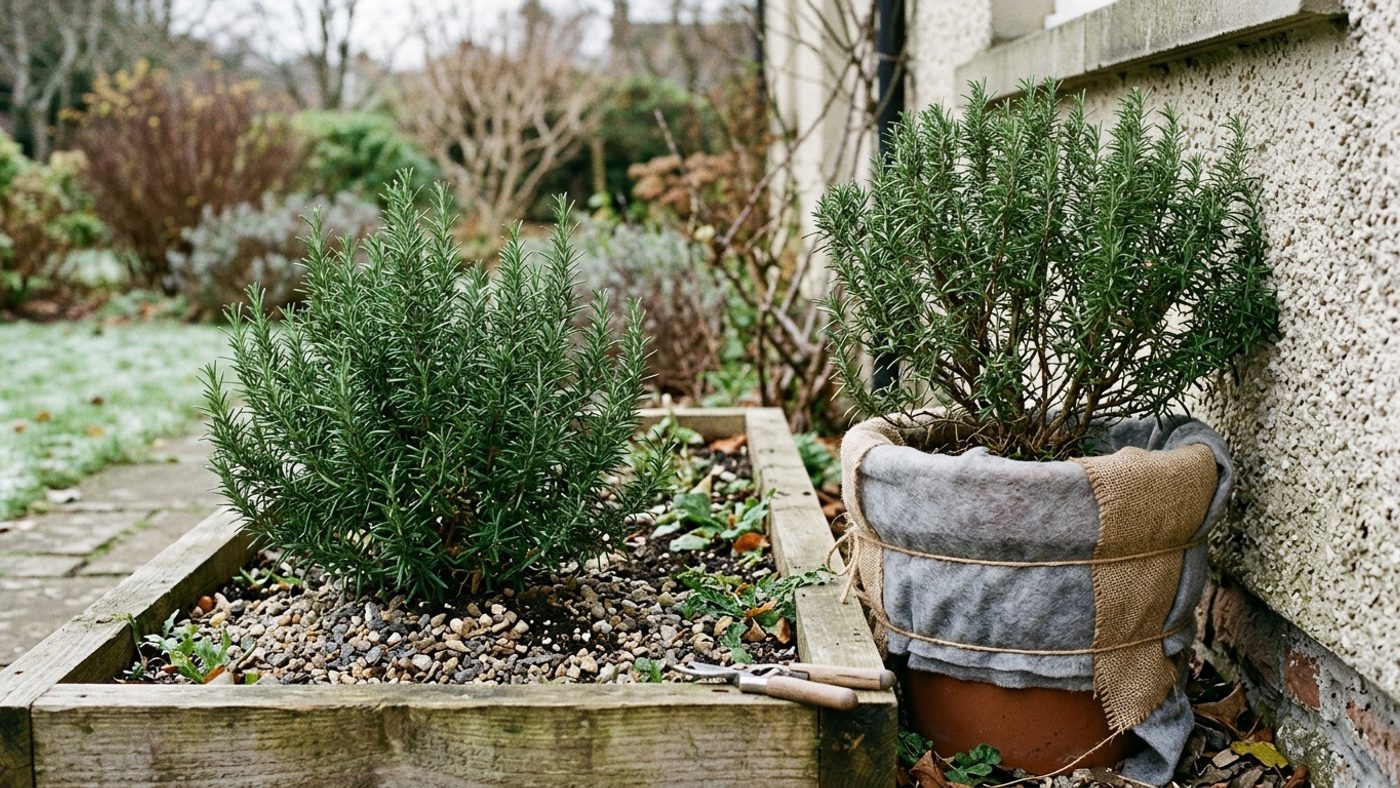
Open ground only works well where the soil is already light and free-draining, or on a sheltered, milder site. On heavier or wetter ground, a raised bed or mound with grit worked through it does the drainage job a border can't. A container gives the most control, a peat-freeCompost made without peat, which is harvested from a slow-forming, carbon-storing wetland habitat that peat extraction damages. Full definition →, soil-based compost with up to a quarter of its volume made up of horticultural grit, in a pot at least 30cm wide and deep with drainage holes that stay clear, but it comes with its own separate risk: a pot's whole root ballThe mass of roots and the soil or compost clinging to them, as it comes out of a pot or out of the ground when a plant is lifted. Full definition → is exposed to freezing air on all sides, which is exactly why the RHS flags potted plants as more vulnerable than the same variety planted in the ground, whatever hardiness rating it carries.
Sun matters too, but it's the more straightforward requirement: rosemary wants full sun, ideally a south- or west-facing spot, in light, free-draining soil. Named AGMThe RHS's Award of Garden Merit: a UK-wide trials award for reliable performance, not a Scotland-specific recommendation. Full definition → cultivarsA plant variety that arose or was bred under cultivation and is kept true by deliberate propagation, rather than a naturally occurring wild species. Full definition → such as 'Miss Jessopp's Upright', 'Foxtail' and 'Rosea' are all judged on general garden performance across the UK, worth choosing on habit and flower colour, but not as a fix for a marginal site, since siting and overwintering do far more for a Scottish rosemary's survival than which named variety gets planted.
Feeding and watering
Once it's established, ground-grown rosemary asks for almost nothing: it doesn't need feeding, thrives even in poor soil, and shouldn't need extra watering beyond normal rainfall, keeping it on the lean, slightly dry side is closer to its native Mediterranean habit than treating it like a thirsty border plant. Container rosemary is the exception on both counts: it needs watering during dry spells, since a pot dries out far faster than open ground, and benefits from a sprinkling of general-purpose granular feed in late spring or early summer, when the nutrients in the compost have had a season to leach away.
Overwintering a rosemary, especially in a pot
A container rosemary needs active winter management, not just a sheltered spot chosen once at planting time:
- Move it, if possible. A greenhouse, porch, or the sheltered side of a wall (a rain shadow) all reduce how wet and how cold the roots get through winter.
- Group pots together near a house wall, clustered containers protect each other's roots better than one standing alone.
- Insulate the pot itself. Wrapping the outside of the container in old blankets or bubble wrap cuts down how fast the compost inside freezes.
- Remove the saucer. A saucer left under a pot through winter collects rain and keeps the base of the compost sitting in water, precisely the wet-roots problem rosemary can't tolerate, so lift it off before the wet season sets in.
- Cover in hard frosts. Hessian, an old bed sheet, or biodegradable fleeceA lightweight, breathable fabric laid or draped over plants to trap a little warmth and keep off frost, wind and some flying pests. Full definition → over the top protects shoots and young growth during a severe cold snap, on top of everything else.
Exactly how much frost risk a given garden carries varies a lot by region and by altitude across Scotland, coastal and low-lying gardens see far less of it than inland or upland ones even a short distance away. Our Scotland frost dates page has the fuller regional breakdown; the short version for rosemary is that the wetter, higher, more inland a garden is, the more winter protection is worth the effort, independent of what the calendar says about frost dates specifically.
Pruning: what it can and can't fix
Once a rosemary is well sited, the actual cut is simple. Trim lightly every year, right after flowering finishes, cutting back into the current season's leafy growth to keep the plant compact, never into the old, bare wood beneath it. A stem still carrying green needles is safe to cut; a stem that's gone entirely brown and leafless underneath is not, because rosemary generally does not resprout from wood that old.
That's also why a hard renovation cut is the wrong tool for a plant that's already gone hollow and woody in the middle: there's no live wood left low down for a hard prune to work with, and plants in this state don't usually recover from heavy pruning and are generally better replaced than rejuvenated. It's the same limit Scottish gardeners run into with overgrown lavender, another semi-woody Mediterranean shrub that regrows freely from soft new growth but not from wood that's gone bare and brown, so a hard cut doesn't get to be the rescue plan just because the plant looks like it needs one.
Pests, pollinators, and what to expect
Rosemary flowers early, and its spring flowers are popular with bees and other pollinating insects. That's worth more in a Scottish garden than it sounds: spring arrives later and colder here than in much of England, so an early nectar source for bumblebees coming out of hibernation is scarcer on the ground when rosemary needs it least, an established, well-sited plant earns its keep this way even in a year it isn't pruned or picked much.
The main pest to know is rosemary beetle (Chrysolina americana), a metallic green-and-purple-striped beetle that also targets lavender, sage and thyme. It's spread across Britain since the 1990s and is now established in Scotland as well as England and Wales, feeding on foliage and flowers through late summer into spring. In most gardens it can be left alone as part of the biodiversity a healthy plot supports: it rarely eats enough to seriously damage an otherwise healthy plant, and a rosemary that's actually struggling is far more likely to have a siting or drainage problem behind it than a pest one.
Starting again from a cutting
Replacing a leggyDescribes a plant that's grown tall, thin and sparse rather than bushy, usually from too little light or not being pinched out. Full definition → rosemary doesn't mean buying a new plant from scratch. Cuttings taken from the still-healthy outer growth of the same plant grow into an identical replacement, and it's worth taking them as a matter of course before a hard prune is even considered, rather than only after a plant has clearly failed. Softwood cuttings from new growth in late spring or early summer root fastest. Semi-ripe cuttings taken in summer, from growth that's just starting to firm up, are a slightly slower but more forgiving option. LayeringPropagating a new plant by pinning a low, flexible stem into the soil while still attached to the parent, so it roots before being cut free. Full definition →, pegging a low, flexible stem into the soil in spring or autumn until it roots on its own before being cut free, needs no propagator at all, and suits a rosemary that already has low-growing stems close to ground level.
A cutting or layered stem started this year buys time to fix whatever the original plant's siting got wrong, rather than replanting straight back into the same waterlogged spot that likely did for the parent plant in the first place.
Common questions
Can I cut a leggy, woody rosemary back hard to fix it?
Not reliably. Rosemary generally doesn't regrow from cuts into old, leafless wood, so a hard prune into that wood tends to leave dead stumps rather than force fresh growth. A badly leggy plant is usually better propagated from and replaced than cut hard.
My potted rosemary died over a winter that wasn’t especially cold, why?
Almost certainly wet roots, not frost. A saucer left under the pot, compost that stayed sodden, or drainage holes that got blocked will kill a rosemary in a container well before the temperature itself does, rosemary's real weakness is wet roots, especially in winter, not cold air.
Is rosemary actually hardy enough to grow outside year-round in Scotland?
In many gardens, yes, most reliably in a sheltered, well-drained spot, more often found on the drier east coast than the wetter west. Its H4 hardiness rating specifically excludes inland valleys, altitude, and central or northerly locations, and container-grown plants are more exposed than the rating implies, so an upland, inland, or exposed garden is a genuinely marginal spot for it.
How do I know if a rosemary stem is actually dead?
Scratch a small patch of bark with a thumbnail. Green underneath means the stem is alive; brown and dry means it’s dead. Check a few stems and, if the tips look dead, work down to thicker wood before deciding the whole plant is gone.
How do I take a cutting to replace an old, woody rosemary?
Softwood cuttings from new growth in late spring or early summer root fastest; semi-ripe cuttings in summer are a more forgiving alternative; layering a low stem into the soil in spring or autumn works without a propagator at all.
Sources
7 sources, recorded with what each was used for
- RHS: How to Grow Rosemary: Siting, drainage, container size/compost mix, winter protection of pots, established-plant cold tolerance, pruning timing and technique, old-wood regrowth limit, propagation methods, cultivars, feeding and watering, pollinator note
- RHS: Salvia rosmarinus (Ro): H4 hardiness rating, soil pH tolerance, full-sun/south-or-west-facing siting, Pruning Group 9
- RHS Hardiness Rating: The H4 definition and temperature band, the inland-valleys/altitude/northerly-locations caveat, and the note that potted plants carry increased risk
- RHS: Container Maintenance: Removing saucers before winter, checking drainage holes, general winter pot protection
- RHS: Why Has My Tree or Shrub Died?: The scratch-test method for checking whether a stem is alive or dead
- RHS: Rosemary Beetle: Identification, host plants, spread across Britain, feeding period, tolerance guidance
- Met Office: Regional Climates: The general east/south-drier vs west/north-wetter pattern behind the article's siting framing