
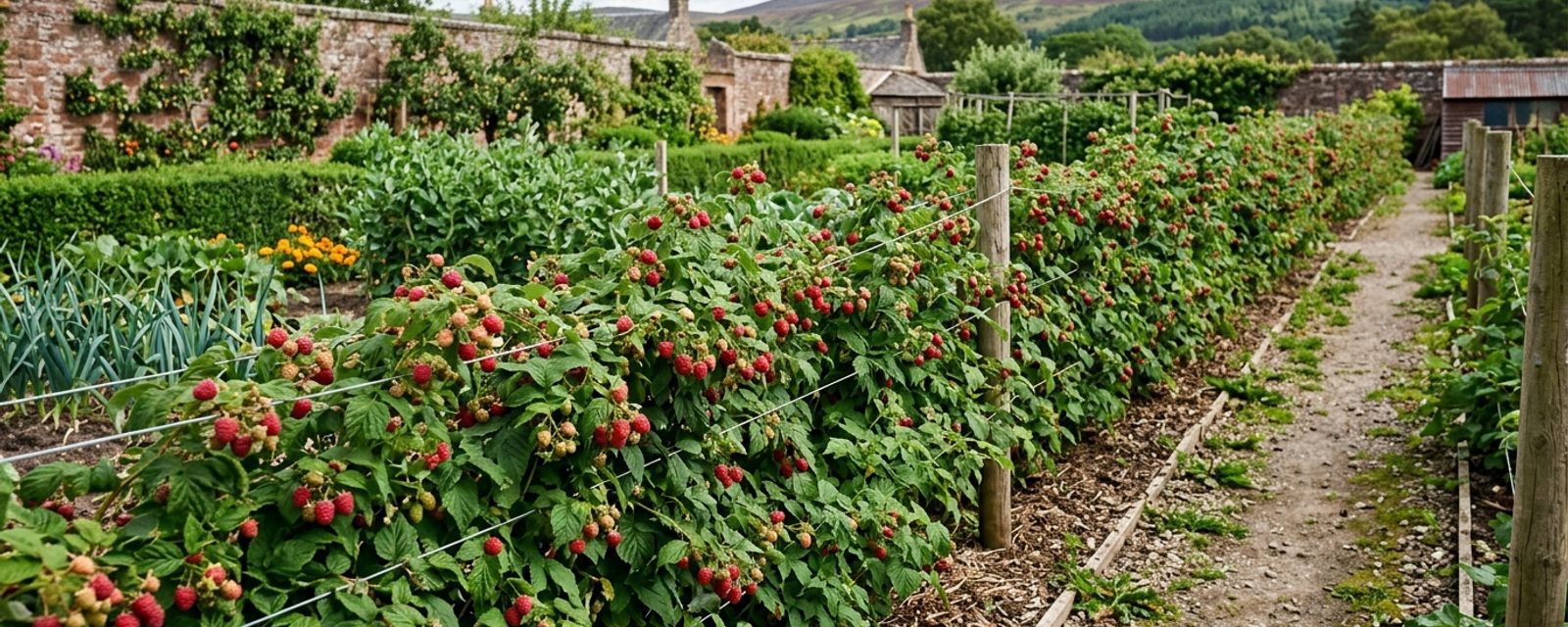
Rubus idaeus
Raspberries run from a November planting of dormant canes to a punnet of ripe fruit the following July, with a cool summer working in the crop's favour rather than against it.
Raspberries are the soft fruit Scotland can genuinely claim as its own. The James Hutton Institute in Dundee runs the UK's raspberry breeding programme, and every Glen-named variety, Glen Ample, Glen Moy, Glen Doll, was bred here. That provenance is a fact worth knowing, though it is heritage, not a guarantee: Hutton breeds for the commercial industry, not home gardens, and nobody trials varieties for Scottish conditions. But the crop itself is built for our climate. Raspberries outright prefer cooler regions. A Scottish summer gives them exactly what they need: steady ripening rather than a rushed burst in a heatwave. A raspberry patch, once established, will crop for up to ten years. That is a decade of fresh fruit from a single planting.
Why raspberries suit Scotland
Summer-fruiting types ripen from late June through September. Autumn-fruiting types start in August and keep going into October, between them covering four months without either needing a heatwave to set fruit.
Autumn-fruiting raspberries are the safer bet for a short season. They crop on the current year's growth, which means they fruit in their first year after planting. Cut everything to the ground in February, and the new canes that spring up will be carrying ripe berries by August. No tying in, no remembering which cane is which, no losing a whole season because last year's stems got damaged. One pruning rule, once a year, and a crop every autumn.
Varieties
Glen Ample was bred at the James Hutton Institute in Scotland: genuine provenance, though heritage rather than a guarantee of garden performance. It also carries the RHS Award of Garden Merit, a UK-wide award, not a Scottish one.
★ Our pick for Scotland
Glen AmpleAGM
Summer-fruiting · mid-season
Bred at the James Hutton Institute in Scotland. High-yielding with large, well-flavoured berries and good disease resistance.
Why this one: Bred at the James Hutton Institute in Scotland, described as high-yielding with good disease resistance. Hutton breeding provenance is a cited fact, not a Scottish recommendation: no source trials varieties for Scottish gardens. But the traits that make a raspberry worth planting, disease resistance, large fruit, reliable cropping, are the same traits the Scottish breeding programme selected for in a Scottish climate.
Also worth considering
PolkaAGM
Autumn-fruiting
Crops in its first year. Autumn types are easier to prune and fruit from August into October.
OctaviaAGM
Summer-fruiting · late season
Large uniform berries with good flavour. Extends the summer crop into late summer.
Show other recommended varieties (3)
All GoldAGM
Autumn-fruiting
Sweet yellow fruits. Can be double-cropped.
Malling JewelAGM
Summer-fruiting · early
Less vigorous, suits smaller plots.
Ruby BeautyAGM
Dwarf
Compact variety for containers.
Best Raspberry Varieties for Scotland → compares all named raspberry varieties head-to-head, with the practical detail that doesn't fit in a summary card.
Soil and site
Raspberries want a sunny, sheltered spot with fertile, well-drained soil that is slightly acidic, ideally pH 6 to 6.7. They will not tolerate waterlogged soil, especially in winter. If your ground is heavy or poorly drained, plant in raised beds. Avoid sites where raspberries have grown before: they can struggle with replant problems.
Choose a sheltered position. Tall summer-fruiting canes catch the wind, and strong gusts can snap the thin fruiting side-branches. Rows running north to south give even light to both sides.
On decent garden soil, no extra preparation is needed. If your soil is poor, mix some garden compost into the planting hole. After planting, spread a mulchA layer of material spread over the soil around plants to suppress weeds, retain moisture, and improve soil structure as it breaks down. Full definition → 5 to 7.5cm deep over the soil. Use well-rotted organic matter or garden compost. Avoid mushroom compost, which is alkaline.
Planting
Plant raspberries during the dormant season, from November to March, whenever the soil is not frozen. Late autumn is ideal. Bare-rootA plant, usually a fruit tree or hedging, sold with its roots exposed rather than in a pot, and only available while dormant. Full definition → canes are cheaper, sold in bundles of five or more, and give you the widest choice of varieties. Buy certified virus-free plants from a fruit nursery or specialist online retailer.
Space plants 40 to 60cm apart, with 1.5 to 2m between rows. Do not plant too deeply: the first roots should be no more than 5cm below the soil surface. Use the soil mark on the stem as a guide. After planting, prune most canes down to 25cm tall. The exception is summer-fruiting raspberries bought as long canes: leave those unpruned or you will lose the first season's fruit.
Put supports in place before planting. Summer-fruiting raspberries need a system of sturdy posts and horizontal wires. Install posts about 1.8m tall with three wires at 60cm intervals. Autumn-fruiting types are shorter and can be supported by simpler posts 60cm tall with parallel wires.
Watering and care
Water well immediately after planting and during any prolonged dry spells in the first growing season. Once established, raspberries should not need extra watering except during exceptionally long dry spells when the fruits are developing.
Apply a 5 to 7.5cm layer of organic mulch in late winter or early spring, leaving a slight gap around the base of the stems. Mulching improves the soil, holds moisture and suppresses weeds. If raspberries are mulched regularly, they should not need additional feeding. If growth is poor, apply a balanced granular fertiliser in early spring.
Pruning summer-fruiting raspberries: after harvesting, cut all the old woody fruited canes to the ground. Select the six to eight strongest young green canes per plant and tie them to the wires, spaced about 10cm apart. Cut any remaining young canes to the ground. These tied canes will fruit the following summer. In February, trim back canes that are taller than the top wire to a bud about 10cm above it.
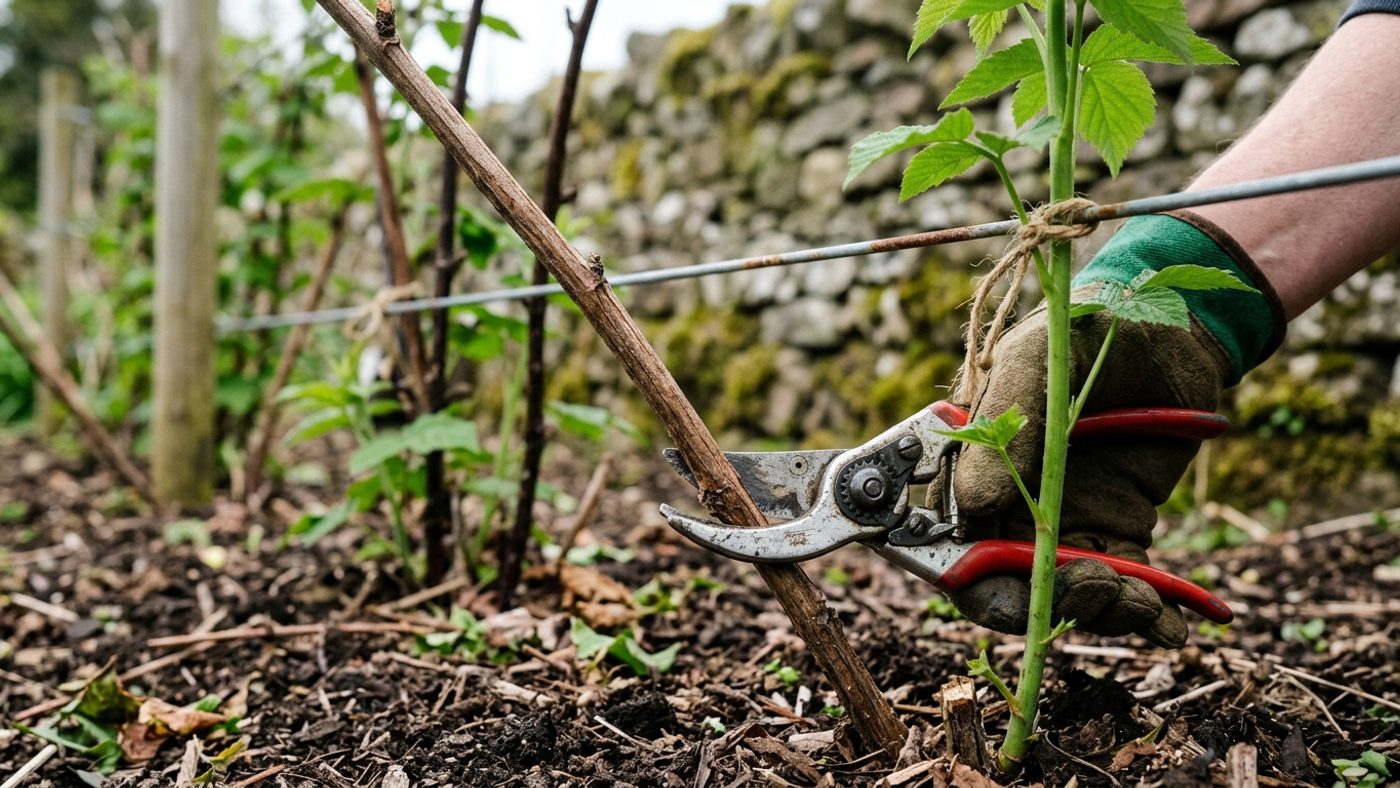
Pruning autumn-fruiting raspberries: in February, cut every cane to the ground. That is the entire pruning regime. New canes emerge in spring and fruit that same autumn. In early summer, thin out overcrowded clumps, removing weaker stems so the remainder are about 10cm apart.
Remove any suckersA shoot that grows from a plant's roots or lower trunk, separate from the main framework, usually removed before it diverts energy. Full definition → that appear outside the row. If you want more plants, healthy suckers from certified virus-free stock can be dug up and replanted.
Harvesting
Early summer-fruiting varieties are ready from late June, with later varieties continuing into September. Autumn-fruiting types start in August and often carry on well into October. Harvest regularly when the berries are richly coloured, plump and pull away easily from the core. Pick on a dry day. Damp berries turn mouldy quickly. Raspberries are best eaten fresh but freeze well, and a glut makes excellent jam.
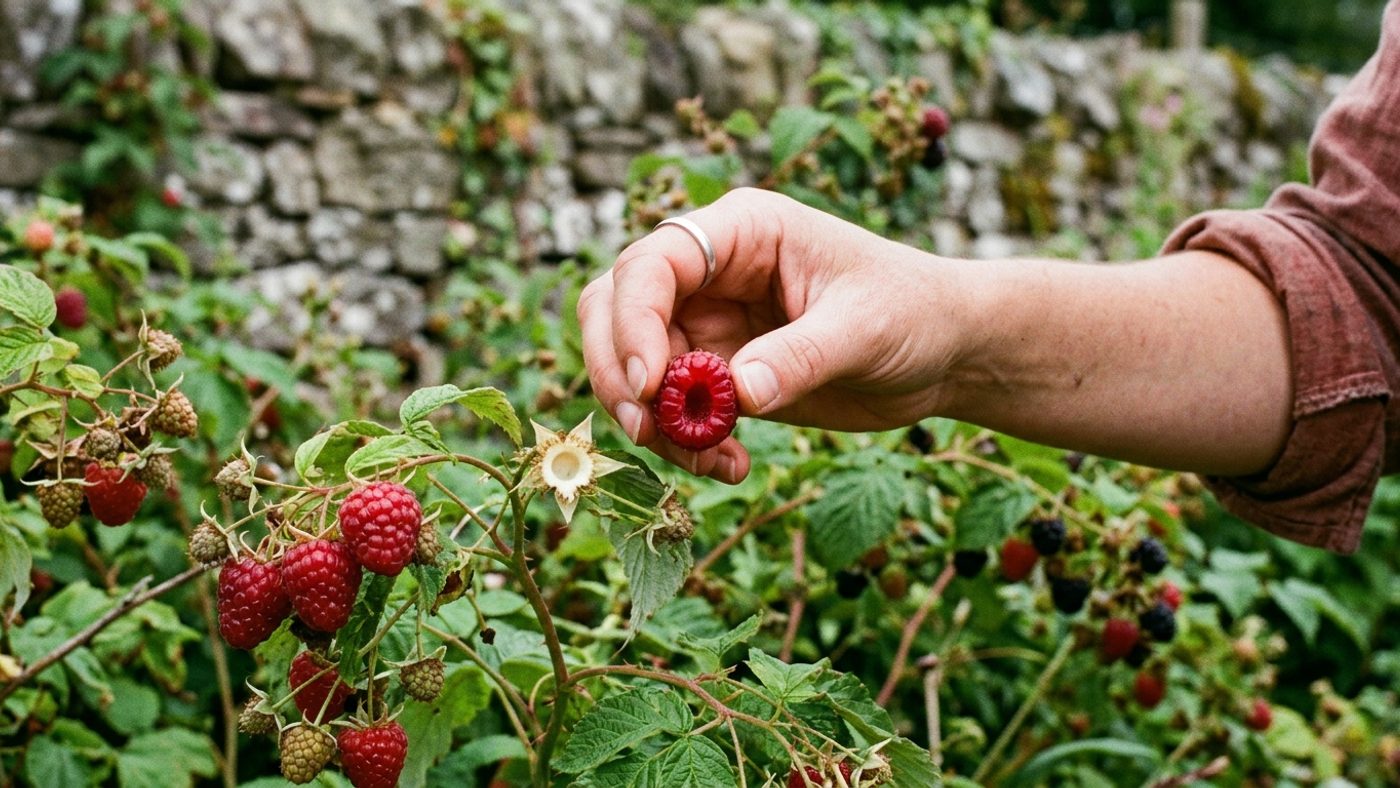
A Scottish raspberry patch in July, the canes heavy with fruit, the air warm enough to bring out the scent of warm berries, is one of the most rewarding things a garden produces.
Common problems
- Birds will take the fruit before you do. Netting supported on canes, raised above the fruit and fastened securely, is the defence. A fruit cage is the permanent solution if you grow a lot of soft fruit.
- Raspberry beetle larvae burrow into the fruit. Pick raspberries regularly and check for small pale grubs inside the berries.
- Grey mould (botrytis) rots the fruit, especially in wet weather. Harvest regularly and remove any mouldy berries. Good airflow between canes reduces the risk.
See more problems
- Raspberry cane blight causes canes to die back in summer. Prune out and destroy affected canes promptly. Space plants for good airflow.
- Viruses spread by aphids cause stunted growth and crumbly fruit. There is no cure. Remove infected plants immediately. Start with certified virus-free stock. The large raspberry aphid in Scotland has evolved to overcome bred-in resistance genes, so do not rely on variety resistance alone: remove aphid-infested tips promptly.
Common questions
Which type of raspberry should I grow in Scotland?
If you can only grow one type, pick an autumn-fruiting variety. Autumn raspberries are less vigorous, easier to prune, and crop in their first year: you cut everything to the ground in February and the new canes fruit that same autumn. Summer-fruiting types take a year to settle before they give you a crop. Autumn types also ripen from August into October, which lines up with a Scottish summer rather than hoping for a warm June. If you have room for both, a summer type and an autumn type together give you berries from late June through October.
Do raspberries need a lot of space?
Summer-fruiting raspberries grow to about 1.8m tall and need a row with posts and wires. Autumn-fruiting types are smaller, around 1.2 to 1.5m, and can be supported by simpler posts. Both can be grown in containers if you choose a compact variety like Ruby Beauty. A row of five or six plants will supply a household with fresh raspberries for weeks.
How do I prune raspberries?
It depends entirely on type, and mixing them up costs you the crop: summer-fruiting raspberries fruit on last year's canes, so only cut out the ones that already fruited and tie in the new green canes, while autumn-fruiting types fruit on this year's growth and get cut to the ground every February. Full sourced breakdown: <a href="/tools/garden-myths/raspberries/">Raspberry Myths →</a>
Why do I need certified virus-free plants?
Aphid-spread viruses are the main threat to a raspberry bed, and there is no cure once a plant is infected: certified virus-free stock from a fruit nursery is what keeps a new row cropping well for up to a decade, and a bed left in place for ten to fifteen years should be expected to decline and eventually need replacing with fresh stock. Full sourced breakdown: <a href="/tools/garden-myths/raspberries/">Raspberry Myths →</a>
Can I grow raspberries in a container?
Yes, but pick a compact variety and use a pot at least 40cm wide and 30cm deep. Fill with two-thirds peat-freeCompost made without peat, which is harvested from a slow-forming, carbon-storing wetland habitat that peat extraction damages. Full definition → multi-purpose compost and one-third loam-based compost. Plant a single cane, insert sturdy bamboo canes for support, and tie in new growth. Container raspberries need regular watering and monthly liquid feeding through the growing season.
Sources
2 sources, and what each was used for
- RHS: Nov-Mar dormant planting, 40-60cm cane spacing, 1.5-2m rows, summer vs autumn types with heights and pruning, support wires at 60cm, ten-year productive life, first harvest timing, pH 6-6.7, AGMThe RHS's Award of Garden Merit: a UK-wide trials award for reliable performance, not a Scotland-specific recommendation. Full definition → varieties
- James Hutton Institute: large raspberry aphid as the key raspberry aphid and virus vector; Glen varieties from the Hutton raspberry breeding programme carry aphid-resistance genes A1/A10, now being overcome by new biotypes