
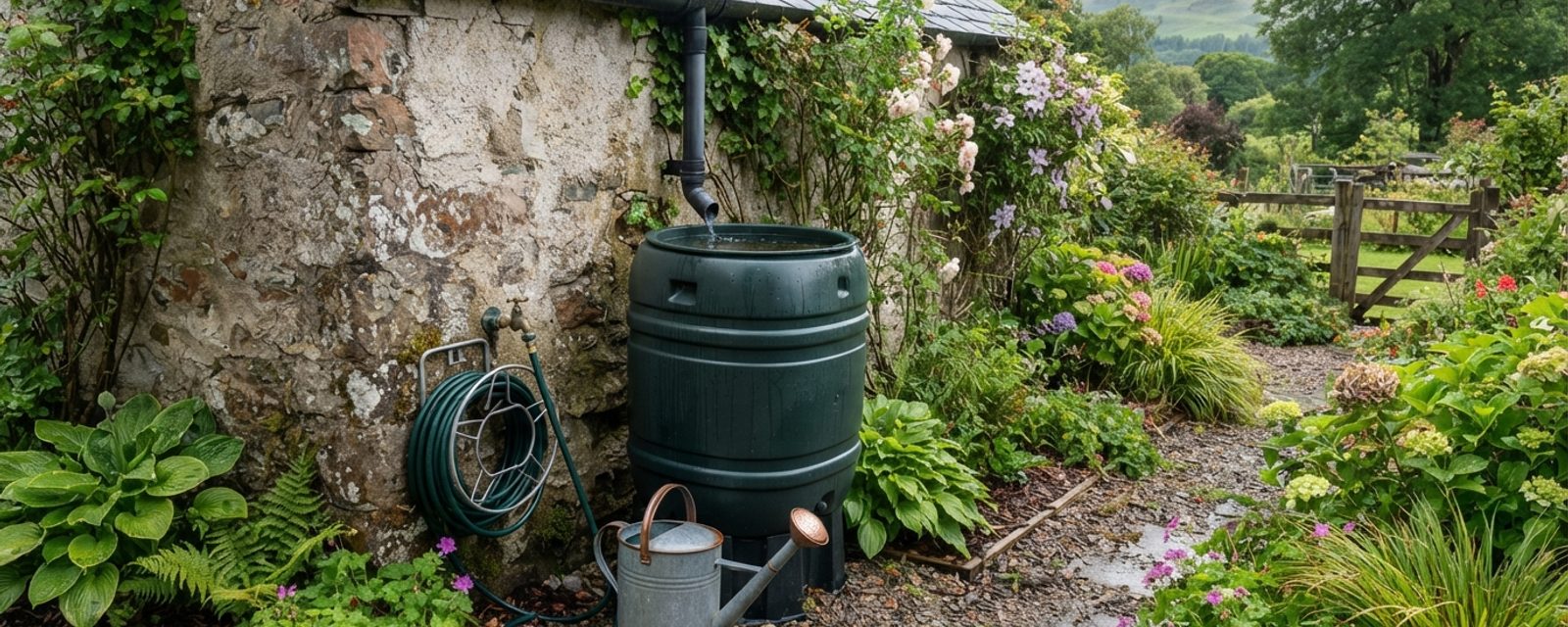
Every time you water a blueberry bush in ericaceous compost with ordinary tap water, you're adding a small dose of dissolved calcium and magnesium carbonate, the minerals that make water "hard." A single watering does nothing measurable. But water that pot twice a week for a whole growing season and those carbonates accumulate in the compost, neutralising the acidity a little more each time, the same way antacid neutralises stomach acid. By late summer, compost that started at pH 4.5 can have drifted up past 6, and a blueberry plant in that compost stops being able to take up iron and manganese properly, the leaves yellow between the veins while the veins themselves stay green (interveinal chlorosis), showing up on the newer growth first, growth stalls, and it looks exactly like a nutrient deficiency because, functionally, it is one. Nothing dramatic happened in any single watering. It's a slow chemical drift, and it's the real reason "use rainwater" shows up so consistently in growing advice for ericaceous (acid-loving) plants specifically.
That's the mechanism. Not every plant in a Scottish garden is exposed to it the same way, though, which plants actually need rainwater, and which don't, is the more useful question.
What's actually in tap water
Mains water in Scotland, like everywhere else in the UK, is treated before it reaches your tap, and two things from that process matter for gardening, though they matter very differently.
Chlorine and chloramine. These are added deliberately, in small amounts, to keep the water safe to drink between the treatment works and your tap. They get a lot of attention in gardening forums and blog posts, usually framed as a threat to soil biology, chlorine "kills the good bacteria," and so on. It's worth being sceptical of how far that claim actually travels. Chlorine is a fast-reacting, short-lived chemical: it binds readily to organic matter and clay particles in soil, including the peaty, organic-rich ground common across much of upland and western Scotland, exactly the kind of soil that neutralises it fastest, and any microbes it does affect in the top few millimetres of compost are part of populations that are large, fast-reproducing, and quick to recover. RHS's own guidance on water sources and general garden watering doesn't mention chlorine or chloramine at all, not as a caution, not as a reason to prefer rainwater. The mineral issue below is the one RHS actually addresses.
Alkalinity and hardness. This is dissolved calcium and magnesium, mostly as bicarbonates, picked up as water passes through rock and soil on its way to the treatment works. It's what makes water "hard," it's what furs up a kettle, and it's mildly alkaline. This is the one that genuinely matters for gardening, because it's cumulative. One watering can with hard tap water won't shift a compost's pH. Fifty waterings across a season, on a plant growing in a fixed volume of ericaceous compost with nowhere for the carbonates to leach away to, will.
Worth a specific warning if your household runs a water softener: a softener exchanges the calcium and magnesium for sodium rather than removing the alkalinity, so softened water solves the "hard water" problem in the kettle sense while doing nothing for a plant's pH, and adds a sodium build-up problem of its own in a pot over time. For ericaceous plants specifically, softened water is no better than untreated hard tap water, it needs the same rainwater workaround.
What's different about rainwater
Rainwater picks up almost no dissolved minerals on its way down, it's naturally soft. It's also typically mildly acidic, in the region of pH 5.5-6.5, close to what most garden soil and potting compost naturally sits at, because falling rain absorbs a little carbon dioxide from the air and forms a weak carbonic acid, the same unremarkable chemistry that makes fizzy water mildly acidic. RHS puts it plainly: rainwater "is naturally soft, low in minerals and has the right pH for most plants, including acid-lovers like rhododendrons and camellias." It contains no added chlorine, because none was added, it was never treated for drinking.
Worth being clear about what's actually driving RHS's own general preference for rainwater, though: their watering advice frames it mostly around not drawing on treated mains supply unnecessarily, "use mains water only as a last resort" is water-conservation language, sitting alongside tips like watering in the evening and mulchingA layer of material spread over the soil around plants to suppress weeds, retain moisture, and improve soil structure as it breaks down. Full definition → to retain moisture. The pH and mineral argument is real, but in RHS's own framing it's specifically attached to acid-loving plants and hard-water areas, not stated as a blanket problem with tap water for the garden generally.
The honest verdict: who actually needs to bother
Not every plant needs the same answer.
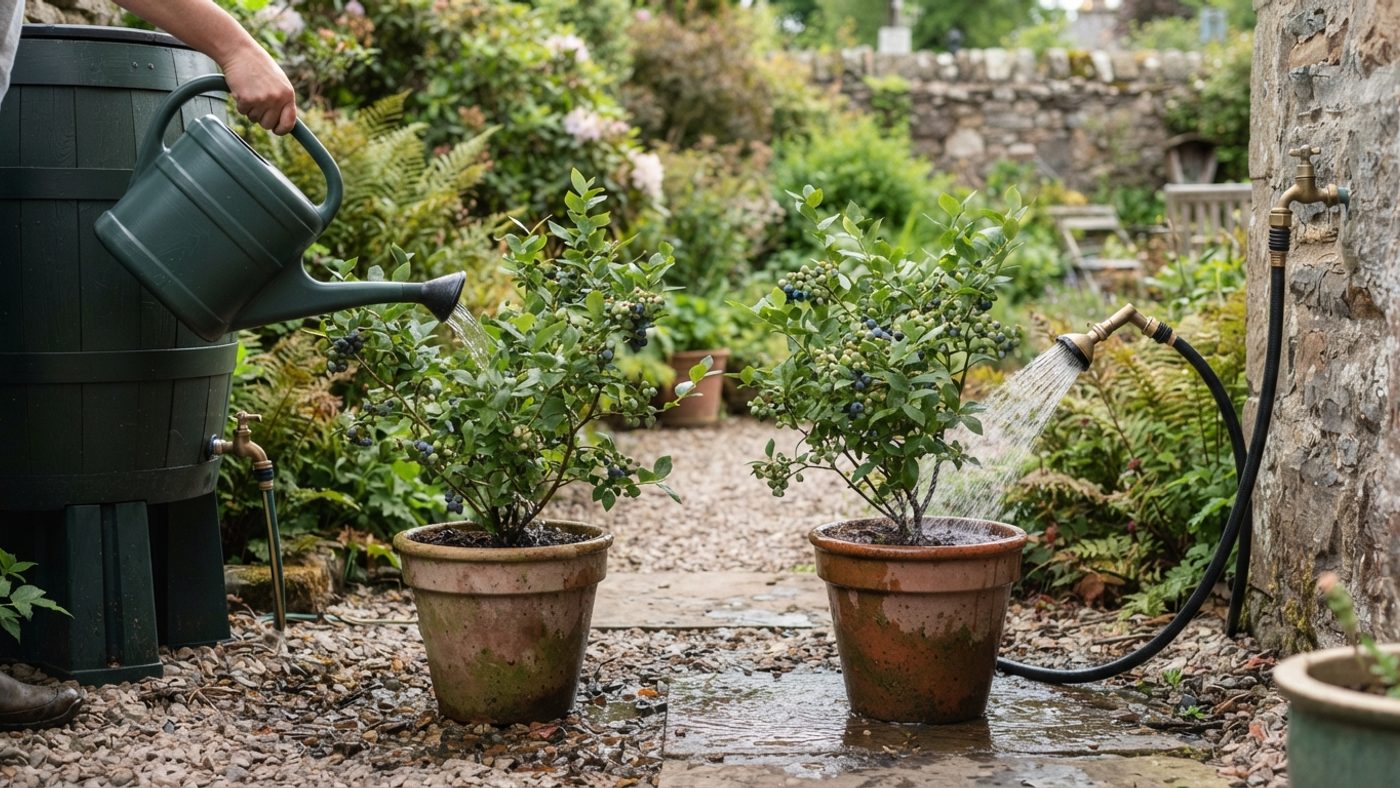
Ericaceous and acid-loving plants genuinely need the distinction made, but pot-grown ones more urgently than plants in open ground. Blueberries are the clearest, best-documented case, and also the sharpest example of why the container matters: a small pot forces the same drift into a much smaller volume of compost, so it happens faster and shows up sooner than it would in the open ground. RHS's own growing guide for blueberries is direct about it: "Use rainwater from a butt, rather than tap water, unless you have no alternative in a drought. Tap water is usually alkaline, especially in hard water areas, so if used regularly it will increase the pH of the compost." Blueberries need acid, ericaceous compost or soil, ideally in the pH 4.5-5.5 range, to take up nutrients properly. Gardeners' World gives the same advice for the same reason: "Use rainwater to water blueberries whenever possible, because tap water contains lime and this can make the soil more alkaline over time." The same logic extends to rhododendrons, camellias, azaleas, and other ericaceous shrubs, though a shrub planted straight into naturally acid, free-drainingSoil that lets water pass through quickly rather than pooling, so roots aren't sitting in wet ground after rain. Full definition → ground has a far larger volume of soil to dilute and buffer the alkalinity in than a potful of compost does, and a soft local water supply on top of that makes tap water a much smaller worry there than for the same shrub in a pot onMoving a plant into a larger pot as its roots fill the current one, giving it more room and fresh compost before it becomes pot-bound. Full definition → a hard-water supply. Anything planted specifically because it wants acid conditions is worth checking both ways, the plant's situation (pot or ground) and the local water, before assuming it needs rainwater at all.
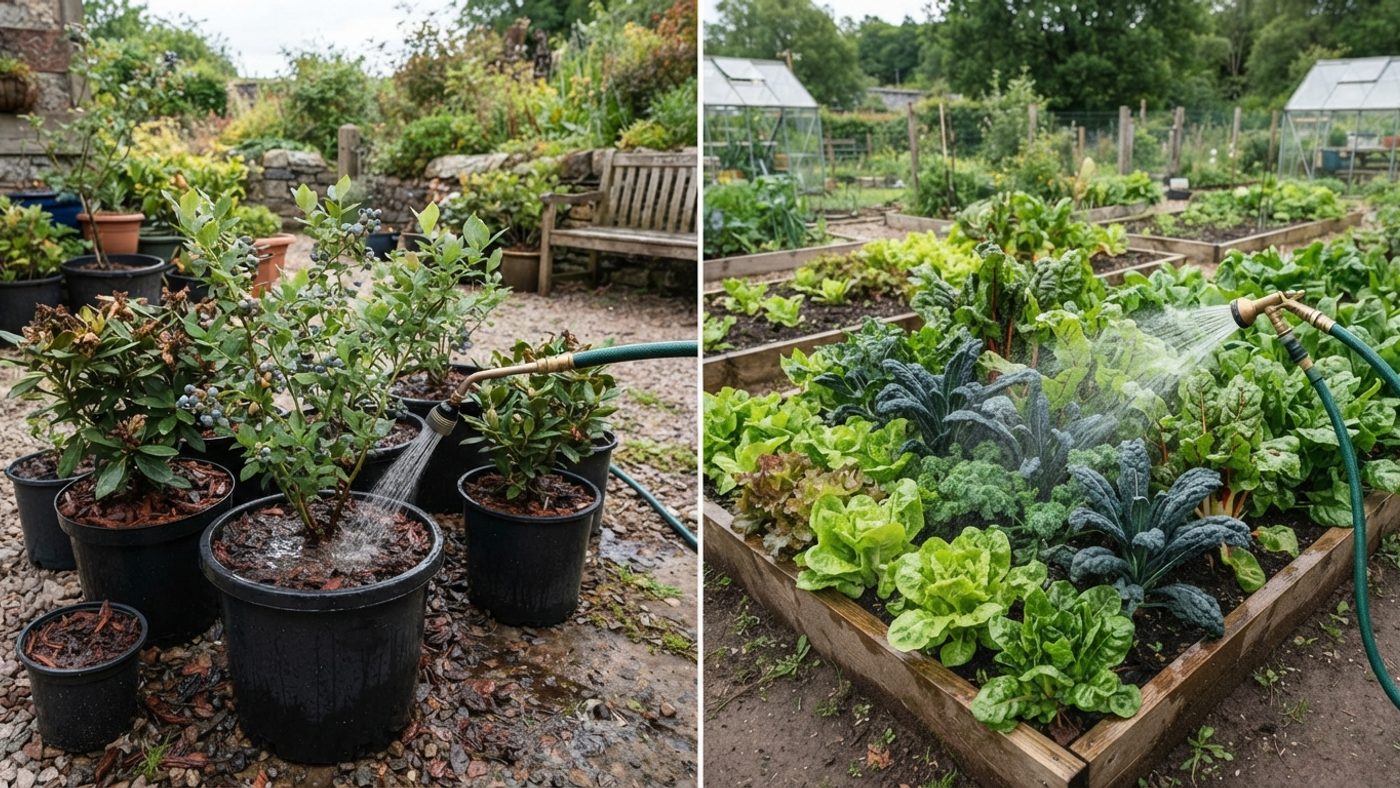
Most ordinary vegetables and garden plants don't need it. Nothing in RHS's own guidance says tap water harms typical vegetables, bedding plants, or most of what fills an ordinary Scottish garden or allotment. Their preference for rainwater, where it's discussed, is framed around reducing mains water use, not around tap water being unsuitable for those plants. A pH nudge that would slowly wreck a blueberry's acid compost is irrelevant to a plant that's happy in neutral-to-slightly-alkaline soil in the first place, which describes most vegetables. If you're growing potatoes, brassicasThe cabbage family: cabbage, kale, broccoli, cauliflower, Brussels sprouts, kohlrabi, swede, turnip and more, sharing the same pests, diseases and rotation rules. Full definition →, beans, or a lawn, the tap-versus-rain question genuinely isn't one you need to lose sleep over.
The practical rule: know which of your plants are the acid-loving exceptions, use rainwater for those specifically when you can, and don't feel obliged to haul water-butt water round the whole plot on principle. A cheap soil or compost pH test kit is the more direct way to check where you actually stand, rather than guessing from water type alone, worth doing before and partway through a season on any ericaceous pot, so drift gets caught while it's still small.
If a blueberry or rhododendron has already yellowed between the leaf veins, switching to rainwater stops the problem getting worse but won't correct it quickly on its own, since it only stops adding more alkalinity rather than removing what's already there. A chelated iron feed (sold as "sequestered iron" for ericaceous plants, applied at the rate given on its own label) treats the immediate deficiency, and for a badly drifted pot, replacing the top third to half of the old compost with fresh ericaceous mix resets it far faster than waiting on rainwater alone to reverse months of build-up.
Is rainwater ever the worse choice?
Not commonly, but it isn't automatically risk-free either. Rainwater picks up whatever's in the air on the way down and whatever's on the surface it ran off, genuine, if generally minor, water-quality caveats exist around atmospheric deposition near busy roads or industrial areas, and around what a roof surface itself is made of before the water reaches a butt. For most domestic garden use these are background-level concerns rather than reasons to avoid rainwater, nowhere near enough to outweigh the pH advantage for an acid-loving plant. The bigger practical risk with rainwater isn't what falls out of the sky, it's what happens to it sitting in a butt afterwards: algae, debris and stagnant water building up are a collection-and-storage problem, tied to how clean and covered the butt itself is kept, not to rain versus tap as a water source, see setting up a water butt for how to avoid it.
Scotland's generally higher rainfall than much of the rest of the UK (see the Scotland climate page for the regional figures) also makes this an easier trade-off in practice: a water butt here has more chance of refilling itself through an ordinary growing season than the same butt would in a drier part of the country, so keeping one going for the plants that actually need it is less likely to mean running dry mid-summer.
It's also a genuine hedge against mains restrictions rather than just a pH workaround: see hosepipe ban rules for how a Scottish Water Shortage Order actually differs from an England-and-Wales hosepipe ban, and why a full butt matters more here than the rare use of that power might suggest.
The Scottish regional picture: check your own supply zone
Water hardness in Scotland is set by local geology, not by a simple compass direction. Because these two catchment types don't sit neatly either side of an east-west line, a general "hard in the east, soft in the west" assumption doesn't reliably tell you what comes out of any one specific tap:
| Catchment geology | Effect on water |
|---|---|
| Limestone or shell-sand ground | Water picks up more dissolved calcium and magnesium on the way to the treatment works, comes out hard |
| Granite, schist, or peat | Water picks up very little in the way of dissolved minerals, comes out soft |
Scottish Water measures and publishes hardness for each of its regulatory supply zones rather than by broad region, and it runs a postcode search tool that identifies which zone serves a given address, entering an Edinburgh (EH1) postcode returns "Glencorse B" as the supply zone, for example. Scottish Water also publishes an annual hardness figure for every zone. Use the postcode search tool to find your own supply zone, then check that zone's published hardness figure, or ask Scottish Water directly, a specific answer for your own address, rather than a regional guess.
What that means practically: don't assume you're in a hard-water area just because you're in the Lothians or Central Belt, and don't assume you're safely in a soft-water area just because you're in the Highlands or on the west coast. Geology, not compass direction, decides it, check your own zone before deciding whether your acid-loving plants are worth the water-butt effort.
The bottom line
Whether a water butt is worth the effort comes down to two things stacking together: is the plant a pot-grown ericaceous one, and is the local supply actually hard. Get either answer wrong, assume every acid-lover needs it, or assume your postcode tells you your water type, and you either waste effort collecting rainwater a soft-water garden never needed, or leave a pot-grown blueberry on a hard supply to drift for a whole season before the yellowing shows up. Check the plant, check the zone, then decide.
Common questions
Do I need to use rainwater on my vegetable patch?
No, not on RHS's own guidance, nothing in their advice suggests tap water is a problem for ordinary vegetables. Their preference for rainwater is mostly about reducing mains water use generally, not about vegetables needing softer or more acidic water.
Is my tap water in Scotland hard or soft?
It depends on your local supply zone rather than which part of the country you're in, hardness follows local geology (limestone and shell-sand catchments run harder; granite, schist and peat catchments run softer), and those don't split cleanly along an east-west line. Check your postcode on Scottish Water's water quality search tool to find your supply zone, then check that zone's published hardness figure.
Will tap water actually kill my blueberry bush?
Not quickly or dramatically, it's a gradual pH drift over a season of repeated watering, not a single event. The visible sign is yellowing between the leaf veins as the compost's pH climbs out of the acid range the plant needs to take up iron and manganese. Switching to rainwater stops it getting worse; a chelated iron feed and, for a badly drifted pot, fresh ericaceous compost will bring it back faster than rainwater alone.
Should I worry about chlorine in tap water harming my soil?
No, RHS's watering and water-source guidance doesn't mention chlorine or chloramine at all. The mineral/alkalinity issue is the one that actually matters, and only for acid-loving plants specifically.
Does rainwater from a water butt need any special care to use safely?
Yes, a butt itself can become the problem rather than the water in it. Algae, debris and stagnant water build up if it's left uncovered or unemptied, which is a hygiene issue separate from the rain-versus-tap chemistry above, and worth more care if you're using it on seedlings specifically.
Is softened water a substitute for rainwater on acid-loving plants?
No, a domestic water softener swaps out calcium and magnesium for sodium, so it removes the hardness but doesn't lower the pH, and the added sodium is its own problem for plants in the pot over time. If your household water is softened, treat it the same as hard tap water for ericaceous plants and use rainwater or unsoftened water instead.
Sources
5 sources, recorded with what each was used for
- RHS: Blueberries, grow your own: Direct guidance on rainwater vs tap water for blueberries and the recommended ericaceous pH range (4.5-5.5)
- RHS: Collecting, storing and reusing water: RHS's general position on rainwater as the preferred water source, mains water as "a last resort", and the softened-water sodium caveat
- RHS: Watering vegetables and fruit: Confirms RHS does not raise tap-water quality as a concern for ordinary vegetable watering
- Gardeners' World: How to grow blueberries: Independent rainwater-vs-lime guidance on blueberries and the pH range (4-5.5)
- Scottish Water: Water Quality Search (postcode lookup): Confirms the Edinburgh (EH1) supply zone is Glencorse B, and that hardness is tracked by individual regulatory supply zone