
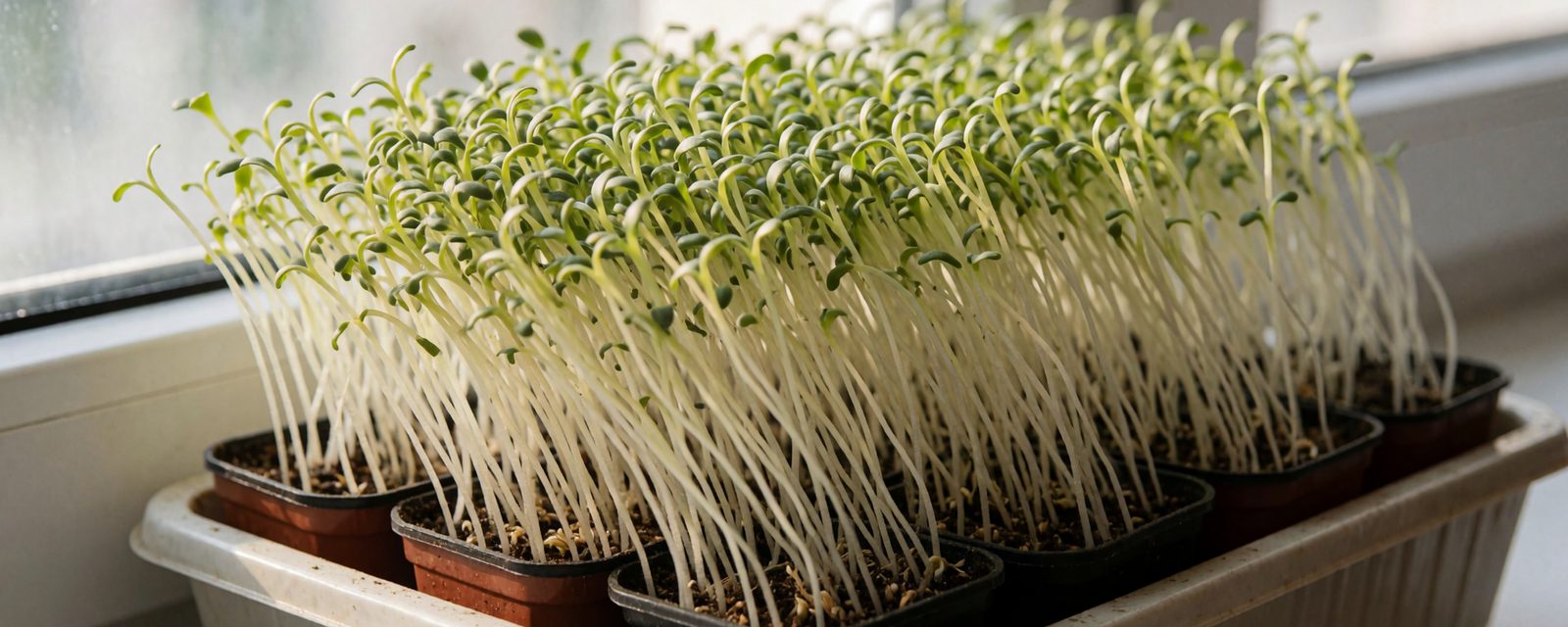
A seedling doesn't grow tall and thin by accident, it's doing exactly what its hormones tell it to do. The plant hormone auxin is produced at the growing tip of a seedling and moves down the stem, and under low light it also triggers something less visible: the internodes, the stem segments between one leaf and the next, elongate further than they normally would. RHS explains it plainly: "In low light levels, plants can become tall and spindly – or etiolated – as internodes become longer than normal," and notes that gibberellin, a hormone that controls stem elongation, increases when light intensity is insufficient, working alongside auxin to drive that stretch.
The same hormone is behind the second thing gardeners notice: a seedling leaning hard toward a window. This is phototropism, the plant's directional bending toward a light source. Auxin accumulates on the shaded side of the stem rather than distributing evenly, and because auxin promotes cell elongation, the shaded side grows faster than the sunlit side, so the stem bends toward the light not because it's being pulled, but because one side of it is physically growing longer than the other.
Put together, that's the whole story of a leggyDescribes a plant that's grown tall, thin and sparse rather than bushy, usually from too little light or not being pinched out. Full definition → seedling: not enough light triggers auxin- and gibberellin-driven internode stretch, and uneven light triggers auxin-driven bending. A seedling under strong, even, overhead light has little reason to do either.
What leggy growth actually looks like
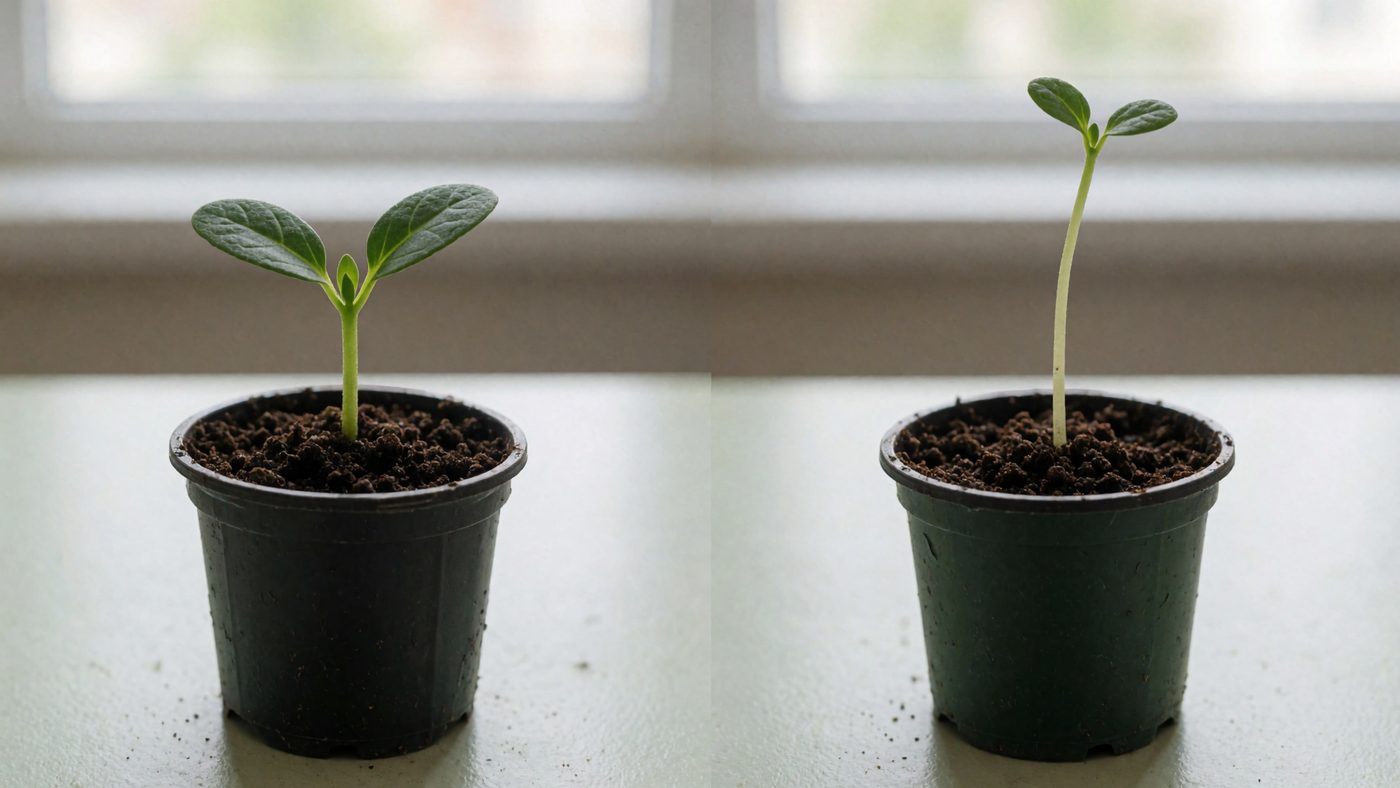
Before troubleshooting causes, it helps to confirm what's being dealt with. A leggy seedling typically shows:
- A thin, pale stem rather than a short, thick one
- Wide gaps between leaves or sets of true leaves, where a healthy seedling would have leaves clustered close together
- A visible lean toward a window or light source
- A weak, floppy stem that struggles to hold the seedling upright, sometimes collapsing under the weight of its own first true leaves
- Pale green or yellowish colour rather than deep green, since energy is going into stretching rather than building chlorophyll-rich tissue
If a tray shows several of these together, especially the stretch-and-lean combination, the seedlings are legging out rather than simply growing normally fast.
Common causes compared
Several distinct conditions can trigger the same auxin-driven stretching response, and they're often present at once.
| Cause | What it does | How to spot it |
|---|---|---|
| Too little light overall | Low light intensity raises gibberellin and auxin activity, elongating internodes | Seedlings are uniformly pale and stretched, even with no obvious lean |
| Light source too far away | Light intensity falls off sharply with distance, so a seedling even a few inches too low from a grow light effectively sits in low light | Stretching is worse under a grow light that seems switched on but is mounted too high |
| Sown too early relative to daylight | Seeds started indoors in deep winter face short day length and weak sun before natural light catches up | Seedlings sown in January/February stretch more than the same variety sown a few weeks later |
| Overcrowding, not thinned | Neighbouring seedlings shade each other's lower stems, and each one bends and stretches trying to reach clear light | Dense, uneven trays where crowded seedlings are visibly taller and thinner than more isolated ones |
| Excess heat without matching light | Warmth speeds up the same auxin/gibberellin-driven growth, so without proportionally strong light the extra growth still goes into stem length rather than sturdy tissue | Seedlings on a heat mat or a warm windowsill stretch faster than the same seeds started somewhere cooler |
| Sown too deep | A seed buried deeper than it needs to be has further to grow before reaching light, so the stem between seed and soil surface stretches before the first true leaves even appear | The seedling looks leggy from the moment it emerges, rather than developing the stretch gradually afterwards |
These causes compound. A tray sown early, kept warm, and lit only by a windowsill is stacking three separate stretch triggers on top of each other, which is why legginess often looks worse than any single factor would predict.
The Scotland angle: less daylight to work with in the seedling-starting window
Everything above applies anywhere seedlings are started indoors. Scotland's geography adds a further factor on top of it, during the exact weeks most edibles get sown indoors: less daylight to work with than further south, at the same point on the calendar.
The Met Office's climate averages for Northern Scotland (Highland, the Western Isles, Orkney and Shetland) note that "the number of hours of bright sunshine is controlled by the length of day and by cloudiness," and that sunshine duration "decreases with increasing altitude, increasing latitude and distance from the coast."
| Area | Annual sunshine (Met Office average) |
|---|---|
| Near the Moray Firth / southern Outer Hebrides | Close to 1,300 hours a year |
| Shetland and the mountains of Northern Scotland | Less than 1,100 hours a year |
| South coast of England | Over 1,750 hours a year |
The same document notes "the sunniest month of the year is normally May, rather than June," with monthly sunshine at Lerwick and Inverness both showing a low January/February base that climbs slowly through late winter, the real rise arriving well after most seedlings are already sown and growing indoors.
That gap matters directly for seedlings. A gardener in northern or island Scotland sowing tomatoes or brassicasThe cabbage family: cabbage, kale, broccoli, cauliflower, Brussels sprouts, kohlrabi, swede, turnip and more, sharing the same pests, diseases and rotation rules. Full definition → indoors in February is working with meaningfully less daylight than a gardener sowing the same seeds on the same date further south, on top of the low light every UK indoor sower already contends with in late winter. It's a sharper, Scottish-specific version of the "sown too early relative to daylight" cause above: the same mistiming carries a bigger light shortfall the further north and west a garden sits. See the article on day length and photoperiod for the fuller mechanics of day length and plant growth.
Can a leggy seedling be saved?
There's no single yes-or-no answer here, it depends on how leggy the seedling is and what it is.
Mild stretching (slightly longer gaps between leaves, stem still holding itself up) is almost always recoverable. Moving the seedling to stronger, closer light and letting new growth come in at a normal internode length usually corrects the look within a couple of weeks, even though the original stretched section stays visible.
Moderate to severe stretching (thin, pale, floppy stem, seedling can't stand unsupported) depends heavily on the crop. Plants that root along a buried stem, tomatoes are the classic example, and brassicas to a lesser degree, can often be saved by burying the leggy portion of stem up to just below the first set of leaves at transplanting: tomato stems readily throw out new roots from buried nodes, turning a liability into extra root mass. The tomato growing guide covers transplanting depth and timing in more detail. Plants that don't root well along the stem, most root vegetables, alliums, and many flowering crops, can't use that trick, so a severely leggy specimen of these is more often best discarded and re-sown under better light than nursed along.
Very severe cases, where the stem has collapsed or snapped, aren't salvageable as that individual plant. Re-sowing under corrected conditions is faster than trying to prop up a broken seedling. As a rough rule: if the stem can still stand upright under its own weight, it's worth trying to save; if it can't, weigh the time cost of nursing it against simply starting again with the light fixed.
Preventing legginess going forward
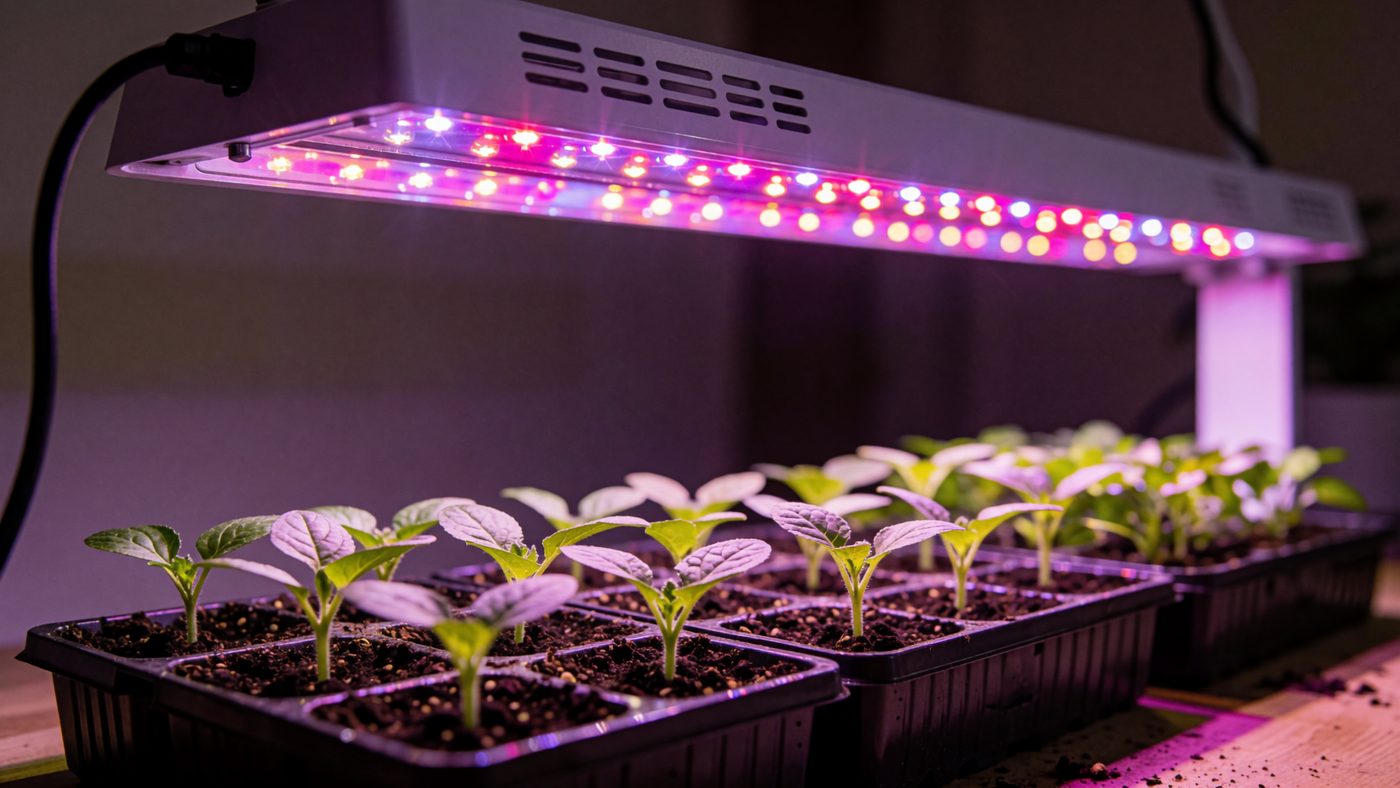
- Increase light intensity and duration. Natural windowsill light is rarely enough in a Scottish February or March; a dedicated grow light close to the seedlings, run for a consistent daily period, does more to prevent stretch than any other single change. The LED grow lights in Scotland article covers appropriate distances and output for seedling stages.
- Keep light close. Because intensity drops off sharply with distance, a grow light mounted too high behaves like a weak light source even if it's a strong one, if seedlings keep stretching even under a light that's switched on, moving it closer is usually the fix before anything else. Exact mounting height varies by fixture wattage and type, so check the specific spacing given for the light in use.
- Time sowing to daylight, not just the calendar. Sowing slightly later, once natural day length and light quality have improved, often produces stockier seedlings than sowing early and fighting weak light for weeks. The seed germination temperature article helps judge realistic sowing windows for Scottish conditions.
- Thin promptly, then pot onMoving a plant into a larger pot as its roots fill the current one, giving it more room and fresh compost before it becomes pot-bound. Full definition →. Removing weaker seedlings as soon as true leaves appear stops neighbours shading each other into a stretch, and pricking outMoving individual seedlings from the crowded tray they germinated in into their own space, once they have their first true leaves. Full definition → the survivors into individual pots, giving each one clear space and light rather than a crowded shared tray, does more for stem thickness than thinning alone.
- Use whatever cooler, brighter shelter is available. An unheated greenhouse, cold frame, or a cool, bright porch on the south side of a house often gives seedlings steadier, stronger light than an indoor windowsill in a heated room, without the room's added warmth pushing growth further than the light can support.
- Line trays with reflective material. White card or kitchen foil around, not over, a tray of seedlings bounces some of the available light back onto them from the side, which helps most on a dim windowsill where light is only coming from one direction.
- Match temperature to light, not the other way round. A warm room without strong light encourages fast, weak growth; if extra light isn't available, keeping seedlings slightly cooler slows growth down to match what the available light can actually support.
- Drop the temperature at night. A cooler night than day, rather than a constant warm temperature round the clock, works against the same warmth-driven stretching and suppresses excess stem elongation on its own, worth doing deliberately if seedlings are on a heat mat or in a heated propagator, rather than leaving the heat source running continuously.
- Add gentle air movement. A few minutes a day of a small fan on a low setting, or lightly brushing a hand over the tops of the seedlings, encourages shorter, thicker stems, the mechanical disturbance signals the plant to invest in sturdiness over height.
Common questions
Is a leggy seedling the same as a "damped off" seedling?
No. Damping offA fungal disease that kills seedlings at soil level, usually caused by overwatering, poor airflow, or reused unsterilised compost or trays. Full definition → is a fungal problem that causes the stem to rot and collapse at the soil line, usually killing the seedling within days. Legginess is a light-driven stretching response, the seedling stays alive but grows thin and tall. A leggy seedling with a healthy, unblemished stem is a light problem; a seedling with a dark, pinched or mushy patch at the base is a disease problem and needs different treatment.
Will a leggy seedling ever look normal again?
The stretched section of stem stays stretched, it won't shorten. But once light conditions improve, new growth above that point typically comes in with normal internode spacing, so the plant as a whole looks less leggy over time even though the early growth remains visible lower down.
Can I fix legginess by moving seedlings outside early?
Only after proper hardening offGradually getting young plants raised indoors used to outdoor conditions over 7–14 days before planting out, so cold, wind and direct sun don't shock or damage them. Full definition →. Moving stretched, soft indoor growth straight outdoors risks wind and cold damage on top of the existing weak stem. See the hardening-off article for the gradual process needed before any seedling, leggy or not, can handle outdoor conditions.
Does overwatering cause legginess?
Not directly through the same light mechanism, but overwatering often goes hand in hand with the conditions that do cause it, seedlings kept too warm and too wet, with weak light, tend to grow soft and stretched for multiple overlapping reasons. Correcting light is still the priority fix.
Is there a point where it's better to just start over than try to save a leggy seedling?
Generally yes, once the stem can no longer support the seedling upright, or once it's clearly a species that doesn't root well from a buried stem. At that stage, re-sowing under stronger, closer light usually produces a usable plant faster than nursing a collapsed one.
Sources
2 sources, recorded with what each was used for
- RHS: How Plants Sense the Environment: The auxin/phototropism mechanism, and the etiolation/gibberellin explanation of internode elongation under low light
- Met Office: Northern Scotland climate: Annual sunshine-hour ranges for Northern Scotland (Highland, Western Isles, Orkney, Shetland), the comparison with south-coast England sunshine hours, and the finding that May, not midsummer, is the sunniest month at Lerwick and Inverness