
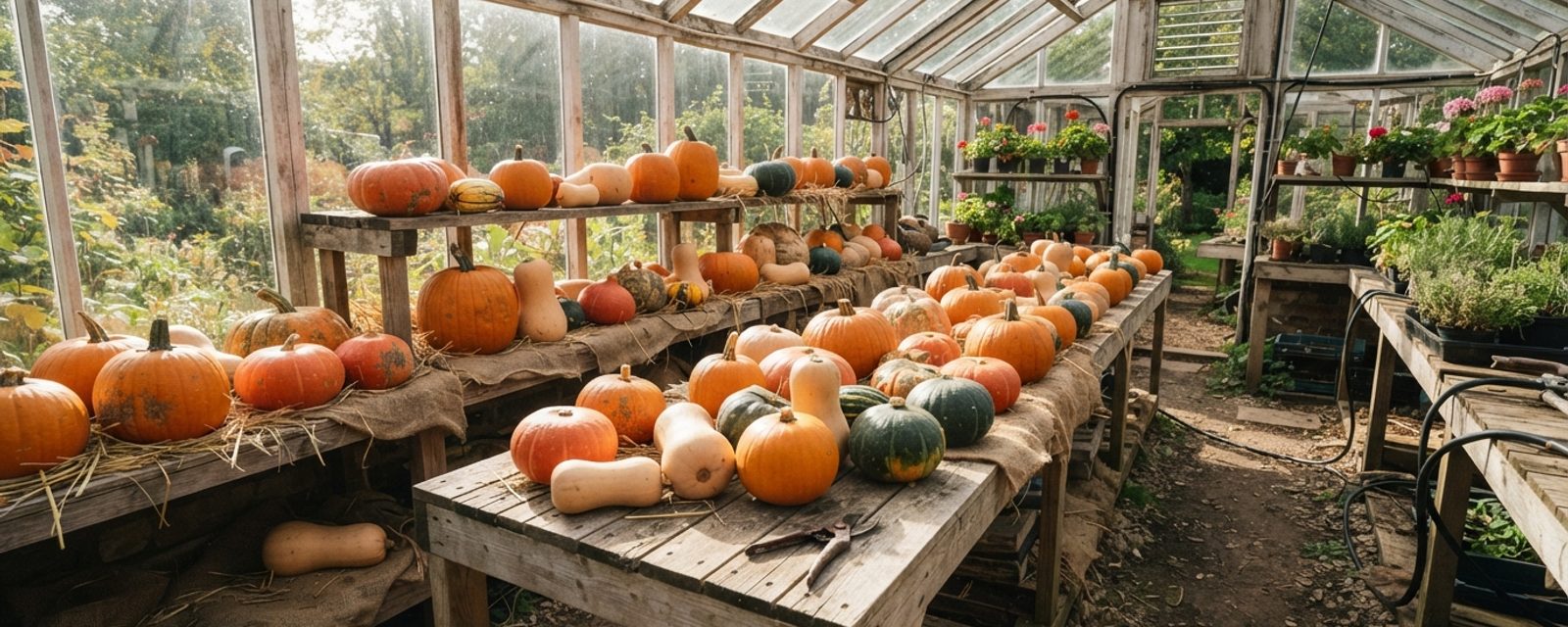
Curing hardens the skin and seals the stem wound; the cool, dry storage that follows only works because that skin barrier is already in place. Skip the cure, or store a still-soft fruit, and it breaks down within weeks instead of lasting the winter.
This runs the opposite way to how root vegetables are handled. Beetroot and carrots are lifted and packed straight into cold, damp conditions, because their problem is shrivelling. Squash and pumpkins have a different problem, decay through a soft or wounded skin, so the process goes warm and dry first (curing), then cool and dry (storage), never cold and damp. A root-cellar mindset applied to a pumpkin rots it faster, not slower.
When to harvest for storage
Squash and pumpkins are frost-tender, unlike root crops, which tolerate a light frost. That fixes the harvest window to the calendar in a way root-veg storage isn't: everything needs to be off the plant before the first hard frost, whatever stage it's at. The regional gap is real:
| Area | Typical first autumn frost |
|---|---|
| Highland/Grampian upland glens | Mid-to-late September |
| Central Belt, lowland | Late October |
| Moray Firth / Highland coast, lowland | Late October |
| Islands (maritime) | Early November |
A six-week spread between an upland glen and the islands is the difference between planning around late September and having until November, figures above are drawn from the site's own regional frost-date reference, itself built on Met Office station data, check that page directly for the area you're actually gardening rather than relying on a single Scotland-wide date. Against that earlier upland deadline especially, some fruit will still be under-ripe when frost arrives; a frost-damaged fruit won't store at all and should be eaten straight away instead. There's no reliable way to finish ripening a fruit once it's off the plant, so choosing varieties and a harvest date that avoid the problem is the safer plan.
Otherwise, leave fruit on the plant as long as possible, flavour keeps developing right up to harvest. Ready fruit shows a tough skin that resists a thumbnail press, sounds hollow when tapped, and has reached its full, deep colour. Cut with at least 10cm of stem attached, using secateurs rather than snapping it off, a short or torn stem leaves a soft point where rot tends to start. Full growing detail is in the squash and pumpkins growing guides.
Curing: the warmth-and-airflow step
Once cut, fruits need roughly a week to ten days in warm, bright, airy conditions before storage. In Scotland that doesn't have to mean baking outdoors in direct sun, RHS names a greenhouse, polytunnel, or coldframe as an equivalent to outdoor sun-curing, somewhere the fruit stays protected from frost and wet while any wounds heal. A run of dry, sunny autumn days isn't something a Scottish September or October reliably delivers, so treat a covered spot as the default rather than the fallback.
US extension guidance describes curing at 27-29°C with 75-80% humidity for about ten days, a target that's genuinely hard to reach outdoors or in an unheated greenhouse here. RHS and Garden Organic give no numeric temperature target at all, only "in the sun" or "under cover," so cure in whichever bright, covered space is available rather than chasing the US figure. Not every type benefits equally: butternut and Hubbard show little gain from curing, and acorn squash can actually be harmed by an extended cure.
Storage conditions: cool, not cold, and drier than a root cellar
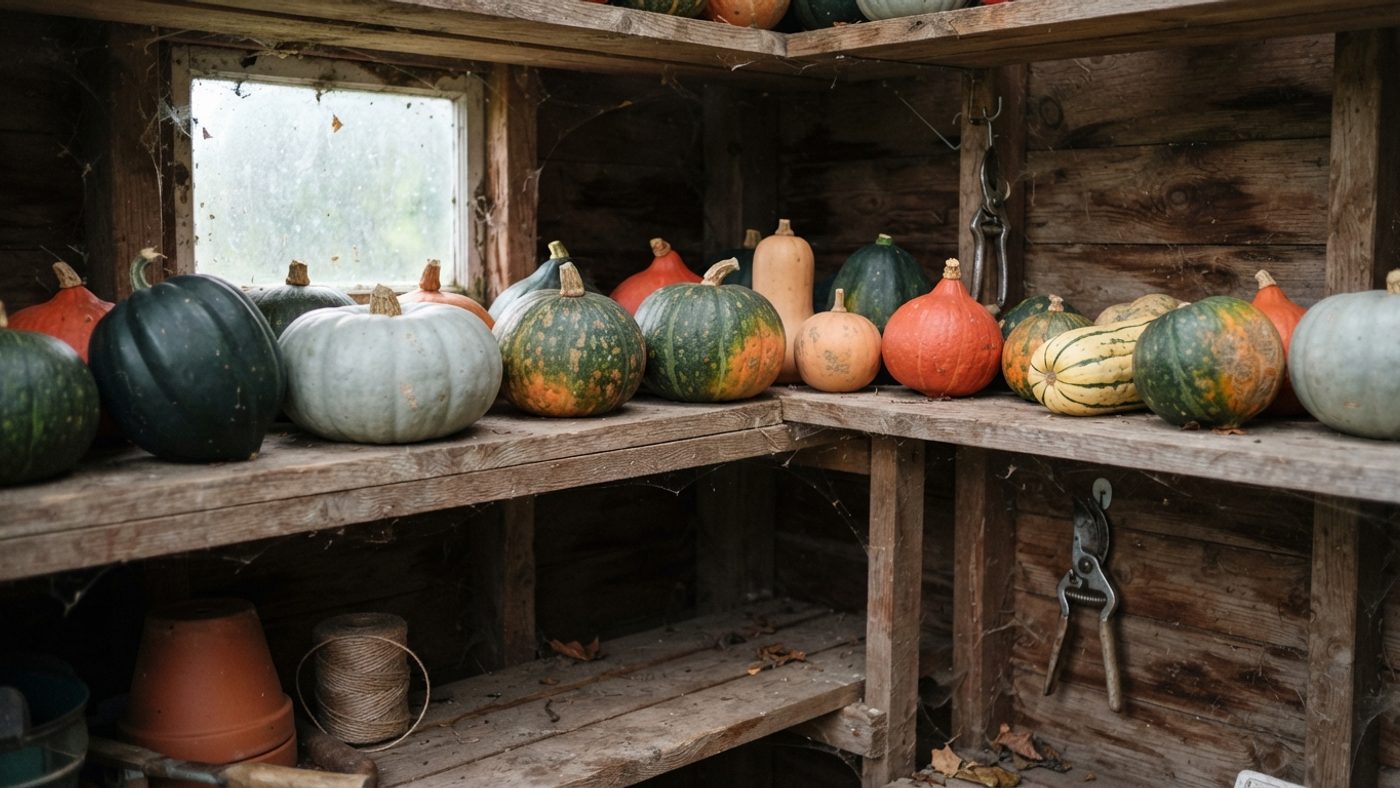
Once cured, move fruit to a well-ventilated spot at 10-15°C, spaced so pieces aren't touching each other or a wall. That's cool storage, not cold storage, a garage, shed, or spare room in that range works; a genuinely cold outbuilding running close to freezing doesn't. The lower bound matters as much as the upper one: an unheated shed can drop below 10°C in a Scottish cold snap, undoing some of what curing built up, so check on stored fruit through a bad spell rather than leaving it alone all winter.
Humidity is where the two crops pull apart from root vegetables: beetroot and carrots are kept damp and near-freezing so they don't shrivel; squash and pumpkins are kept cool but drier, since the risk runs the other way, toward decay. Exact humidity figures disagree between US sources, but RHS's own storage guidance for both squash and pumpkins specifies a well-ventilated 10-15°C spot with fruit kept apart, ventilation and spacing matter more here than chasing an exact percentage. Ventilation earns its place in a Scottish shed specifically because the air coming in after a wet autumn is often already damp, airflow keeps the space around cured fruit from turning humid again.
How long storage actually lasts
"Three to six months" gets quoted as a single figure, but storage life varies by variety, and pumpkins skew shorter than some winter squash types:
| Source | Type | Typical duration |
|---|---|---|
| RHS (squash guidance) | Winter squash, mixed varieties | 3 months or more |
| RHS (storing profile) | Squash/pumpkins, mixed varieties | Up to 6 months, variety-dependent |
| RHS (pumpkin guidance) | Pumpkins | At least 3 months, up to 6 in ideal conditions |
| Alabama Extension (US, comparison only) | Hubbard squash | 5–6 months |
| Alabama Extension (US, comparison only) | Butternut-type squash | 2–3 months |
| Alabama Extension (US, comparison only) | Acorn squash | 5–8 weeks |
The Alabama figures are American and not a Scotland-specific target, treat the RHS ranges as the primary guidance for what to expect here. A Hubbard bought to last the winter and an acorn squash bought for the same job aren't equivalent, and a pumpkin kept past Halloween is working against a shorter clock than a butternut sitting next to it. Smaller-fruited varieties generally have the shorter, more reliable ripening window, which is also the safer bet against a Scottish autumn: a compact, RHS Award of Garden Merit-holding variety is the lower-risk pick for actually finishing here, while a larger keeper is worth the extra ripening risk only where the season and shelter allow it. See Best Squash Varieties for Scotland and Best Pumpkin Varieties for Scotland for the fuller comparison.
Checking for rot in storage
Check stored fruit regularly through winter for soft spots, sunken patches, or mould, especially near the stem end, where rot is most likely to start if the stem was cut short. Remove an affected fruit immediately rather than leaving it in place, the same reason fruit are spaced apart in storage in the first place, so one going soft doesn't take its neighbours with it. Don't try to rescue a fruit through a soft spot either, remove the whole thing rather than cutting out the bad patch and returning the rest to storage; the good flesh can generally still be cooked once cut open and the bad part discarded, but use it straight away rather than putting it back on the shelf.
Common questions
Can I cure a squash or pumpkin indoors, away from a greenhouse?
No source supports curing on a windowsill or in an airing cupboard, the guidance names outdoor sun or a greenhouse, polytunnel, or coldframe as the covered alternative. Stick to one of those rather than improvising an indoor spot.
Is it fine to store squash and pumpkins in the same shed as my carrots and beetroot?
Only if that shed isn’t cold and damp, which is exactly what root crops want. Squash and pumpkins need a cool but not cold spot around 10-15°C with good ventilation and a drier atmosphere than a root store provides.
Can I speed up curing by using a heater or a warm cupboard?
No source recommends it, and it works against what curing is actually doing: the process needs steady warmth and airflow over a week or more, not a quick blast of heat, and a poorly ventilated warm cupboard risks trapping moisture against the skin rather than drying it out.
What does “RHS Award of Garden Merit” mean when picking a variety for storage?
It’s an RHS quality mark given to varieties that perform reliably in UK trials, it isn’t a Scotland-specific award or a storage-life rating on its own. It’s used here as a proxy for a dependable, well-tested variety, not as a guarantee of how long a particular fruit will keep.
My squash has a soft spot, can I cut it out and keep the rest in storage?
No, remove the whole fruit rather than returning a cut one to storage, a wounded fruit sitting among sound ones risks spreading rot to its neighbours. Use the good flesh straight away instead.
Sources
5 sources, recorded with what each was used for
- RHS: Pumpkins and Squashes — Storing: Curing duration and covered-space equivalence, storage temperature range, up-to-six-months duration, rot-removal instruction, ripeness indicators, stem-cutting detail, frost-damaged-fruit guidance
- RHS: Pumpkins — grow your own: Harvest stem length, curing duration/location, storage temperature and duration for pumpkins specifically
- RHS: Squash — grow your own: Harvest and storage guidance for squash specifically
- Garden Organic: Pumpkins and Squashes growing guide: Harvest indicators and curing instruction
- Alabama Cooperative Extension System: Pumpkins and Winter Squash: Curing temperature/humidity figures, variety curing exceptions, variety-by-variety storage duration comparison (US source, used for mechanism and comparison only, not as a Scottish target)