
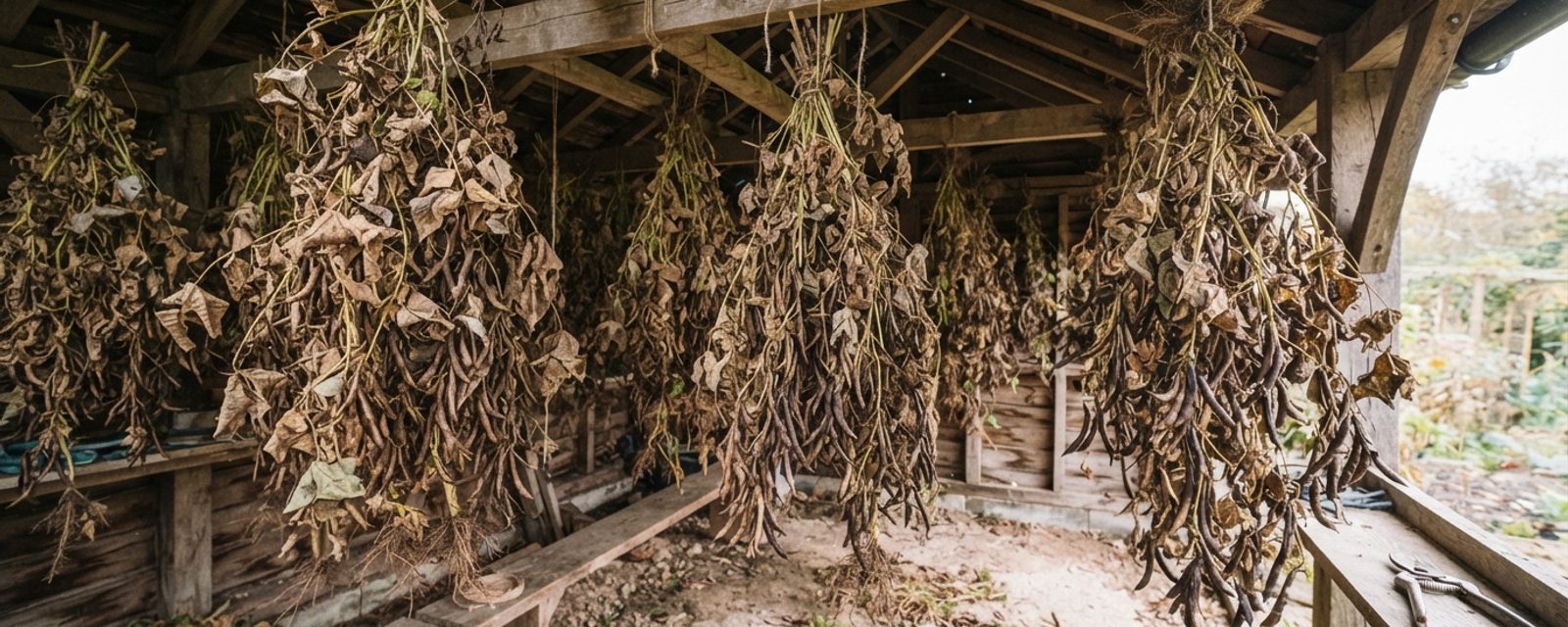
A bean pod that looks dry isn't the same as a bean that's dry enough to store. Below about 14-15% moisture, the bacteria and mould spores that would otherwise break a bean down simply can't get started, there isn't enough free water in the seed for them to use. Above that threshold, a jar of "dried" beans that feels hard and rattles can still soften, sweat, and turn mouldy within weeks. Getting a bean from the plant to genuinely shelf-stable is less about waiting for a certain look and more about driving off that last, invisible fraction of water.
What this article is (and isn't) about
This is about letting a much larger share of a runner bean, French bean, or broad bean crop dry fully on the plant so the beans themselves become food, a dried pulse for soups, stews, and casseroles over winter, the same category as a shop-bought bag of haricot or borlotti beans. It assumes the reader already knows how to grow the crop; for sowing, spacing, and support, see the runner bean, French bean, and broad bean growing guides.
It is not about picking pods young and stringless to eat fresh, the default method covered in those growing guides. It's also not the same as saving a few dried pods to replant next spring: seed-saving needs only a handful of pods per plant, stored in a labelled paper envelope, whereas drying for food means committing most or all of a plant's pods to the dry-down and storing the result in bulk, in an airtight jar, to eat.
What "dry" actually means
Teagasc, Ireland's agriculture and food development authority, publishes the moisture figures below for beans grown as a dried crop, a commercial arable-trial figure rather than a domestic garden one, but the underlying moisture chemistry is the same one at work in a kitchen jar:
| Moisture content | What that means |
|---|---|
| 20-25% | Fresh bean seed straight out of the pod |
| 18-20% | Can look and sound dry (shrivelled skin, some rattle) but still holds enough water for mould to establish in a sealed jar |
| 14-15% or below | Genuinely dry, too little free water left for mould or bacteria to get started |
That's the mechanism behind the classic dried-bean storage failure: a pod that felt "done" going into the jar at 18-20%, and beans that turned soft, sweated, or spotted with mould weeks later because they never actually reached the 14-15% mark. Garden Organic's guidance for broad beans names the opposite failure directly: pods left to dry outdoors may rot before they get there.
Which types actually suit drying
| Type | Suitability | Notes |
|---|---|---|
| Borlotti (French bean type) | Best suited | Mottled red-and-cream pods and beans; ‘Borlotto Lingua di Fuoco’ is a named RHS pick |
| Runner bean ‘Czar’ | Well suited | A climbing heritage variety bred to be left to mature and used like a butter bean |
| Cannellini (French bean type) | Well suited | Small white kidney-shaped beans |
| Broad beans | Suited, with more care | Pods and beans are prone to blackening and rotting if left out too long |
| Standard fresh-pod runner/French beans | Poorly suited | Bred for tender pod texture young, not seed yield at maturity |
Most named drying varieties, including the ones above, are climbing types rather than dwarf bush types, worth factoring in if choosing seed with this method already in mind next season.
When to stop picking fresh and let the crop go to dry
This is a one-way decision per plant, not per pod: once a bean plant is left to mature its pods instead of being picked every few days, it stops flowering and setting new pods, so the two harvest strategies can't really run side by side on the same plant for long. Pick a portion of the crop fresh through summer as normal, then choose a subset of plants, or the last flush of pods on existing plants, from July onwards and simply stop picking them, letting those pods run on to maturity instead. There's no fixed calendar date for the switch, it depends on when pods began setting and on the variety.
Getting pods to full dryness in Scotland
Two things affect drying outdoors here. Day-to-day dampness is the smaller issue: picking straight after rain adds surface moisture the beans then have to shed again, so RHS advises picking on a dry day where possible, and getting the last of the crop in before the first frost, check the regional frost-date reference for the area actually being gardened, since the gap between an upland glen and a coastal lowland garden can run to several weeks. A genuinely wet turn in the season is the bigger one: Garden Organic's guidance for both French beans and broad beans is to uproot the whole plant and hang it upside down somewhere warm and airy, a shed, porch, or similarly dry, dark spot, to finish drying under cover rather than risk it in the ground. For broad beans specifically, Garden Organic warns that pods left to dry outdoors in place may rot.
That fallback is built into the method wherever it's practised, not something Scotland's climate forces on top of it, the same way curing squash under cover, rather than in direct outdoor sun, is simply the accepted method here rather than a workaround. Start pods drying on the plant as normal, and treat pulling whole plants indoors as the standard response to a spell of wet weather, not a sign the crop has failed. Teagasc's commercial bean-growing region shares the same cool, wet, Atlantic-influenced climate with a short summer that much of Scotland does, a general climate description rather than a measured comparison of rainfall or growing-season length, and it publishes beans deteriorating only slowly even in the low-20s percent moisture range, provided they then dry down properly afterwards. That makes a slow finish under cover a genuine option, not a compromise. RHS's own fallback for pods that clearly won't finish before frost, pick, shell, and freeze the almost-mature beans, using them from the freezer like dried ones, covers the small number of stragglers that don't make it even that far.
Two gaps are worth stating plainly rather than papering over. No source names which drying-suited variety matures earliest, so there's no way to recommend one borlotti or runner type over another specifically for beating a Scottish first frost, sowing as early as the crop's frost tolerance allows is the only lever a reader has without that data. No source covers finishing a slow batch with gentle artificial heat, a very low oven, an airing cupboard, a dehydrator, as an alternative to hanging plants under cover; it may work, but it isn't recommended here since nothing confirms it.
Testing for true dryness
"Rattles in the pod" is a real signal but not a precise one, since pods can rattle before the beans inside have hit true shelf-stable dryness. Two more concrete checks work better in combination:
- The thumbnail test. Once shelled, a bean that's genuinely dry can't be dented with a thumbnail, it should feel rock-hard, with no give at all.
- The pod-colour test. Pods should have gone fully brown and brittle (or, for broad beans, black and crispy) with no green or grey patches remaining, a pod that snaps cleanly rather than bending has finished; any patch that still bends or feels leathery hasn't.
Both should pass before beans go into an airtight container; a bean that fails either test needs longer on the drying tray first.
Shelling and storage
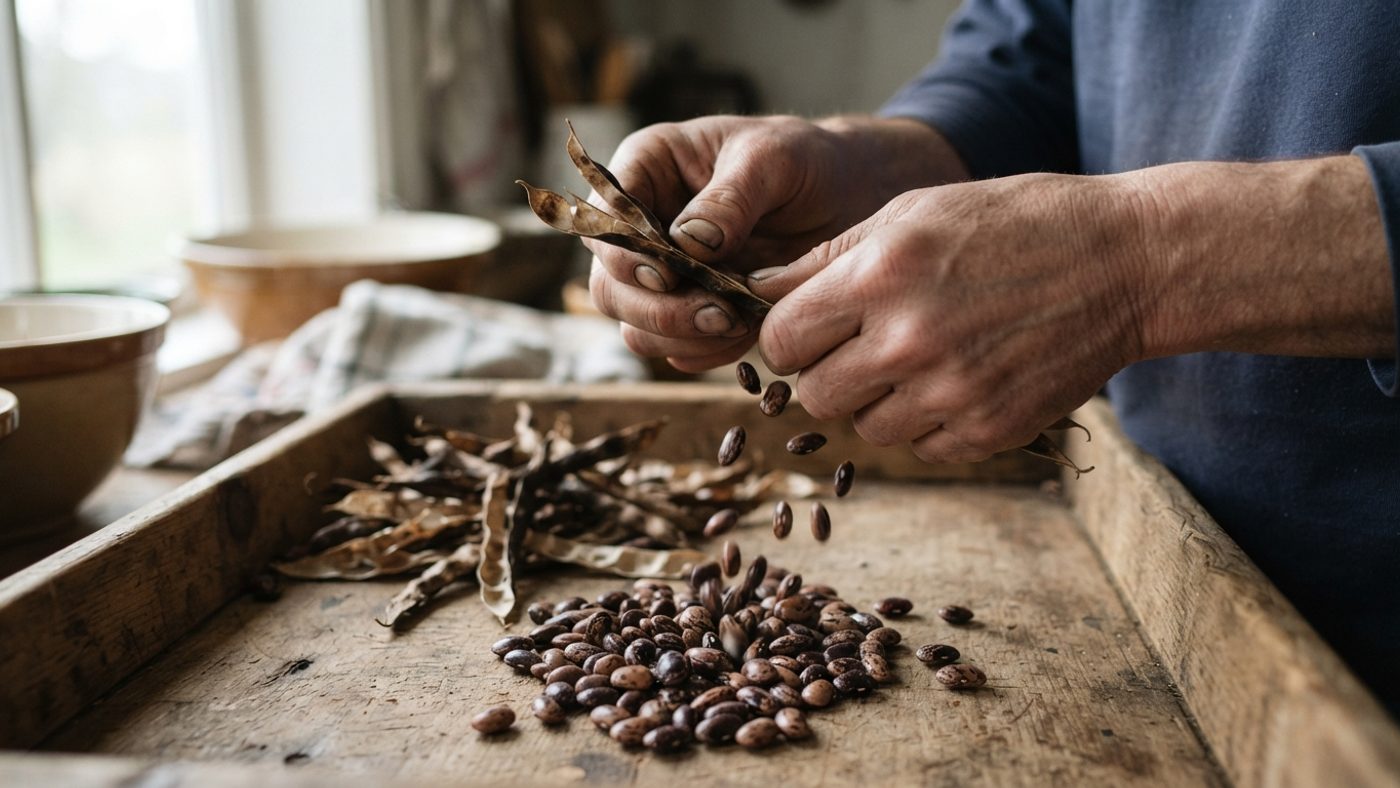
Once pods have dried fully, split them open by hand and pop the beans free. A pod that's still leathery will resist and is a sign it needs more drying time first, not more force. After shelling, spread the beans out on a tray in a warm, dry room rather than jarring them immediately, this final open-air stage is what actually gets rid of the residual moisture a rattling pod doesn't guarantee has gone. No source gives a fixed number of days for this stage, use the same thumbnail test as before rather than a calendar: once a bean genuinely won't dent, it's ready to jar.
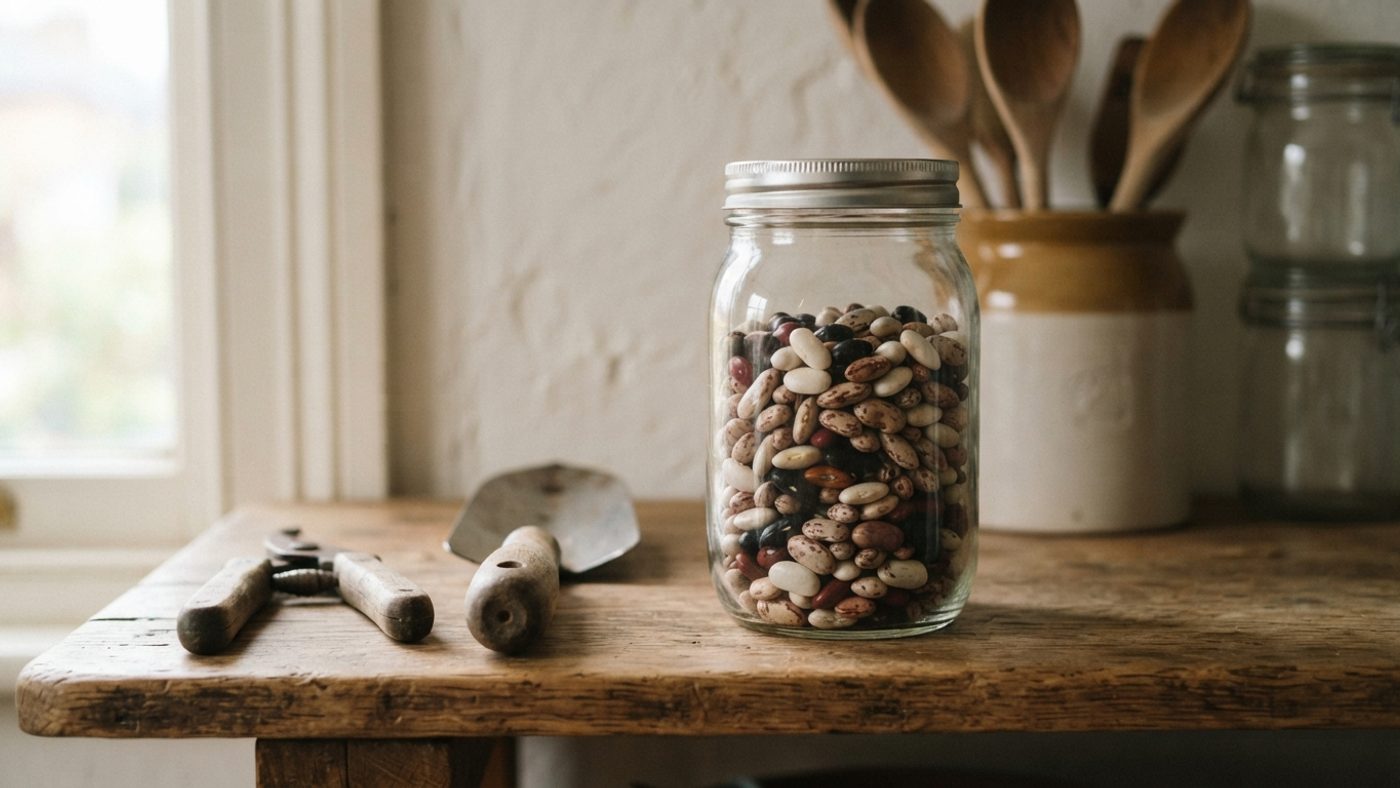
Store fully dried beans in an airtight jar (Kilner, Weck, or screw-top) somewhere cool and dark, they'll keep at best quality for several years there, or about a year in an ordinary kitchen cupboard. Beans kept for seed rather than eating go in a paper bag in a cool, dry place instead, and last at least 3 years for germinationA seed sprouting: breaking dormancy and putting out its first root and shoot, given the right warmth and moisture. Full definition →. The spread here isn't a contradiction so much as a difference in how conservative each figure is: "several years" assumes beans were dried thoroughly and kept somewhere consistently cool and dark, while shorter estimates assume more ordinary kitchen conditions. Either way, quality fades gradually well before the beans become unsafe to eat.
Common problems
Rot on the plant. Garden Organic's caution for broad beans is that pods left to dry outdoors can rot before finishing, the trigger for pulling the whole plant to finish indoors. Uneven drying within a batch. Pods on the same plant don't all mature together, so a single pick will contain some fully brittle pods and some still slightly green, sort and test individually rather than jarring a whole harvest as one batch. Picking after rain. Surface moisture adds back what the drying process is trying to remove. Small holes or grubs inside stored beans. This points to bean weevil or a similar seed-feeding insect laying eggs before harvest. No confirmed source-backed home treatment is given here, discard any bean that's visibly holed rather than risk the rest of the batch.
Common questions
Can I dry beans I originally grew to eat fresh, or do I need a special variety?
Most runner and French beans can be left to dry, but varieties bred for tender young pods rather than seed yield tend to give a smaller, less consistent dried harvest. If drying is the main goal, borlotti-type French beans or a variety like the runner bean ‘Czar’ are more reliable choices for next season.
How do I know when to stop picking pods fresh and let them dry instead?
It’s a per-plant decision, usually made from July onwards: once you stop picking a plant’s pods to let them mature, that plant stops flowering and setting new pods, so treat it as a one-way switch rather than something to do on and off through the season.
Is it actually realistic to dry beans outdoors in a Scottish autumn?
Yes. Start pods drying on the plant as normal, and if a wet spell threatens before they finish, pull the whole plant and hang it upside down somewhere warm and airy under cover to finish. That fallback is the standard response to any damp autumn, wherever the method is practised, not a special accommodation Scotland needs on top of it.
My beans rattle in the pod, are they dry enough to store?
Not necessarily. Rattling is a useful early sign but not proof, check further by trying to dent a shelled bean with a thumbnail. If it dents at all, it needs more drying time before going into an airtight container.
Why did my stored dried beans go mouldy?
Almost always because they weren’t fully dry before they were sealed into a jar. A bean can look and sound dry while still holding enough internal moisture for mould to take hold once air exchange stops, hence the thumbnail test before storage, not just the pod rattle.
How long will home-dried beans actually keep?
Realistically around a year at good eating quality in an ordinary airtight jar in a cool cupboard, extending to several years in ideal cool, dark, consistent storage. They don’t become unsafe overnight after that, quality just fades gradually, so treat the figure as a "best by" guide rather than a hard limit.
Sources
5 sources, recorded with what each was used for
- RHS: Beans for drying — grow your own: Harvesting/drying process, avoiding picking after rain, harvesting before first frost, freezing near-mature beans as a frost fallback, storage in airtight jars
- RHS: Growing beans for drying (feature): Variety recommendations (Czar, Borlotto Lingua di Fuoco, cannellini, Yin Yang/Calypso), dryness testing by rattle, drying on trays
- Garden Organic: How to grow broad bean: Rot risk when pods dry outdoors, bringing whole plants in to dry, pod colour/texture dryness cues ("black and crispy"), 3-year seed storage figure
- Garden Organic: How to grow French bean: Drying pods on the plant, uprooting and hanging plants indoors in bad weather, 3-year seed storage figure
- Teagasc: Beans — Harvest: Moisture content figures (20-25% at harvest, 14-15% needed for long-term storage), used as a climate-comparable technical reference, explicitly caveated as a commercial field-bean figure rather than a garden or Scottish one