
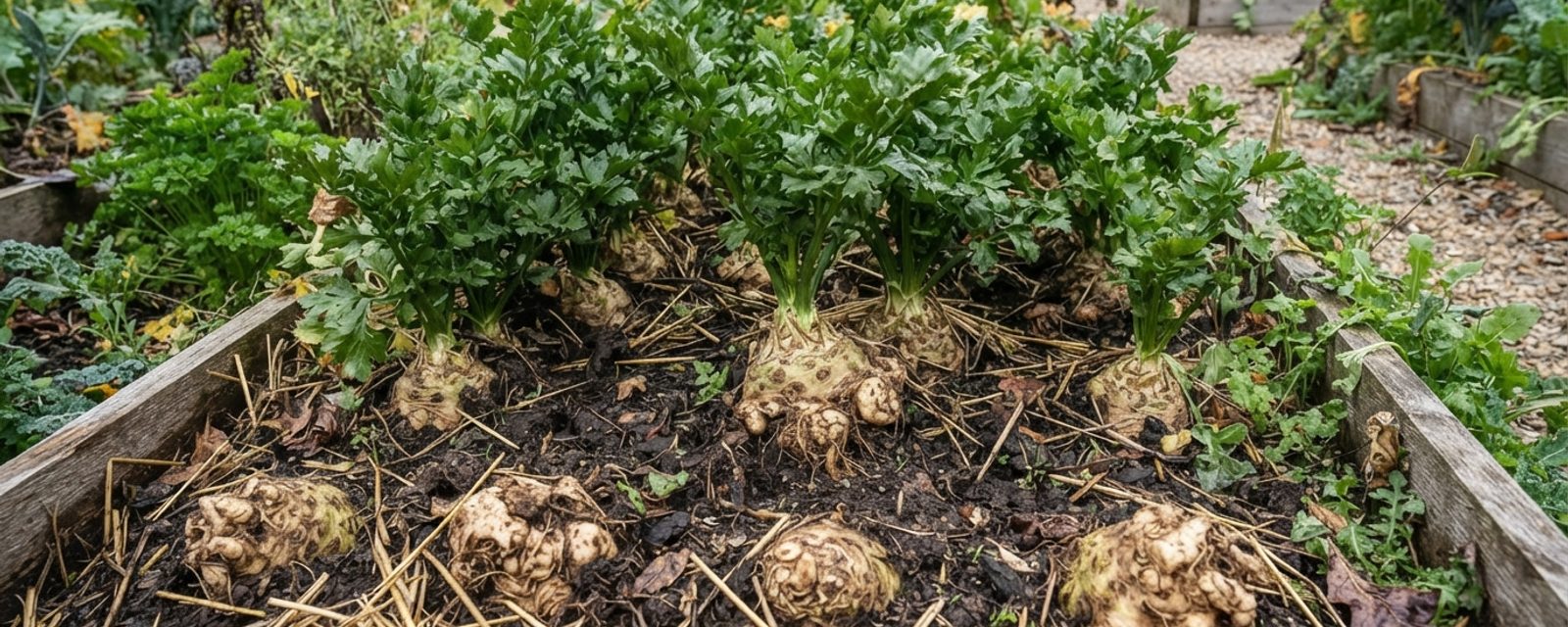
By the time carrots and beetroot need to be out of the ground or under a mulchA layer of material spread over the soil around plants to suppress weeds, retain moisture, and improve soil structure as it breaks down. Full definition →, celeriac is only getting started. Both of those roots max out at "through to March" if conditions are kind. Celeriac, left in the ground, can go further still, RHS's own celeriac guidance describes it as hardy enough to remain in the ground until needed, with plants dug up as required. That's not a small difference in planning terms: the decision about celeriac doesn't have to be made on the same autumn schedule as the rest of the root bed, and for most plots, the honest answer is that it doesn't need to be made at all.
Why celeriac's timing is different
Carrots and beetroot are lifted or mulched against a real deadline: a hard freeze reaching an exposed root splits or softens it, so both crops get covered or brought in before the worst of winter. Celeriac faces the same frost but tolerates it better; the root itself isn't at risk from moderate cold. The practical limit is the ground, not the root: RHS recommends a thick straw mulch for colder regions, specifically to stop the soil freezing solid, since frozen ground makes lifting difficult even though the celeriac underneath it is unharmed.
Practically, this means the usual root-vegetable autumn rush, checking frost dates, getting carrots and beetroot out or covered before the first hard frost, doesn't apply to celeriac in the same way. Check regional frost timing if a specific harvest date needs planning, or for the carrot and beetroot crops that do face that deadline, but celeriac's own calendar is closer to "whenever it's convenient" than "before it's too late."
Drainage, not cold, is the one place local ground conditions do change the decision. Heavier, slower-draining soil, clay especially, and low-lying or high-rainfall plots generally, holds more water through winter than free-drainingSoil that lets water pass through quickly rather than pooling, so roots aren't sitting in wet ground after rain. Full definition → ground, and that's exactly the condition the waterlogging exception below is written for.
In-ground storage: the default, and usually the right one
Leaving celeriac where it grew is the lower-effort option, and for most gardens it's also the better one. The roots need no attention beyond the mulch already described in the celeriac growing guide: clear away old leaves as the plant matures so the crownThe base of a perennial plant where roots and shoots meet, often sold and planted as a ready-made dormant plant rather than grown from seed. Full definition → stays exposed, then before the hardest frosts arrive, pile on a thick layer of straw to keep the ground workable. After that, lifting is just a matter of forking up whatever's needed, whenever it's needed, from October through to March or later.
There's also a flavour argument for leaving roots in place rather than lifting everything at once. Both RHS and Gardener's World note that the longer celeriac stays in the soil, the stronger its flavour gets, a root lifted in December has had longer to develop than one lifted in October, a genuine incentive to lift only as much as is needed for the week ahead rather than clearing the whole bed early out of habit.
In-ground storage has one real weak point: heavy or waterlogged soil. RHS's advice is specific on this, on heavy soil or a site prone to winter waterlogging, dig up and store celeriac in late autumn instead of leaving it in place. Sitting water around a root that's otherwise happy to overwinterKeeping a plant alive and intact through the cold months, whether left outdoors, moved under cover, or stored dormant. Full definition → causes exactly the rot in-ground storage is supposed to avoid, so the decision here turns on drainage rather than on cold. A raised bed or a well-drained patch removes the problem; heavy clay or a low-lying corner of the plot doesn't, whatever the temperature does.
A second, less common risk in situ: an extended hard freeze can lock ground solid for a week or more in colder inland and upland areas, making forking up a root genuinely impractical even under a good mulch. Where a spell like that is forecast, lift what's likely to be needed over the following fortnight beforehand rather than relying on being able to dig through frozen ground at short notice. Slugs and mice can also work into an exposed crown over a long, mild, wet stretch, worth a spot-check on a few roots after any such spell. On an exposed or coastal plot, a stiff winter gale can also rock a tall, leafy plant enough to loosen its grip in the soil; a mulch that also weighs down and steadies the base helps here as well as insulating it.
A traditional soil-and-straw clamp isn't the standard advice for celeriac from either source used here, and given that it already stores well simply left in place, there's little reason to build one for a typical home crop. Once the worst of winter has passed and roots are being lifted as needed rather than protected against a hard freeze, the mulch itself needs no special removal, let it rot down into the bed once the row is cleared.
Lifting and storing indoors
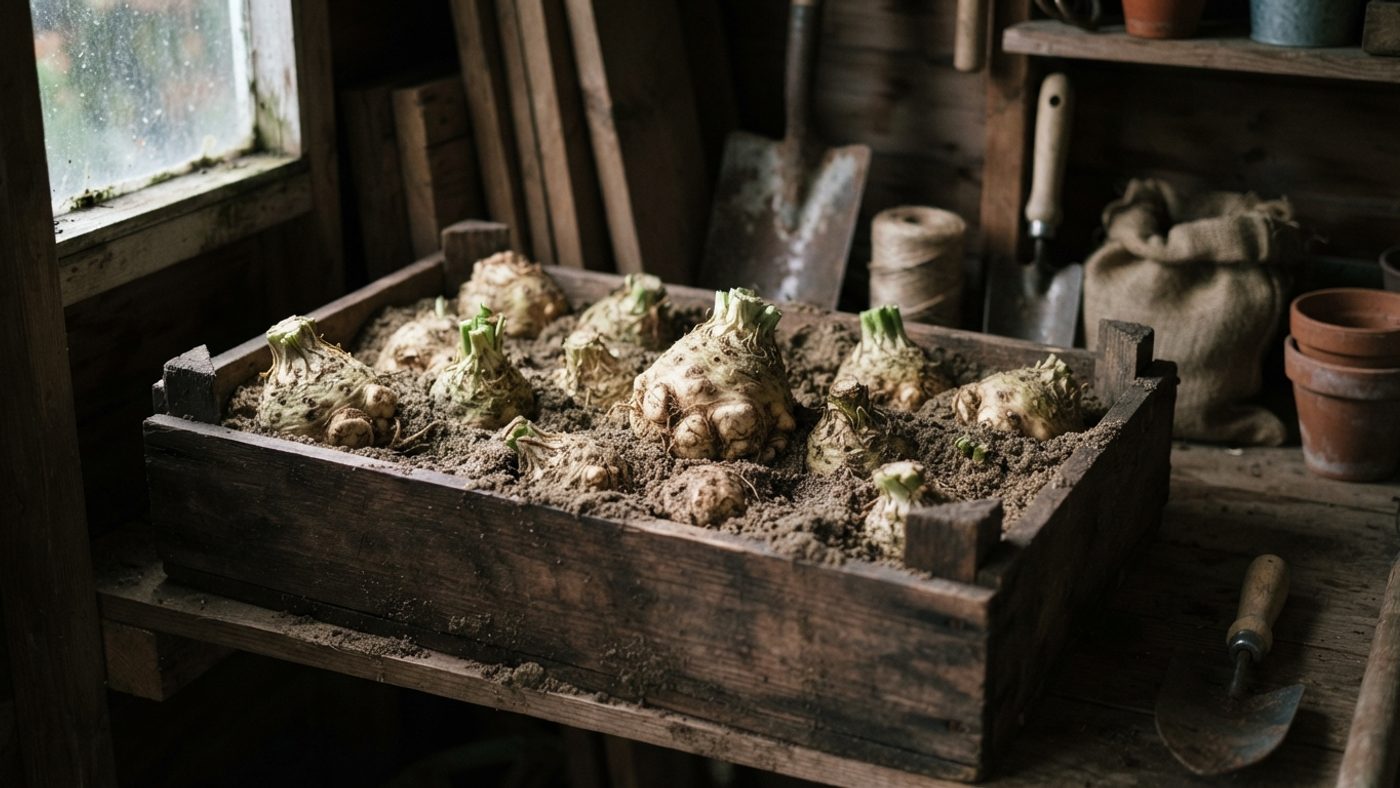
Where the ground needs to be freed up, or where drainage rules out leaving roots in place, the lifted method is straightforward. Twist the leaves off close to the crown rather than cutting them, and don't wash the roots, Garden Organic's general storage advice is to brush off loose soil instead, since a damp surface left after washing works against the storage rather than for it. Pack the roots into a container of moist sand, peat-freeCompost made without peat, which is harvested from a slow-forming, carbon-storing wetland habitat that peat extraction damages. Full definition → potting compost, or coir, RHS names potting compost or coir specifically for celeriac, and sand for root vegetables generally including celeriac, so any of the three does the job; the goal is to keep the medium slightly damp, not wet, so the crown and root don't dry out and shrivel over winter.
Store the container somewhere cool, dark, and frost-free, a shed, garage, or cellar, aiming for the same 0-4°C range used for carrots and beetroot in the same kind of box; no separate figure is published for celeriac specifically, but the storage requirement is identical across all of them. Given that celeriac is best left in the ground and used fresh, lifted storage is best treated as a fallback for when the ground is genuinely needed back, not as an upgrade on leaving roots in place.
Handling celeriac's shape and crown
Celeriac isn't a smooth root like beetroot or a tapered one like a carrot, it's knobbly, with a mass of fine roots and soil-holding crevices around a crown that's been kept exposed above soil level all season rather than buried. That shape has two practical consequences at storage time. First, brushing soil off cleanly is harder than with a smooth root, and it's more tempting to reach for water to get it properly clean, worth resisting for the same reason as with any root going into storage, since a damp surface is where rot gets a foothold. Second, the exposed crown and its cluster of side roots and old leaf bases are the part most likely to trap moisture or damaged tissue, so it's worth a closer look at the crown end specifically, not just the visible surface of the swollen root, when checking a stored celeriac over.
Checking on stored roots
Whichever method is used, check stored celeriac every couple of weeks rather than leaving it untouched until it's needed. Only sound roots with no blemishes or broken skin should go into storage in the first place, since a root cannot heal once it's been damaged; any that are already damaged or beginning to spoil should be used immediately rather than added to the store.
Signs to look for: softening, discolouration, or a sour smell at the crown or cut surfaces mean rot has set in, pull the root and use or discard it rather than letting it sit against sound roots nearby. A little surface mould on the packing material in a lifted box isn't unusual over a long winter and doesn't necessarily mean the roots themselves are affected, but it's worth wiping out and refreshing the packing medium if it appears.
In-ground vs lifted storage, compared
| In-ground | Lifted (compost, coir, or sand box) | |
|---|---|---|
| Effort | Low — mulch and leave | Moderate — lift, pack, find storage space |
| Realistic duration | Through to spring | No fixed duration published; similar cool-store season into early spring if roots stay sound |
| Best suited to | Free-draining soil, no urgent need for the bed | Heavy or waterlogged ground, or the bed is needed back |
| Main risk | Waterlogging; frozen ground making lifting difficult during a hard cold spell | Drying out or rot if packing material isn’t kept damp |
Using part of a root, or freezing instead
Celeriac doesn't need to be used whole once lifted. A root that's been cut into can be kept a short while longer in the fridge, wrapped or in a container, but it won't last anywhere near as long as an intact, unlifted one. For a root still in the ground or in a storage box, the better approach is to only lift or unpack as much as is needed for the week ahead, leaving the rest whole and undisturbed for as long as possible.
Celeriac also freezes reasonably well once peeled, chopped, and blanchedExcluding light from part of a growing plant, usually by earthing up, wrapping or covering, so it grows pale, tender and less bitter. Full definition → briefly in boiling water before cooling and bagging, the same principle used for carrots and other root vegetables going into the freezer. It won't keep the texture of a freshly lifted root, so it suits a stockpile of stewing or mashing celeriac rather than replacing either storage method above, but it's a genuine option where shed space is tight or a heavy crop has been lifted all at once.
Common questions
Can celeriac really be left in the ground all winter in Scotland?
Yes, on free-draining soil, with a straw mulch as standard rather than an extra for only the harshest sites. The one exception: on heavy or waterlogged ground, lift and store indoors in late autumn instead, since sitting water causes the rot that in-ground storage is otherwise good at avoiding.
What’s the actual difference between storing celeriac in compost, coir, or sand?
Very little in practice. RHS names potting compost or coir for celeriac specifically, and moist sand for root vegetables generally, celeriac included. Whichever is used, the material just needs to stay slightly damp, not wet.
How do I know when a celeriac root is actually ready to lift, rather than just deciding on a date?
Size is the practical guide: a root that’s reached tennis-ball size or larger is worth harvesting, though there’s no upper limit forcing you to lift it by then, unlike a crop such as kohlrabi that turns woody past a certain point. A smaller root is still usable, it just peels down to less.
Will an exposed celeriac crown survive a hard Scottish winter left in the ground?
Yes, provided the ground itself doesn’t freeze solid or sit waterlogged, a mulch handles the first, free-draining soil the second. The crown’s exposure is a growing requirement, not a winter vulnerability.
Can I still use part of a celeriac root once it’s been cut into?
Yes, but only for a short while, once cut, keep the remainder wrapped or in a container in the fridge rather than back in long-term storage, since a cut surface won’t keep the way an intact root does.
Sources
4 sources, recorded with what each was used for
- RHS: Celeriac — grow your own: Celeriac hardy enough to remain in the ground until needed, straw mulch for colder regions to stop the soil freezing, twisting off leaves before storing, peat-free potting compost or coir as packing medium, lifting in late autumn on heavy or waterlogged ground, October-to-March harvest window
- RHS: Root vegetables — storing: Celeriac described as best left in the ground and used fresh but storable in moist sand in boxes; general sand/box method shared across carrots, celeriac, swedes and beetroot; 0-4°C and frost-free/dark storage location
- Garden Organic: Harvesting and storing vegetables: No washing/scrubbing at harvest, twisting leaves off close to the crown, layeredPropagating a new plant by pinning a low, flexible stem into the soil while still attached to the parent, so it roots before being cut free. Full definition → box storage with damp packing material, produce needing to be blemish-free going into store since it can’t heal once damaged
- BBC Gardeners' World Magazine: How to grow celeriac: "The longer they stay in the soil, the stronger the flavour," and the October-to-March harvest window (independently confirmed on RHS's own page too)