
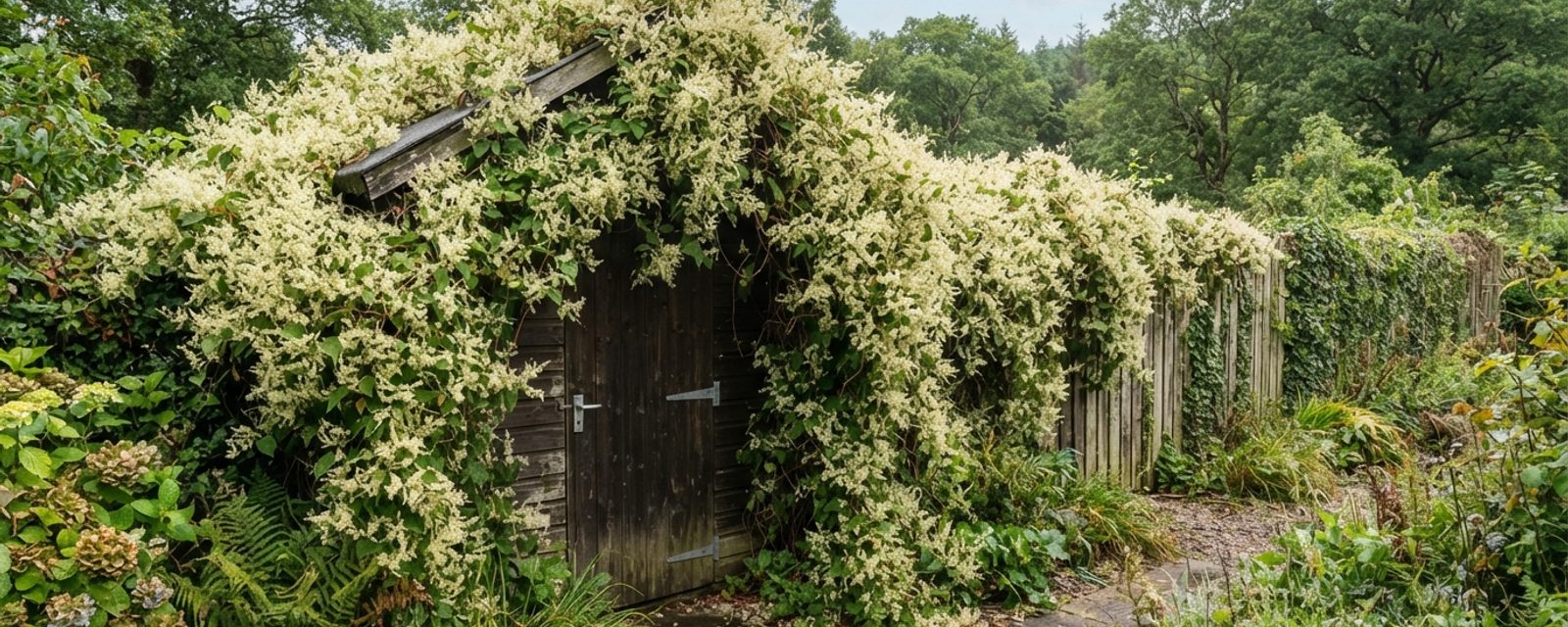
The shed roof went first. By late July the ridge tiles had disappeared under a mat of heart-shaped leaves, and by August the whole structure had a green, faintly triangular silhouette instead of a shed-shaped one. Somewhere under there was still a fence, and possibly a bit of next door's hedge. The plant had started the year as a modest climber against a trellis; six months later it was pulling guttering away from the wall, and the flower clusters (panicles) of small creamy-white, pink-tinged blooms foaming over everything made it look almost deliberate, like a planting scheme gone feral.
The first question most gardeners ask at that point is whether they're looking at Japanese knotweed. The second, once they've worked out they aren't, is whether they're now in some kind of legal trouble. Mostly, no. But "not the same legal category as knotweed" and "not a problem" are different things, and the amount of cutting, digging and hauling ahead is real.
What you're actually looking at
This is almost certainly Russian vine, Fallopia baldschuanica, also sold and written about under the older names Polygonum baldschuanicum and Fallopia aubertii. It's also known as mile-a-minute plant, mile-a-minute vine, Chinese fleeceA lightweight, breathable fabric laid or draped over plants to trap a little warmth and keep off frost, wind and some flying pests. Full definition → vine, fleece flower and silver lace vine. It's a vigorous, woody, twining deciduous climber with heart-shaped dark green leaves, grown as a wall shrub. It flowers in summer, producing panicles of small pink-white flowers, later followed by small pink fruits.
Its native range runs from Pakistan to Tajikistan, a fact worth holding onto, since it turns out to matter for the legal section below, not just as background. It was introduced into British gardens around 1894, purely as an ornamental.
Scale is the giveaway. Left unchecked it reaches 8-12 metres in height with a spread of 4-8 metres, and the "mile-a-minute" nickname isn't pure hyperbole, a single growing season is enough for it to run several metres along a fence line, up a shed wall or into the canopy of a small tree. It's rated hardy to below −20°C, so a Scottish winter doesn't set it back the way it might a marginal plant; it comes back every spring ready to do the same thing again.
Russian vine sits in the same family, Polygonaceae, as Japanese knotweed, and the two get confused constantly, partly because of that shared "impossible to control" reputation, partly because both are climbing, spreading, leafy thugs that turn up uninvited. They are not the same plant, they are not covered by the same legal regime, and they are not disposed of the same way.
Russian vine vs Japanese knotweed: the actual differences
| Feature | Russian vine (Fallopia baldschuanica) | Japanese knotweed (Fallopia japonica) |
|---|---|---|
| Growth habitA plant's characteristic shape and manner of growth, such as upright, spreading, creeping or bushy. Full definition → | Twining climber, needs something to climb up (fence, shed, tree, hedge) | Upright shrub-like stand with bamboo-like canes; doesn’t twine or need support |
| Leaves | Heart-shaped | Broad, roughly shovel- or shield-shaped, with a flat base |
| Stems | Slender, wiry, twining | Hollow, jointed, cane-like, often reddish-purple speckled |
| Flowers | Small creamy-white/pink-tinged panicles in late summer | Small creamy-white flower clusters, similar timing |
| Listed on Schedule 9, WCA 1981 | Not listed | Listed |
| Waste classification | Ordinary garden waste | Controlled waste under the Environmental Protection Act |
| Regrowth from root fragments | Root system can reshoot if not fully removed; not known to regenerate from tiny rhizome fragments the way knotweed does | Notorious for this, rhizome fragments as small as 1cm can grow into new plants |
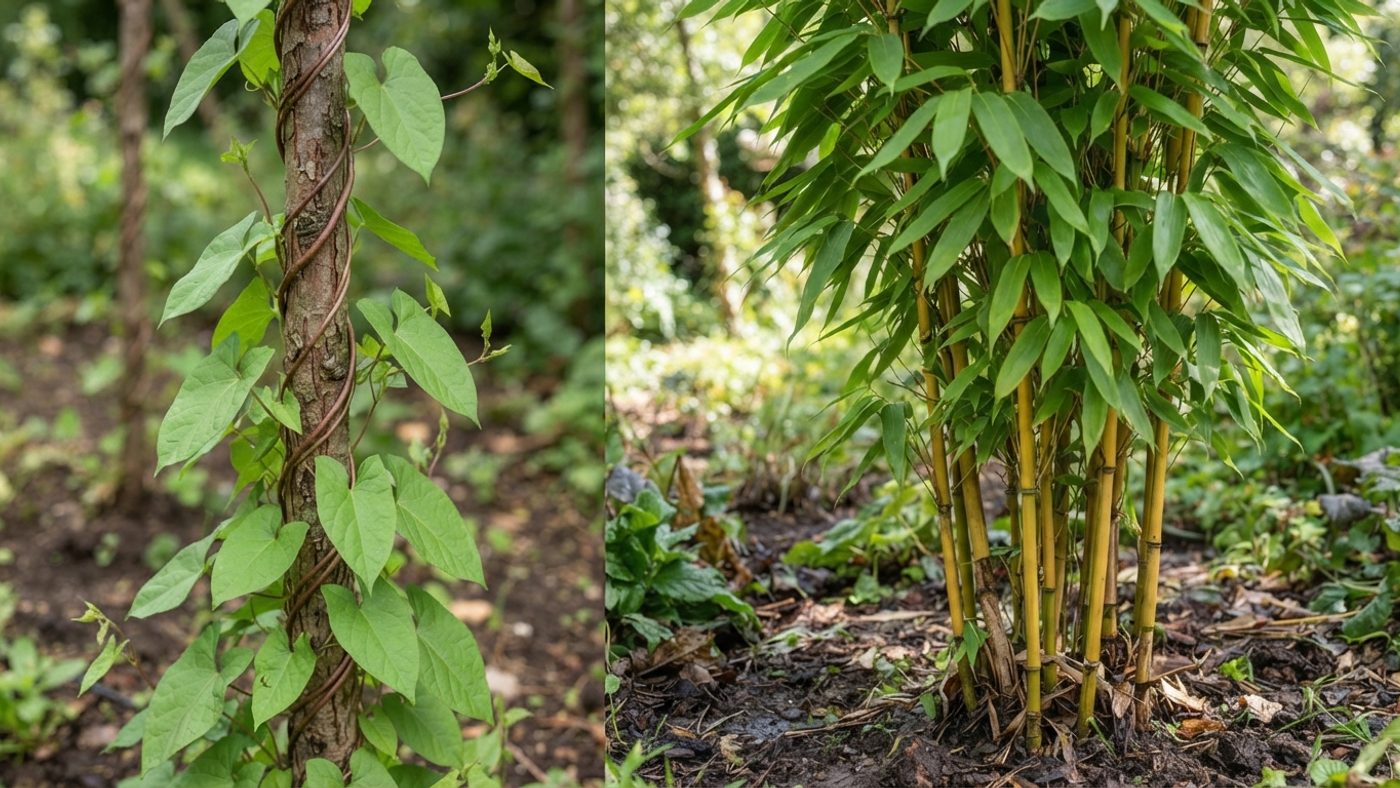
The clearest field check is habit: knotweed stands up on its own like a dense stand of canes; Russian vine climbs and twines and needs something to climb. If what's in front of you is scrambling over a fence or up into a tree rather than standing as a self-supporting thicket, that's already pointing away from knotweed.
The legal position, and it's not quite the same north of the border
Japanese knotweed's legal weight comes from a specific listing: in England and Wales it appears on Schedule 9, Part II of the Wildlife and Countryside Act 1981, and Section 14 of that Act makes it an offence to plant a listed species or otherwise cause it to grow in the wild. That England-and-Wales list also names giant hogweed, Himalayan balsam, Rhododendron ponticum, and a number of other invasive non-natives, but it isn't the test that applies in Scotland, for reasons that matter here. Fallopia baldschuanica, Polygonum baldschuanicum and "Russian vine" do not appear on that list under any of those names, in any case.
In Scotland, Section 14 reads differently, and doesn't use that list at all: the offence covers planting, or otherwise causing to grow, any plant in the wild at a place outwith its native range. Russian vine's native range is Pakistan to Tajikistan, nowhere near Scotland, so anywhere in Scotland counts as outwith its native range, and if it's caused to grow in the wild here, that falls within the broader Scottish duty regardless of Schedule 9. Growing it in a garden is a different matter, covered below.
| England and Wales | Scotland | |
|---|---|---|
| What triggers the offence | Planting, or causing to grow in the wild, a species named on Schedule 9 | Planting, or causing to grow in the wild, any plant at a place outwith its native range, no list required |
| Does Russian vine’s absence from Schedule 9 matter? | Yes, decisive. No listing, no offence. | No, Schedule 9 isn’t the test here |
Critically, in both jurisdictions the duty attaches to cause, not to simply having an established plant on your land: it's about not letting seed, cuttings or fragments spread into the wild, a hedge bank, a riverside, waste ground beyond the garden boundary, not about the plant existing in the garden itself. An established specimen already growing in a garden isn't, on this wording, committing anyone to an offence just by being there. A defence is available where reasonable steps were taken to prevent it, and licences can be issued in specific circumstances such as reintroduction projects. The Statutory Group on Non-Native Species coordinates the various public bodies with responsibilities in this area; anyone who spots a concerning stand spreading into truly wild ground, rather than an established garden problem, can log it through Scotland's Environment web page on invasive non-native species.
Put plainly: Russian vine doesn't carry Japanese knotweed's Schedule 9 baggage anywhere in Great Britain, so there's no formal notification duty and no controlled-waste classification attached to it, two of the reasons knotweed carries such a heavy reputation with buyers, lenders and surveyors, and neither applies here. What's different in Scotland is the underlying "don't let a non-native plant spread into the wild" duty, which is broader here than England and Wales's Schedule 9 test and does technically reach Russian vine once it's actually spreading beyond the garden, the reporting route above is what that looks like in practice, not a routine concern for an established garden specimen.
Why it's still worth taking seriously regardless
The weight of the growth alone can pull at guttering, fence panels and shed roofing; the twining habit works stems into gaps in trellis, fascia boards and hedge branches in a way that's genuinely difficult to unpick without damaging whatever it's climbing on. Left to run into a small tree, it can smother the canopy enough to shade out the tree's own leaves. It's a plant named among "garden thugs" capable of quickly outgrowing an average garden and smothering or outcompeting whatever's nearby. Anyone considering planting it fresh, rather than dealing with an existing one, is worth steering toward a spot with real room to spare, a boundary fence or a small shed is rarely it.
Getting it back under control
Because it's a woody climber rather than a herbaceous weed, control is closer to shrub pruning than to spot-treating a lawn weed. Non-chemical control, cutting and digging out, handles the vast majority of thuggish garden climbers like this one, and weedkiller is generally the wrong tool here, since many are resistant to it, or need several repeat applications to have any real effect.
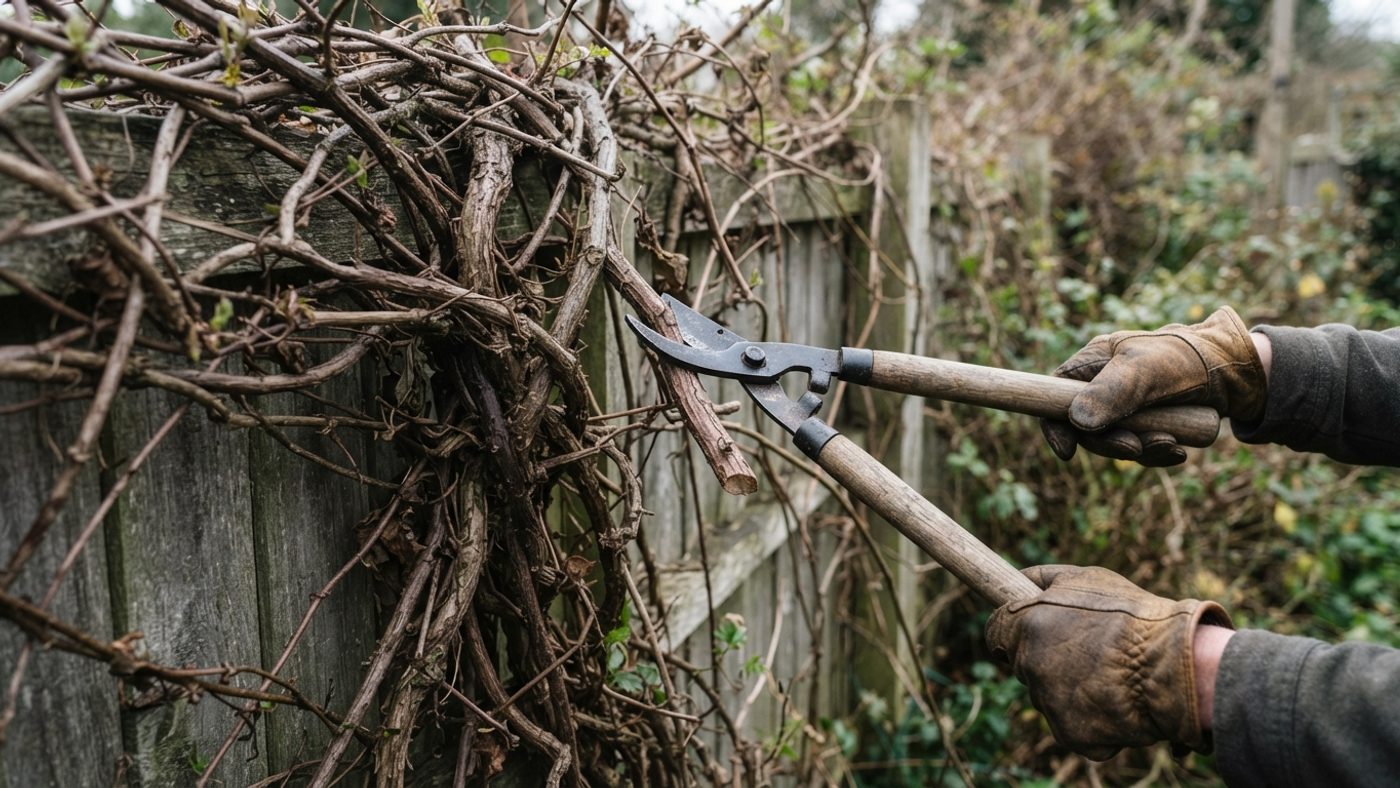
Cut back hard. Removing the top growth first, the mass smothering the shed, fence or hedge, makes the base and root crownThe base of a perennial plant where roots and shoots meet, often sold and planted as a ready-made dormant plant rather than grown from seed. Full definition → (the woody point where the roots meet the stems) accessible and stops the plant putting further energy into the parts you're about to remove anyway. There's no fixed optimal season specifically for this plant, but tackling the heaviest cut while it's leafless and dormant over winter makes it far easier to see what's actually being smothered underneath, before following up through the growing season for regrowth.
Dig out the root system. Use a spade and border fork to lift as much of the root system as possible. Getting the crown and main roots out gives the best chance of stopping it resprouting from the same point.
Watch for regrowth from what's left behind. Russian vine isn't documented as reshooting from the tiny, centimetre-scale rhizome fragments that make Japanese knotweed so hard to eradicate, but a root system that hasn't been fully dug out can still resprout from whatever's left in the ground. Follow up over the next season and remove any new shoots while they're small, rather than assuming one dig-out has finished the job.
Expect it to take more than one session, particularly on an established specimen that's had several years to build a woody root crown.
For anything climbing into a tree canopy, or where the vine has worked itself deep into guttering, fascia or roofing, it's worth treating that as a job for a professional rather than a ladder-and-secateurs afternoon, see removing large tree branches safely for the line between DIY and calling one in.
Disposing of the cuttings
Russian vine is not classed as controlled waste, unlike Japanese knotweed, where the plant and any contaminated soil fall under separate legal handling requiring a registered waste carrier and an authorised disposal site. Ordinary garden waste routes are fine for Russian vine. As with any thuggish, vigorous plant material, don't put the tougher roots, rhizomes or woody crown into a home compost bin, since a domestic heap usually doesn't get hot enough to kill them off, put that material into a council green waste bin or take it to a local recycling site instead. Softer top growth can usually go straight into green waste or compost without the same concern.
If it's coming from next door
There's no formal notification or removal mechanism aimed specifically at Russian vine encroaching from a neighbour's side of a boundary, the way there increasingly is around knotweed. Practically, that makes it a conversation rather than a legal process, worth raising early, since a vine that's already several metres into your garden only gets heavier and more entangled with fencing the longer it's left.
Common questions
Is Russian vine illegal to grow in the UK?
It isn’t listed on Schedule 9 of the Wildlife and Countryside Act 1981, so it doesn’t carry Japanese knotweed’s specific legal baggage, no notification duty, no controlled-waste classification. In Scotland, the broader duty not to cause any non-native plant to spread into the wild still technically applies to it, the same as it would to most garden plants that aren’t native here, but that’s about preventing spread beyond the garden, not about keeping an established plant.
How do I tell Russian vine apart from Japanese knotweed?
Habit is the clearest check: Russian vine is a twining climber that needs something to grow up, with heart-shaped leaves and small creamy-white to pink flower panicles in late summer. Japanese knotweed stands upright on its own as a dense, cane-like stand with hollow, jointed, often reddish-speckled stems and broader, shield-shaped leaves, it doesn’t climb or twine.
Can I put Russian vine cuttings in my green waste bin?
Yes. It isn’t classed as controlled waste, so ordinary council green waste bins or local recycling sites are fine for the material. Avoid putting tougher roots and rhizomes into a home compost bin, since domestic heaps often don’t get hot enough to kill them.
How many growing seasons should I expect this to take, realistically?
For a specimen that’s had several years to build a woody root crown against a shed or fence, plan on more than one season: an initial hard cut-back and dig-out, then at least one follow-up season checking for new shoots from whatever root was left behind. A younger, smaller plant tackled early is often a one-season job, the size and age of what you’re dealing with matters more here than the technique itself.
My neighbour’s Russian vine is growing over my fence, can I make them remove it?
There’s no statutory notification or removal duty specific to Russian vine the way there increasingly is around Japanese knotweed. It comes down to a direct conversation with the neighbour rather than a legal process.
Sources
6 sources, recorded with what each was used for
- Wildlife and Countryside Act 1981, Schedule 9: Checked directly for “Fallopia,” “Polygonum” and “Russian vine”: none of these appear in Part II (Plants), which lists Japanese knotweed, giant hogweed, Himalayan balsam, Rhododendron ponticum and other invasive non-natives instead
- Wildlife and Countryside Act 1981, Section 14: The England/Wales wording (tied to species named on Schedule 9) and the current Scotland wording (planting, or causing to grow, any plant in the wild at a place outwith its native range, with no list requirement), plus the Section 16 licensing/defence provisions
- gov.scot: Invasive non-native species: The Scottish duty applying to any non-native plant caused to grow in the wild outwith its native range, the availability of Section 16 licences for specific circumstances, the Statutory Group on Non-Native Species, and the reporting route via Scotland’s Environment web page on invasive non-native species
- RHS: Fallopia baldschuanica (Russian vine): Identification (leaf shape, flower/fruit description, common names), height and spread figures (8-12m x 4-8m), hardiness ratingThe RHS's H1a–H7 scale for how much cold a plant can survive outdoors, H1a being tender indoor-only and H7 hardy anywhere in the UK. Full definition →, native range (Pakistan to Tajikistan)
- RHS: Garden thugs — potentially invasive plants: Names Russian vine specifically as capable of fast outgrowing an average garden; non-chemical control (cutting/digging) recommended over weedkiller; dig-out method; disposal guidance
- RHS: Japanese knotweed: Used for the Japanese knotweed comparison points only: its Schedule 9 listing, controlled-waste classification, and regrowth from rhizome fragments as small as 1cm