
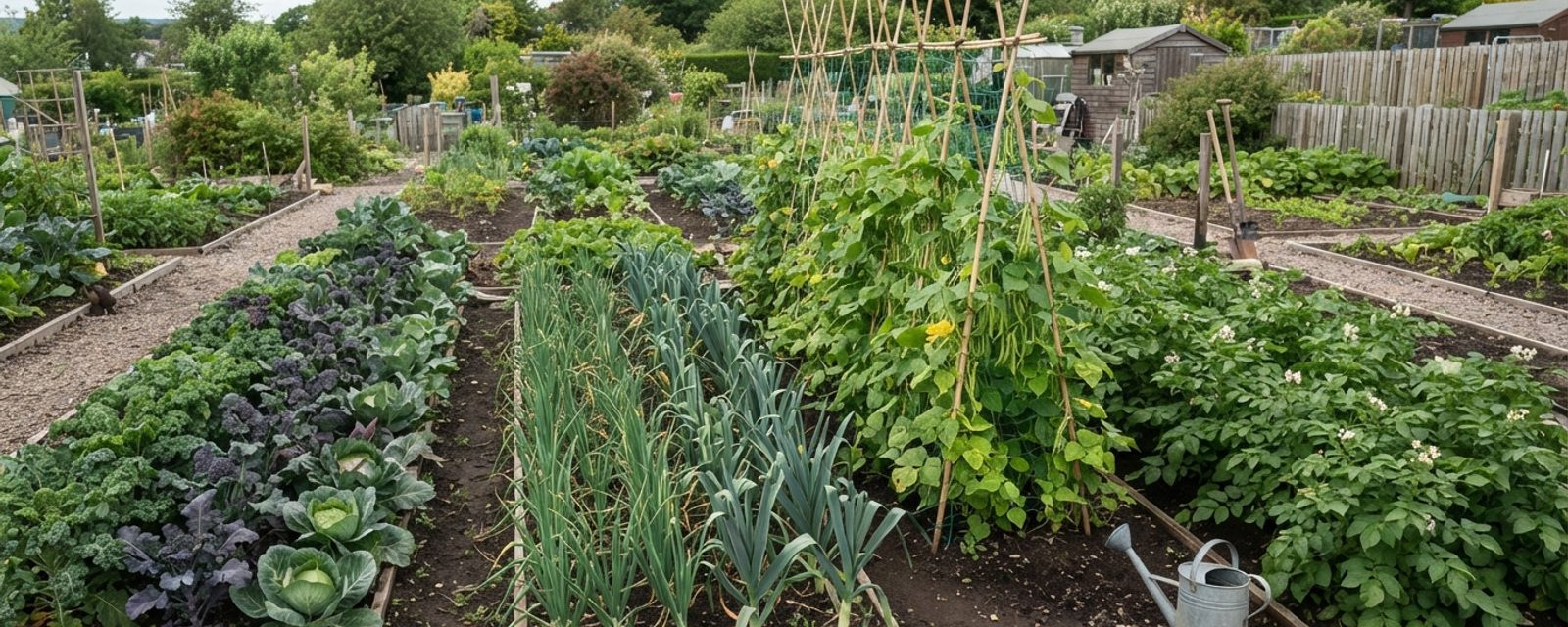
Every plant family draws on the soil in a particular way and leaves behind a particular set of soil-borne organisms that specialise in attacking it. Grow the same family in the same patch of ground year after year and two things build up in parallel: the pests and pathogens that target that family multiply because their host keeps reappearing on schedule, and the specific nutrients that family relies on get drawn down faster than they can replenish.
Why rotation works: what's actually happening in the soil
ClubrootA soil-borne fungal disease of the brassica family that swells and distorts roots, and survives in soil for years. Full definition → spores can persist in soil for up to 20 years once brassicasThe cabbage family: cabbage, kale, broccoli, cauliflower, Brussels sprouts, kohlrabi, swede, turnip and more, sharing the same pests, diseases and rotation rules. Full definition → have been grown there repeatedly, waiting for the next cabbage or kale crop to infect. Onion white rot behaves the same way: it survives in the soil as sclerotia, small hard resting bodies the fungus forms to sit dormant in soil until an allium root triggers them, and they can remain viable for at least 15 years. Neither organism can do much damage to a plot growing something else, so moving each family to fresh ground each year starves the pathogen of its host while it's still building up to damaging numbers.
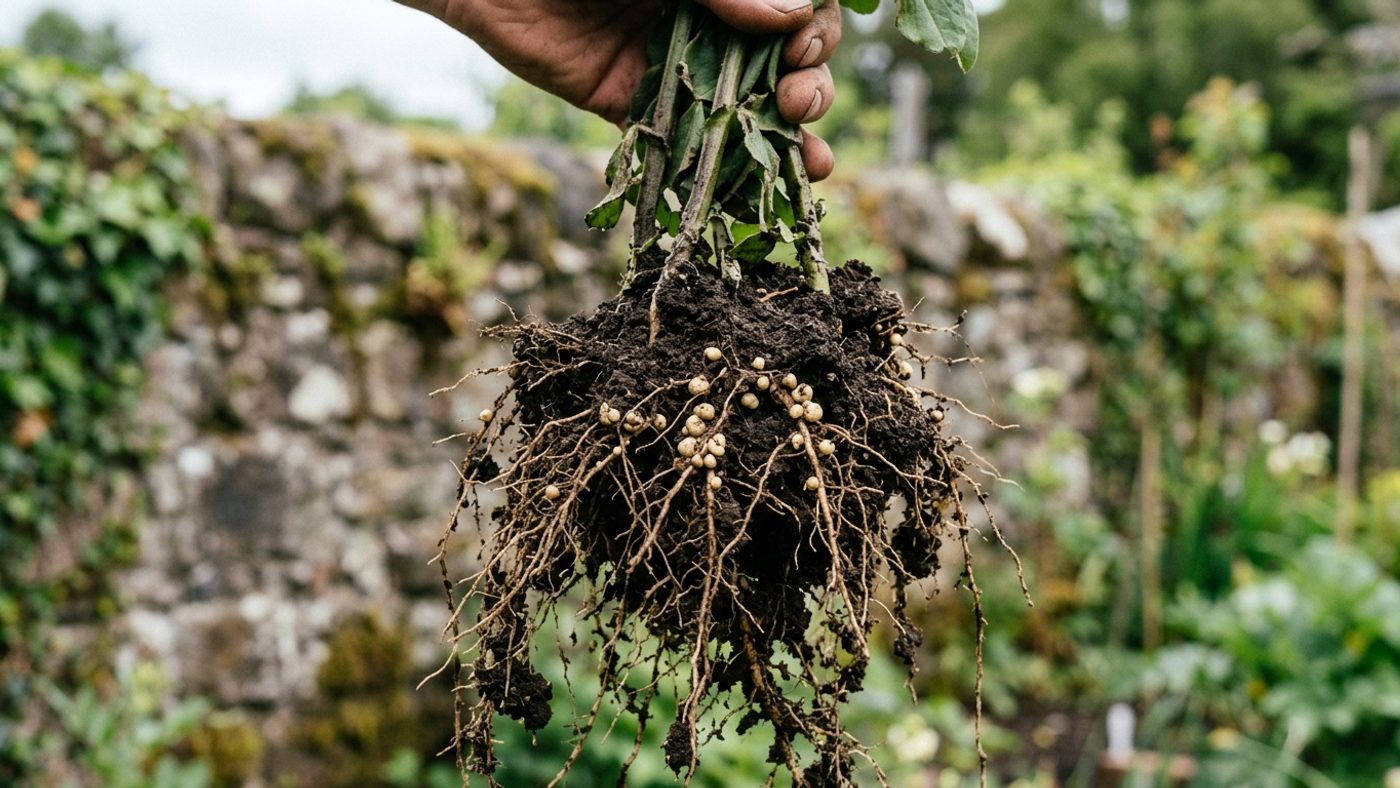
The nutrient side works in the opposite direction: legumes (peas, broad beans, French and runner beans) fix atmospheric nitrogen into the soil through bacteria living in nodules on their roots, leaving the ground richer in nitrogen than they found it. Cutting the plants off at soil level at the end of the season, rather than pulling the roots out, leaves those nodules in the ground to break down and feed whatever follows. Brassicas are heavy feeders that do well following legumes for exactly that reason. Roots, by contrast, tend to fork and split in freshly manured, nitrogen-rich ground, so they're better placed after a crop that has already used up some of that fertility, typically brassicas or alliums, not straight after manuring. A rotationMoving each crop family to different ground each year, on a multi-year cycle, so pests and diseases that build up in soil don't get a repeat host. Full definition → plan is really just a way of sequencing these two mechanisms, pest/disease starvation and nutrient hand-off, so each bed works in the crop's favour rather than against it.
The four core groups to rotate
- Brassicas, kale, broccoli, calabrese, cauliflower, cabbage, Brussels sprouts, kohlrabi, pak choi, and also swede, turnip, radish, rocket and land cress. Swede and turnip are Brassica napus and Brassica rapa respectively, and radish belongs to the same family too, all commonly mistaken for roots, but botanically brassicas through and through, and vulnerable to clubroot along with every other family member.
- Legumes, French beans, broad beans, runner beans, peas. The nitrogen-fixers of the rotation; best followed by a hungry brassica crop.
- Alliums, onions, garlic, leeks, shallots, spring onions. The group most at risk from onion white rot and allium rust.
- Roots, carrots, beetroot, parsnips, celeriac. Best on ground that wasn't recently manured, and good to follow brassicas or alliums.
- Nightshades (Solanaceae), tomatoes, potatoes, peppers, chillies, aubergines. Potatoes are the one grown outdoors at scale and belong firmly in the outdoor bed rotation; tomatoes, peppers, chillies and aubergines are more often grown under cover, so they're less of a rotation concern for an open plot. Clear away every potato tuberA swollen underground stem or root a plant uses to store energy, which can also grow into a new plant, the classic example being a potato. Full definition → at harvest rather than leaving small ones behind, a volunteer potato sprouting the following spring, outside its rotation slot, is a common way blight and other soil-borne potato problems carry over between years, blight itself is most common in warm, wet weather, conditions much of Scotland gets more of than the UK average.
A worked 4-bed, 4-year rotation
This is the classic structure behind most allotment rotation plans: four beds, four families, each family moving one bed along every year so it takes four years to return to the same ground. Exact sowing and planting months vary by individual crop and by how far north or how exposed the plot is, so treat the table below as which family goes where, not when, check each crop's own sowing window before planting.
| Bed | Year 1 | Year 2 | Year 3 | Year 4 |
|---|---|---|---|---|
| Bed A | Legumes | Brassicas | Alliums & roots | Potatoes |
| Bed B | Brassicas | Alliums & roots | Potatoes | Legumes |
| Bed C | Alliums & roots | Potatoes | Legumes | Brassicas |
| Bed D | Potatoes | Legumes | Brassicas | Alliums & roots |
Alliums and roots share a bed here deliberately, both prefer ground that isn't freshly manured, so pairing them means one crop doesn't have to wait behind the other for depleted-enough soil. Along any single bed's row, the sequence always runs legumes, then brassicas, then alliums/roots, then potatoes, in that order, before looping back, the same four-step hand-off, just read left to right instead of down the family list.
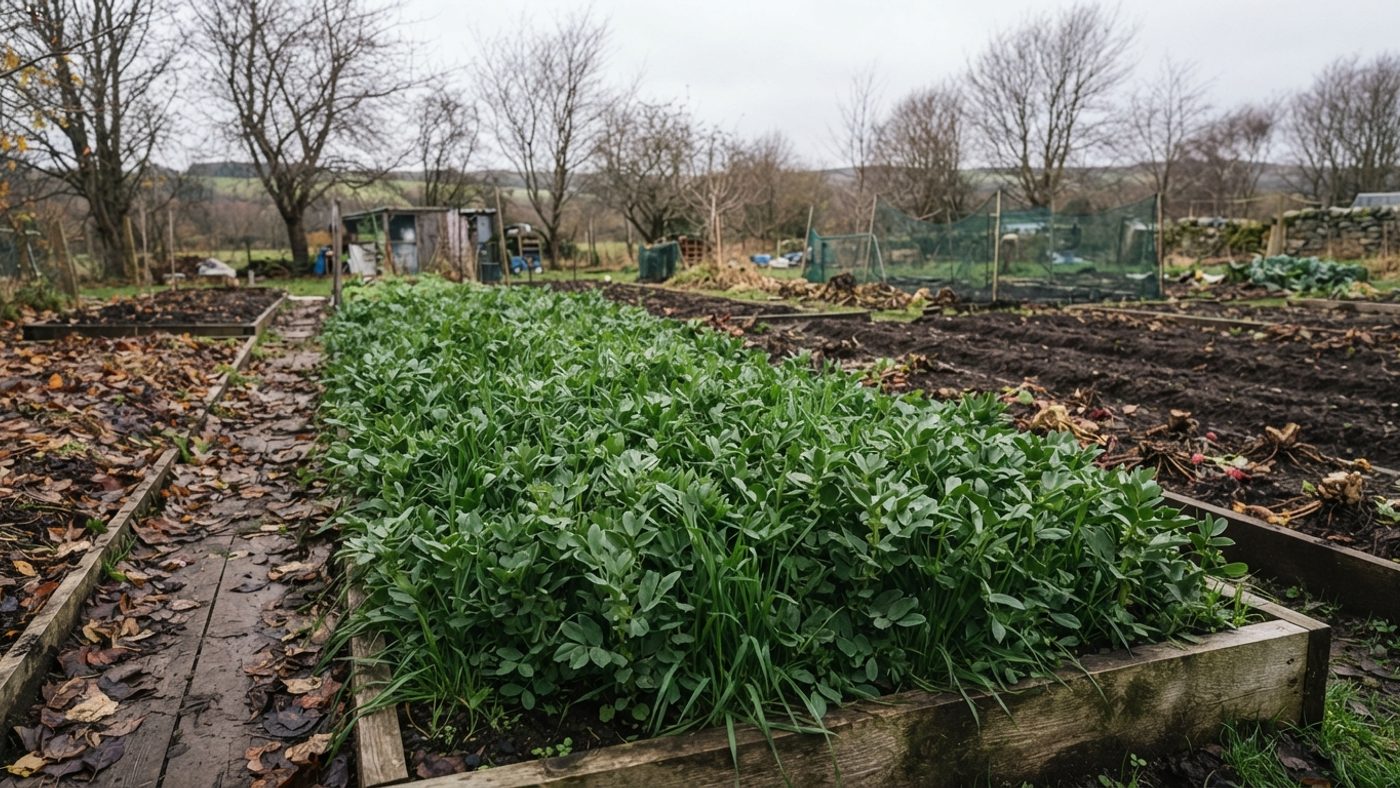
In practice, Bed A in Year 1 might carry broad beans in spring followed by a late sowing of peas; the same bed in Year 2 goes to kale, calabrese and a row of swede; Year 3 puts in leeks, onion setsSmall immature bulbs planted directly rather than grown from seed, giving a faster, more reliable crop in a short growing season. Full definition → and a bed of carrots and beetroot; Year 4 takes maincropThe main, usually latest-sown and longest-growing type of a crop, grown for bulk and storage rather than an early harvest. Full definition → and early potatoes, manured the previous autumn. Meanwhile Bed D is running potatoes in Year 1, so the whole plot is never carrying more than one bed of any family group, and every bed sees all four groups exactly once every four years. A bed sitting empty over a long, wet Scottish winter between one crop coming out and the next going in is also worth sowing with a green manureA fast-growing crop sown specifically to be dug back into the soil, adding organic matter and, with legumes, fixing nitrogen. Full definition →, field beans or grazing rye both overwinterKeeping a plant alive and intact through the cold months, whether left outdoors, moved under cover, or stored dormant. Full definition → well and are sown August to November, rather than leaving it bare. Dug back in before the next crop goes in, either holds the soil structure together and keeps nutrients from washing straight through over the wettest months. Skip mustard here specifically: it's a fast, popular green manure but it's a brassica itself, so sowing it ahead of this rotation's brassica bed just extends that family's time in the ground instead of resting it. Field beans carry the same logic in reverse, as a legume, they're a natural fit ahead of a brassica bed, but sowing them as green manure in a bed that's due to take the legume food crop the following year effectively runs two legume seasons back to back, so keep grazing rye for that particular slot instead.
Green Manures for a Short Scottish Season → goes species-by-species through the sowing windows above, plus which quicker summer green manures are worth fitting in when a bed empties earlier in the year.
What doesn't fit the standard groups
- Perennials, asparagus, rhubarb, globe artichoke. These occupy the same ground for several years running, so they need a permanent bed of their own outside the rotation entirely, not a slot that gets reassigned annually.
- Flexible crops, courgettes, cucumbers, squash, pumpkins, sweetcorn. None of these belong to the four core families, and none carry the same soil-borne disease risk, so they can go wherever there's space, useful as gap-fillers when a bed is under-planted or a crop has failed.
Does Scotland's soil make this more important?
There's one place where local conditions genuinely change the calculus: clubroot. Scotland's soils tend to be more acidic and higher in organic matter than the rest of the UK, and most vegetables do best around pH 6.5. Clubroot risk rises specifically in ground that's both wetter and more acidic than that, and flooding helps spread it between areas, guidance from Farm Advisory Service Scotland written with oilseed rape in mind, but clubroot is the same soil-borne organism on any brassica, garden or field, and its wet/acidic triggers work the same way on both. The table below sets Scotland's own figures against that pH 6.5 benchmark and against a drier part of the UK:
| Measure | Typical Scottish figure | For comparison |
|---|---|---|
| General-purpose garden pH target (RHS) | pH 6.5 | — |
| Scottish farm soil below pH 5.8 (SRUC survey) | Close to half of samples | — |
| Scottish farm soil above pH 6.2 (SRUC survey) | Around one in five samples | — |
| Annual rainfall, wettest Scottish Highlands sites | 4,000mm+ | Around 500-700mm, driest parts of eastern England (Met Office) |
Where heavy, poorly-drained ground and a soil test showing low pH genuinely coincide on a plot, test the soil and lime it, and keep the brassica bed on the strictest rotation the plot can manage. Liming has a trade-off worth knowing: pushing pH up too far, or too often, favours potato common scab instead, so test before liming rather than adding it as a matter of routine, and keep the potato bed out of any patch that's just been limed for brassicas.
Clubroot-resistant cultivarsA plant variety that arose or was bred under cultivation and is kept true by deliberate propagation, rather than a naturally occurring wild species. Full definition → are worth growing alongside rotation and liming on ground that's already infected, not instead of them, RHS names cabbage 'Kilaton F1The first-generation offspring of two specific, deliberately chosen parent plants, bred for a predictable, uniform result but not worth saving seed from. Full definition →' and Brussels sprouts 'Crispus F1' among cultivars bred with some resistance, though none is fully immune. On a small plot, the space itself is usually a bigger everyday limit on how strict a rotation is achievable than the weather is, the same is true on allotments the length of the UK.
Common mistakes
- Rotating on too small a plot to matter. If a "bed" is only a metre or two across, pathogen spores and pests can often reach the next bed over anyway, rotation reduces risk, it doesn't guarantee immunity, and on a very cramped plot the benefit shrinks accordingly.
- Losing track of where potatoes actually sit. Potatoes are a nightshade, not a root, and they're usually the crop that goes into freshly manured ground, put them in the wrong slot and the bed that should have taken hungry potatoes instead gets root vegetables that fork and split in overly rich soil. Potato cyst nematode (eelworm) is the other reason to keep potatoes strictly on their own rotation slot: like clubroot and white rot, it's a soil-borne pest that builds up wherever the same family keeps returning, spreads in soil carried on tools and boots, and can cut tuber yield by more than 80% where it's established, serious enough that Scotland's own seed potato scheme requires land to test free of it before seed potatoes can be planted there at all.
- Underestimating how big the brassica family is. Swede, turnip and radish are all brassicas, not roots. A gardener who diligently rotates cabbage and broccoli but then plants radish or swede in what they think is the "roots" bed is unknowingly putting brassicas back into ground that should have been clubroot-free that year, breaking their own rotation without realising it.
- Treating onion white rot as something rotation fixes. Once white rot sclerotia are established in soil, they survive for at least 15 years, longer than any practical rotation cycle, so rotation mainly helps prevent alliums building up disease pressure in the first place; it can't be relied on to clear an already-infected patch.
Common questions
Do I need to rotate if I only grow a few vegetables?
If you're only growing one or two crops from a single family, formal rotation matters less, the main risk is repeated brassica or allium crops in exactly the same soil. Still avoid planting the same family in the same spot two years running where you can.
Where do potatoes go in a rotation?
Potatoes are part of the nightshade (Solanaceae) family, not roots. They're typically grown in freshly manured ground and placed at one end of the rotation sequence, with roots and alliums coming later once that fertility has been used up by an intervening crop.
Can I skip a year of rotation?
Occasionally, yes, without major harm, but skipping repeatedly, or reverting to the same bed two years in a row for a brassica or allium crop, is exactly the pattern that lets clubroot or white rot build up in the soil.
What if I don't have room for four separate beds?
A three-bed version works by combining legumes with brassicas (since legumes feed brassicas well) and running alliums/roots and potatoes as the other two groups. Fewer beds means faster cycling back to the same ground, so treat pH management and not overcrowding brassicas as more important, not less.
Is swede or turnip a root vegetable or a brassica?
Botanically, both are brassicas (Brassica napus and Brassica rapa), along with radish. Plant them in the brassica slot of your rotation, not the roots bed, putting them in the wrong bed is one of the most common ways gardeners accidentally undermine their own rotation.
Sources
12 sources, recorded with what each was used for
- RHS: Crop rotation: Core rotation groups, 3-year/4-year plan structure, exceptions for perennials and flexible crops
- RHS: Club root: Clubroot host range, spore survival (up to 20 years), link to acidic/wet soil, resistant cultivars
- RHS: Onion white rot: Sclerotia soil persistence (at least 15 years), why rotation alone can't clear established infections
- RHS: Potato blight: Blight being most common in warm, wet weather
- RHS: Soil pH and testing: The general-purpose pH 6.5 target most vegetables do best around
- RHS: Green manures: Field bean and grazing rye as overwintering green manures, and mustard's own clubroot risk as a brassica-family green manure
- Garden Organic: Planning your planting: Four-year rotation model and nutrient hand-off between hungry and light-feeding crops
- NatureScot: Scotland's soils: Scotland's soils tend to be more acidic and higher in organic matter than the rest of the UK
- SRUC: Acidic soils could be affecting production on many Scottish farms: Survey findings on Scottish farm soil pH distribution
- Farm Advisory Service Scotland: Clubroot: Clubroot risk highest in wet, low-pH ground; drainage and liming as key levers (written for oilseed rape, but the same pathogen affects all brassicas)
- SASA (Science and Advice for Scottish Agriculture): Potato Cyst Nematodes (PCN): PCN yield impact, spread via infested soil, and the Scottish Seed Potato Classification Scheme requiring PCN-free land
- Met Office: How much does it rain in the UK?: Regional rainfall figures used in the Scotland-vs-UK rainfall comparison