
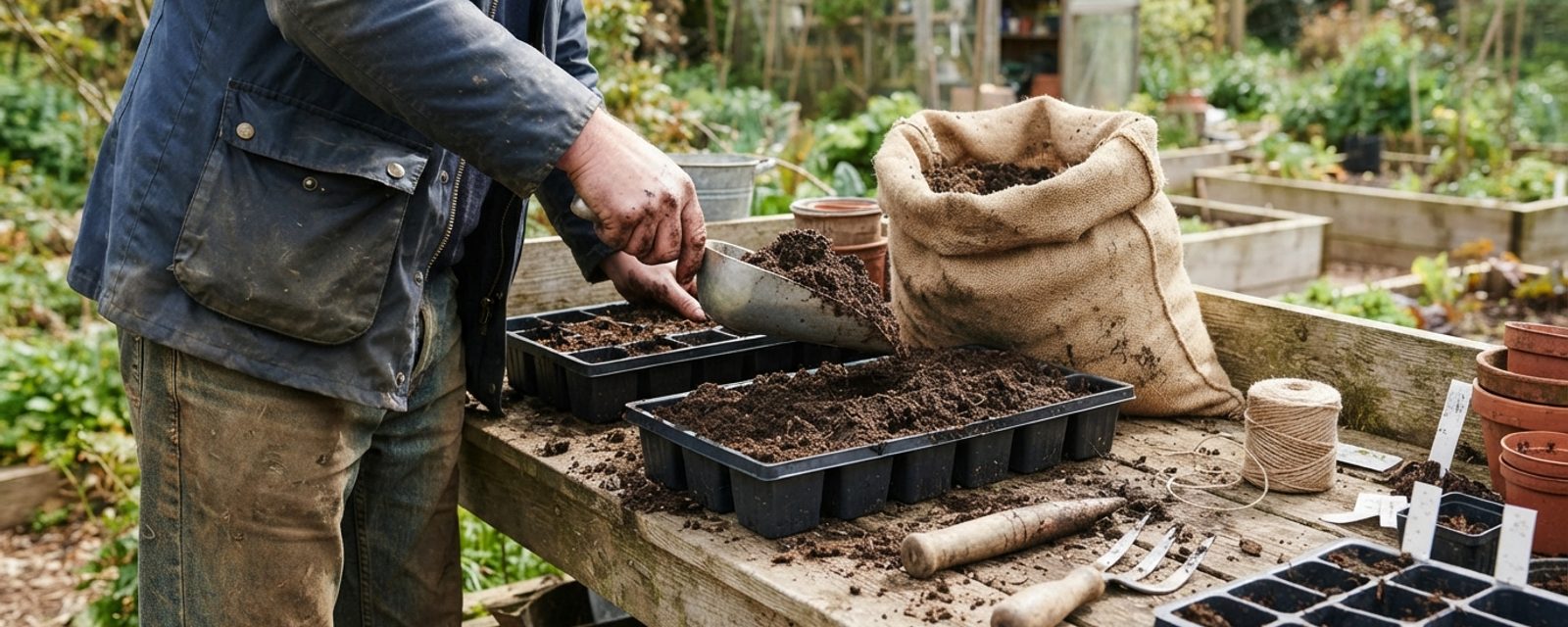
Seed compost isn't a blank slate. Even a good-quality mix can carry low levels of Pythium, Phytophthora, Rhizoctonia and Fusarium, the oomycetes and fungi that cause damping off. These organisms are opportunists: they're often already present in small numbers, and what turns them into a seedling-killing problem is the environment a propagator unintentionally builds around them, high humidity, poor air circulation, and seed sown too thickly. Damping offA fungal disease that kills seedlings at soil level, usually caused by overwatering, poor airflow, or reused unsterilised compost or trays. Full definition → can affect most seedlings, particularly under those conditions, and is especially damaging in spring when light levels and temperatures are low and seedlings grow slowly.
That framing matters before reaching for a sterilisation method, because it means the pathogen load in the compost is only half the equation. A tray of perfectly sterile compost, overwatered and left in a sealed propagator lid with no ventilation, can still succumb. For the full symptoms, identification and non-chemical control options, see the damping off pest page.
Scotland's spring conditions make that exposure window longer, not shorter. Low light and cool temperatures are the aggravating factors, and later last-frost dates across most of Scotland (see the regional frost dates guide) mean seedlings often have to sit in trays and modulesA tray divided into small individual cells, each sown with its own seed or seedling, so each plant grows undisturbed roots until it's ready to plant out. Full definition → for longer before it's safe to plant them out, more time for damp, humid conditions to matter, whatever the compost started out carrying.
The finding that matters most: buying fresh usually beats sterilising
Seedlings raised in commercial growing compost usually start free of damping-off organisms. Fresh, bagged seed or multipurpose compost is manufactured to be free of the pathogens that cause damping off, along with weed seeds, that's part of what a buyer is paying for over garden soil or old compost. Starting clean matters more here than it would somewhere with a shorter, milder spring: the longer a seedling sits in a tray waiting for Scotland's later frost-free window, the longer any surviving pathogen has to find its moment. Sterilisation is a fallback for when home-produced compost must be used instead, not a routine step for shop-bought material with nothing to sterilise out of it.
That reframes the home-sterilisation question. A lot of the oven/microwave advice circulating online is really solving a problem, reused or homemade growing media carrying disease, that's more directly solved by not using that media for seed sowing in the first place. Garden Organic's own seed-sowing guidance backs this from a different angle: it doesn't recommend sterilising, it recommends making a purpose-built seed mix (equal parts loam, good-quality topsoil, and sharp sand, with sieved leafmould if available) rather than repurposing ordinary garden compost, which it says is unsuitable for seed sowing because it has too many nutrients.
Compost guidance for the shop-bought route points the same direction: always buy fresh bagged compost rather than an old, stale or waterlogged sackful, buying only as much as can be used within six to eight weeks, and sealing the bag after use to stop bugs and weed seeds getting in. Compost that's been open on a shelf for a year, or reused from last year's pots, has already had ample opportunity to pick up contamination that a fresh bag hasn't. Most bagged mixes sold today are peat-freeCompost made without peat, which is harvested from a slow-forming, carbon-storing wetland habitat that peat extraction damages. Full definition →, which holds and drains water differently to the peat-based mixes older advice was often written around, one more reason to follow the bag's own watering guidance rather than an old habit, whatever compost is used.
When sterilising reused compost or soil is actually worth it
Sterilising earns its effort in narrower circumstances:
- Reusing old potting compost for cost or waste reasons, where buying fresh every time isn't practical or affordable, and the compost has no obvious contamination (no mould, no smell, no history of damping off in that batch).
- Garden soil needed for a specific mix, for example bulking out a homemade seed compost with loam, where the soil is going into direct contact with germinatingA seed sprouting: breaking dormancy and putting out its first root and shoot, given the right warmth and moisture. Full definition → seed rather than being used as a mulchA layer of material spread over the soil around plants to suppress weeds, retain moisture, and improve soil structure as it breaks down. Full definition → or border amendment.
- Compost that's already caused a damping off outbreak, though here RHS advice is stronger than "sterilise and reuse": never reuse pots and trays in which damping off has been a problem. The same caution applies to compost that was in direct contact with an affected sowing; treating containers as disposable, or thoroughly disinfecting them, is the recommended position, not treating the growing medium as salvageable with heat.
For compost that's simply left over from healthy, disease-free pots, RHS's own guidance on reusing spent compost doesn't ask for sterilisation at all, it recommends mixing spent compost roughly 70:30 with fresh organic matter for containers, digging it into borders, or using it as a mulch. That's a materially lower bar than seed sowing, because plants in pots are unlikely to suffer soil-borne diseases, so the compost from dead container plants is generally safe to reuse for those lower-risk uses, sowing seed into it directly is a different, higher-risk use the guidance doesn't extend to.
What actually kills the pathogens, and the honest gap in home methods
RHS advice names the method, steam sterilisation, for treating home-produced compost, but its published guidance doesn't specify an exact home-appliance temperature or duration for gardeners to work to. A lot of oven-bake and microwave instructions circulating online quote quite specific numbers, a target soil temperature and a timed hold, but no recognised horticultural authority backs a precise figure for home use, so treat any single exact number as a rule of thumb someone invented, not a verified standard.
What can be said with more confidence, from general plant pathology: Pythium and Phytophthora are oomycetes, water moulds, not true fungi, and generally the easier of the four to kill with heat. Rhizoctonia and Fusarium are true fungi, more heat-tolerant, and need sustained, evenly distributed heat to kill reliably. That difference matters in practice because a method that's hot enough to deal with the oomycetes can still leave the tougher fungi alive, and it's exactly where oven and microwave methods are weakest, since both are prone to uneven heating, leaving cool pockets where pathogens survive while other parts of the same tray are overheated. A proper steam steriliser, or a pressure cooker used for the purpose, distributes heat more evenly through damp compost than a domestic oven or microwave does, which is part of why steam rather than dry heat is the named method, but even then, without a specific verified time and temperature to work to, there's no way to promise every pocket of a home batch has actually reached a lethal temperature.
There's also a real trade-off heat-sterilising doesn't solve on its own: killing the pathogens in a batch of compost also kills the competing, harmless microbes that would otherwise occupy that space. Freshly sterilised compost isn't inoculated against reinfection, it's simply empty of competition, so any pathogen spore that lands on it afterwards, from the air, a watering can, or a dirty pot, can establish with nothing to compete against. That's part of why fresh commercial compost and clean containers come first, rather than treating home sterilisation as a fix that, once done, removes the risk for good.
The safety and practicality case against oven sterilising at home
Even setting sourcing gaps aside, the oven method carries real downsides that rarely get weighed against the alternative of just buying a fresh bag:
- Fire and appliance risk. Baking damp organic matter in a domestic oven for an extended period is not a normal oven use case. Once compost dries out during baking, continued heat can scorch or smoulder rather than sterilise, an unattended oven left running for the sake of a tray of soil is a real, avoidable risk, not just a theoretical one.
- Smell. Baking soil releases a strong, persistent, unpleasant odour through the kitchen, commonly enough of a problem that it's cited as a reason to prefer other methods.
- Uneven heating. A tray or dish of compost heats unevenly in a domestic oven; the centre can lag well behind the edges, meaning the outcome is neither reliably sterile nor reliably safe from scorching.
Comparing the realistic options
| Approach | What it addresses | Effort | Key risk/limitation |
|---|---|---|---|
| Buy fresh, bagged seed/multipurpose compost | Removes the contamination problem entirely | Low (cost of a bag) | None specific to sterility; still needs good watering/airflow practice |
| Reuse old compost as-is for seed sowing | Not recommended by RHS for this use | None | Carries forward whatever pathogen load, weed seed and nutrient imbalance the old batch has |
| Steam sterilise home-produced compost | Reduces pathogen load per RHS advice | Moderate | RHS doesn't publish a home-method temperature/time; effectiveness depends on even heat penetration |
| Oven-bake soil/compost | Attempts to replicate steam sterilisation with dry heat | High | Fire/scorch risk, strong smell, uneven heating leaves cold spots |
| Disinfect pots and trays | Removes residual pathogens on containers, not the growing medium itself | Low-moderate | Doesn't sterilise the compost itself, a separate step alongside compost hygiene |
Bottom line
Use a fresh, unopened bag of seed or multipurpose compost, bought within the last few weeks rather than pulled from a part-used sack, and put the effort that would have gone into sterilising into thin sowing, good airflow, appropriate watering, and clean or disposable pots and trays instead, the risk factors that actually drive damping off. Reach for sterilisation only when reusing compost or soil is a deliberate choice: cost, waste reduction, or a specific homemade mix. If sterilising, remember that steam is the named method without a precise home-oven recipe, that a domestic oven carries real fire, smell and uneven-heating risks, and that sterilised compost is empty of competing microbes rather than immune to reinfection, so it still needs the same clean-container, good-airflow discipline afterwards as any other batch. For full detail on recognising and managing an active damping off outbreak, see the damping off pest page.
Common questions
Is bagged multipurpose or seed compost already sterile?
Fresh commercial compost is manufactured to be usually free of damping-off organisms, per RHS, it isn't guaranteed sterile in a lab sense, but it starts free of the pathogens that cause the disease, which is the practical point for seed sowing.
Is there anything I should change about watering to reduce damping off risk?
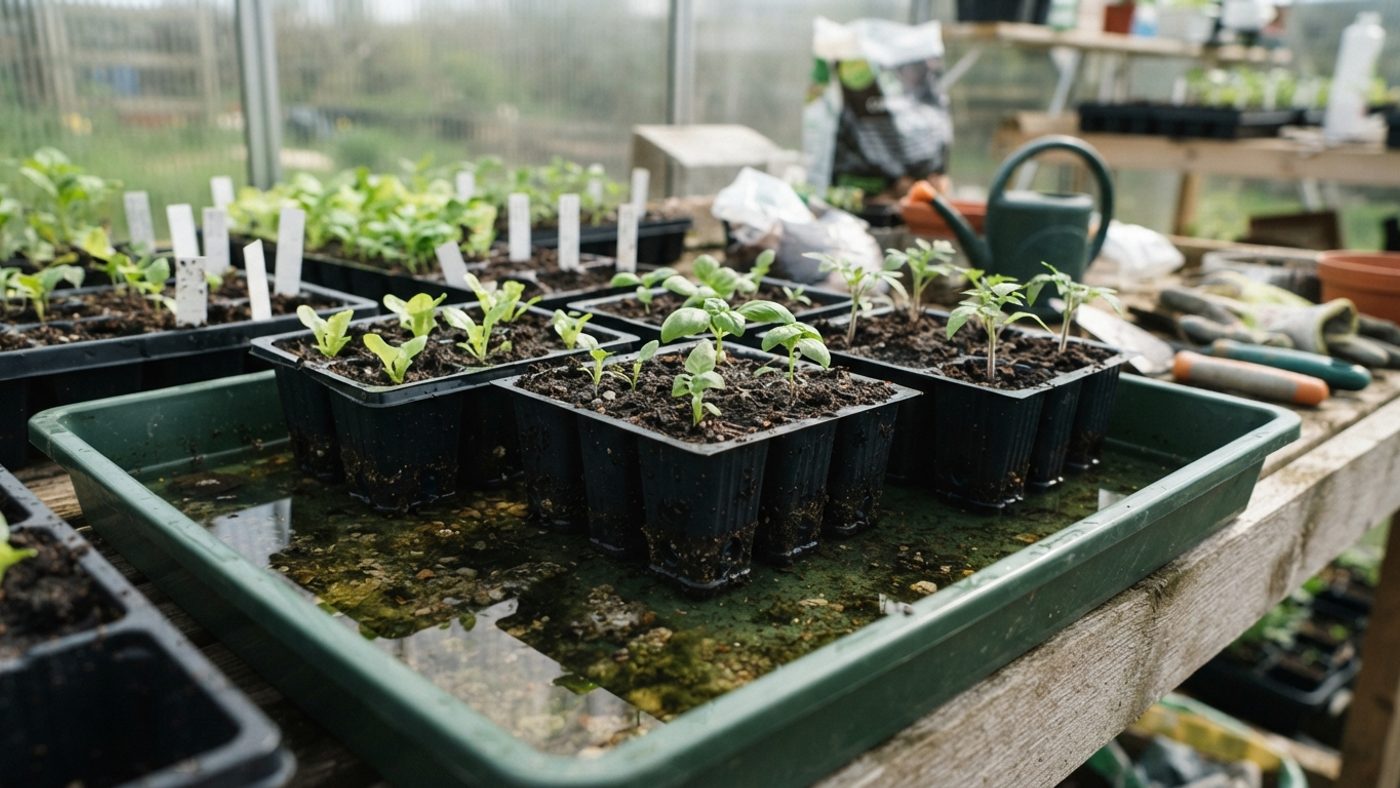
Watering from below, standing trays or pots in a shallow reservoir and letting compost draw water up, rather than watering overhead, keeps the compost surface less saturated and avoids splashing spores between cells, both of which matter more than which compost the seed went into in the first place.
What temperature kills damping-off pathogens?
RHS guidance recommends steam sterilisation for home-produced compost but does not publish a specific home-oven or microwave temperature and time; oomycetes such as Pythium and Phytophthora are generally less heat-tolerant than true fungi like Rhizoctonia and Fusarium, which need more sustained, even heat to kill reliably.
Is it safe to bake soil in a kitchen oven?
It carries real risks worth weighing against simply buying fresh compost: the smell is strong and persistent, uneven heating can leave cool pockets where pathogens survive, and extended baking of damp organic matter is outside normal oven use, with a genuine scorch risk if it dries out unevenly.
Can I reuse compost from pots that had damping off?
RHS advice is not to sterilise and reuse in this case, but to treat it as compromised: never reuse pots and trays in which damping off has been a problem, with reused containers washed and treated with a disinfectant such as Jeyes Fluid if they must be kept.
What about solarising compost in a black bag in the sun instead of heating it indoors?
Some gardeners use it, but no recognised horticultural authority publishes a verified time, temperature or effectiveness figure for it, so treat it as unproven rather than a reliable substitute for a known method.
Thinking about what to do with compost at the other end of its life? See reusing spent compost from pots and grow-bags.
Sources
6 sources, recorded with what each was used for
- RHS: Damping off, Causes, Symptoms & Control: Pathogen identification (Pythium, Phytophthora, Rhizoctonia, Fusarium), favourable conditions, commercial vs home-produced compost guidance, steam sterilisation recommendation, pot/tray reuse and disinfection advice
- RHS: How to reuse spent compost: Guidance on reusing compost for mulching, borders and container top-ups; confirms no seed-sowing-specific reuse guidance is given
- RHS: Pythium, a garden pathogen?: Background on Pythium biology and prevalence in UK gardens
- Garden Organic: Successful seed sowing: Homemade seed compost recipe (loam, sharp sand, leafmould) as an alternative to sterilising reused material
- Garden Organic: Garden compost or potting compost?: Why ordinary garden compost is unsuitable for seed sowing (nutrient level, texture)
- Gardeners' World: Best compost to use for which job: Recommendation to buy fresh bagged compost within 6-8 weeks of use and seal the bag to prevent contamination