

Stand in your garden on a clear, still morning after a frost and walk it end to end. There's usually one exact place where the frost is still sitting thick on the grass or the fence rail while the rest of the garden has already cleared. Or it's not the ground you notice, it's a plant: the same courgette or dahlia gets nipped black at the tips every single time, while its neighbour half a metre away, in slightly different ground, comes through untouched.
That's not bad luck, and it's not really about your postcode's frost date. It's your garden telling you it has its own microclimateThe local growing conditions in one specific spot that differ, sometimes substantially, from the wider area's average climate. Full definition →, with its own frost calendar running independently of the regional one. Some gardens also have the opposite spot, a corner that stays noticeably milder, where the first frost holds off for weeks longer than everywhere else. Learning to read both is the difference between losing a tray of young plants for no obvious reason and knowing, before you ever sow, exactly where in the garden that sowing will actually survive.
That distinction matters more here than in much of the UK. Scotland's growing season already runs shorter than most of the rest of Britain's, so a garden spot running consistently colder or warmer than the regional figure isn't a minor curiosity, for a marginal crop it can be the difference between a sowing that works and one that doesn't.
Why some spots run colder than others
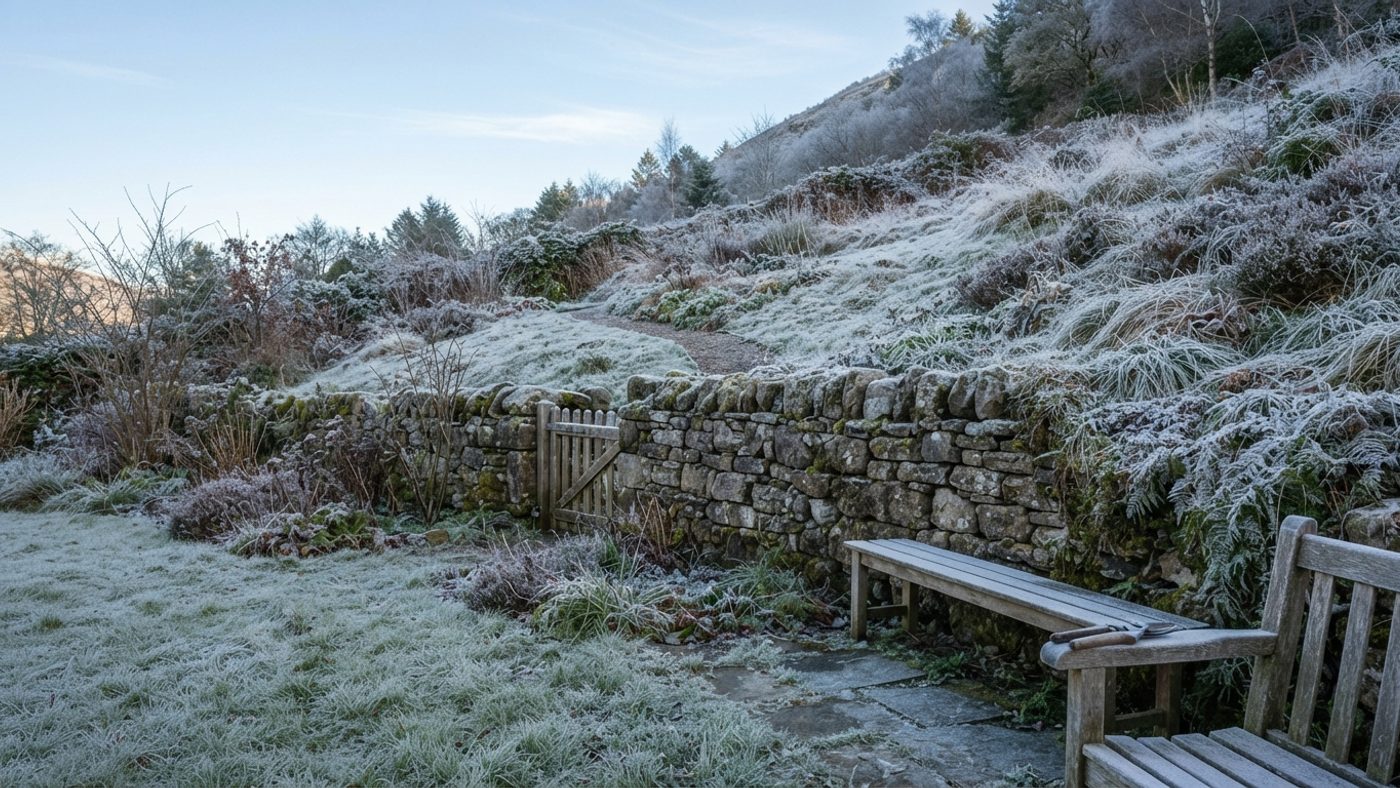
Cold air is denser than warm air, so on a still, clear night it drains downhill and pools wherever that flow gets blocked, a hollow, the base of a slope, or upslope of a solid wall, fence, or gapless hedge. A permeable barrier lets that same draining air keep moving through instead of damming up against it. Overhead cover matters too, for a different reason: frost forms fastest under a clear night sky, because that's what lets heat radiate away from the ground uninterrupted, so a spot under a tree canopy, eaves, or a pergola can escape a light frost that hits the open garden around it. See protecting plants from frost for the fleeceA lightweight, breathable fabric laid or draped over plants to trap a little warmth and keep off frost, wind and some flying pests. Full definition → and cover techniques for a frosty night once you know a spot is at risk.
What a suntrap actually is, and why it works the opposite way
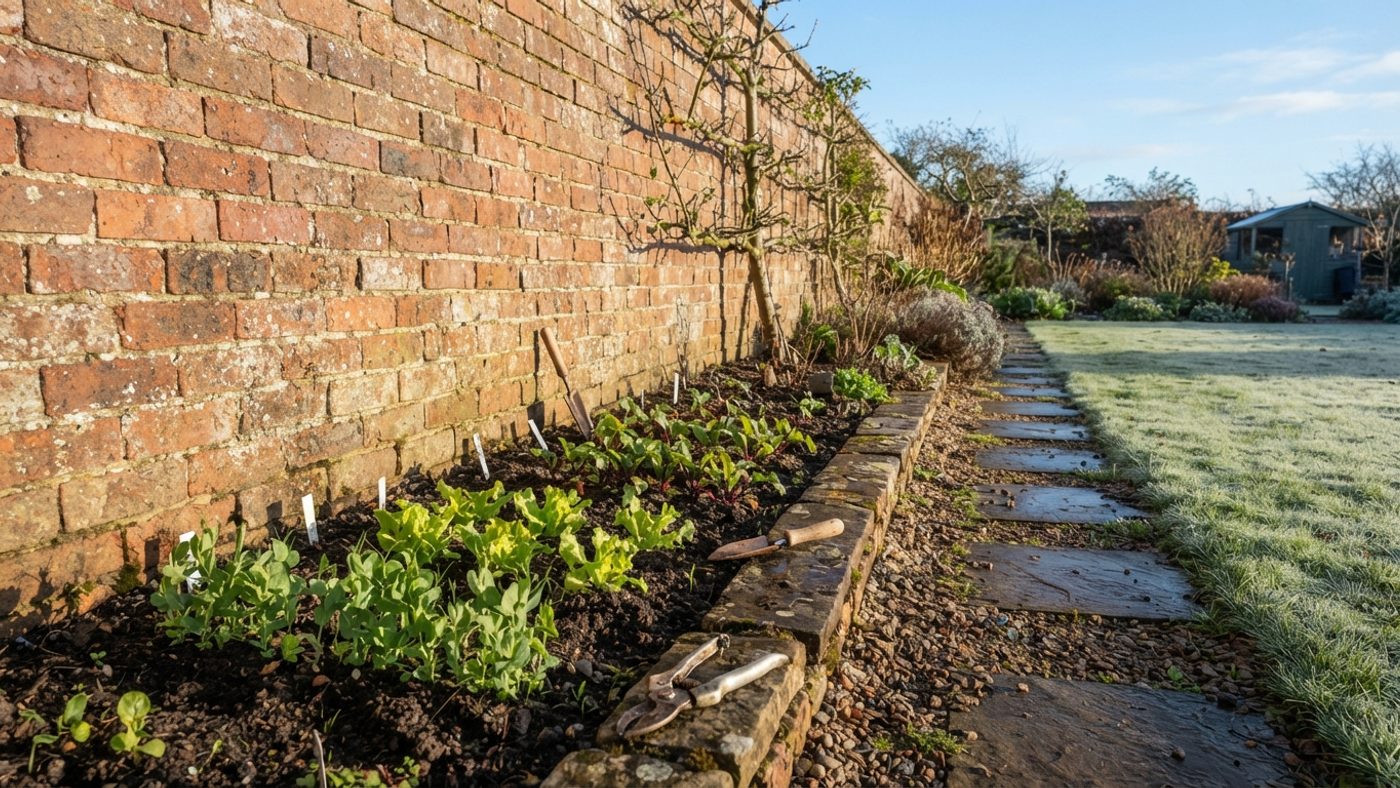
A suntrap runs the same kind of barrier in reverse. Where a frost pocketA low-lying spot where cold air drains and pools on still nights, making it noticeably more frost-prone than the surrounding area. Full definition → is created by a barrier blocking something that needs to keep moving, a suntrap is created by a barrier holding something in place: heat. A south-facing wall or close-boarded fence absorbs solar energy through the day, stores it in its mass, and releases it slowly through the evening and into the night, while the same solid structure that would dam cold air on a slope instead blocks the cold wind that would otherwise strip that stored heat away. The result is a spot that runs measurably warmer than the open garden around it, both because it's had direct heat added to it by day and because it's sheltered from the wind-chill losing that heat overnight.
This is also why the same physical feature, a solid wall, can be exactly the wrong thing at the base of a slope and exactly the right thing on a south-facing aspect. It isn't the wall that's good or bad; it's whether what's arriving at it is cold air that needs to keep draining, or heat that needs to be held.
| Frost pocket | Suntrap | |
|---|---|---|
| Typical location | Low point, hollow, valley bottom, or upslope of a solid barrier | South-facing, against a sunny wall or fence |
| What it does | Traps cold air on clear, still nights | Absorbs heat by day, re-radiates it at night |
| Effect vs open garden | Runs colder, frost lingers longer | Runs warmer, frost holds off longer |
| Barrier that helps | Permeable — gaps, hedge, open fencing | Solid — reflects and retains heat |
How to actually find both spots in your own garden
Neither strictly needs equipment. What they need is watching the garden across a handful of frosty mornings and noting a pattern rather than a one-off.
Signs of a frost pocket
- Frost visibly lingers there, on grass, on a bench, on a cold frame lid, after it has cleared everywhere else in the garden, sometimes by an hour or more.
- The same specific plant, or the same specific bed, gets nipped repeatedly while plants nearby of the same type and hardiness come through fine.
- It sits at the low point of a slope, in a hollow, or immediately on the uphill side of a solid wall, fence, or dense hedge.
- Standing water collects there after rain, ground that pools water often pools cold air for the same drainage reasons.
Signs of a suntrap
- It's south or south-west facing against a solid wall or fence.
- Snow or frost clears there noticeably first.
- Plants at the edge of hardiness for your area, figs, tender salvias, borderline-hardy climbers, have quietly survived winters there that killed the same plant elsewhere in the garden.
- It feels warm to stand in even on a cool but sunny day, and the wall or fence is warm to the touch in the evening after a sunny afternoon.
Walk the garden specifically looking for these on a still, clear morning after a forecast frost, then check again on a sunny afternoon a few weeks apart from a cold snap, the two spots often reveal themselves fastest at opposite times of year. A cheap min-max thermometer left out overnight in the suspect spot, and another in an open part of the garden as a comparison, confirms and quantifies the difference far more reliably than eye and memory alone.
One caveat: everything above is about the still, clear-night kind of frost, where cold air genuinely pools and drains the way described here. A cold spell arriving on a strong wind behaves differently, the cold is being carried in bodily rather than settling out of a calm sky, and a frost pocket's usual shelter doesn't count for as much on a night like that. A suntrap's advantage also depends on the wall or fence actually cutting the wind, not just facing the sun: an otherwise well-placed south-facing spot that's still open to a strong prevailing wind won't hold its stored heat nearly as well, worth checking specifically on an exposed or coastal site, where that wind is rarely absent for long.
Siting decisions: what goes where
Once you've found both spots, the practical answer is straightforward: put the earliest sowings and the most frost-tender crops in the suntrap, and either hold off in the frost pocket or plant things that can shrug off the cold there.
| Suntrap | Frost pocket | |
|---|---|---|
| Sow there | Earliest sowings, most frost-tender crops (courgettes, French beans, tender annuals) | Hold off, or sow later than the rest of the garden |
| Good fit | Borderline-hardy perennials and shrubs, best chance of overwinteringKeeping a plant alive and intact through the cold months, whether left outdoors, moved under cover, or stored dormant. Full definition → outdoors | Crops that shrug off a late touch of frost — kale, leeks, and broad beans all keep growing through it undamaged |
| Fix if not working | Check it's actually sheltered from the prevailing wind, not just south-facing on paper | Improve surface drainage; put a gap in a solid wall or fence, or grow a low permeable hedge in front of it |
The regional frost date remains the right starting point, but the station behind it sits on its own single patch of ground, almost certainly neither a frost pocket nor a suntrap. Treat that regional figure as the middle of a range your own garden could sit either side of, and adjust using what you've actually observed at home.
Common questions
What actually causes a frost pocket?
Cold air is denser than warm air, so on a still, clear night it sinks and drains downhill like a fluid. Where that downhill flow reaches a hollow, a valley bottom, or gets blocked by a solid barrier, it pools instead of continuing to move, and that pooled cold air is what makes a frost pocket run colder than the surrounding garden.
Why does a hedge help with a frost pocket but a solid fence make it worse?
Draining cold air moves as a shallow current across the ground. A permeable barrier, a hedge with gaps at its base, open-slat fencing, lets that current keep passing through, so it never builds up depth in one place. A solid wall or gapless fence blocks it completely, so the cold air piles up against the barrier the way water dams against a solid wall, creating a pool of the coldest air in the garden right where it's stopped.
Can I fix a frost pocket, or should I just plant around it?
Both are reasonable. If the barrier at the base of the slope is solid, adding gaps or swapping to a permeable hedge can let cold air keep draining and genuinely reduce the effect. Where that isn't practical, the simpler answer is to sow later there than the rest of the garden and choose hardier crops or varieties for that spot, rather than fighting it.
Is a suntrap just a frost pocket in reverse?
Not exactly, though the same solid wall or fence is doing the work in both cases. In a frost pocket the barrier blocks cold air that needs to keep draining away. In a suntrap the barrier is doing the opposite job: absorbing and holding solar heat by day, releasing it slowly at night, and blocking the wind that would otherwise strip that heat away.
How many years of watching does it take before I can trust the pattern?
One bad night in an otherwise fine spot could just be a fluke of that particular evening. Two or three frosts, or two or three winters, repeating in the exact same corner is a genuine pattern worth acting on. If unsure, treat the spot as a frost pocket for planning purposes until it's proven otherwise, the cost of sowing a week or two later there is small, and the cost of losing a tray of tender plants to a frost you half-expected isn't.
Sources
3 sources, recorded with what each was used for
- RHS: Understanding microclimates in your garden: The definition and mechanism of frost pockets (cold air sinking and flowing downhill to low points), the effect of gaps in barriers on alleviating frost pockets, and the description of south-facing walls/suntraps absorbing and releasing heat
- Met Office: What is frost and ice?: The radiative-cooling mechanism (surfaces losing heat to a clear night sky faster than they gained it during the day), the role of clear, calm conditions in frost formation, and why cover overhead (cloud, or a tree canopy) reduces radiative heat loss
- Gardeners' World: 10 plants for frost pockets: The frost pocket definition (low-lying areas where cold air collects) and management advice for improving drainage and choosing hardy plants in an existing frost pocket