
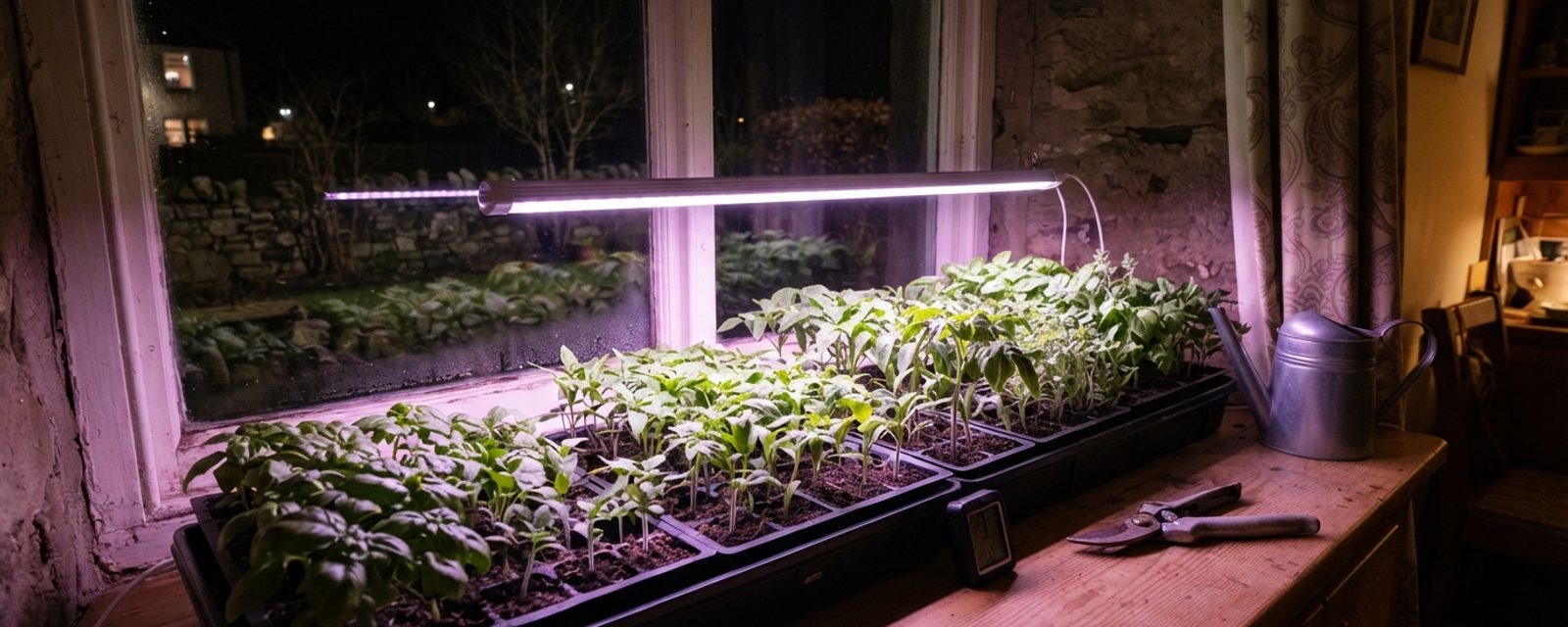
Most seed packets print a sowing month, not a location. "Sow February to March" is written for a UK-average daylight budget, and Scotland doesn't get the UK average. A gardener in Edinburgh sowing tomatoes on a windowsill in February is working with measurably less daylight, and measurably less bright sunshine, than someone doing the same thing in Cornwall on the same date, and considerably less than someone in Shetland. That gap is why LED grow lights earn their electricity cost here more reliably than they do further south, and why "just put it on a bright windowsill" is weaker advice in a Scottish January than the seed packet assumes.
How much less daylight, really
The Met Office's 1991-2020 long-term averages give three comparison points: Camborne in Cornwall (an England comparator), Edinburgh's Royal Botanic Garden, and Lerwick in Shetland. Annually, Edinburgh gets 1,449 sunshine hours against Camborne's 1,672, about 13% less. But annual totals blur the picture, because the shortfall isn't spread evenly across the year, it's worse in some months than the annual average suggests and milder in others.
Broken down by month, the seed-starting window (December to March) looks like this:
| Month | Camborne, Cornwall | Edinburgh (RBGE) | Edinburgh vs Camborne | Lerwick, Shetland |
|---|---|---|---|---|
| December | 55.38 hrs | 49.15 hrs | 11% less | 20.58 hrs |
| January | 61.13 hrs | 55.17 hrs | 10% less | 27.36 hrs |
| February | 84.54 hrs | 82.23 hrs | 3% less | 57.62 hrs |
| March | 125.32 hrs | 117.32 hrs | 6% less | 97.70 hrs |
| Dec–Mar total | 326.37 hrs | 303.87 hrs | 7% less | 203.26 hrs |
Edinburgh's shortfall is worst in the two darkest months, December and January (10-11% less than Camborne), then narrows through February and March. Lerwick's annual sunshine total is 1,158 hours against Camborne's 1,672, 31% less across the year, but its Dec-Mar shortfall runs even deeper, at 38% less, in December specifically, Lerwick averages under 40 minutes of bright sunshine a day.
Sunshine hours measure bright, unobstructed sun, not total daylight. Day length is a separate, purely astronomical fact, and it stacks the same way: on the December solstice, London gets around 7 hours 50 minutes of daylight, Edinburgh gets around 6 hours 58 minutes, and Lerwick gets around 5 hours 49 minutes. So a Scottish seed-starter is working with a shorter window each day and less bright sun within that window, a double shortfall that a Cornwall-based sowing date doesn't account for.
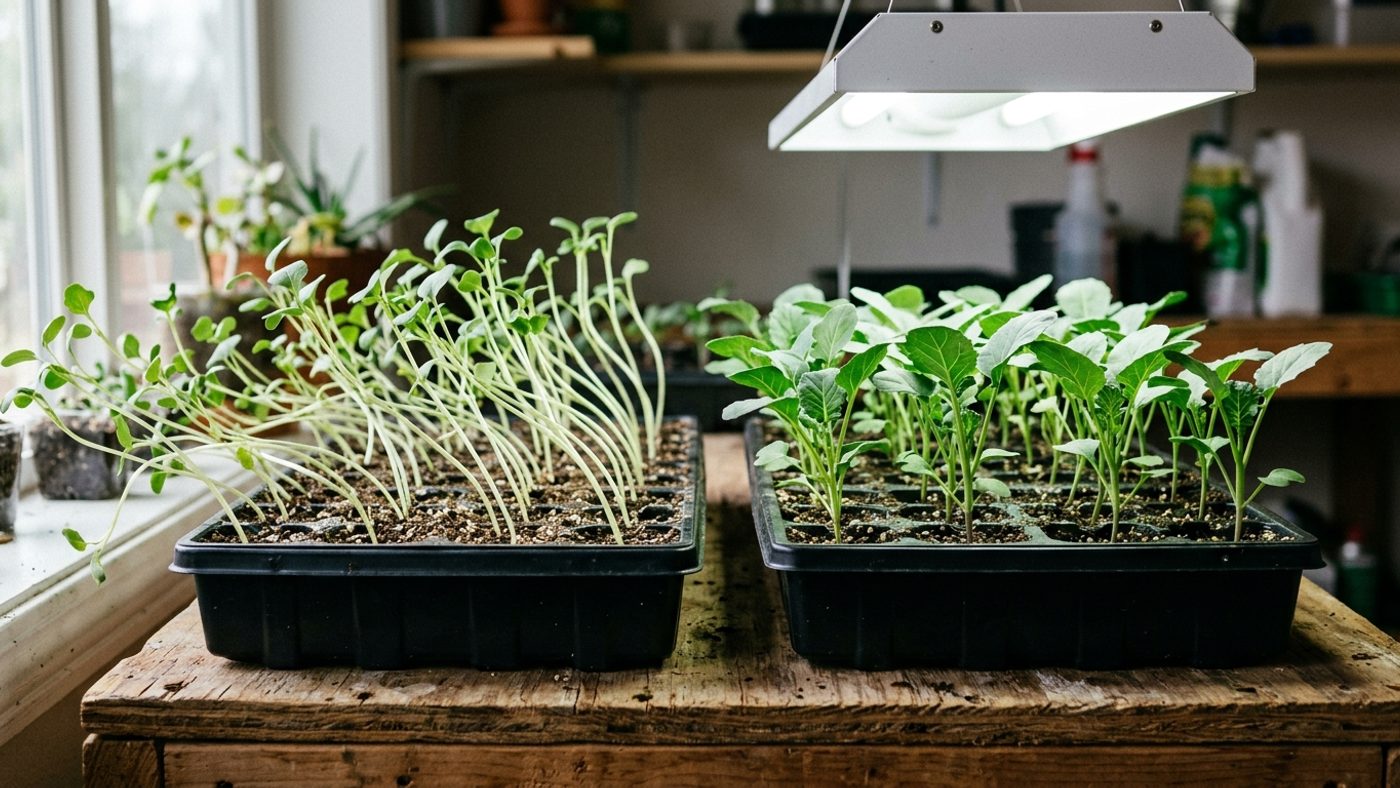
The practical consequence: seedlings started on a windowsill in a Scottish December or January are very likely light-starved even on a "good" day, because there simply isn't enough daylight hitting the glass, for enough hours, to meet what a seedling needs. The tell-tale sign is legginessDescribes a plant that's grown tall, thin and sparse rather than bushy, usually from too little light or not being pinched out. Full definition →, thin, pale stems that stretch and lean hard towards the window, with wide gaps between leaves and a seedling that looks tall for its age rather than sturdy. That's the gap a grow light is filling, not a nice-to-have, but a substitute for daylight hours that genuinely aren't there yet.
What seedlings need from light
Most vegetable and flower seedlings are long-day plants needing around 16 hours of light a day, per RHS guidance on artificial lighting for indoor plants, and when they don't get enough, they turn pale and leggy, stretching upward in search of light at the expense of sturdy stem growth, exactly the risk a Scottish windowsill runs in December and January. Two wavelength bands do the real work: blue light is what counters that stretching, driving compact, stocky growth, while red light drives stem and flower development, which is why full-spectrum white LEDs (blending both, sometimes with a touch of far-red) are the standard choice for a general seed-starting setup rather than a single-colour light. Mounting distance matters for the same reason: light intensity falls off fast with distance, so on a low-wattage Scottish setup where every bit of supplemental light is doing real work, getting the fixture close is not a minor detail. For fluorescent tubes the RHS recommends positioning around 60cm above the plants; LED panels and strips typically run much closer, per manufacturer guidance below.
Spectrum, PAR and wattage: what the numbers on the box mean
"PAR" (photosynthetically active radiation) is the 400-700nm band plants actually use. "PPF" (photosynthetic photon flux) is the total useful light a fixture puts out, measured in µmol/s. Manufacturers quote these because wattage alone doesn't tell you how much usable light you're getting, two 100W lights can differ a lot in output depending on the LEDs used. What a seedling actually experiences over a day is its total light "budget", how much light lands on it, added up across however many hours the light runs (growers call this DLI, Daily Light Integral, but the concept matters more than the acronym). A weaker light run for longer hours can deliver the same daily total as a stronger light run for fewer, which is the practical reason the 14-16 hour duration below matters as much as the wattage figure itself.
The table below uses two current UK-sold LED products as worked examples at different scales, a compact panel (Spider Farmer SF1000) and a low-power propagator strip (SunBlaster), with figures taken from the manufacturers' own published specifications, a reliable ballpark rather than an independently tested measurement. Other UK grow-light sellers publish the same kind of spec sheet, so read these two as a template for comparing whatever's actually in front of you in a shop or online listing, not as the only options worth buying.
| Wavelength / spec | What it does for seedlings | Typical figure (manufacturer-claimed) |
|---|---|---|
| Blue, ~400-500nm | Compact, stocky growth, shorter internodes (the stem sections between leaves, shorter means a sturdier seedling) | Included in "cool white" 4800-6800K components |
| Red, ~600-700nm | Stem and flower development | 660-665nm diodes (Spider Farmer SF1000) |
| Far-red, ~700-740nm | Triggers flowering and stem-elongation responses; only worth having at seedling stage as a small proportion, since too much can encourage the same stretching a Scottish seed-starter is trying to avoid | 730-740nm diodes (Spider Farmer SF1000) |
| Full-spectrum white | General-purpose seedling and vegetative light | 2800-3000K + 4800-5000K (SF1000); 6538-6698K (SunBlaster strip) |
| Panel output, 100W draw | Core coverage for a small windowsill/shelf tray | Spider Farmer SF1000: PPF 249.21 µmol/s, core coverage 60x60cm, max 90x90cm |
| Strip output, 8-32W draw | Direct-mount over a propagator lid, 1-2in above seedlings | SunBlaster strips: PPF 15.62-58.37 µmol/s across 12in-48in lengths |
For a single seed tray or two on a windowsill, a low-wattage strip light mounted close to the lid does the job; a 100W panel is more suited to a multi-shelf rack with several trays underneath it.
Running an LED grow light: a real cost example
Running cost is straightforward to work out yourself once you know the wattage. Ofgem's Direct Debit price cap sits at 26.11 pence per kWh for July-September 2026, averaged across England, Scotland and Wales, VAT included, that rate resets every quarter, so check Ofgem's current figure for an up-to-date number, but the calculation method below doesn't change. Here's a worked example for a small home setup: a single SunBlaster 24in strip (16W) run 16 hours a day for six weeks, roughly the length of a typical seed-to-transplant window.
A Scottish grower starting seeds specifically because natural light is short in December and January may reasonably run a light for longer than this six-week example, an earlier start under lights is exactly the point for the darkest sowings, so treat the figures below as a per-week or per-light-hour cost to scale up, not a fixed total: roughly 47p a week for the smallest strip, £2.93 a week for the panel.
| Setup | Wattage | Hours/day | Weeks | Total kWh | Cost at 26.11p/kWh |
|---|---|---|---|---|---|
| SunBlaster 24in strip (windowsill tray) | 16W | 16 | 6 | 10.75 kWh | £2.81 |
| SunBlaster 48in strip (2-tray propagator lid) | 32W | 16 | 6 | 21.50 kWh | £5.61 |
| Spider Farmer SF1000 (2-shelf rack) | 100W | 16 | 6 | 67.20 kWh | £17.55 |
To redo this for your own setup: multiply the light's wattage by hours run per day, divide by 1000 to get kWh/day, multiply by the number of days you'll run it, then multiply by the current pence-per-kWh rate. A single windowsill strip costs less than a bag of compost to run for a full six-week seed-starting stretch; even the multi-shelf panel comes in under £20 for the season.
Setting up on a windowsill, propagator or in a greenhouse
Run the light for around 14-16 hours a day, matching the long-day- plant guidance above, using a cheap plug-in mechanical or digital timer rather than manual switching, either is fine, the point is consistency rather than remembering to flick a switch at the same time every day. Keep the timer and any extension lead well clear of trays, splashes and watering, a windowsill propagator setup means water and a mains-powered light in close proximity, so route cabling away from where you'll be watering, don't leave a socket exposed to drips, and use an RCD-protected socket or plug-in RCD adaptor for extra protection near any watering setup. If your electricity supplier offers a cheaper overnight tariff (Economy 7 or similar), shifting some of the light's running hours into the cheap-rate window cuts the running cost further, since a light doesn't care what time of day it's switched on. Mount strip lights close, the manufacturer's own guidance for the SunBlaster strips is 1-2 inches above a propagator lid, and raise panel-style lights as seedlings grow to avoid scorching, following the manufacturer's height chart.
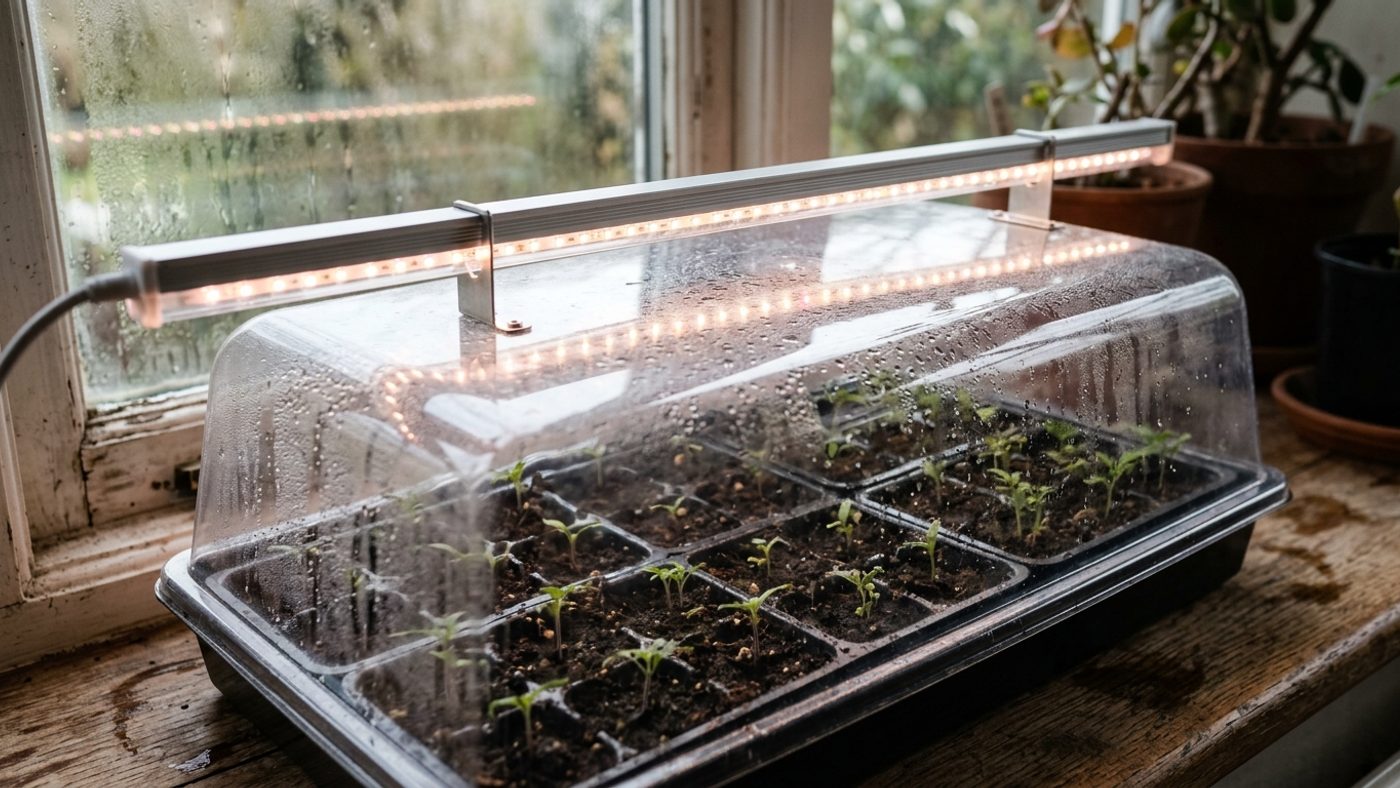
In an unheated greenhouse or porch, a grow light supplements light levels but does nothing for temperature; it isn't a substitute for a heated propagator if frost or near-freezing night temperatures are the limiting factor rather than light. The two problems, insufficient light and insufficient warmth, need separate fixes, and conflating them is a common reason a grow light "doesn't seem to help": if seedlings are cold as well as dark, the light alone won't fix leggy, stalled growth.
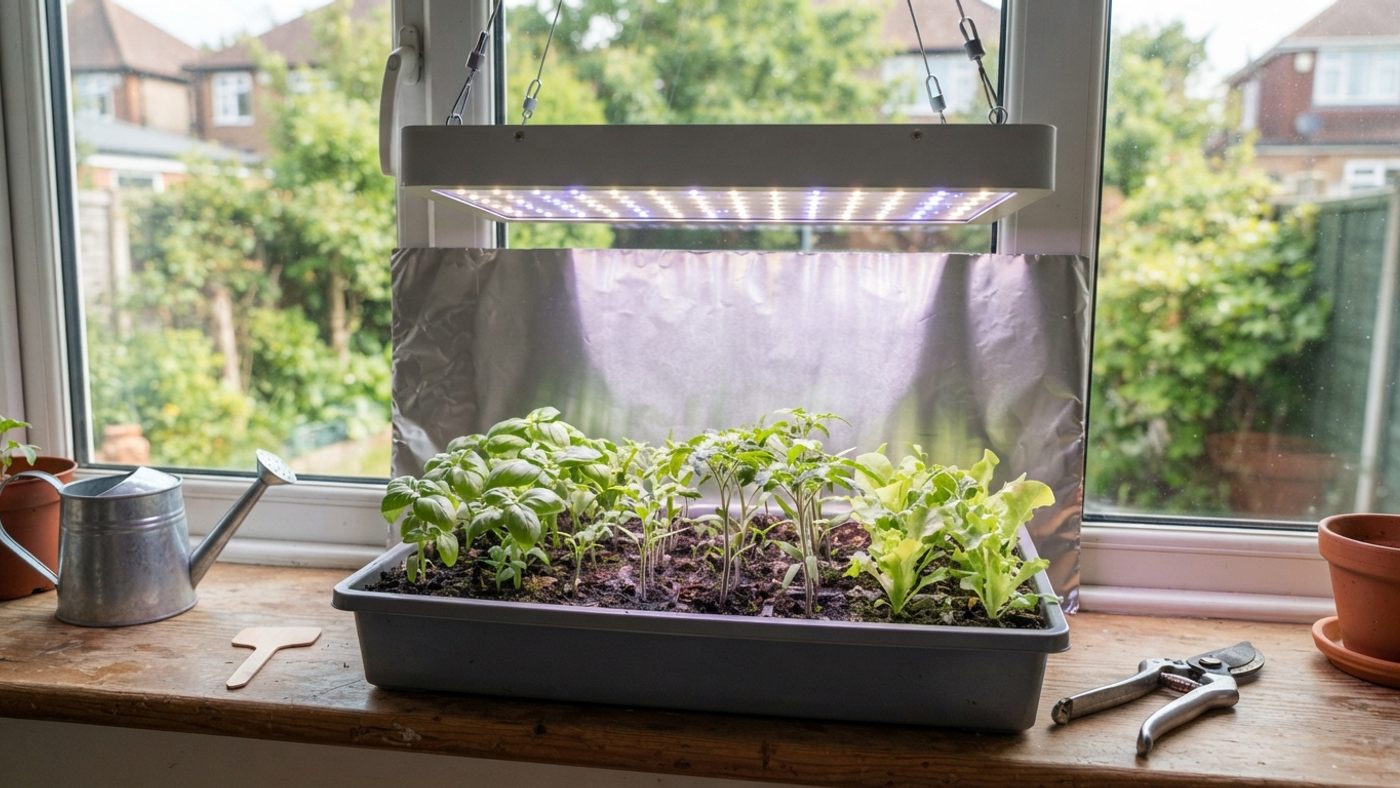
A north-facing window in a Scottish flat or terrace gets close to none of the sunshine-hours figures above, those are outdoor, unobstructed readings, and glass, orientation and overshadowing by neighbouring buildings all cut what actually reaches the sill further still. A south- or west-facing window makes real use of what daylight there is; a north-facing one is close to relying on the grow light alone. A sheet of foil or mylar behind the tray, or a simple reflective propagator lid, redirects light that would otherwise be lost past the seedlings back onto them, a cheap way to get more out of a modest strip light rather than buying a bigger one.
A grow light changes how well-lit and sturdy your seedlings are indoors, but it doesn't shorten how late a Scottish frost falls, check your own region's last-frost date before assuming an earlier sowing date under lights means an earlier planting-out date too. Starting seeds under light lets you sow to a sensible indoor timetable rather than the calendar on an England-average seed packet, but seedlings still need hardening off and a frost-safe planting-out date once they're ready to go outside. Choosing shorter-season or earlier-maturing varieties is a complementary, no-extra-electricity way to work with a shorter effective Scottish growing season alongside a grow light, not instead of one. This matters most for the crops usually started earliest under lights precisely because they're slow and heat-loving, chillies and aubergines in particular, sown weeks ahead of tomatoes and needing both consistent light and steady warmth to get away well before a Scottish spring properly starts.
Lit trays under cover run warm and often humid, which is exactly the condition damping-offA fungal disease that kills seedlings at soil level, usually caused by overwatering, poor airflow, or reused unsterilised compost or trays. Full definition → fungi need to thrive, damping-off is a fungal rot that collapses seedlings at soil level almost overnight, and it spreads fast between crowded trays. Good airflow around the tray (a small fan on low, or simply not crowding trays together under the light) and watering from below rather than overhead both cut that risk, and matter more once a light is added to an already-covered propagator setup.
Common questions
Do I need a grow light to start seeds indoors in Scotland?
Depends on the month and the window. A bright, unobstructed south-facing sill can often manage from late March onward. For December-February sowings, treat a grow light as close to essential rather than optional, see the monthly figures above for why.
How many hours a day should I run a grow light?
Around 14-16 hours a day for most vegetable and flower seedlings, which the RHS classes as long-day plants. Use a timer so this stays consistent without daily intervention.
Is a cheap grow light worth it, or should I buy a proper one?
A basic full-spectrum LED strip (roughly £35-£50 from a UK grow-light supplier) is genuinely adequate for a windowsill tray or two, the running cost is a few pounds across a whole seed-starting season either way, so the main trade-off is coverage area and build quality, not spectrum quality. A multi-shelf setup benefits from a proper panel with even coverage across the whole shelf.
Can I use a grow light in an unheated greenhouse?
Yes, as a light supplement, but it won't add warmth. If your greenhouse or porch is dropping close to freezing overnight, seedlings need heat (a heated propagator or mat) as well as light, light alone won't compensate for cold-stalled growth.
Will a grow light replace a heated propagator?
No, they solve different problems. A grow light adds light intensity and day length; a heated propagator adds warmth for germinationA seed sprouting: breaking dormancy and putting out its first root and shoot, given the right warmth and moisture. Full definition → and early growth. A cold, dark Scottish porch or unheated greenhouse in January is short of both, so the two are usually worth combining there rather than treating one as a substitute for the other.
Sources
10 sources, recorded with what each was used for
- Met Office: Edinburgh, Royal Botanic Garden long-term averages (1991-2020): Monthly and annual sunshine hours for Edinburgh
- Met Office: Camborne, Cornwall long-term averages (1991-2020): Monthly and annual sunshine hours for the England comparator
- Met Office: Lerwick, Shetland long-term averages (1991-2020): Monthly and annual sunshine hours for Lerwick
- timeanddate.com: Sunrise and sunset times in Edinburgh, December: Winter solstice day length for Edinburgh
- timeanddate.com: Sunrise and sunset times in London, December: Winter solstice day length comparator
- timeanddate.com: Sunrise and sunset times in Lerwick (Shetland Islands), December: Winter solstice day length for Lerwick
- RHS: Artificial Lighting for Indoor Plants: Photoperiod requirements, spectrum principles, mounting distance guidance
- Spider Farmer UK: SF1000 LED Grow Light product page (manufacturer technical documentation): Wattage, PPF, spectrum composition, coverage area, price — clearly labelled as manufacturer-claimed, not independently tested
- Hyjo (UK retailer): SunBlaster LED product page (supplier technical documentation): Wattage, PPF, spectrum, sizing, price, mounting guidance for propagation-scale strip lights — clearly labelled as supplier-claimed, not independently tested
- Ofgem: Changes to energy price cap between 1 July and 30 September 2026: UK average Direct Debit electricity price used in the running-cost example