

A fruit tree's roots have never, in their evolutionary history, been asked to survive an air frost. In open ground, even a hard freeze only nibbles at the top few centimetres of soil, everything below stays buffered by the sheer thermal mass of the earth around it, rarely dropping far below zero even after weeks of cold. A tree in a container has no such buffer. Its entire root system sits inside a few litres of compost with air, and often wind, on every side of the pot. When the temperature drops, that compost can cool at close to the same rate as the air itself, and a hard freeze can turn the whole rootballThe mass of roots and the soil or compost clinging to them, as it comes out of a pot or out of the ground when a plant is lifted. Full definition → solid, something that essentially never happens to a tree growing in the ground.
For a bedding plant this barely matters; it was never going to survive the winter anyway. For a woody perennial fruit tree that's expected to live in the same pot for a decade or more, an apple on M9 rootstockThe root system and lower stem a fruit tree is grafted onto, chosen to control the tree's eventual size rather than for its own fruit. Full definition →, a step-over pear, a fan-trainedA fruit tree or bush trained flat with branches radiating out from a low point, the standard shape for wall-grown stone fruit. Full definition → plum, it's the central problem of growing fruit in a container in Scotland. Everything else in overwinteringKeeping a plant alive and intact through the cold months, whether left outdoors, moved under cover, or stored dormant. Full definition → a potted fruit tree follows from this one fact: the roots are exposed to cold in a way they were never built for.
Roots are the weak point, not the branches
It's worth being precise about what "hardy" means on a fruit tree label. Hardiness ratings and rootstock vigour guides describe the plant's tolerance for cold as a whole, but top growth and roots are not equally tough. Stems and buds of temperate fruit trees are genuinely built for this: their cells are adapted to control exactly where and how ice forms in freezing weather, so they survive being frozen in a way soft, unhardened tissue can't. Roots, by contrast, evolved underground, insulated from anything like the same range of cold. A tree whose branches shrug off a night at -12C can still suffer real root damage at temperatures a container gardener might not think twice about, simply because the roots were never selected for that kind of exposure. If root damage does happen, it isn't usually an instant kill: a tree with a damaged root system typically leafs out weak and late the following spring, or fails to put on much growth, rather than dying outright, though enough damage in one hard winter can kill a young or newly potted tree.
One more cold-sensitive point worth knowing: on a graftedJoining a chosen fruiting variety onto a separate rootstock, so the tree grows the fruit of one plant on the roots of another. Full definition → fruit tree, the graft union (the visible knuckle low on the trunk where the fruiting variety was joined onto the rootstock) often sits just above the compost line. It's neither fully insulated by the pot nor as toughened as older bark higher up the trunk, so it's worth including when you're wrapping or mulchingA layer of material spread over the soil around plants to suppress weeds, retain moisture, and improve soil structure as it breaks down. Full definition →, not just the compost surface and the branches above it, and this matters most exactly where the rootball itself is most at risk, in upland and Highland-interior gardens where a hard freeze can sit for days rather than clear overnight (see the regional figures below).
Dwarfing rootstocks (the root system a fruiting variety is grafted onto, chosen specifically to keep the whole tree small enough for a pot, M9 and M26 for apples, Colt or Gisela 5 for cherries, St Julien A for plums) are also, by their nature, more compact and shallower-rooted, which means less compost mass around the root system to begin with. A restricted rootstock chosen for container suitability is, unavoidably, a rootstock with less insulation to spare. One practical lever follows directly from this: choosing the largest pot the tree can reasonably manage, rather than the smallest one that looks tidy, since more compost mass takes longer to freeze through and gives the roots more of a buffer.
Pot material and frost-crack risk
The pot itself becomes part of the problem in a way it isn't for an in-ground tree. Wet compost that freezes expands, and a rigid, unglazed terracotta or clay pot can crack under that pressure, a risk that simply doesn't apply to a plastic or resin container, which flexes instead.
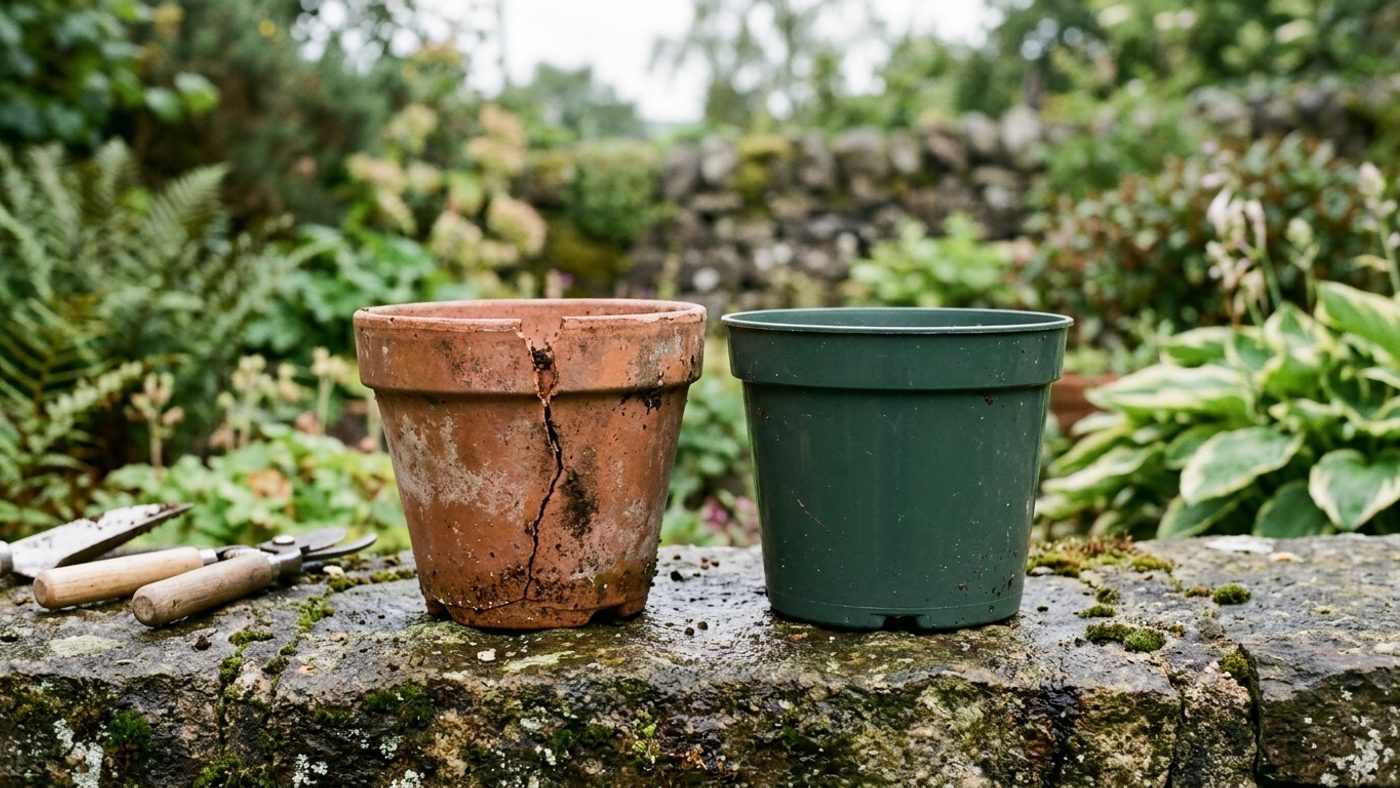
Clay pots are heavy and stable; plastic is durable, light and easier to manage, and that stability-versus- practicality trade-off becomes a genuine winter liability once you factor in freeze damage. This risk scales directly with how deep and how long the freeze goes: a pot that only chills for a night or two in the Central Belt is at far less risk than one sitting through the weeks of sub-zero cold a Highland-interior or upland winter can bring (see the station figures below), where a rootball can stay frozen solid for days at a stretch and the pressure on the pot wall has far longer to act. A cracked pot in spring means root disturbance and repotting on top of whatever cold damage already occurred; it's worth deciding on container material with winter in mind, not just how it looks on the patio in July, and keeping compost from sitting waterlogged going into a freeze reduces the risk regardless of material. Raising the pot off the ground on pot feet or bricks helps for the same reason drainage always helps: it breaks direct contact with cold, wet paving and lets meltwater drain away instead of refreezing against the base of the pot.
Moving a mature potted fruit tree is a physical logistics problem
A trained fan or cordonA fruit tree or bush trained as a single main stem with short fruiting side-spurs, usually grown at an angle against a wall, fence or wire. Full definition → in its fourth or fifth year, in a 45-50cm pot of soil-based compost, is heavy, often well beyond what one person can lift. This is the practical difference from moving a small tender container plant under cover: it may simply not be feasible to shift the tree at all, and the decision becomes what genuinely needs moving versus what can be insulated in place. Wheeled pot feet or a sack trolley, positioned before the tree gets heavy rather than after, make relocating a mature specimen realistic; without that groundwork, "just move it into the greenhouse" isn't always honest advice.
Where moving isn't practical, two low-effort steps do most of the remaining work: wrapping the pot itself in bubble wrap or straw, and standing several pots together against a wall so they shelter each other and lose less heat between them than they would spaced out individually. A layer of mulch, bark or straw over the compost surface (not just around the sides) closes off the one part of the pot that's otherwise open straight to the sky. In practice that means two or three layers of bubble wrap or an old duvet/hessian sack wrapped snugly round the pot's sides and tied or pinned in place, leaving the compost surface itself open to rain rather than sealed under plastic; it needs to keep breathing and draining, just insulated.
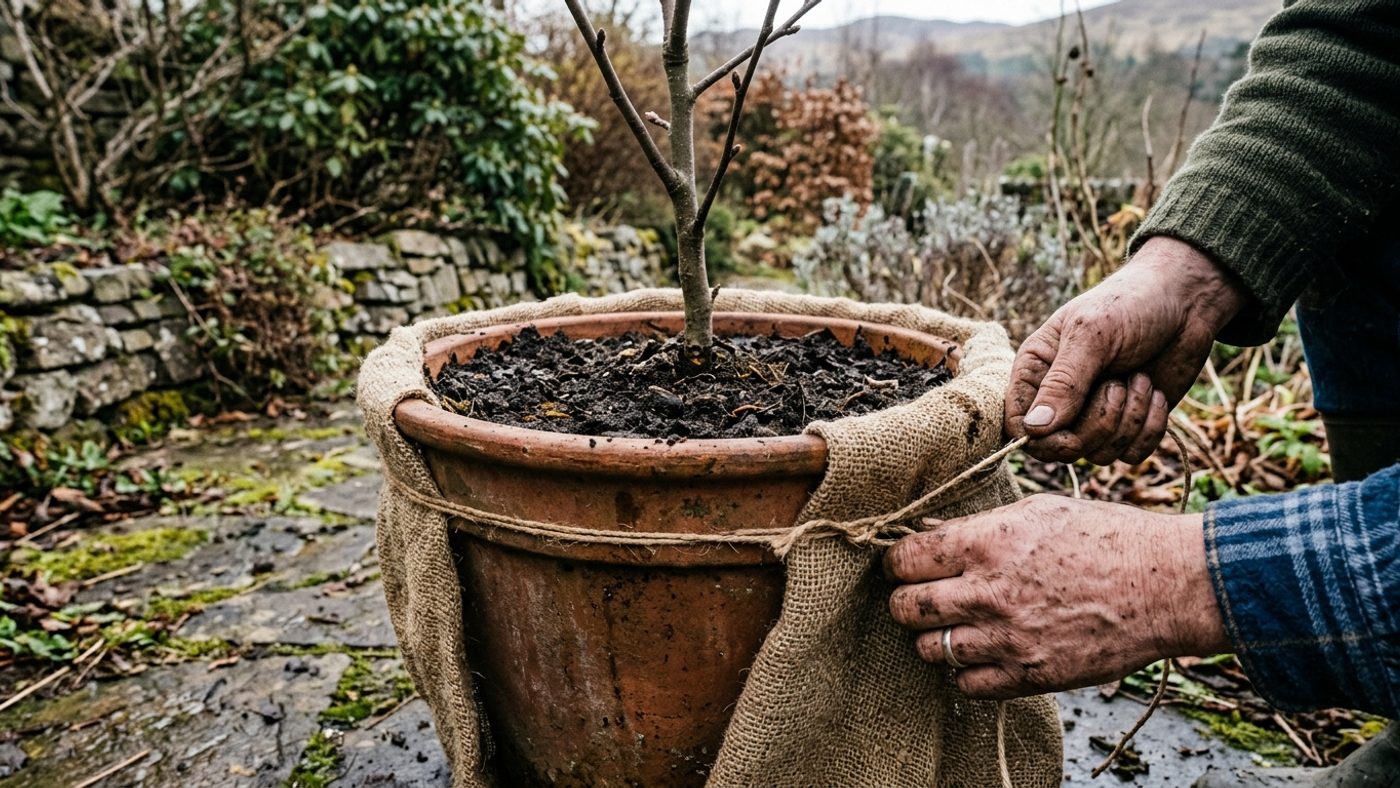
Straw or loose mulch packed around the pot works the same way, but be aware it can also give mice and voles a sheltered place to overwinter and gnaw at bark or roots; check under it occasionally through winter rather than leaving it undisturbed for months. Put this on once night frosts are becoming a regular feature (rather than one cold snap) in autumn, and take it off again in spring once night frosts have largely stopped, the same general timing as removing a fleeceA lightweight, breathable fabric laid or draped over plants to trap a little warmth and keep off frost, wind and some flying pests. Full definition → cover. A wrapped, dormant tree still needs occasional water if the compost dries out during a mild dry spell, but far less than in the growing season, check by feel rather than watering on a schedule.
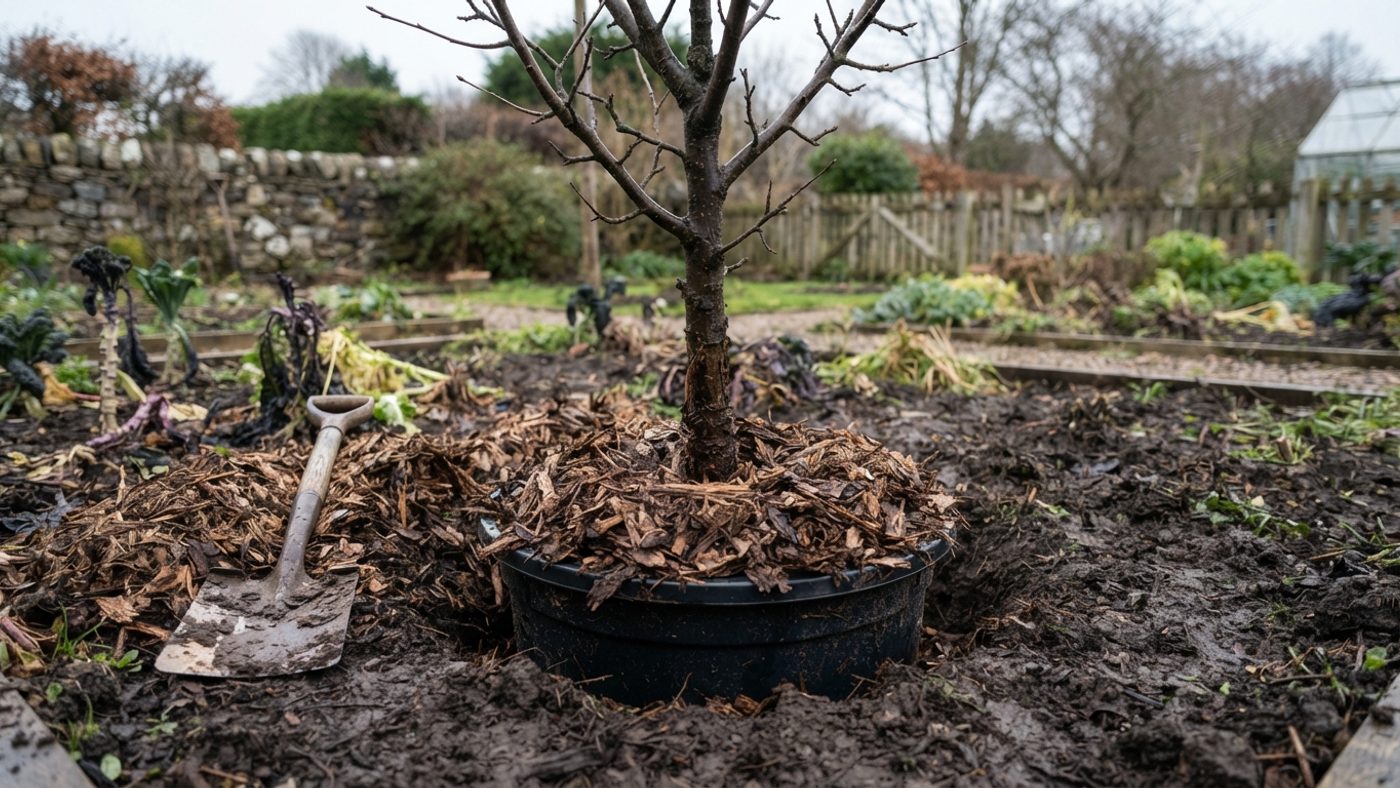
Where a garden has a spare bed or a gap in the vegetable plot, another option worth knowing is plunging the whole pot into the ground and mulching over the rim, effectively borrowing the soil's own insulation for the coldest months, a technique that gets a potted tree closer to the buffered conditions an in-ground tree enjoys, at the cost of digging it out again in spring.
If a pot does crack over winter despite this, don't panic: repot into a slightly larger container as soon as the ground is workable in spring, disturbing the rootball as little as possible, and expect a slower start to the season rather than assuming the tree is lost. For the general mechanics of fleece, wrapping and siting against frost, which apply here too, see protecting plants from frost.
How much colder does Scotland actually get, and where does that change the advice?
Met Office 1991-2020 station normals give a clear, checkable picture of how much winter cold depth varies across Scotland:
| Station | January air-frost days | December air-frost days |
|---|---|---|
| Stornoway (Islands) | 4.7 | 5.5 |
| Inverness (lowland Highlands) | 8.88 | 9.24 |
| Edinburgh (Central Belt) | 9.03 | 10.40 |
| Braemar (339m upland) | 17.3 | 17.0 |
Lowland Scotland, Edinburgh and Inverness alike, sits at roughly nine to ten air-frost days a month across December and January: wrapping the rootball and standing pots somewhere sheltered, as covered above, is genuinely adequate for most Central Belt and coastal Highland gardens. Stornoway records fewer air-frost days than either, the mildest station in this comparison, root-freezing specifically is a smaller worry there than the table alone might suggest for "Scotland." Island gardens are more exposed to wind than cold, though, so the wrapping still helps, and a windbreak or a sheltered wall against desiccating wind matters at least as much as insulating against frost on its own.
Braemar is the real outlier: roughly double the winter air-frost days of Edinburgh or Inverness, frost recorded in nearly every month of the year bar July, and a recorded extreme minimum of -27.2C. At that kind of cold depth, a compost-filled pot is at genuine risk of freezing solid for days at a stretch, not just overnight, and wrapping in a sheltered spot stops being sufficient on its own; upland and Highland-interior gardens in that climate bracket are the ones where moving trees properly under cover for the coldest stretch of winter (an unheated porch, garage or lean-to, not necessarily heated glass) earns its place as a genuinely different, stronger step, not just a generic worst-case precaution.
Common questions
Do I need to protect a potted fruit tree's roots every winter, or only in hard frosts?
In most of lowland Scotland, insulating the pot (bubble wrap, straw, or grouping pots together) from autumn through to spring is worth doing as routine practice rather than waiting for a cold snap, since a container can freeze through faster than gardeners expect. In upland or Highland-interior gardens with regular double-digit air-frost days, treat it as essential rather than optional.
Is a plastic pot actually safer than terracotta for a fruit tree that stays out all winter?
For frost-crack risk specifically, yes: plastic and resin containers flex rather than crack when wet compost inside freezes and expands, while unglazed terracotta or clay is vulnerable to exactly that. Terracotta's weight and stability are real advantages for a tall trained tree in wind, so the trade-off is worth weighing rather than assuming one material wins outright.
Should I bring my patio apple or pear tree indoors for winter?
Most hardy apples, pears and plums on dwarfing rootstocks are bred to be left outdoors year-round and don't want a warm indoor environment, which can disrupt the dormancy they need. "Under cover" for a hardy fruit tree usually means an unheated space, a porch, garage, or against a sheltered wall, not a heated room.
What's different about protecting a trained form like a fan or cordon compared with a bush tree in a pot?
The root-zone risks are the same regardless of trained form, but a fan or espalierA fruit tree trained flat against a wall or wire framework with horizontal tiers of branches, most often apples and pears. Full definition → against a wall or frame is harder to move as a unit and often relies more on in-place wrapping of both pot and branch structure. See our guide to fan training fruit trees for how these forms are built, which affects how practical moving them really is.
Does root protection cover blossom protection too?
No, they're different problems. Root-zone protection is about the compost freezing over winter while the tree is dormant; blossom frost is a late-spring risk to open flowers on an already-warmed-up tree, and trained forms against a sunny wall often flower earlier than a bush tree, putting them more at risk of it. Root wrapping doesn't help with that; see our guide to protecting plants from frost for covering blossom on a frosty spring night, and our regional frost dates for when your area's last spring frost typically falls.
Sources
4 sources, recorded with what each was used for
- RHS: Fruit in containers: Dwarfing rootstock/pot-size relationship, container material trade-offs (clay vs plastic), and general container fruit-growing guidance
- RHS: Preventing winter damage: Wrapping container roots in bubble wrap or straw, grouping pots together, and general winter plant protection technique
- RHS: Frost damage: The mechanism of frost injury and root-vs-top-growth hardiness differences
- Met Office: UK climate long-term averages (1991-2020 station normals): Winter (December/January) air-frost-day figures for Edinburgh, Inverness, Stornoway and Braemar