
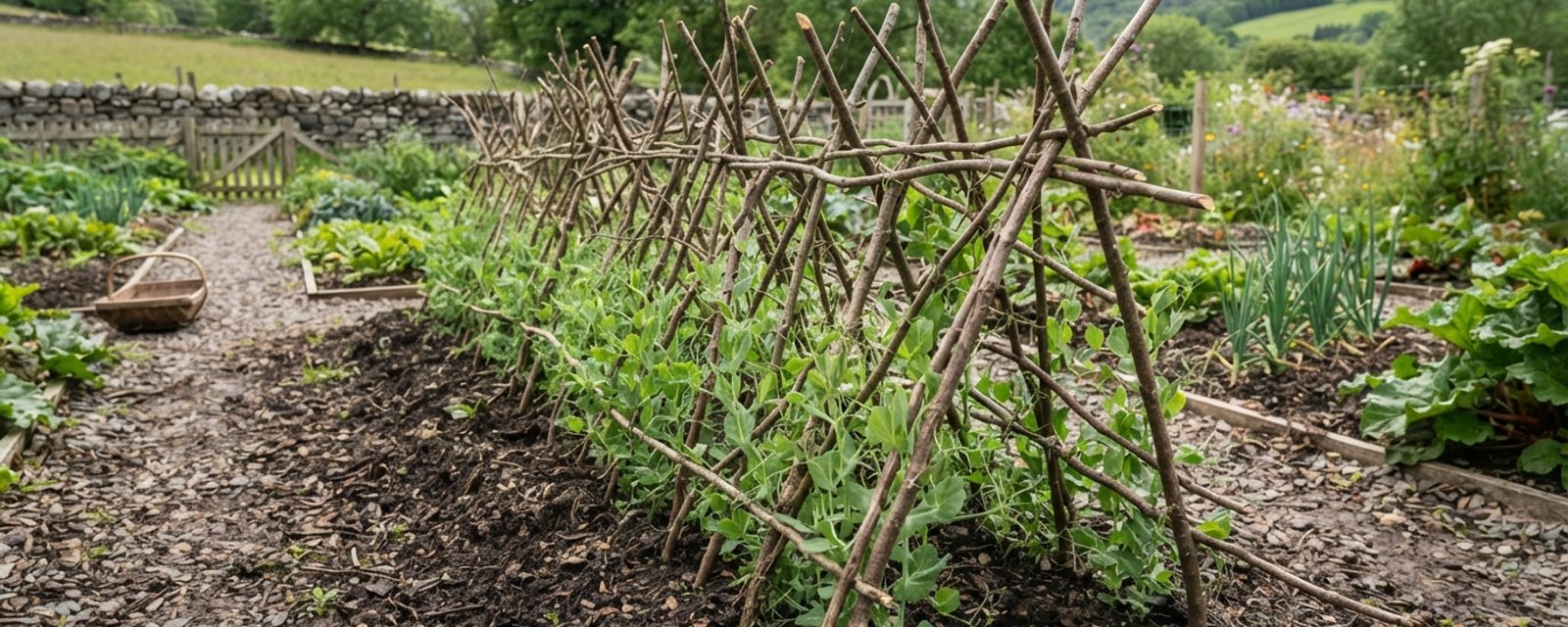
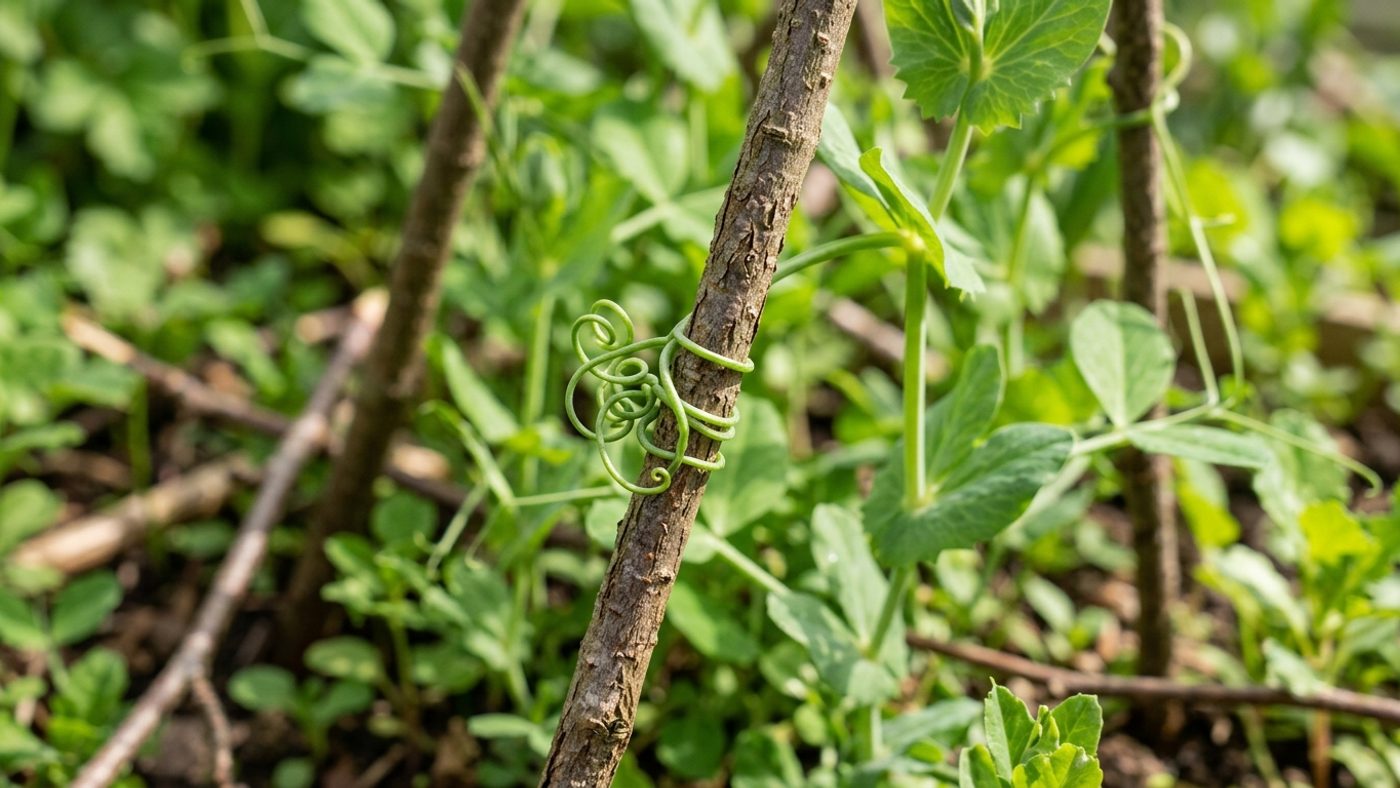
A pea doesn't grow up a support so much as grope for one. Each leaf carries tendrils, thread-like extensions that grow out searching for something to touch, and the moment one brushes something thin enough to wrap around, it curls into a spiral and pulls itself tight, hauling the stem in behind it. That's why a single smooth cane is a poor match for a pea plant, and why a twiggy branch stuck in the ground works so much better: it offers dozens of thin contact points at every height the plant reaches, rather than one.
How a pea actually climbs
Tendril-bearing plants climb this way generally: they "grow straight until they contact something they can grasp... then reflexively contract into a spiral and wrap around the support." Sweet peas do the same, on tendrils carried on their own winged stems.
A cane offers one contact point, and it's often too fat for a tendril to close around anyway. A twiggy branch offers dozens, side-shoots, forks, and fine twig-ends the plant can find with almost no effort at every height it reaches. The support isn't holding the plant up; the plant is climbing the support, and it needs plenty to grab.
What a pea-stick actually is
A pea-stick is simply a branch with plenty of twiggy side-shoots left on it, cut to a manageable length and pushed into the ground alongside a row of peas (or other tendril climbers) so the plant has something to grip as it grows. It isn't a manufactured product, it's a piece of prunings, traditionally hazel, chosen and trimmed for the job rather than grown for it.
Hazel and birch are the traditional choices, but "most any woody species can be used", the twigginess matters more than the species. Willow, where it's grown or coppiced in a Scottish garden, works just as well as either and is often the more available of the two, pick whichever twiggy prunings you actually have to hand. What makes a branch a good pea-stick is:
- A reasonably straight main stem so it stands upright when pushed into the ground
- Dense, fine side-branching along most of its length, not just at the tip
- Enough rigidity to stay put in wind and rain, but thin enough for a tendril to close around
Sourcing pea-sticks: a use for what you'd otherwise burn or bin
This is where pea-sticks earn their keep over a bought support: the material is a byproduct of pruning you're probably doing anyway.
- Hedge and shrub prunings. Any twiggy hedge trimmings, hazel, birch, willow, dogwood, viburnum, that would normally go on the bonfire or to the green bin can be sorted for straight, well-branched pieces before the rest is chipped or burned.
- Coppiced hazel. Coppicing, cutting a tree back hard to a low stool so it regrows a flush of straight new stems, is the classic source. The Woodland Trust notes hazel wood has long been used for "pea sticks and bean poles used by gardeners" alongside older uses like thatching spars and hurdles.
- Any dense, twiggy prunings. The RHS's own low-carbon gardening advice frames this explicitly as a sustainability move: growing or gathering your own hazel, dogwood or birch stems avoids buying plastic-coated canes and supports, and the same page specifically flags saving the twiggy offcuts from trimming hazel poles "for supporting peas."
If you don't have access to your own hedge or coppice, a neighbour clearing a hazel hedge, an allotment site's communal prunings pile, or a local woodland working party are all realistic sources, the material is functionally waste until someone uses it.
A note on Scotland's hazel
Hazel is native and widespread across Scotland, and it isn't a scarce or marginal species here, the Woodland Trust lists it as common in hedgerows and woodland understorey across Britain generally, and Forestry and Land Scotland describes hazel as a light-demanding pioneer species that readily forms dense, self-perpetuating stands, including in the far north-west. Coppicing itself is a different story: Forestry and Land Scotland states plainly that commercial coppicing was a major industry in Scotland only until the early 1900s, after which cheaper synthetic and imported materials took over, and there has been "little or no coppicing activity in Scotland for over 100 years." Where the tradition survives at all, it's chiefly through conservation and woodland-management projects rather than as a working rural craft.
One caution if you're cutting from the wild rather than a garden hedge: Scotland's western seaboard has ancient Atlantic hazel woods carrying nationally rare lichen, liverwort and moss communities on the bark, and both Forestry and Land Scotland and the Woodland Trust advise against coppicing these ancient stands. Stick to garden hedges, managed plantings, or coppice grown for cutting, and this doesn't affect you.
Hazel's presence in Scotland isn't unusually scarce compared with England, so sourcing material isn't harder here than further south. Damp wood softens faster than wood that dries out between wettings, worth bearing in mind on a consistently wet plot.
If you're cutting from anywhere other than your own garden, a hedge you don't own, a wood, or common land, get the landowner's permission first, the same rule as any other pruning or cutting on land that isn't yours. And if you're cutting hedge or hazel prunings yourself rather than using material already down, keep hard cutting to the dormant season, roughly November to February: hedges and hazel in leaf between March and August are likely to be sheltering nesting birds, and disturbing an active nest is an offence under the Wildlife and Countryside Act 1981.
How to set up pea-sticks
Timing. Push supports in before, or right at, sowing or transplanting time, to avoid disturbing roots later. Scotland's growing season generally starts later and runs shorter than the rest of the UK (see Scotland's frost dates for the regional breakdown), so sow and stake by your own local last-frost date rather than a generic UK calendar.
Height and spacing at a glance. Match the stick height to the plant's mature height, not the seedling in front of you, a stick much shorter than the plant leaves the top growth unsupported and flopping.
| Plant | Typical mature height | Stick height needed | Spacing along the row |
|---|---|---|---|
| Garden peas / sugar snaps (dwarf-medium) | up to ~60cm | 50-60cm | ~10cm intervals |
| Main-crop / tall peas | 1.2-1.8m | matched to variety - check the seed packet | ~10cm intervals |
| Sweet peas (border-grown, not exhibition) | varies by variety | twiggy supports as an alternative to an obelisk | close enough for tops to interlock |
Arrangement. Push sticks in along the row close enough that their twiggy tops overlap and interlock, rather than standing as isolated poles. Angle the butt ends in slightly from both sides of a double row so the tops cross and lean into each other, this self-braces the row against wind far better than sticks standing dead vertical, and it's worth taking seriously in an exposed or coastal Scottish garden, where a wind-loaded row of twiggy sticks is more likely to go over than the same row somewhere sheltered.
Depth and firmness. Push each stick firmly into the soil, deep enough that it doesn't rock when you push against it. A stick that leans or falls over mid-season takes the developing plant with it, and a pea plant already committed to climbing one support won't happily transfer to a replacement.
Slug, pigeon and deer protection. Young pea seedlings are vulnerable at exactly the point sticks go in. A twiggy structure doesn't protect against slugs, pigeons or deer on its own, it's worth combining with the usual seedling defences (grit, copper tape, clochesA small, portable clear cover placed over an individual plant or short row to trap warmth and keep off wind, rain and pests. Full definition →, or netting draped over the row) until plants are established enough to shrug off some damage. On a rural or semi-rural plot, deer and rabbits will strip a young pea row as readily as slugs will, and a low temporary fence or mesh sleeve around the row is worth it until the plants have bulked up.
Ongoing care. Twiggy supports need very little tending once in, unlike netting, there's no need to tie plants in, since the tendrils do that job themselves. Trim back any twigs growing awkwardly across the row if they start shading neighbouring plants.
Which plants actually benefit, and which don't
- Peas (garden peas, mangetout, sugar snaps) - the classic use, and the reason the technique carries their name.
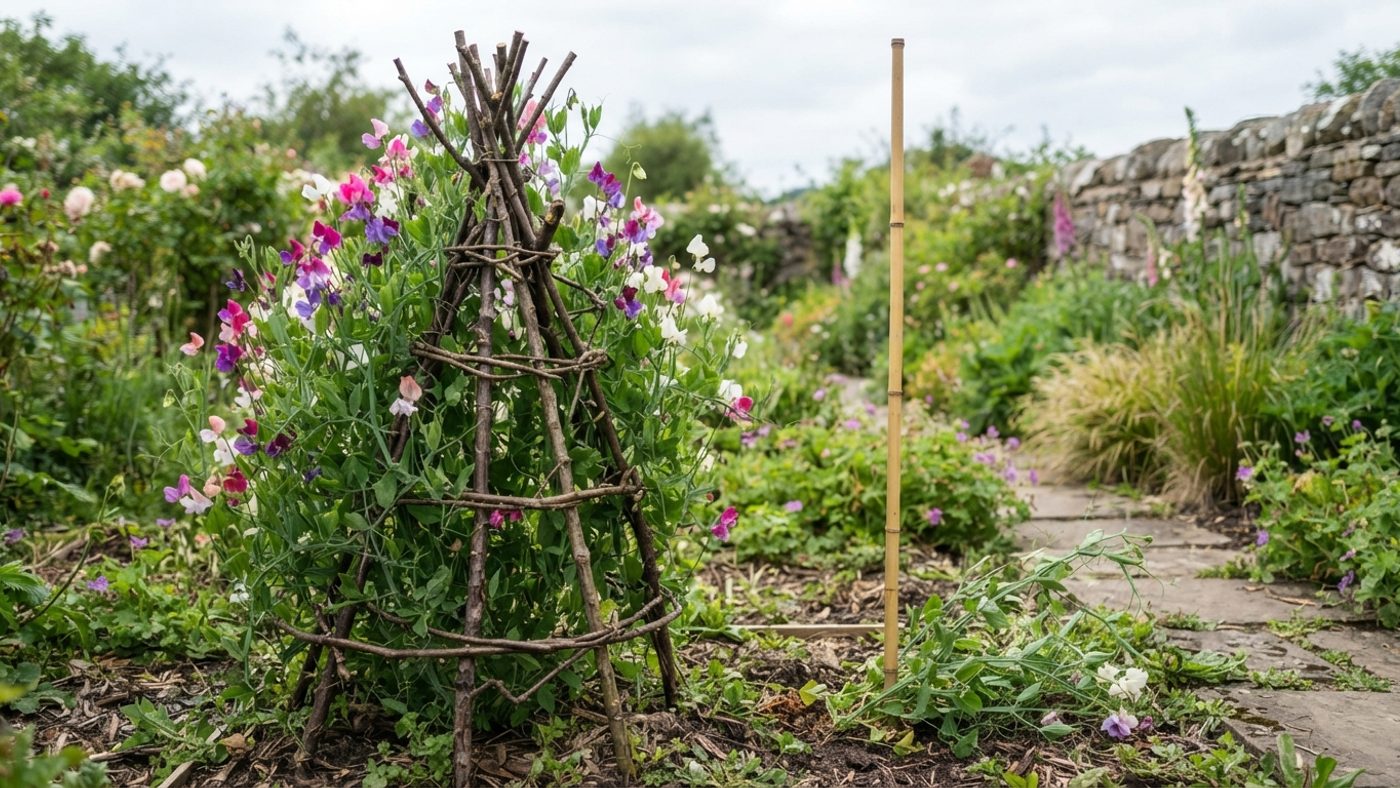
- Sweet peas - their tendrils work the same way, and twiggy supports are a legitimate option for border-grown, non-exhibition plants.
- Other genuinely scrambling or tendril-bearing plants can use the same principle, though hazel pea-sticks specifically are sized for lighter climbers rather than heavy woody ones.
The same twiggy technique works for border perennials that just need light support to lean into, delphiniums, campanulas, and floppy peonies or dahlias, rather than a heavy tie-in job. See staking tall perennials for the fuller run of support methods and which plants need which.
Pea-sticks are the wrong tool for twining climbers, plants that don't use tendrils at all, but instead wind their whole stem around a support as they grow. Runner beans are the clearest example: Phaseolus coccineus is "a green-leaved twining climber," and the recommended supports for it are tall, sturdy single uprights, an A-frame or wigwam of 2.5m canes or hazel poles spaced 15-30cm apart, rather than a twiggy tangle. A twining stem needs one thick, continuous pole to spiral around from base to tip; a branching pea-stick actually works against it, because the stem keeps meeting forks and side-shoots that interrupt its wind. If you're growing runner beans, use hazel poles as straight uprights in a frame, not as bushy pea-sticks.
Pea-sticks vs netting: a fair comparison
Netting is the standard modern alternative, and RHS grow-your-own advice for peas lists it as the recommended method for taller varieties: "netting or chicken wire attached to posts or bamboo canes." Garden Organic's guidance for peas also lists "wire mesh, netting or sticks" side by side as interchangeable options. Neither treats one as superior, they're genuinely different trade-offs.
| Hazel pea-sticks | Pea netting | |
|---|---|---|
| Material cost | Free if sourced from your own or a neighbour’s prunings | Bought new, though reusable for several seasons if stored dry |
| Setup effort | Cutting to length and pushing in by hand; no ties needed, tendrils self-attach | Needs a frame of posts or canes to hang the net from, plus initial tensioning |
| Reusability | Single season for a fresh-cut stick - twigs dry, go brittle, and eventually snap | Multiple seasons if rolled and stored dry between uses |
| End of life | Fully biodegradable; can be composted, chipped, or burned | Most is plastic and doesn’t break down; some biodegradable/jute nets now exist |
| Appearance | Visually blends with a mixed border; looks at home among other planting | Looks visibly artificial, though disappears once the plants fill in |
| Height flexibility | Fixed once cut - different heights need different sticks | Easy to fit taller frames as needed with the same net |
The folk claim that a twiggy structure gives songbirds somewhere to perch that netting doesn't is plausible but unconfirmed. Hazel does support wildlife in its own right, as a living, growing plant: the Woodland Trust records it as a food source for woodpeckers, nuthatches, tits, wood pigeons, jays, small mammals and hazel dormice, and its flowers as an early pollen source for bees. A cut offcut stuck in the ground as a pea support isn't the same thing as the living tree, whatever incidental use a bird makes of it as a perch.
Common questions
Do I need to strip the leaves off before pushing hazel branches into the ground?
No - pea-sticks are used as cut, leafless prunings from dormant-season cuts (late winter is the usual time to prune hazel), so there's normally no foliage to strip. If you're using material cut in leaf, remove the leaves so they don't wilt and drop debris over the seedlings.
Can I reuse the same pea-sticks next year?
Not reliably. Thin twigs dry out and become brittle over a season outdoors, and by the following spring they’re prone to snapping under the plant’s weight. Treat them as a single-season material and cut fresh sticks each year, which is straightforward if you’re sourcing them from your own hedge or coppice prunings.
What height of pea-stick do I need for my variety?
Match it to the plant’s expected mature height rather than guessing. Around 50-60cm sticks suits garden peas and sugar snaps; check the seed packet for your specific variety’s height and choose branches close to that, since a stick much shorter than the plant leaves the top growth unsupported and flopping.
Are pea-sticks only for peas?
No. They’re also useful for pole beans, delphiniums, campanulas, and floppy peonies or dahlias that need a discreet framework rather than a visible cane. The common thread is a plant that needs light support to lean on or grip, rather than a heavy climber needing a rigid frame.
Can I use pea-sticks for runner beans?
Not as pea-sticks. Runner beans are twining climbers that wind their whole stem around a support, and the recommended supports for them are tall single uprights, an A-frame or wigwam of 2.5m canes or hazel poles, rather than a branching twiggy structure. Hazel poles are a genuine traditional material for runner bean frames, but used as straight uprights, not left twiggy.
Sources
9 sources, recorded with what each was used for
- RHS: How to grow peas: Support methods (netting/chicken wire vs pea sticks), spacing, timing of support installation
- RHS: How to grow runner beans: A-frame/wigwam cane and hazel-pole support structures for runner beans
- RHS: Phaseolus coccineus (runner bean) plant details: Confirms runner bean as a "twining climber"
- RHS: How to grow climbers and wall shrubs - Growing Guide: General climbing mechanisms (tendrils, twining stems, stem roots, sticky pads)
- RHS: Sweet peas (annuals) - Plant Guide: Tendrils on winged sweet pea stems; twiggy supports and obelisks as options; cordonA fruit tree or bush trained as a single main stem with short fruiting side-spurs, usually grown at an angle against a wall, fence or wire. Full definition →/cane method for exhibition sweet peas
- RHS: Low carbon gardening - Grow your own garden sundries: Sourcing hazel/dogwood/birch prunings for supports, saving twiggy hazel offcuts specifically for pea sticks, sweet pea frame construction from hazel and willow
- Garden Organic: How to grow peas: Support with wire mesh, netting or sticks; spacing and plant size
- Woodland Trust: Hazel (Corylus avellana): Native range and UK distribution, coppicing as habitat management, traditional and garden uses of hazel wood (pea sticks, bean poles), wildlife value
- Forestry and Land Scotland: Hazel: Hazel's distribution and growth habitA plant's characteristic shape and manner of growth, such as upright, spreading, creeping or bushy. Full definition → in Scotland, history of Scottish coppicing and its decline over the last century, caution against coppicing ancient Atlantic hazel woods, traditional uses