
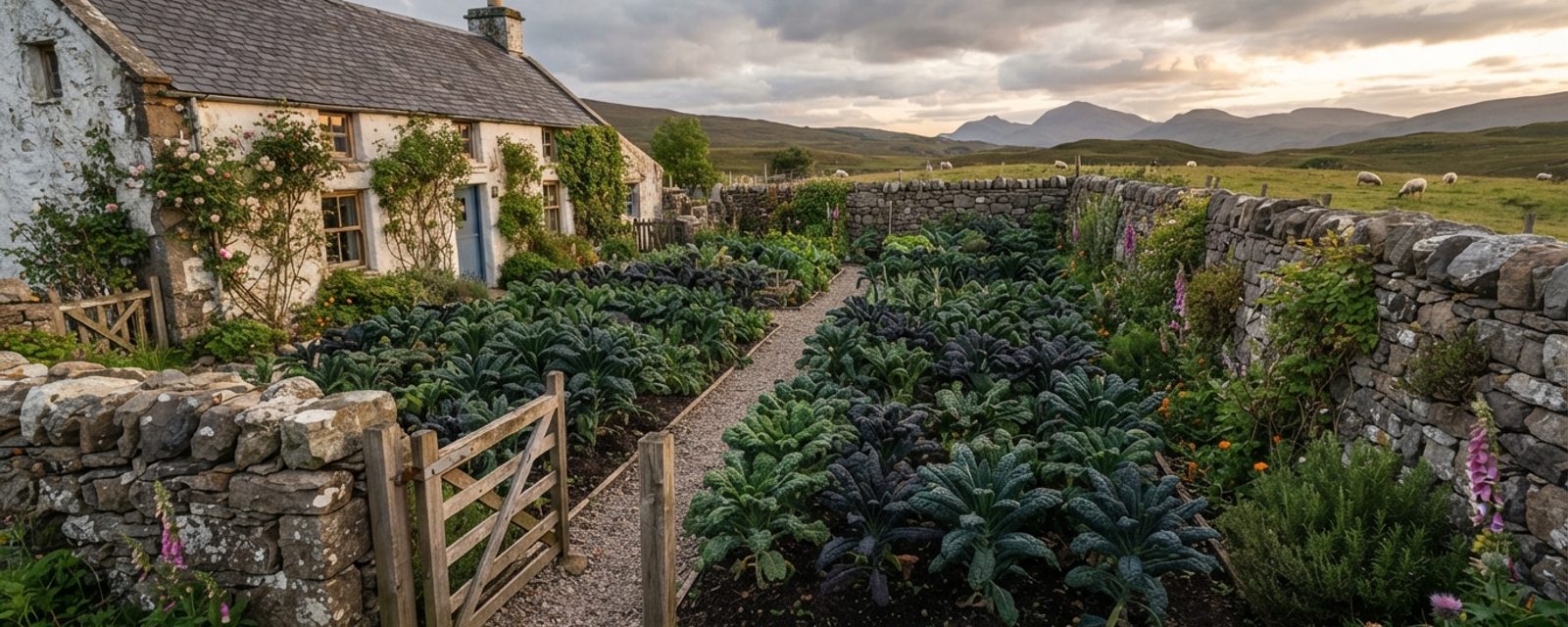
A kailyard was never a plot you applied for. Long before Scotland had waiting lists for allotments, most rural and small-town households simply had one attached to the house they lived in: a small, walled patch of ground, legally defined in 1811 as no more than "a few falls" (an old Scottish land-area unit), growing kail and a handful of other vegetables for the pot.
Quick answer
A kailyard was a small, enclosed vegetable garden attached to a cottage, farmhouse or tenement, a benefit of a tenancy or farm-service job rather than something applied for separately. The word is documented in Scottish property records from 1586, and the tradition faded through the 19th century as the tied farm-tenancy system it depended on declined. It's a genuinely different tradition from the later Victorian allotment movement: older, tied to a home rather than a separate site, and kale-dominated by deliberate limitation rather than open choice. Shetland's plantie-crub and kale-yard system is the one place a version of it is still, quite literally, being kept alive.
What a kailyard actually was
The name is literal: "kail" is the old Scots word for cabbage or borecole (a loose-leafed kale), and a "yard" in this sense is simply an enclosed piece of ground, not a lawn. Kale earned that central role for a practical reason as much as a cultural one: it's frost-hardy and keeps producing leaves through a Scottish winter when most other vegetables have finished, exactly the trait a household relying on one small plot for its own food would need most. Put together, a kailyard was the household's own dedicated kale-and-vegetable patch, walled or dyked off from whatever surrounded it, a field, a farm road, a neighbouring cottage.
It wasn't reserved for the poor. The Dictionaries of the Scots Language records the word being used for landowners' kailyards as well as tenants', and Cambridge University Press's academic history of cottage gardens in the east of Scotland, 1750–1914, states plainly that kailyards belonged to "anyone, rich or poor, landowner or cottar." (A cottar was a farm labourer given a small cottage, often with its kailyard attached, as part of their pay, rather than a wage in cash.) What made a kailyard specifically a farm servant's or cottar's kailyard was that it came bundled with the cottage as part of the job, a benefit of the tenancy, not applied for separately from a landlord or council. Highland crofting tenancies, a separate legal arrangement covered in this site's allotment history article, typically included the same kind of attached kitchen garden as part of the croft, though the detailed documentary record below is Lowland and east-coast, not specific to croft gardens.
In towns, the same idea took a squeezed, urban form. Edinburgh's kailyards were fitted into the narrow strips behind and between tenement buildings, a form the National Trust for Scotland's own history of Edinburgh's historic food supply calls "burgage gardens", used for growing vegetables or keeping livestock in whatever space could be found between one building and the next.
The word itself, and a documentary trail back to 1586
"Kail" is an old word. It appears in Scots records from the late 14th century, borrowed from the Old Norse kál, and it stayed the everyday Scots word for cabbage and kale for centuries, hence "kail brose," "kailpot," and the whole vocabulary of a diet built around it. "Kailyard" as a compound word is attested from at least 1568 in written form, and the Dictionaries of the Scots Language's entry for "kail" cites the Edinburgh Testaments recording, in 1586, "Ane littill hous and cailȝaird", a little house and kailyard, named together as a single property, exactly the pairing that defined the tradition for the next three centuries.
The same dictionary entry, and its documentary trail, run on well past that first appearance:
- 1706, the Lamont Papers record a property transfer including "the house, kailyaird, kiln and acre of Moninacre," the kailyard listed as a distinct, valuable part of a smallholding, alongside the house and kiln.
- 1712, the Urie Court Book, a barony court record, rules that "noe cottar nor grass man...shall not hinder nor impead the entering tennent to labour the emptie ground of ther kaill yeards at Pasch yeirlie", an outgoing cottar was not to obstruct an incoming tenant's right to work the kailyard's ground at Pasch (Easter), the point in the farming year when a new tenancy typically began.
- 1814, John Sinclair's General Report of the Agricultural State and Political Circumstances of Scotland records that day-labourers, hedgers, ditchers, dikers, village shoemakers, tailors and joiners "have now almost universally little gardens, called kail-yards, attached to them", the clearest single statement that by the early 19th century, a kailyard was the ordinary, expected accompaniment to a working household's home, not a rarity.
- 1819, Walter Scott's The Bride of Lammermoor has displaced tenants recalling how they "had contrived to get feu-rights to their little possessions, their huts, kail-yards and rights of commonty", fiction, but fiction using the word exactly as the legal and court records above do, decades before "kailyard" came to mean anything else.
Taken together, that's a continuous run of documented usage, legal, agricultural and literary, from the late 16th century to the early 19th, all describing the same thing: a small, enclosed, kale-growing garden tied to a house.
The law behind the wall
Kailyards weren't informal patches of ground people grew vegetables on when they got round to it. In the 17th and 18th centuries, Scotland's barony courts, the local courts through which a landowner administered a rural estate and its tenants, actively regulated them. Cambridge's academic history states that these courts required tenants, and sometimes cottars, to have kailyards for greens, and required them to protect those kailyards with dykes (stone or turf walls), with some estate records going as far as specifying tree-planting around the boundary as well.
By the early 19th century, the term had a formal legal definition. The agricultural writer George Skene Keith defined a kailyard in 1811 as "a small enclosure of a few falls of ground for planting coleworts or raising garden roots", coleworts being an old name for a loose-leafed cabbage close to kale, and a fall being an old Scottish unit of land area, confirming just how modest these plots actually were: a few falls, not an acre.
What a kailyard was not allowed to become is just as telling as what it was. This picture comes from Cambridge University Press's academic history of cottage gardens in the East of Scotland between 1750 and 1914, which states that "the range of crops was always limited" there and that farmers actively discouraged their tenants and farm servants from growing anything beyond "the most basic" vegetables. A kailyard existed to grow kale, cabbage, and a narrow range of roots for the household pot, not a varied kitchen garden, and not a source of produce a tenant might sell for income. That limitation was the landowner's choice, not the tenant's, and it's part of why the kailyard reads today as a subsistence arrangement bound up in a farm-service relationship, rather than an early version of growing food for its own sake. The barony-court dyking rules and crop limits described here are specifically documented for the east of Scotland, and may well have varied elsewhere.
Not the allotment movement: two different traditions
It's worth being direct about a mix-up the similar subject matter invites. This site's history of allotments in Scotland covers a real and separate tradition, and the two are easy to confuse, because both are about ordinary people growing their own vegetables on a small patch of ground. They are not the same thing, and didn't come from the same place.
| Kailyard | Allotment | |
|---|---|---|
| Era | Documented from 1586; the term's ordinary use fades through the 19th century | Legally created by the Allotments (Scotland) Act 1892; a 20th-century mass movement |
| How you got one | Came attached to a tenancy, a cottage, or a farm-service job, a benefit of the arrangement, not a separate application | Requested from a town council; today, a legal waiting list under the Community Empowerment (Scotland) Act 2015 |
| Who had one | Farm servants, cottars, and tenants under a feudal/agricultural tenancy, also landowners, on their own ground | The urban "labouring population" named in the 1892 Act; today, applicants of any background |
| Where it sat | Physically attached to, or immediately behind, the cottage, farmhouse or tenement | A separate plotted site, often some distance from home, on council or other allotted land |
| What grew there | Kale-dominated, with farmers actively limiting the range of other crops a tenant could grow | Whatever the plotholder chooses to grow, within the site's own rules |
The clearest way to hold the two apart: a kailyard was a small benefit of where you lived and worked, tied to a landowner-tenant or farm-service relationship that had largely faded by the time allotments became law. An allotment is a piece of land a council or landowner separately makes available, applied for and administered independently of your home or your employer. One reason the kailyard tradition is harder to trace after the mid-19th century is that the agricultural and tenancy structures it depended on were themselves changing, while the allotment movement that eventually replaced it as Scotland's main small-plot-growing tradition was built from the start as an urban, civic institution, not a private arrangement between a landowner and a farm servant.
Why kailyards declined, and why the word turned sour
There's no single clean end date for the kailyard tradition, and that absence is itself informative: kailyards didn't end so much as fade as the agricultural and social structures that produced them, tied farm-service tenancies, cottar households, barony-court-regulated estates, themselves declined through the 19th century. What is well documented is what happened to the word.
By the 1890s, "kailyard" had become, in the words of Cambridge's own chapter abstract, "indisputably negative." The shift happened because the word was picked up as the name for a genre of sentimental Scottish fiction, the "Kailyard School," a term coined by critics to describe the rural, dialect-heavy, heavily nostalgic stories of writers like J.M. Barrie, S.R. Crockett and Ian Maclaren, popular from the 1880s. The Bottle Imp, the peer-reviewed journal of the Association for Scottish Literary Studies, traces the connection directly to Maclaren's 1894 collection, which referenced a traditional song about "the bonnie brier bush in our kail-yard", the literal garden lending its name to the literary genre built around the same cosy, backward-looking image of Scottish rural life.
That's a genuinely separate topic from the growing practice this article covers, the Kailyard School is about a body of late-Victorian fiction and the critical backlash against it (most sharply, George Douglas Brown's 1901 novel The House with the Green Shutters, written specifically against the genre's sentimentality), not about vegetable gardens. But it's the reason the word itself curdled: once "kailyard" meant sentimental, small-minded, backward-looking fiction, the actual gardens it was named after inherited the same faintly parochial, old-fashioned connotation, at exactly the point in history, the late 19th and early 20th centuries, when the tied farm-service tenancies that produced most real kailyards were themselves fading out.
Shetland's living variant: plantie crubs and a landrace still being conserved
Shetland kept its own, distinct version of the kailyard system running for far longer than the mainland tradition, and part of it is still active today, the clearest present-day link this history has.
The Shetland system used two structures rather than one. Seedlings were started in a plantie crub (also spelled plantiecrub or crö): a small, circular, stone-walled enclosure built specifically for raising young cabbage plants, sheltered from Shetland's wind and salt spray. Once established, the seedlings were transplanted out into a larger kale yard, often also stone-walled, the direct island equivalent of the mainland kailyard, but built in stone rather than turf or dyke, a difference driven by Shetland's exposure and its lack of hedging timber.
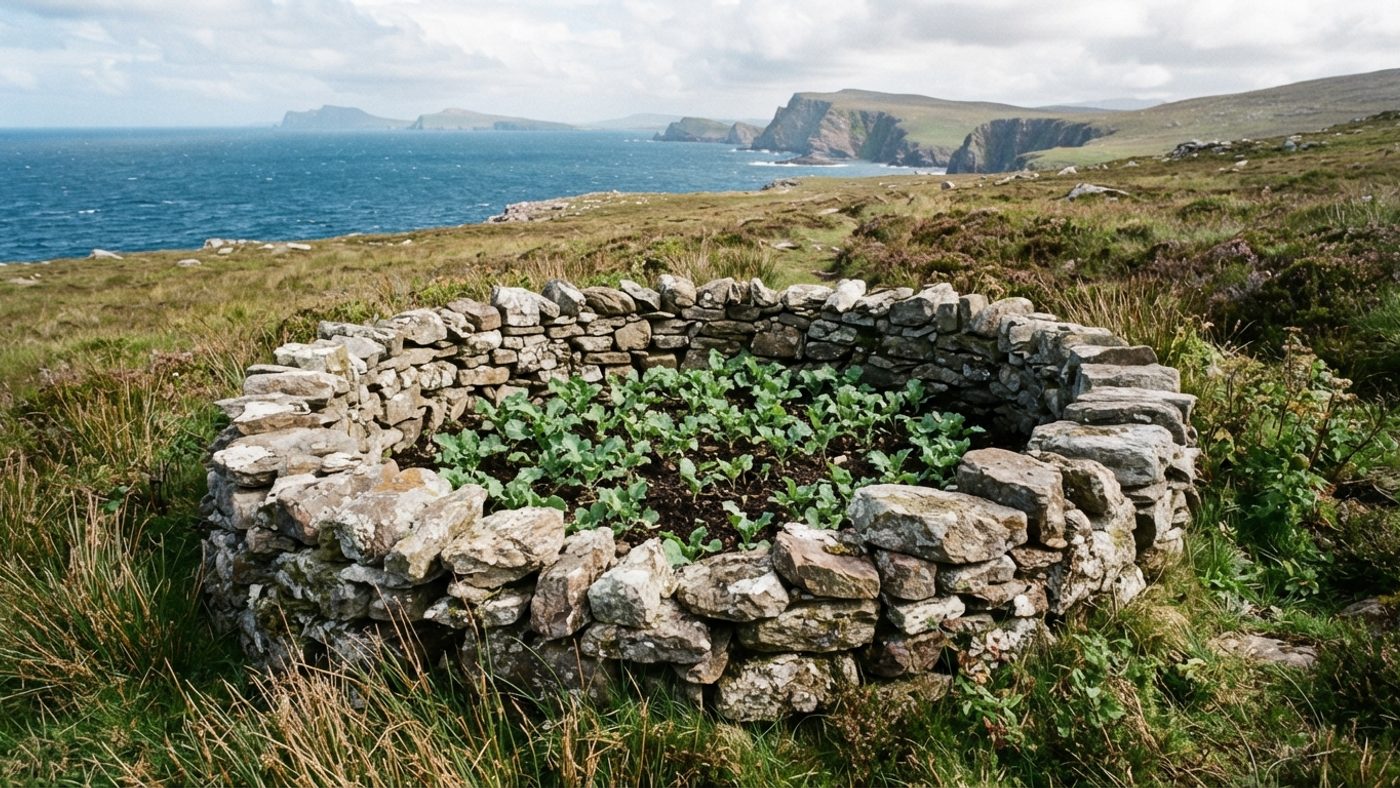
The crop grown in these yards, now known as Shetland Cabbage, is a landrace, a locally adapted, traditionally propagated crop variety, distinct from any commercially bred cultivarA plant variety that arose or was bred under cultivation and is kept true by deliberate propagation, rather than a naturally occurring wild species. Full definition →, that Scotland's Science and Advice for Scottish Agriculture (SASA), a Scottish Government body, states has been grown on Shetland "since at least the 17th century," among the longest documented histories of any vegetable variety still grown in Scotland. Its use changed significantly over that time: originally grown as a human vegetable, it shifted to become winter feed for cattle and sheep, and cultivation of any kind has fallen sharply over roughly the last 30 years as the crofting and smallholding practices that depended on it have themselves declined.
That decline is exactly why active conservation work exists. Seed was collected from Shetland in the 1980s and deposited with the Warwick HRI vegetable genebank, where some accessions were found to carry clubrootA soil-borne fungal disease of the brassica family that swells and distorts roots, and survives in soil for years. Full definition → resistance. When the Scottish Government's Landrace Protection Scheme was set up in the mid-2000s, SASA gathered further material directly from Shetland and Foula, and now holds around 81 accessions of Shetland Cabbage from a wide range of locations across the islands, showing real variation in leaf colour, head density and disease resistance between different growers' lines. Unlike almost everything else in this history, that work is ongoing now, not a closed historical chapter.
Common questions
Is a kailyard the same thing as an allotment?
No. A kailyard was a small vegetable garden attached to a house, cottage or tenement, and came with a tenancy or farm-service job rather than being separately applied for. An allotment is a plot on a separate site, made available by a council or other landowner and requested independently of where you live, a distinctly 19th- and 20th-century, urban civic institution created by the Allotments (Scotland) Act 1892. Read the full history of allotments in Scotland for that separate tradition.
Is "Kailyard School" the same thing as this gardening tradition?
No, though the two are connected by name only. The Kailyard School was a genre of sentimental late-19th-century Scottish fiction, named after the garden because its stories leaned on a cosy, nostalgic image of rural cottage life. The literary genre is what made the word "kailyard" turn negative from the 1890s onwards; the gardens themselves are a much older and separate subject.
What did people actually grow in a kailyard?
Mainly kale and cabbage, with a narrow range of other vegetables and roots. Farmers deliberately discouraged tenants and farm servants from growing a wider variety, so a kailyard wasn't a general-purpose kitchen garden in the way a modern allotment plot might be, it was a limited, kale-dominated subsistence patch.
Is the kailyard tradition still alive anywhere in Scotland?
The most direct living link is in Shetland, where the plantie crub and kale yard system, and a named landrace called Shetland Cabbage grown since at least the 17th century, are still the subject of active seed conservation by SASA, the Scottish Government's variety-testing body, which now holds around 81 accessions collected from across the islands.
Why did the word "kailyard" become an insult?
Because it was borrowed, from the 1880s onwards, as the name for a genre of sentimental Scottish fiction, the "Kailyard School", written by authors like J.M. Barrie and Ian Maclaren. Once critics turned against that genre's sentimentality, the word picked up the same negative, backward-looking connotation, and it stuck to the actual gardens as well as the books.
Can you visit a real kailyard today?
Not in the way you can visit a preserved historic garden, mainland kailyards mostly disappeared along with the tied farm-service households that kept them. Shetland is the exception: its plantie crub and kale yard structures, and the seed conservation work behind Shetland Cabbage, are the closest thing left to seeing the tradition in active use rather than only in records.
Sources
6 sources, recorded with what each was used for
- Dictionaries of the Scots Language: "kail": Etymology of "kail" and "kailyard," the 1568 first written form, the 1586 Edinburgh Testaments citation, and the dated 1706, 1712, 1814 and 1819 documentary citations
- John Sinclair, General Report of the Agricultural State and Political Circumstances of Scotland (1814): The day-labourers/hedgers/ditchers/dikers/shoemakers/tailors/joiners quote, as reproduced in The Bottle Imp
- The Bottle Imp (Association for Scottish Literary Studies): Scots Word of the Season — Kailyard: Etymology corroboration, the 1586 Edinburgh Testaments citation, and the Kailyard School's literary origins and 1890s backlash
- Cambridge University Press: "Kailyards and Farm Servants," in Cottage Gardens and Gardeners in the East of Scotland, 1750–1914: Who used kailyards, barony-court dyking regulations, the 1811 legal definition, deliberate crop-range limitation, and the word turning negative by the 1890s — abstract-only access, the full chapter text is paywalled; every claim cited to this source comes from the publicly visible abstract, not the full chapter
- SASA (Science and Advice for Scottish Agriculture): Shetland Cabbage: The plantie crub/kale yard system, Shetland Cabbage's 17th-century origin, its shift from food to livestock feed, its decline, the 1980s Warwick HRI genebank collection, and the ~81 accessions currently held by SASA
- National Trust for Scotland: Edinburgh's Pantry — Tatties, neeps, oranges and lemons: Edinburgh's tenement kailyards described as "burgage gardens," and the kailyard's role in the everyday Scottish diet