
If getting down to weed a border means you won't be able to get back up without help, if a standard trowel handle digs into a joint that's already sore by mid-morning, or if you've stopped trusting your footing on a path the moment it rains, the problem usually isn't your enthusiasm for gardening, it's that the garden wasn't built with your body in mind.
Gardening remains one of the most repeatedly recommended activities for physical and mental wellbeing, including on NHS inform's own advice pages, which frames even small-scale, potted gardening as a legitimate way to manage anxiety. The barrier is rarely gardening itself. It's usually bed height, tool design, path surface, or a lack of clear planning around energy and reach, all of which can be redesigned.
Gardening on Prescription: What Green Prescribing Actually Means in Scotland → covers the more formal side of that same link, including the local NHS-linked Green Health Partnerships now running in parts of Scotland.
Planting choice matters too, particularly for sensory access, and each of these is fixable without necessarily rebuilding the whole garden at once. If it's general lifting technique or back strain you're managing day to day, see our guide to looking after your back while gardening; this one works through beds, tools, planting, and paths.
Raised beds and containers: height, reach and access
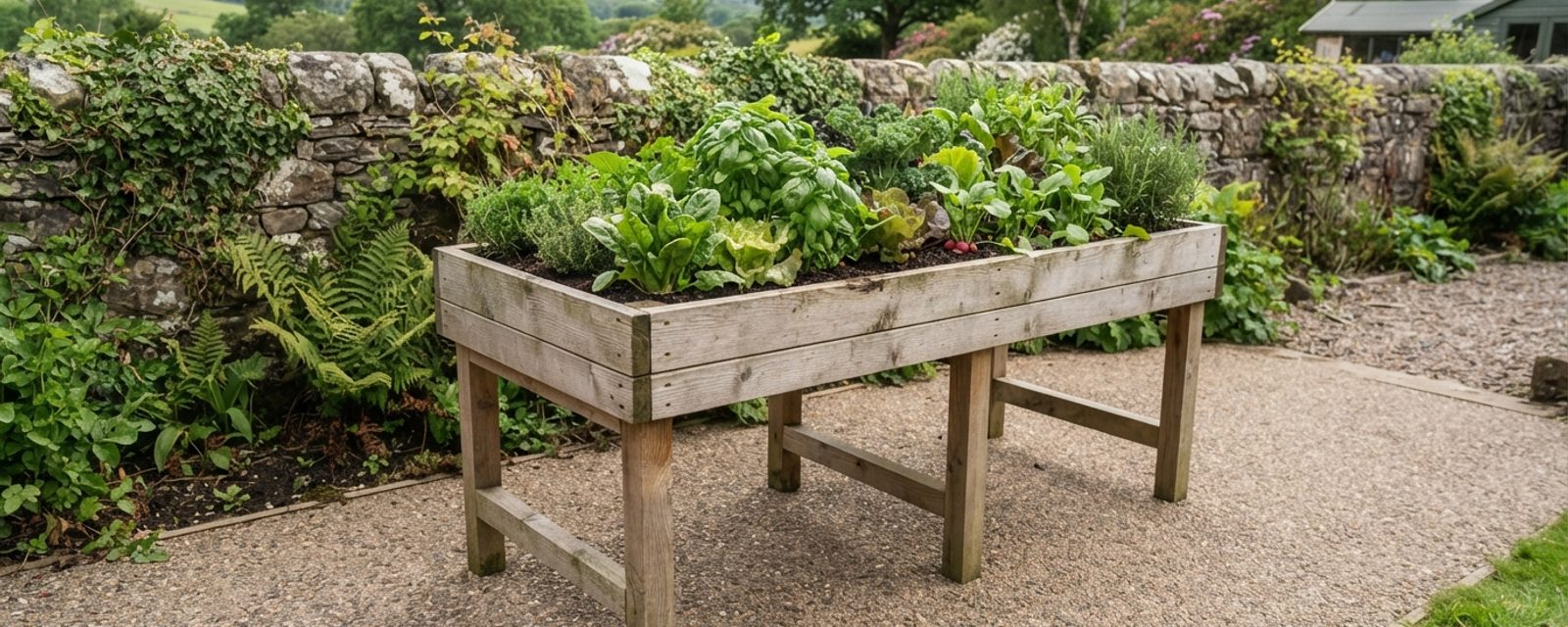
The single highest-impact change for anyone who can't kneel, bend, or reach the ground comfortably is simply raising the growing surface. Thrive's guidance on wheelchair-friendly design notes that raising beds by just 10cm improves access, and that elevated planters let a wheelchair user bring the chair up against or even under the bed, cutting out the awkward reach-and-twist motion that causes most gardening-related strain. There's no single "correct" height or path width, it depends on whether you're gardening from a seated position, a wheelchair, or standing but unable to bend:
| Situation | Bed height | Bed width (one-sided reach) | Path width | Turning circle |
|---|---|---|---|---|
| Seated / wheelchair gardening | 60-75cm, open base for footplate and knee clearance | 90-120cm | at least 1.2m | 2.4m for a single manual wheelchair |
| Standing but can't bend or kneel | 45-60cm | 90-120cm | at least 1.2m | — |
| Space needs to work for anyone to turn 180° without reversing | — | — | 2.2m | 2.8m |
Table-style raised planters with an open base work better than solid-sided raised beds for wheelchair access. Beds accessible from both sides can be wider than the 90-120cm one-sided figure, and should be reachable from all sides wherever the layout allows, to minimise stretching from any single position. Adjustable-height or telescoping raised beds are also worth knowing about if more than one person gardens the same bed, or if a condition is likely to change over time, they cost more than a fixed bed but avoid rebuilding later.
Containers are a lower-cost, more flexible route to the same outcome, particularly useful for smaller gardens, tenanted properties, or anyone testing what height and reach actually work for them before committing to permanent raised beds. Cost varies widely: a few large containers or a secondhand raised bed kit are the cheapest way to start, while a full run of built, table-style raised beds and resin-bound paths cost considerably more, worth trialling height and reach with containers first before committing to a permanent, more expensive layout.
Drainage matters more in a raised bed than in open ground, and matters more still in Scotland's wetter, cooler summers: a bed that's essentially a large, contained box needs a gravel or rubble layer at the base and clear outflow, or it waterlogs and sits cold and sour rather than freely draining the way open soil does. A polytunnel, cold frame, or even a large clocheA small, portable clear cover placed over an individual plant or short row to trap warmth and keep off wind, rain and pests. Full definition → placed over a raised bed also extends a short growing season while keeping everything at the same accessible working height, and is worth considering alongside the bed itself rather than as an afterthought.
Adapted and ergonomic tools
Standard garden tools assume a certain grip strength, wrist range, and standing posture that many people don't have, whether from arthritis, a stroke, reduced hand strength, or another condition affecting dexterity. Thrive's guidance on specialist and adapted tools sets out the practical priorities clearly, and it's worth working through them in order rather than buying the first "ergonomic" tool that comes up in a search:
- Handle width and shape: wide, padded, or T-bar handles distribute grip pressure across the whole hand rather than concentrating it in the fingers, which matters most for arthritis and reduced grip strength.
- Weight and material: aluminium, carbon fibre, and plastic tools are consistently the lightest options, which matters most if lifting or carrying itself is the difficulty. Stainless steel tools are heavier but cut through heavy or compacted soil with less effort per stroke, a real advantage on Scotland's often clay-heavy, poorly-draining ground, where digging resistance is higher than in a lighter, sandier soil, so for digging specifically the reduced effort can outweigh the extra weight, even though it's the wrong trade-off for someone who struggles with weight rather than digging force.
- Handle length: long-handled trowels, cultivators, forks, and hoes let you work from a standing or seated position without bending to ground level, and are the main tool adaptation for anyone who can't kneel.
- Interchangeable-head systems: a single comfortable handle with swappable tool heads reduces both the number of tools you need to store and carry, and the cost of finding out a specific tool doesn't suit you.
- Add-on handles and arm cuffs: fitted to existing tools, these help maintain a natural arm position and can reduce strain for people with limited forearm rotationMoving each crop family to different ground each year, on a multi-year cycle, so pests and diseases that build up in soil don't get a repeat host. Full definition →.
- Kneelers, perching stools, and seat-height benches: a padded kneeler with side handles takes the strain out of getting back up, and a perching stool or a bench set at the height of an adjacent raised bed lets you work seated for longer without needing to stand at all, both are low-cost first steps if a full raised-bed rebuild isn't realistic yet.
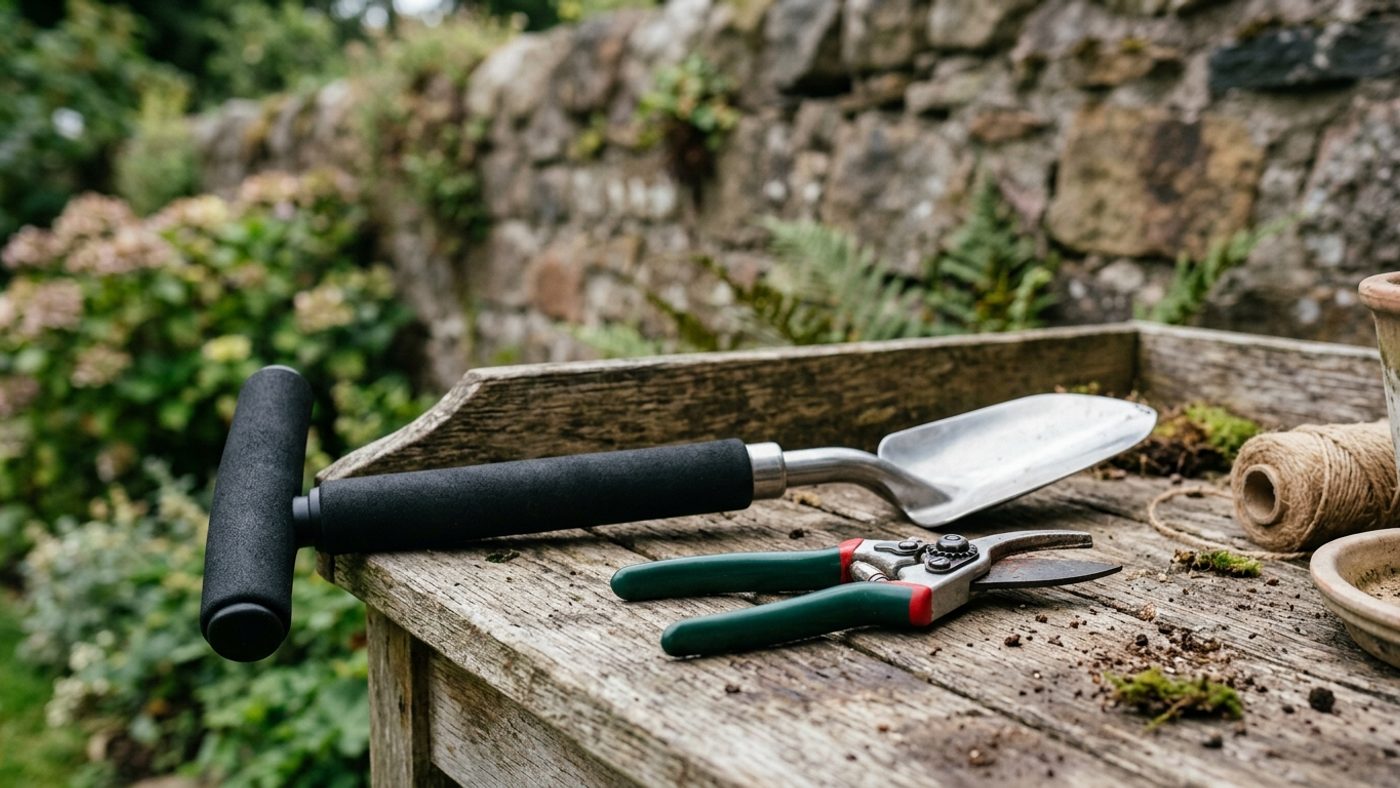
Thrive's consistent advice, worth repeating because it saves money as much as effort, is to try tools before buying where possible, Assist UK's Disability Living Centres and the Disabled Living Foundation's Equipment Centre in London both let you handle equipment before committing, rather than guessing from a product description.
For pruning and cutting tasks specifically, cut-and-hold secateurs (which grip the stem after cutting) reduce the need for a separate hand to catch falling material, and keeping any blade tool properly sharpened reduces the force needed to cut, a blunt tool is a strain risk regardless of the handle design.
Reduced sensation in hands or feet, common alongside diabetes, stroke, or some forms of arthritis, is worth a separate word of caution, since it removes the usual early warning of a thorn, a sharp raised-bed edge, or a tool handle that's got too hot in the sun. Gloves that are cut- and puncture-resistant rather than just gardening gloves, and a quick visual check of hands and feet after gardening rather than relying on feeling for damage, are sensible habits here.
Sensory gardens: planting for visual impairment and beyond
A garden can be genuinely redesigned around senses other than sight, rather than adapted for sight loss as an afterthought once the planting's already decided. A sensory garden isn't a specialist category reserved for visual impairment either, scent, texture, and sound planting benefits anyone, but it becomes a functional access tool when sight is limited, because it gives a garden landmarks that don't depend on seeing them. The same consistent, memorable layout also helps anyone who finds a changing environment disorientating, including people with dementia or other cognitive conditions, Trellis, Scotland's therapeutic gardening charity, works with a number of care homes on exactly this kind of stable, sensory-led design (see Funding and support, below).
Scent is the most direct orientation cue. Planting strongly scented species at path edges and doorways, rosemary, lavender, thyme, and mint along a border you brush past, or a climbing jasmine or honeysuckle near a seating area, creates recognisable waypoints through smell alone. Scent is strongest when plants are touched or brushed rather than just walked past, so plant aromatic species where sleeves and hands will naturally contact them, not purely for visual display. Rosemary, lavender, and thyme all want free-drainingSoil that lets water pass through quickly rather than pooling, so roots aren't sitting in wet ground after rain. Full definition → soil, which is exactly what a raised bed or large container gives you and open Scottish ground often doesn't, another reason scent planting and raised beds work well together here rather than as two separate decisions.
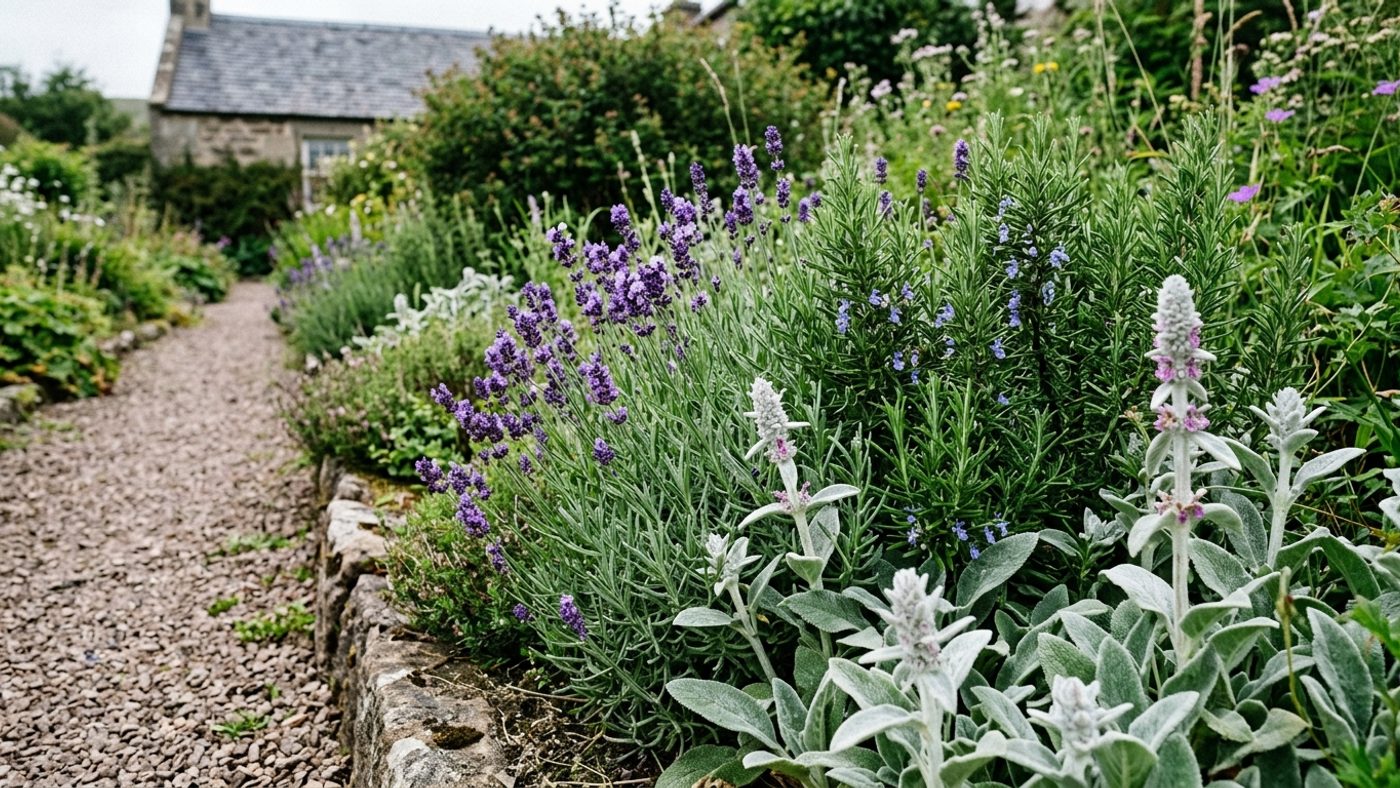
Texture does double duty as both a sensory experience and a wayfinding tool. Soft, fuzzy foliage (lamb's ears, verbascum), deeply ridged or leathery leaves (bergenia, hosta), and papery ornamental grasses give a garden a tactile "reading" that's distinct from smooth-leaved planting nearby. Thrive's guidance on tools for visually impaired gardeners also recommends bright, high-contrast tape on bed edges and tool handles as a simple, cheap visual aid for gardeners with some residual sight.
Sound turns wind and weather into orientation cues. Ornamental grasses that rustle in a breeze, ornamental bamboo, wind chimes near an entrance, or a small water feature all give a consistent, direction-locatable sound that helps someone orient themselves in the garden without needing to see it. Positioning matters: a sound feature works best near a decision point (a path junction, a seating area, an entrance) rather than scattered randomly through the planting.
Path definition is the physical complement to sound and scent cues. A change in underfoot texture, from smooth paving to a slightly raised gravel or brick edge, at a junction or change of direction gives a cane-detectable or foot-detectable signal that something is changing, without requiring sight to notice it. Raised bed edges themselves double as a trailing guide for a hand or cane along a path.
Path surfaces in a wet climate
Thrive's wheelchair-friendly design guidance flags that path performance shifts with the seasons: lawns become very difficult to go over in autumn and winter, and loose gravel is only workable for wheelchairs if it's large, angular gravel properly bedded into a firm sub-base, otherwise wheels simply spin in it. Scotland's climate is well known for extended, changeable wet weather, especially on the west coast and in upland areas, with wet spells that tend to run on rather than clear after a day or two, a general, widely-recognised pattern rather than a precise published statistic, so treat it as a sound basis for planning rather than an exact figure. A surface that's merely inconvenient when damp elsewhere, bark chip, loose gravel, grass, compacted earth, is a reasonable bet to stay soft, muddy, or slippery for longer stretches in a Scottish garden. That points towards well-drained, firm-bound surfaces for any path in regular use.
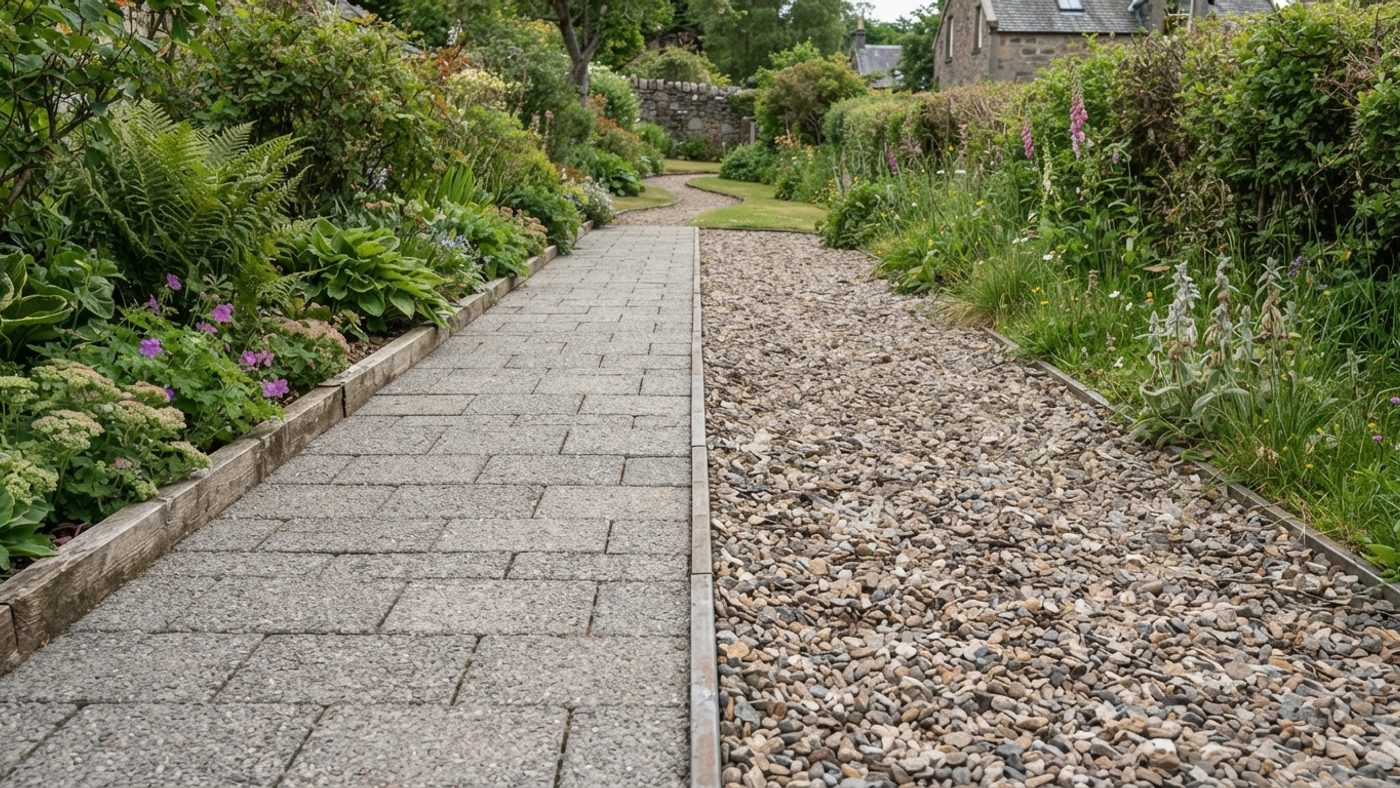
The surfaces that perform most consistently through a wet winter are resin-bound aggregate (small stone chippings set in a solid resin binder, so it looks like gravel but feels and behaves like a hard, seamless path underfoot, also sold as "bonded aggregate") and standard paving with a textured, non-slip finish. Both shed water rather than holding it, and don't rut or soften the way loose gravel, bark, or grass can. Exposed, windy sites add a second consideration alongside the surface itself: a hard, level path is still difficult to use safely in a strong gusting wind if you rely on a stick, frame, or wheelchair for balance, so a sheltered route (a hedge, fence, or wall on the windward side) is worth factoring in alongside drainage, not instead of it. If budget only stretches to adapting the paths used most often, the main route from door to shed, or door to the most-used bed, prioritising those in a firm, well-drained, sheltered surface will do more for year-round access than a larger area of a cheaper one.
Practical adaptations by condition
| Condition | Key challenge | Practical adaptation |
|---|---|---|
| Arthritis / reduced grip strength | Standard tool handles concentrate pressure on painful joints; kneeling or repeated bending aggravates hips and knees | Wide, padded or T-bar handles; lightweight aluminium or carbon-fibre tools; interchangeable-head tool systems; raised beds (45-75cm) to remove kneeling and repeated bending; cut-and-hold secateurs to reduce grip-and-catch actions |
| Visual impairment | Difficulty distinguishing planting areas, path edges and hazards; disorientation in open garden space | Scent-led planting (lavender, rosemary, mint) at path edges as orientation cues; high-contrast or textured path edging; wind chimes or rustling grasses near decision points; bright tape on tool handles and bed edges; consistent, memorised layout kept stable season to season |
| Wheelchair or mobility-scooter use | Standard bed heights and path widths force awkward reach and can be physically inaccessible | Raised beds 60-75cm with open base for footplate/knee clearance; paths at least 1.2m wide with 2.4m turning circles; firm, well-drained surfaces (resin-bound aggregate or paving) rather than loose gravel, bark or grass |
| Reduced stamina / chronic fatigue conditions | Extended activity causes disproportionate fatigue or symptom flare-up | Work in short planned sessions (around 20 minutes before a break); wheeled tool trolleys to avoid repeated carrying trips; automatic or lightweight curly-hose irrigation to remove watering as a manual task; low-maintenance, slow-growing planting (shrubs, perennial herbs, ground-cover geraniums) instead of labour-intensive annual bedding |
Funding and support
Thrive is the UK's principal charity dedicated specifically to gardening for people with disabilities and health conditions, and it's a strong starting point regardless of where in the UK you live: it publishes free, detailed guidance (tools, techniques, condition-specific advice) and runs in-person social and therapeutic horticulture programmes, though its physical centres are based in London, Reading, and Birmingham. RHS's own disability advice page also signposts to the Gardening for the Disabled Trust, which provides financial assistance and practical support UK-wide for disabled gardeners, and to the CLA Charitable Trust, which funds agricultural and horticultural education for disabled or disadvantaged people.
Scotland has its own dedicated equivalent in Trellis (the Scottish Therapeutic Gardening network), based in Perth and working nationally with over 500 groups, hospitals, care homes, schools, community gardens, on health-focused gardening projects. For a Scottish community group or care setting, contact Trellis directly: it runs training courses for people setting up or running a therapeutic or accessible garden project, holds an information and advice service, and helps groups find funding for garden projects. Trellis's own network is also a more realistic place to try adapted tools in person than the London-based Assist UK and Disabled Living Foundation centres mentioned above, if you're not able to travel south.
For structural changes to your own home or garden, widening paths, adding ramps, building raised access, Scotland runs its own system rather than the Disabled Facilities Grants used in England and Wales. Scottish councils provide mandatory grants (covering 80-100% of costs depending on circumstances) for essential adaptations, usually following an assessment by an Occupational Therapist, as set out on gov.scot's housing adaptations page. That page is explicit about indoor examples, level-access showers, widened doors, ramps, lowered kitchen surfaces, but doesn't itself specify whether garden or path adaptations are covered; each council publishes its own "Scheme of Assistance" (the local policy document setting out exactly what it will and won't fund), so it's worth asking your council's care and repair service directly whether outdoor access improvements fall within scope.
A second route worth raising with a social worker or care assessor is Self-Directed Support (SDS), Scotland's system for funding a personal care and support package, which can in some circumstances extend to equipment or adaptations that support wellbeing and independence, garden access potentially included depending on individual assessment, ask what SDS can cover before assuming it's housing-adaptations-grant or nothing. No named, dedicated Scotland-specific garden-accessibility fund exists on top of these general routes; Trellis and Thrive remain the strongest starting points for finding out what's realistically available in your own area.
If you don't have a garden of your own, most Scottish local authorities run allotment waiting lists under the Community Empowerment (Scotland) Act 2015, and it's worth asking your council's allotments team directly whether any accessible plots (raised beds, wider paths) exist on their sites, provision varies by site and council rather than being guaranteed everywhere.
Common questions
What is the best raised bed height for a wheelchair user?
Around 60-75cm with an open base is the most workable range, since it lets a wheelchair's footplates and knees tuck under the bed edge and brings the growing surface to a comfortable working height without excessive reaching.
Can I make my garden accessible without expensive structural work?
Yes, containers and freestanding raised planters achieve much of what built raised beds do, at lower cost and without committing to a fixed layout, and are a sensible way to test what height and reach actually suit you before any permanent changes.
What plants work best in a sensory garden for someone with visual impairment?
Strongly scented plants at path edges and touch height (lavender, rosemary, thyme, mint), tactile foliage (lamb's ears, bergenia), and rustling ornamental grasses near path junctions give the most useful combination of orientation cues and sensory interest.
Does Scotland's weather actually change garden accessibility design?
Yes, in practice. Loose or soft surfaces, bark chip, loose gravel, grass, compacted earth, perform worse in wet, cold conditions generally, and Scotland's climate, particularly on the west coast and in upland areas, is well known for wet spells that run on rather than clear quickly. Firm, well-drained surfaces such as resin-bound aggregate or textured paving hold up far better over a Scottish winter.
Is there Scotland-specific funding for accessible garden adaptations?
There's no single named fund dedicated to garden accessibility specifically, but Scotland does have its own routes: Scottish councils provide mandatory housing adaptations grants (typically following an Occupational Therapist assessment) that may cover outdoor access work depending on your local authority's rules, and Trellis, Scotland's own therapeutic gardening charity, helps groups find funding and runs training and advice services. Thrive and the Gardening for the Disabled Trust add UK-wide charitable support on top of these.
Sources
10 sources, recorded with what each was used for
- Thrive: Gardening in a wheelchair: Practical technique and work-pacing advice for wheelchair gardening
- Thrive: Wheelchair friendly garden design: Path width/turning circle figures, raised bed height guidance, seasonal surface performance
- Thrive: Gardening tools and equipment when blind or visually impaired: Tool and wayfinding advice for visual impairment
- Thrive: Specialist or adapted tools: Ergonomic tool selection for arthritis/reduced grip strength
- Thrive: How we help: Programmes, centre locations, and get-involved/funding routes
- RHS: Tips for Gardening with Disabilities: Organisation signposting, funding bodies (Gardening for the Disabled Trust, CLA Charitable Trust)
- NHS inform: Getting into the garden: Gardening and accessible nature engagement for mental wellbeing
- gov.scot: Equipment and adaptations — Independent living: Scotland's housing adaptations grant system and application route via local councils
- Trellis (Scottish Therapeutic Gardening network): About Us: Scotland's own therapeutic gardening charity: training, advice, and funding-finding support
- legislation.gov.uk: Community Empowerment (Scotland) Act 2015, Part 9: Statutory basis for Scottish local authority allotment waiting lists and duties