
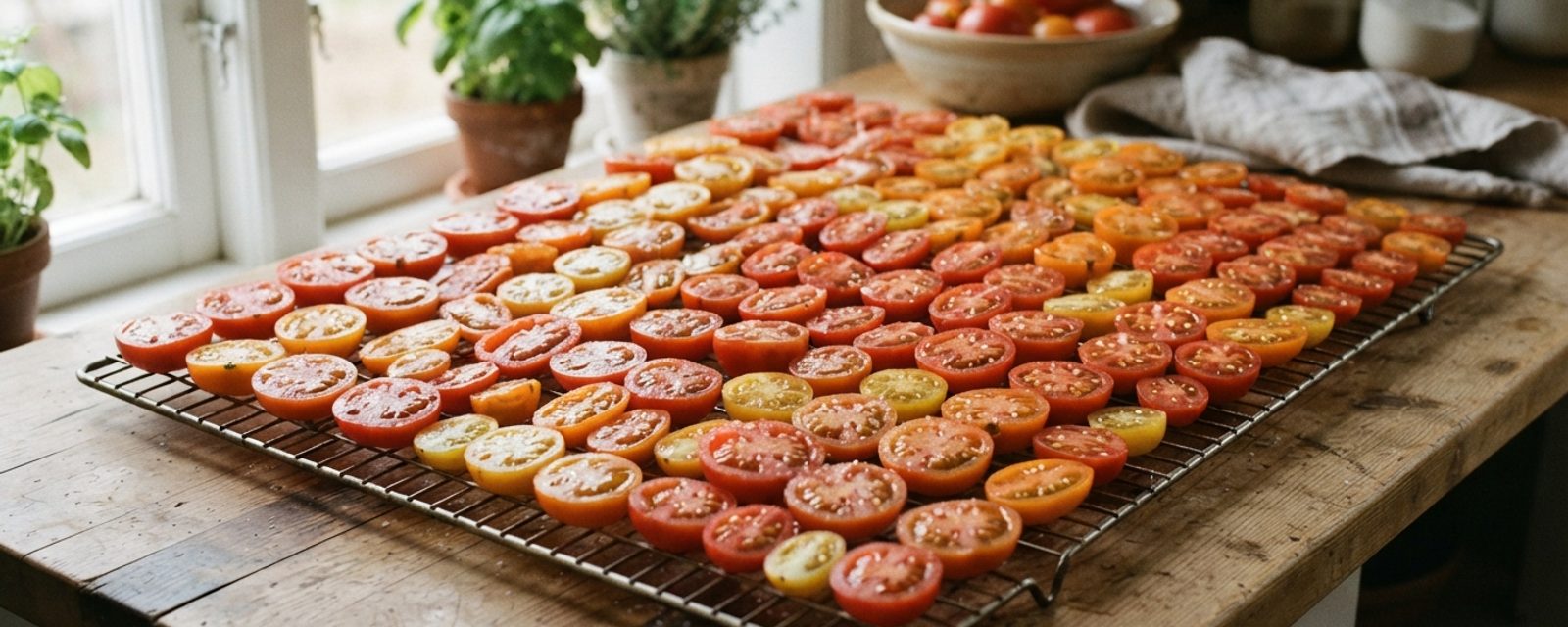
You did the sums before you started: a warm shelf, a few weeks of August sun, tomatoes halved and laid out to dry the way every recipe blog describes. Then the west of Scotland delivered its actual August, cloud by the day, a run of showers, humidity that never really drops below "damp." The tomatoes on the windowsill went soft and started weeping juice rather than shrinking and concentrating. Some grew a fuzz of mould at the cut edge before they'd lost even half their moisture. This isn't a technique failure. It's a climate mismatch, and it's worth understanding exactly what true sun-drying needs before turning to the oven and dehydrator instead.
What true sun-drying actually requires
Traditional sun-dried tomatoes, the kind made in Puglia or Andalusia for centuries, depend on several days of sustained heat, low humidity and near-constant airflow. Halved tomatoes are laid out in direct sun and turned regularly, and the process typically takes multiple days from start to finish, not hours. Through all of that time the fruit has to stay above the temperature and below the humidity threshold that lets bacteria and mould take hold before the water content drops low enough to be safe. That's why traditional sun-drying setups also use fine mesh netting over the trays: days left uncovered outdoors is an open invitation to flies and wasps, and any rain or heavy dew during the drying window can undo days of progress and start the mould risk over again.
Scotland rarely gets that run of days, and the west coast is where the odds are worst: the Met Office's own western Scotland climate summary puts spring and summer wet days on the coast at around 35 in each season, and notes that Scotland tends to stay under the influence of Atlantic weather systems through summer in a way that other parts of the UK don't. The drier east, in the rain shadow of the western hills, gets a somewhat better run of dry spells, but even there a genuinely reliable multi-day stretch, warm and dry enough to fully dehydrate a tray of tomatoes, isn't something you can plan a harvest around. Tomatoes left out too long in damp air don't dry, they rot, because the moisture never leaves fast enough to outpace bacterial growth before the next shower arrives. An oven or a dehydrator does the same essential job as the sun, driving off moisture faster than spoilage organisms can establish themselves, but with heat you control rather than weather you're hoping for. A polytunnel or greenhouse on a genuinely warm, still day gets closer to true sun-drying conditions than an open windowsill, since it traps heat and cuts the risk of rain or dew landing on the trays, but it still can't be relied on to deliver several consecutive warm days on demand the way an oven can.
Choosing tomatoes that will actually dry well
Meaty, low-moisture varieties dry faster and shrink less disappointingly than watery ones. Roma and other plum types, along with small varieties bred for sauce and paste, have thicker flesh and fewer seed cavities relative to their size. Principe Borghese, an Italian heirloom bred specifically for drying, is commonly grown by home dryers for exactly that reason, and it's a reasonably compact, early-cropping plant that suits a Scottish greenhouse or polytunnel season rather than needing the longest possible growing window. Beefsteak types and other large, juicy slicing tomatoes are the wrong choice: they carry so much water that they take far longer to dry and tend to collapse into something closer to leather than the chewy, concentrated result you're after. Cherry and small salad tomatoes work too, and need less prep since they can often be dried in halves without seeding; Sungold, Gardener's Delight and Sweet Aperitif are all reliable croppers in a Scottish greenhouse or polytunnel and dry down well.
A note if your glut is the awkward kind: end-of-season fruit still green when the first frost threatens, or fruit with the odd early touch of blight. Green tomatoes won't dry down the same way, since they're mostly water and haven't developed the concentrated sugars and flesh structure that make ripe fruit dry well; ripen them indoors first rather than trying to dry them green. Any fruit with blight lesions should be cut away and discarded, not dried: drying concentrates whatever is in the flesh, and it isn't a process that makes damaged or diseased tissue safe to eat.
Preparing the tomatoes
Wash and dry the fruit, then halve them (or quarter larger ones). For tomatoes with a lot of seed jelly, scoop it out with a teaspoon; this speeds drying and reduces the wet pockets where mould can start later. Lay the pieces cut side up on the tray or dehydrator rack, don't let them touch, and a light sprinkle of salt at this stage helps draw out surface moisture as well as seasoning the finished result.
Oven versus dehydrator
There's no single official UK figure for oven-drying tomatoes; the institutional guidance that does exist comes from US university food-science departments rather than a UK government source, and it broadly agrees on a low, steady heat held for several hours, with airflow to carry moisture away.
| Method | Temperature | Typical time | What to watch for |
|---|---|---|---|
| Oven | Roughly 60-65°C (140-150°F), the lowest a domestic oven will hold steady | Several hours, checked regularly; total time depends on tomato size and your oven's real low-end temperature | Prop the door open slightly so moisture can escape; rotate trays for even drying; larger halves take considerably longer than a thin scatter of cherry tomatoes |
| Dehydrator | Around 60°C (140°F), typically within the appliance's 30-70°C (85-160°F) range | Several hours to overnight, again dependent on size and thickness | Generally dries more evenly than an oven thanks to consistent airflow, but still check trays partway through and rotate if your model runs unevenly |
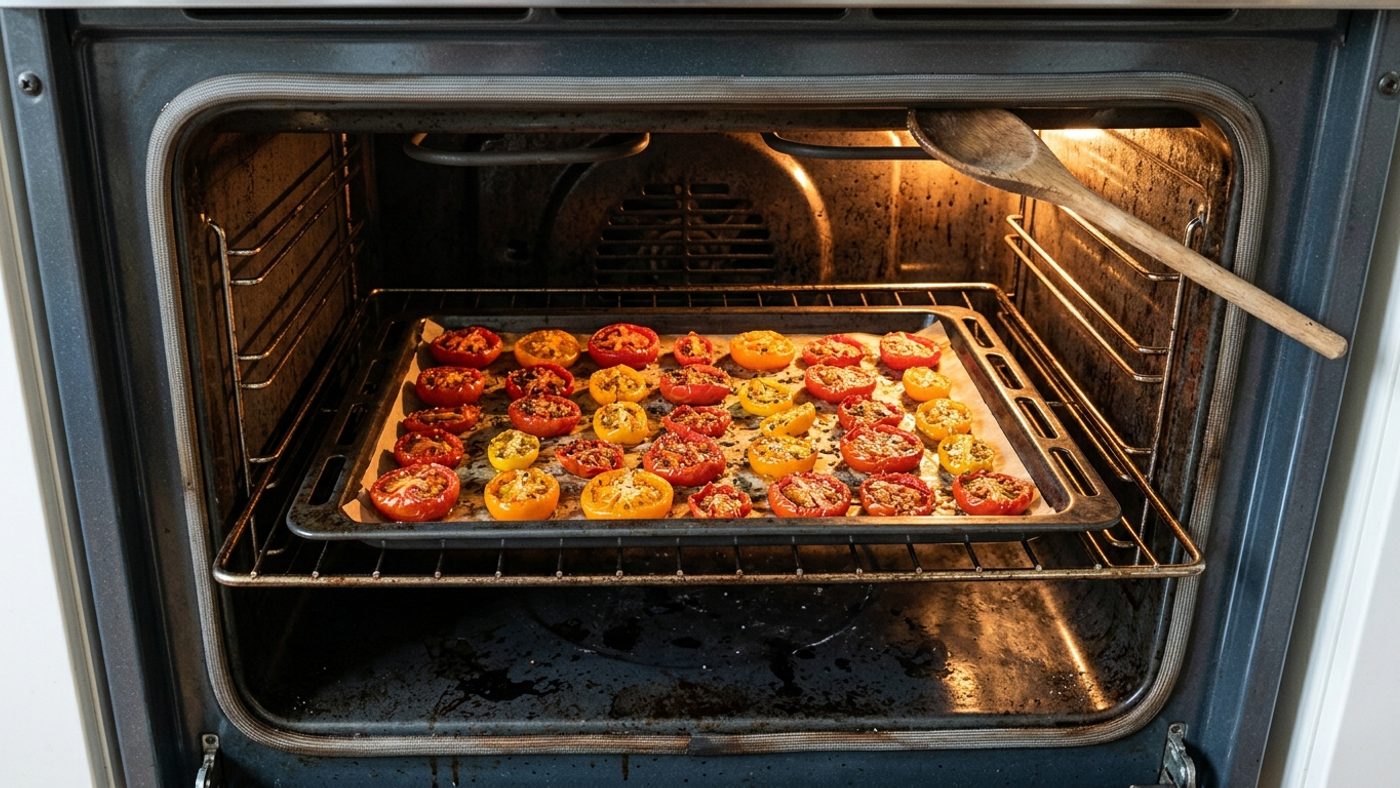
If you're working with a fan oven, it's worth erring towards the cooler end of that range and checking earlier than the timings above suggest: none of the sourced guidance gives a separate fan figure, but the same logic that applies to baking, moving air drying the surface faster, applies here too, so lean on the doneness test rather than the clock. If neither oven nor dehydrator will hold low enough, an airing cupboard or an oven left on just its interior light overnight is a slower but genuinely usable low-tech option, since both hold a gentle, steady warmth over many hours; it takes considerably longer than the low-oven method, so check over several days rather than one evening.
Tomato size, water content and how thickly you've packed the tray change the real drying time more than any single published figure can. Given how unreliable a single dry spell is here, most gluts end up needing more than one batch regardless of method, and it's worth knowing that a dehydrator run overnight on low costs noticeably less to run than an oven held on low for several hours across those repeat batches.
How to tell they're actually done
Properly dried tomatoes are shrivelled and leathery, dry to the touch on the outside, and still pliable and chewy rather than snapping like a crisp. That chewy-not-brittle texture is the target for tomatoes specifically; other vegetables are dried to a genuinely brittle, "crisp" state with very low moisture content, but tomatoes are traditionally left with more residual moisture and more give.
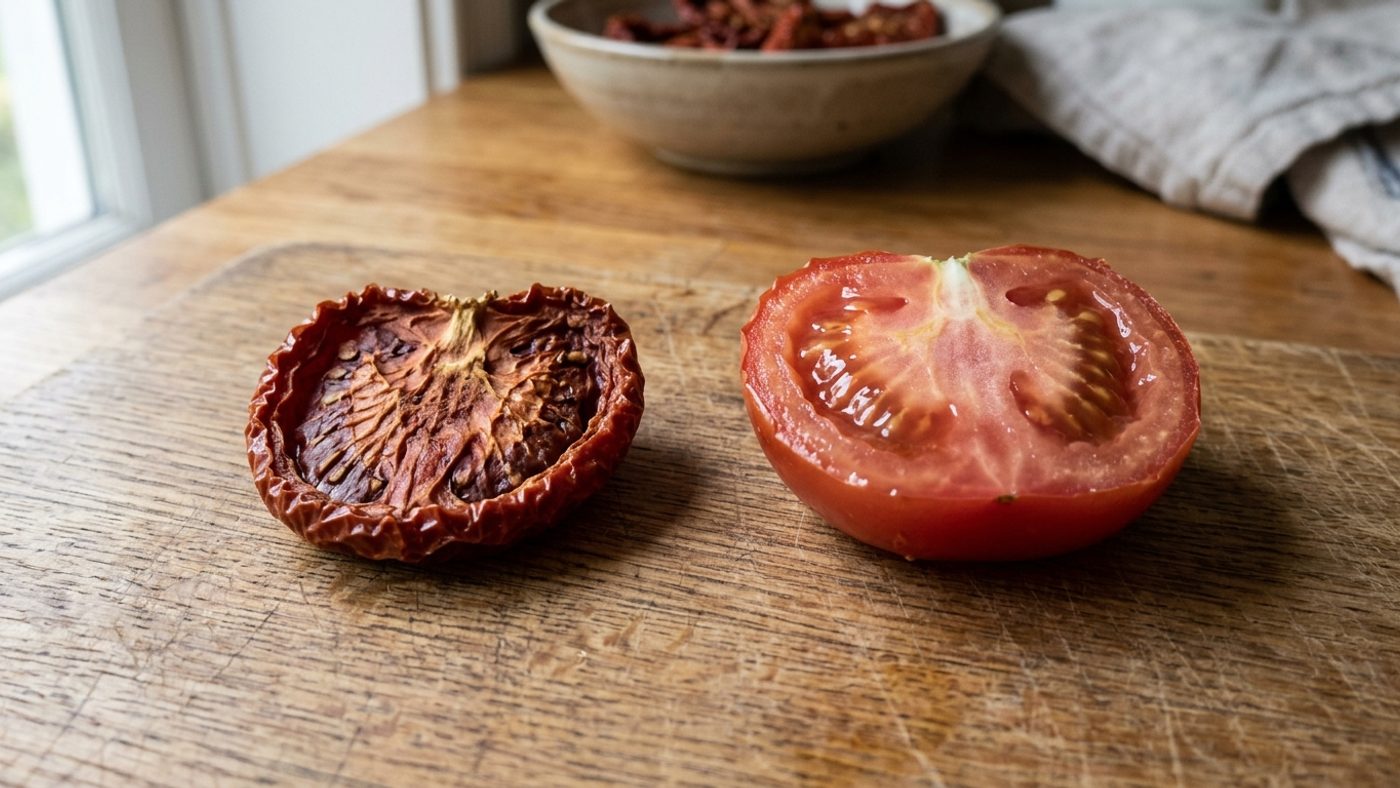
The reason to take this seriously rather than eyeballing it once and calling it finished: pieces that look dry on the outside can still be damp in the middle, especially thicker slices or ones packed close together on the tray, and that trapped moisture has nowhere to go once the jar is sealed. The National Center for Home Food Preservation flags under-drying as a real cause of mould turning up later in storage, not a hypothetical one, and recommends checking dried food periodically for exactly this. If you're at all unsure, put the batch back in for longer rather than packing it away. It's worth using a glass jar rather than an opaque tub for this reason: any moisture that collects on the inside of the glass is easy to spot, and checking periodically over the first week or two in storage is a sensible habit before you commit a full batch to long-term airtight storage.
Storing dried tomatoes safely
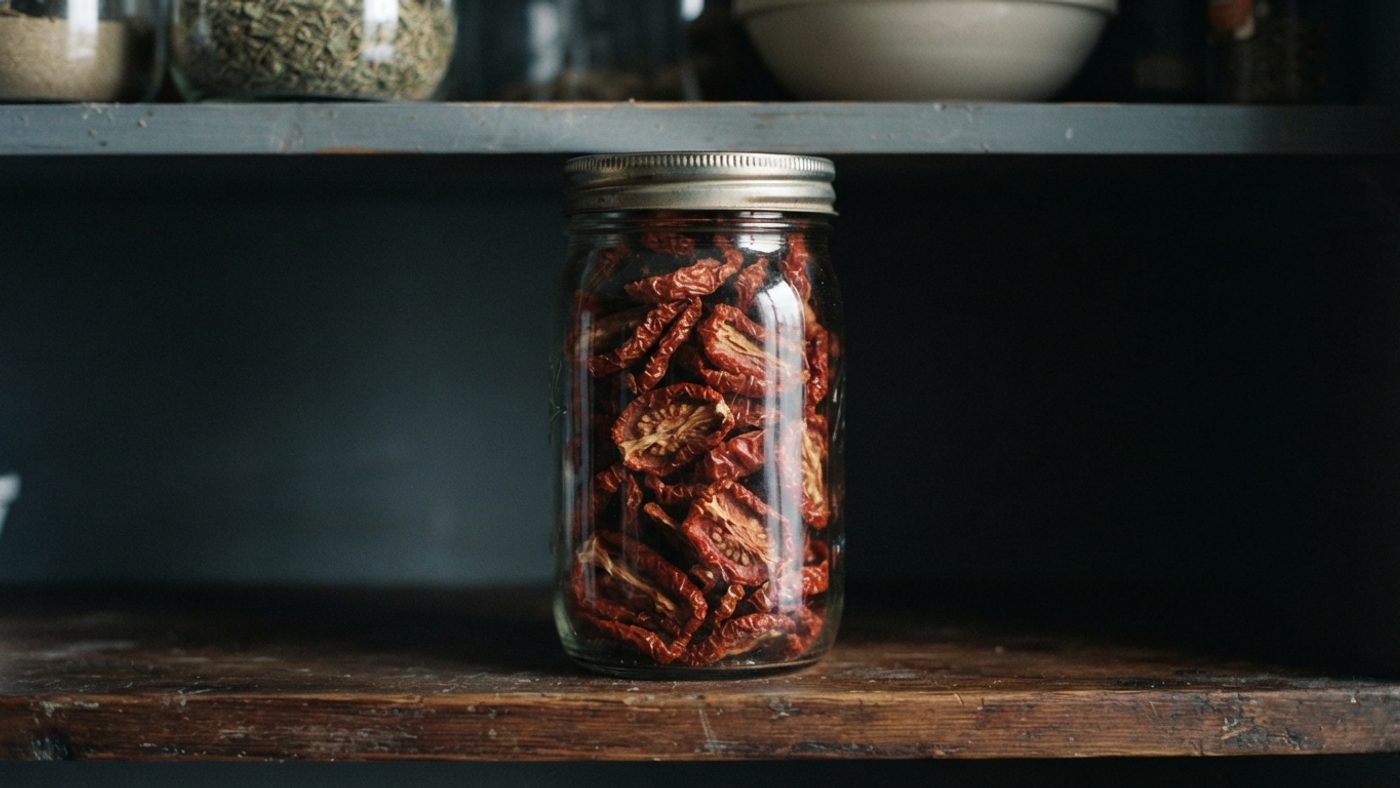
Once they're properly dry, storage in a clean, airtight jar in a cool, dark cupboard works. Dried vegetables have roughly half the shelf life of dried fruit: the National Center for Home Food Preservation puts vegetables at around six months at a cool room temperature (about 15°C), dropping to closer to three months if the storage spot is warmer, so a cool cupboard rather than one near the oven or a radiator genuinely extends how long a jar stays good. That's about quality fading, not a hard safety cut-off, but it's still worth using the older jars first. The airtight seal matters wherever you live, but it's doing extra work here: a jar that isn't properly sealed, or one that's opened and closed often in a steamy kitchen, lets ordinary room humidity back into the tomatoes over time, which is why the same condensation check worth doing after drying is worth repeating occasionally through the jar's life in storage, not just once.
A rough sense of scale: tomatoes lose the great majority of their weight as water when dried, so a full tray of fresh fruit shrinks down to what can feel like a disappointingly small handful once it's done. It's worth drying more than one batch if you've got a genuine glut to get through, rather than judging the effort worthwhile from a single small tray.
The genuine safety issue is what happens if you cover them in oil. Oil-covered vegetables at room temperature create a low-oxygen environment, and that's exactly the condition Clostridium botulinum needs to grow and produce toxin, which oxygen normally suppresses. This isn't a theoretical worry, it's a documented reason food-safety authorities advise against storing home-dried tomatoes in oil at room temperature. Refrigeration alone isn't a complete guarantee either, since the bacterium can still be present, just slowed; the safest home approach is refrigeration and use within a couple of weeks, and if you want to keep a jar longer, freeze it instead of relying on the fridge alone. Dried tomatoes without oil freeze well and keep for months, and are an easy way to hold a big glut without needing to eat through it in a hurry.
Using them
Rehydrate dried tomatoes by soaking in warm water or stock for twenty to thirty minutes before using them in sauces, stews or bread doughs, or use them straight from dry, finely chopped, stirred into slow-cooked dishes where they'll soften as they cook. Blitzed to a powder, dried tomato skins or thoroughly dried pieces make a concentrated flavour booster for soups and dressings through the winter, long after the greenhouse crop is finished.
Common questions
Can I dry tomatoes outdoors in Scotland if I catch a genuinely hot week?
In principle, if you get several consecutive dry, warm, low-humidity days, cover the trays with fine mesh to keep off flies and wasps, and are prepared to bring everything in at the first sign of rain or heavy dew. In practice that run of weather is unreliable enough here that most growers get more consistent, safer results from an oven or dehydrator, which don't depend on the forecast holding.
My oven's lowest setting is hotter than the guidance range, is that a problem?
It will dry the tomatoes faster and with less control, and there's more risk of the outside finishing before the inside has actually lost enough moisture. Propping the door open a little further to let more heat escape, checking more frequently, and prioritising the doneness test over any specific time are sensible ways to compensate.
Why do my dried tomatoes go mouldy in the jar after a few weeks even though they looked dry?
This is almost always under-drying, usually in thicker pieces or ones packed close together on the tray so moisture couldn't escape evenly. Break a few open before storing a whole batch and check the centre, not just the surface.
Is it safe to store my dried tomatoes in olive oil like the jars you buy in shops?
Not at room temperature, even though shop-bought jars sit on an unrefrigerated shelf. Commercial producers use processes and controls a home kitchen doesn't have. At home, oil-covered dried tomatoes should go in the fridge and be used within a couple of weeks, or in the freezer for longer storage.
Do cherry tomatoes need less prep than larger varieties?
Yes. Halved cherry tomatoes have less seed jelly and less flesh depth, so they can usually go straight onto the tray cut side up without scooping, and they dry noticeably faster than halved or quartered larger fruit.
Sources
6 sources, recorded with what each was used for
- RHS: What to do with a tomato glut: The general oven/dehydrator drying approach for a home glut
- Met Office: Western Scotland — climate: West Scotland's wet-day frequency in spring and summer, and Scotland's continued exposure to Atlantic weather systems through summer compared with the rest of the UK
- National Center for Home Food Preservation (University of Georgia): Food Dehydrators: Dehydrator temperature guidance
- National Center for Home Food Preservation (University of Georgia): Packaging and Storing Dried Foods: Doneness/moisture description, checking dried foods periodically in storage, vegetable storage-life figures
- National Center for Home Food Preservation (University of Georgia): Resources for Home Preserving Tomatoes: The botulism risk of storing tomatoes in oil at room temperature
- University of Illinois Extension: Drying: Oven drying temperature range and the room-temperature jar/condensation check after packing
A note on the numbers above: no UK body publishes an official oven temperature or time for drying tomatoes, so the specific figures in this piece come from US university food-science sources rather than a UK one. Treat them as a well-supported general range rather than an official single number, and prioritise the doneness checks in the text over the clock.