
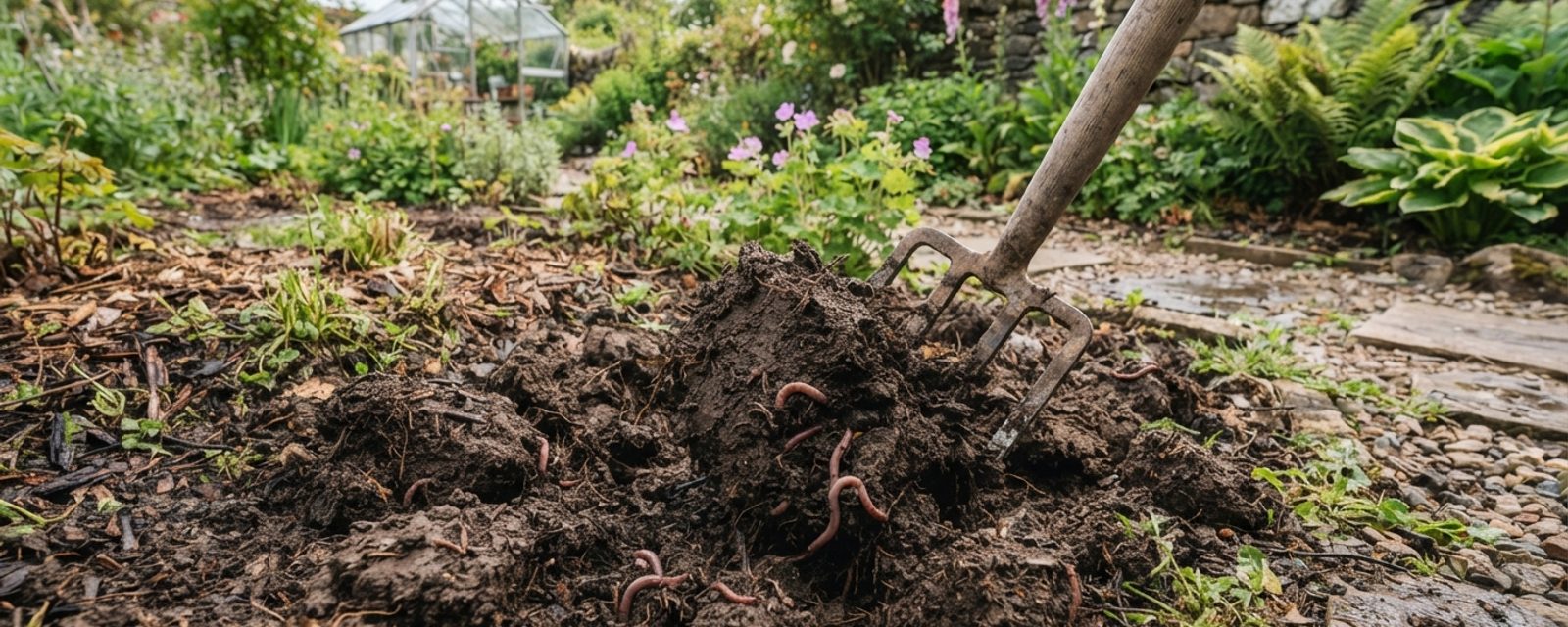
Underneath every lawn and border in a Scottish garden, earthworms are already doing structural work most gardeners never see. They burrow, and those burrows become permanent channels that let air, water and plant roots move through soil that would otherwise compact and waterlog. They eat their way through dead leaves, spent compost and decaying root matter, and what comes out the other end, a worm cast, carries several times the nitrogen and phosphorus of the soil the worm started with, along with a dense population of the bacteria that keep nutrients cycling.
Darwin, working from British earthworm counts, calculated that they could turn over enough soil in a year to bury a football pitch under 15 tonnes of castings, the same casting and burrowing still going on, at whatever scale, in an ordinary garden bed right now. None of this requires a gardener to do anything: earthworms are not something to be introduced. They are already there. The question worth asking is not how to get them, but how not to lose them.
What earthworms are actually doing underground
Three things, mainly: burrowing, casting, and breaking down organic matter, and the mix of species already present in a garden determines how much of each is happening.
Burrowing creates physical channels through the soil profile. In compacted or heavy clay ground, those channels are often the only route water has to drain away from root zones, and the only route roots have to reach past the topsoil. Soil without a working earthworm population can be dramatically less able to absorb water, which shows up above ground as pooling, waterlogging and increased runoff after rain, a bigger practical concern on Scotland's generally wetter, slower-draining ground than in drier parts of the UK, where those drainage channels are doing more work.
Casting is the visible byproduct of feeding: worms process organic matter and mineral soil through their gut and excrete it as a cast, either underground or on the surface. Cast material is enriched relative to the surrounding soil, with markedly higher nitrogen, phosphorus and microbial content than the soil the worm ingested, a natural, slow-release fertilising effect that costs the gardener nothing.
Organic matter breakdown is the least visible but arguably the most valuable job. Worms pull fallen leaves, spent mulchA layer of material spread over the soil around plants to suppress weeds, retain moisture, and improve soil structure as it breaks down. Full definition → and decaying plant debris into the soil, physically incorporating it rather than leaving it to slowly rot on the surface. That incorporation is what converts a mulch layer into actual soil structure over a season or two, rather than a layer that just sits on top.
Not all earthworms do the same job
Britain has roughly 30 earthworm species, of which around 16 are likely to turn up in an average garden, they vary considerably in size, colouring and where in the soil profile they operate. Farm advisers group them into three broad ecological types by behaviour, and a garden with a mix of all three gets the fullest range of soil benefits rather than just one.
| Ecological group | Where they live and feed | What they contribute |
|---|---|---|
| Epigeic (surface-dwelling) | Live in leaf litter and surface organic matter, rarely burrow into mineral soil | Break down surface debris and compost fastest; the specialist composting types (tiger worm, Eisenia fetida, and Dendrobaena veneta) fall into this group and are what’s used in wormeries |
| Endogeic (topsoil-dwelling) | Live and feed within the upper soil layer itself, in horizontal, often temporary burrows | Mix organic matter through the topsoil, improve structure at root depth |
| Anecic (deep-burrowing) | Live in permanent vertical burrows up to several metres deep, surfacing at night to feed | Drag surface leaf litter down into the subsoil to feed on the fungi that grow on it; produce the visible casts seen on lawns; the common earthworm (lob worm, Lumbricus terrestris) is Britain’s only deep-burrowing species and its largest, reaching up to 35cm |
Anecic worms build a midden, a small pile of leaf fragments, stones and debris, at the burrow entrance, thought to protect the opening from drying out and predation. If a lawn shows small, tidy mounds of debris rather than smooth grass, that's often a midden rather than damage.
Worm casts on a lawn are a separate, narrower question, covered in full in the piece on worm casts in lawns, including why they're a sign of healthy soil rather than a problem to fix.
How to tell if a garden's earthworm population is healthy
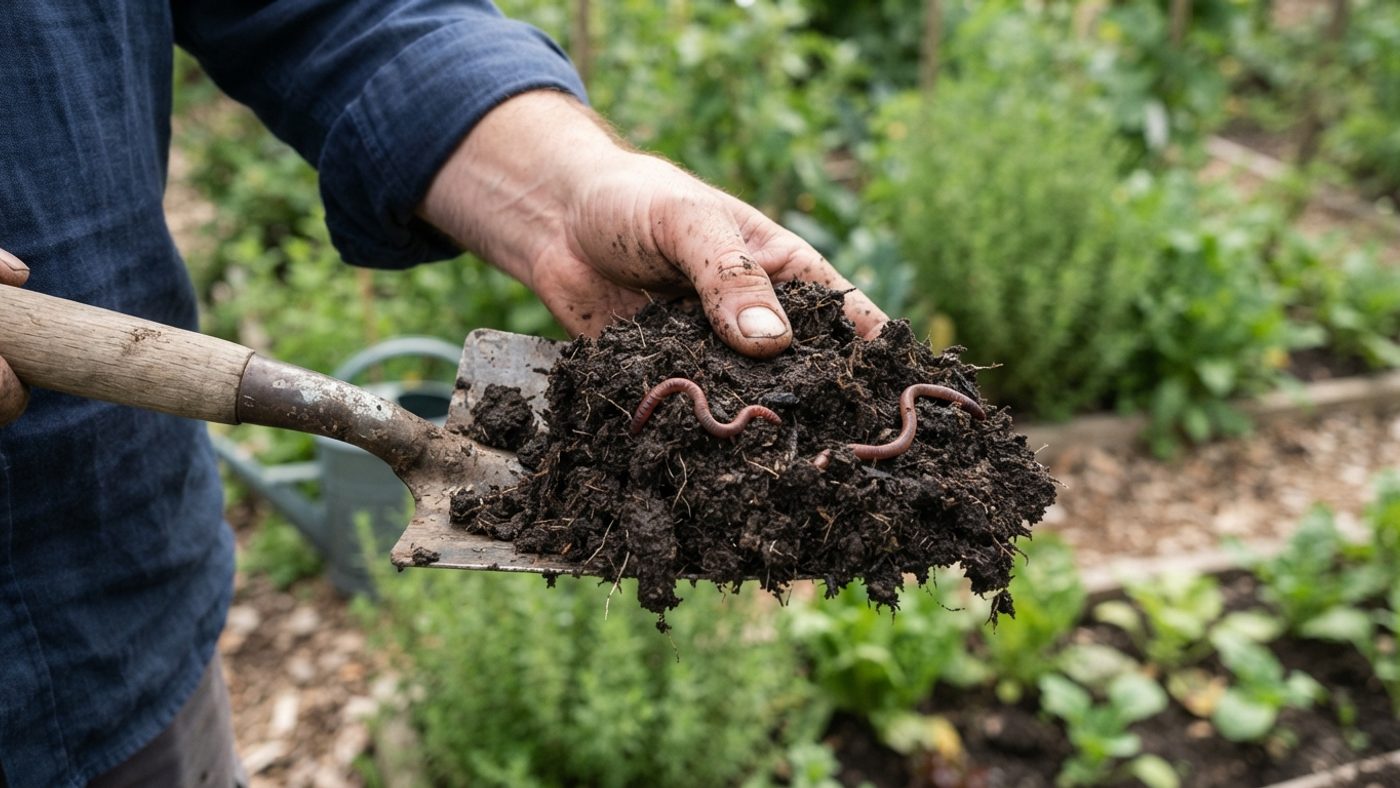
The standard field check is a spade test done in spring or autumn, when soil is moist and reasonably warm rather than baked dry or frozen: dig out a block of soil roughly a spade's width and 10cm deep, break it apart on a tray or sheet, and count the worms found in it by hand. A healthy population typically shows 5 to 10 earthworms in that sample. Fewer than that, especially combined with compacted, poorly draining, or visibly lifeless soil, points to a population under stress rather than one that's simply small by nature.
A few things to look for alongside the count:
- Mixed sizes and types — a population made up only of small, pale, fast-moving worms (more typical of compost-type species) without any larger, sluggish, deep-dwelling individuals suggests the anecic group is missing, which usually means drainage and deep-soil structure aren't getting the benefit they should.
- Visible casts on the surface, especially on lawns in autumn and spring, these are a sign of deep-burrowing worms actively working, not a symptom of anything wrong.
- Middens at burrow entrances in beds or lawn edges, again a sign anecic worms are present and active.
- Bird and animal activity — blackbirds and other ground-feeding birds working a lawn or bed are often following earthworm activity near the surface, since worms are a major food source for birds as well as badgers. Molehills are the same signal underground: moles feed heavily on earthworms, and a mole tunnelling through a lawn or border is a reliable (if unwelcome) sign there's a population worth eating down there.
What harms earthworm populations
| Cause | Why it hurts worms | What to do instead |
|---|---|---|
| Pesticides | Any chemical applied to soil eventually reaches the worms living in it, direct-contact treatments and rain-carried residues alike. Neonicotinoid and other systemic insecticides, and several fungicides, have measurable sublethal effects (slower growth) even where they don’t kill outright | Avoid applying pesticides and fungicides to soil |
| Digging and tilling | Destroys the permanent burrow systems anecic species depend on, and can kill worms through direct physical damage. Digging wet, heavy ground, common on Scottish soil for much of the year, compounds this by wrecking drainage channels exactly when waterlogging is the bigger risk | Go no-digA growing method that avoids turning the soil over, building fertility instead by adding organic matter on the surface. Full definition → where practical; if digging, avoid doing it on saturated ground |
| Cultivating in frost | Earthworms retreat deeper and go dormant in cold weather; digging frozen or near-frozen ground disturbs a population with nowhere left to retreat to | Leave beds undug over winter, or work them before the first hard frosts |
| Compaction | Repeated foot traffic, machinery or poor structure reduces the oxygen in soil that earthworms need | Use paths/boards rather than walking on beds; mulch to improve structure |
| Acidic or waterlogged soil | Earthworms are scarce below roughly pH 6.0-6.2 or in soil that sits wet for long periods; waterlogging is the sharper risk on Scotland’s generally wetter, slower-draining ground than in drier parts of the UK | A cheap home pH kit shows where a garden sits; lime naturally acidic, peaty ground (common in upland and Highland gardens) following the tested rate; improve drainage where water pools |
| Invasive flatworms | The New Zealand flatworm, now established in parts of Scotland, feeds exclusively on earthworms, a genuine predation pressure where numbers drop sharply with no other obvious cause | Check for flatworms if a previously healthy bed’s earthworm count crashes; an earthworm wriggles using bristles along its body, a flatworm moves with a slow, smooth glide |
| Dry, sandy soil | Free-drainingSoil that lets water pass through quickly rather than pooling, so roots aren't sitting in wet ground after rain. Full definition → sandy ground that’s low in organic matter dries too fast and offers too little to feed on | Add organic matter and mulch to hold moisture |
How to actively encourage them
- Add organic matter regularly, as compost, well-rotted manure or leafmould rather than as synthetic fertiliser. Organic feeding has been shown to increase earthworm numbers where inorganic fertiliser alone does not.
- Adopt a no-dig approach where practical. Rather than digging organic matter into soil, apply it as a mulch layer on top, 15-20cm for a new bed, topped up with roughly 5cm annually thereafter, and let soil organisms, worms included, work it in themselves. This avoids destroying burrow systems and lets soil develop the fine, stable pore structure that supports both drainage and worm activity, which digging repeatedly undoes.
- Avoid pesticides and go easy on synthetic fertilisers, particularly anything applied directly to soil rather than foliage.
- Keep soil covered rather than bare. Mulch retains the moisture earthworms need and gives surface-dwelling species material to feed on. Leaving fallen leaves and grass clippings on beds over winter, rather than clearing them away, does the same job through the coldest months and gives epigeic species a steady feed exactly when they need it most.
- Reduce hard surfacing where possible, paving over soil removes habitat outright and cuts off the organic matter supply that keeps a population fed.
- Diversify planting. Gardens with a mix of habitat, vegetable beds, shrubs, lawn, support a broader range of earthworm species than a single uniform area, since different ecological groups favour different conditions.
A new raised bed or container garden starts with little or no earthworm population of its own, since there's no surrounding soil for worms to colonise from. Filling it with good-quality compost or topsoil and mulching consistently is what draws worms in over a season or two, without needing to buy and add worms directly.
Composting itself is worth a separate mention: the surface-dwelling species used in wormeries, tiger worms and Dendrobaena veneta, are a different, faster-breeding group from the ones doing structural work in open soil, and a working wormery is one of the most direct ways to turn kitchen and garden waste into the organic matter that then goes back onto beds as mulch or compost.
Does Scotland's climate make a difference?
Places further west and north in the UK, which covers most of Scotland, tend to be wetter and cooler than the east and south, and earthworm activity is genuinely constrained by both extremes of moisture (waterlogging) and by freezing temperatures, which push worms into dormancy. Clay-heavy and loam soils retain moisture and organic matter better than sandy ground, so they generally support higher earthworm numbers, relevant wherever a garden sits on heavier ground, which is common but not universal across Scotland.
The New Zealand flatworm is worth calling out on its own rather than as a footnote: unlike most of what affects garden earthworms, it's a threat considerably more established in Scotland and Northern Ireland than in most of England, arriving originally in imported plant pots and now found in gardens across the country. Where a previously healthy bed's earthworm count crashes with no other obvious cause, checking the soil for flatworms specifically, not just assuming poor conditions, is worth doing before reaching for any other fix.
The species present in Scottish gardens are the same three ecological groups, and broadly the same common species, found across Britain. The practical advice, organic matter, no-dig, avoiding chemicals, watching drainage, doesn't change north of the border. What does change locally is timing: soil that's slow to warm and quick to waterlog in a wet spring pushes worm activity later into a shorter active season than a gardener further south might expect, without changing which worms are there once conditions suit them.
Common questions
How long does it take a damaged earthworm population to recover?
There’s no single reliable figure, it depends on how severe the damage was and how quickly conditions improve, but populations generally rebuild over one to a few growing seasons once the cause (tilling, chemical use, compaction) stops and organic matter and cover are restored. Recolonisation happens from surrounding soil and from surviving worms and their cocoons, small protective capsules of eggs laid in the soil that can survive conditions an adult worm can’t, so improving conditions matters more than any single fix.
Why does my lawn have small piles of soil on the surface, and should I get rid of them?
Those are almost certainly worm casts, produced by deep-burrowing anecic species as they feed and burrow, a sign of a healthy, active population rather than a problem. See the piece on worm casts in lawns if they’re a genuine nuisance on a lawn specifically.
Are all garden earthworms the same?
No. Britain has around 30 earthworm species, roughly 16 of which turn up in gardens, split across three ecological groups: surface-dwelling (epigeic), topsoil-dwelling (endogeic) and deep-burrowing (anecic). Each does a different job, and a healthy garden usually has all three represented.
What’s the single worst thing for garden earthworms?
Physical disruption and chemical exposure both matter, but pesticide residues and cultivation that destroys permanent burrows (tilling, deep digging) are the two most consistently documented harms. Compacted or waterlogged soil compounds both.
How do I actually check if my garden has enough earthworms?
Dig out a spade-width block of soil about 10cm deep in spring or autumn when the ground is moist, break it apart, and count the worms by hand. Five to ten in that sample is considered a healthy population; noticeably fewer, especially in compacted or lifeless-looking soil, suggests conditions need improving.
Curious about other wildlife your garden might be overlooking? See garden spiders, dragonflies and damselflies and lacewings.
Sources
9 sources, recorded with what each was used for
- RHS: Earthworms: Species counts, ecological groups (surface-dwelling vs deep-burrowing), specialist composting species and pot worms, limiting factors (acidity, waterlogging, dormancy), no-introduction-needed guidance
- Met Office: UK regional climates: The general comparative climate statement that places further west and north in the UK tend to be wetter and cooler than the east and south
- NatureScot: Worms: Global species count, Darwin’s soil-turnover figure, New Zealand flatworm as invasive earthworm predator in Scottish gardens, earthworms as prey for badgers/buzzards/blackbirds, earthworm-vs-flatworm movement as an identification cue
- Farm Advisory Service Scotland: Earthworms for Soil Health: Three ecological categories (epigeic/endogeic/anecic), assessment methods and timing, healthy-population benchmark, pH guidance, threats (tillage, compaction, acidic fertiliser)
- Soil Association: Why are worms important for healthy soil?: Worm cast nutrient enrichment figures, water infiltration impact of earthworm loss
- Garden Organic: No-dig Gardening: No-dig method, mulch depth and materials, effect on soil structure versus digging, soil organisms working mulch into soil
- Buglife: Lob Worm (aka Common Earthworm): Anecic burrowing behaviour, size, diet, lifespan, threats including pesticides and invasive flatworms
- Buglife: The secret life of the Common Earthworm: Anecic classification detail, ploughing/pesticide harms
- The Wildlife Trusts: Go Wild for Worms!: UK species count, hard-surfacing as a harm, garden encouragement measures (compost, reducing paving), citizen-science surveys